

Most advice on how to grow a trade business starts with the same prescription, spend more on advertising, post more often, and chase a larger stream of leads. That advice skips the expensive part. If calls go unanswered, quotes sit in an inbox, and your online presence gives buyers no reason to trust you, extra attention only creates more missed opportunities.
The better growth question is, how many of the people already finding you become booked jobs? Local discovery can put your business in front of buyers when they're actively comparing contractors, but consistent follow-up, credible proof, and enough crew capacity determine whether that attention turns into revenue. A busy phone isn't the same as a healthy pipeline.
Table of Contents
- Why More Advertising Is Not the Answer
- Building Local Search Visibility That Drives Enquiries
- Creating a Review System That Builds Trust Automatically
- Staying Visible on Social Media Without the Daily Grind
- Turning Enquiries Into Booked Jobs with Faster Response
- Scaling Without Outrunning Your Crew and Capacity
Why More Advertising Is Not the Answer
A trade business can look busy while losing money. The owner pays for clicks, watches impressions rise, and receives enquiries, yet the crew is on-site and nobody responds. By afternoon, the potential customer has contacted the next electrician, plumber, carpenter, or HVAC technician who answered.
Paid visibility has a place, but it cannot fix a weak booking process. Broad home-service benchmarks report a 4.80% click-through rate, a 10.22% conversion rate, and an average cost per lead of about $66 for Google Ads. Category-level CPC ranges from $2.94 to $9.03, while CPL ranges from $29.08 to $101.49 across home-service subcategories, according to home services marketing benchmarks from CallRail. These figures describe acquisition conditions, not guaranteed profit. Your margin still depends on response speed, quoting, scheduling, travel time, and whether the customer commits.
Fix the leaks before adding pressure
The biggest leaks usually appear after the first enquiry:
- Slow acknowledgement: The customer does not know whether the message arrived or when someone will respond.
- Unclear next step: The business asks for details but offers no simple route to a quote or site visit.
- Thin trust evidence: The profile has a logo and phone number, but few recent reviews, project photos, or useful answers.
- No follow-up owner: Everyone assumes someone else will call back, so the lead disappears.
Audit the path from enquiry to booking before increasing advertising. Call your own number outside working hours, submit the contact form, and inspect the reply. It should confirm receipt, set a clear expectation, and capture the information needed to qualify the job.
Practical rule: Don't buy more attention until you can reliably respond to the attention you already receive.
The U.S. home services market exceeded $524 billion in 2025, and 75% of home services businesses expect revenue to grow in 2026, according to CallRail's home services data. Demand creates opportunity, but it does not separate your business from nearby competitors. Consistent trust-building content, prompt follow-up, and an easy next action do. Accept only the jobs your operation can deliver well, then build a process that turns existing attention into booked work.
Building Local Search Visibility That Drives Enquiries
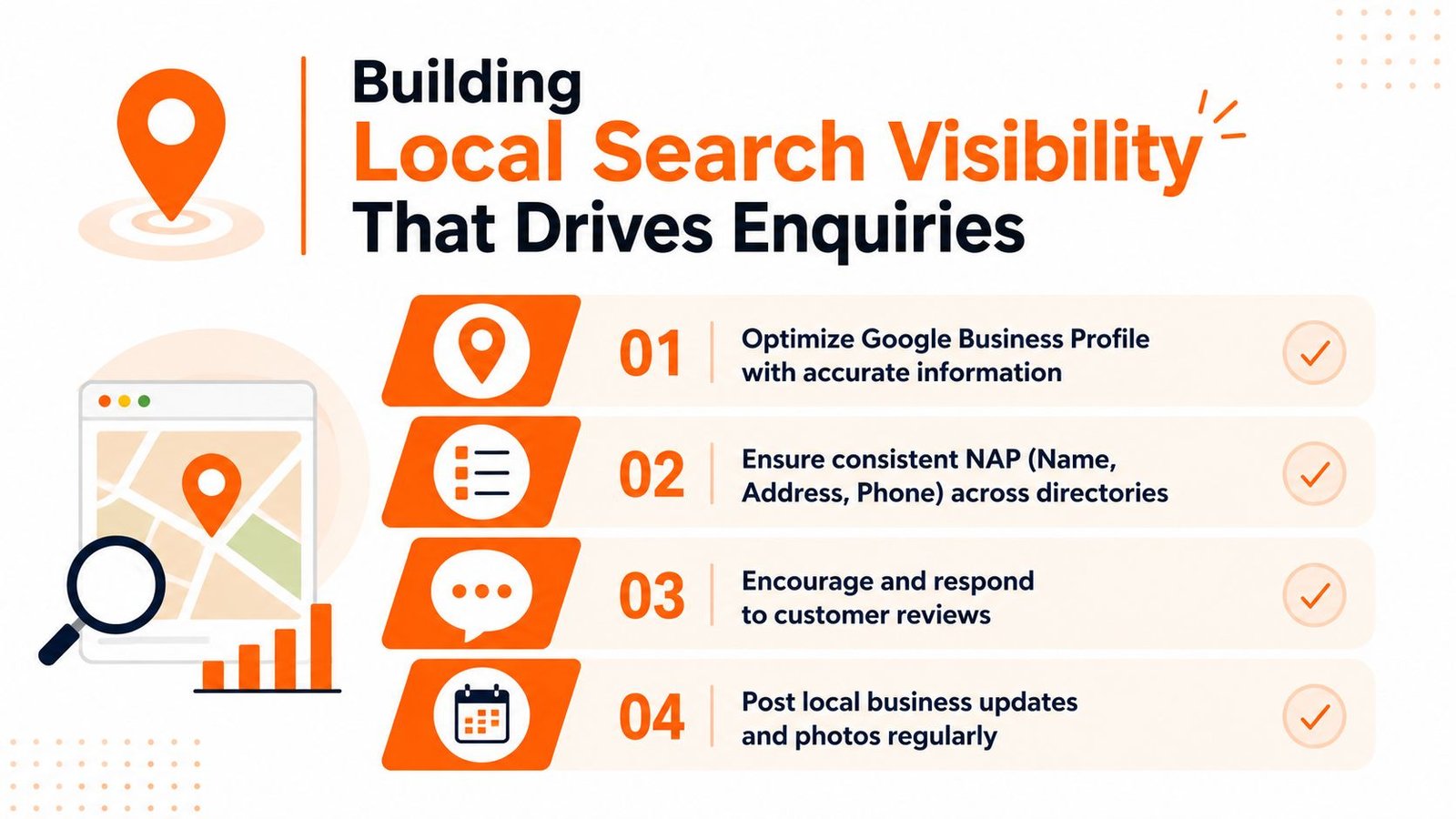
Local search works best when the profile answers a customer's immediate question: can this trade handle my problem in my area? Forty-six percent of all Google searches have local intent, and 72% of consumers use search engines to find local contractors, according to home-service marketing statistics from OnwardCraft. Showing up for a specific service and location puts the business closer to a buying decision than broad awareness advertising.
Start with a complete, accurate Google Business Profile. Select the right primary category, add relevant services, define genuine service areas, and keep the phone number, hours, website, and booking details current. Use project photographs that show the work, equipment, finished result, and people behind the job. Stock images create no useful proof. A customer wants to recognise their own situation in what they see.
Make every local signal agree
Keep the business name, address or service-area details, and phone number consistent across directories and profiles. Store the approved contact details, service descriptions, opening hours, and emergency availability in one master record. That gives whoever updates the listings a reliable source and reduces mistakes.
Use this working checklist:
- Profile accuracy: Check categories, service areas, contact details, and booking options.
- Service clarity: Describe the jobs you want in the language customers use.
- Proof of work: Add recent photographs and explain the problem solved, materials used, or result delivered.
- Review activity: Request genuine feedback and reply professionally to every review.
- Useful updates: Share completed work, seasonal advice, local business news, and availability changes.
Local search requires content that supports the decision, not just a listing that exists. Seventy-eight percent of local mobile searches lead to a purchase within one day, while another source reports 76% lead to an offline purchase within 24 hours, as documented by Socio Apt's small-business social media statistics. Use those figures as a reason to keep the profile current, then connect it to a follow-up process that answers enquiries and gives customers a clear next action.
Do not spend hours on obscure directories while your main profile has old photos or unanswered questions. Update the places customers check first, publish useful proof consistently, and use this guide to improve local visibility for contractors as part of the routine.
Creating a Review System That Builds Trust Automatically
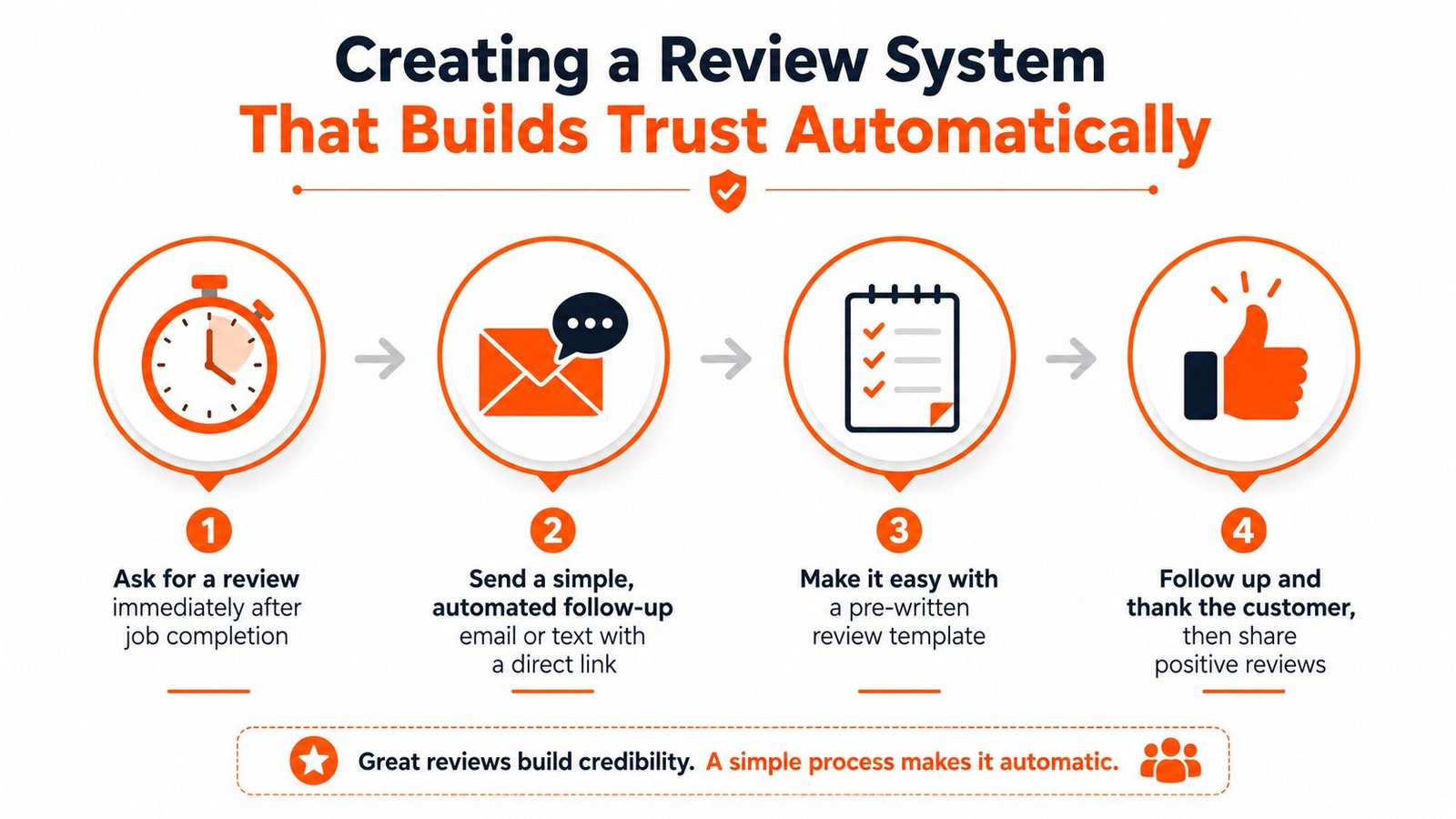
Reviews should not rely on whether a tradie remembers after a long day. Put the request inside the job-close process, alongside the final walkthrough, invoice, and warranty information. Customers are more receptive while the work is complete, the area is tidy, and the result is fresh in their mind.
Review quality affects whether attention becomes a booked job. Sixty-eight percent of consumers won't consider a business rated below four stars, while 31% require a rating of 4.5 or better, according to contractor review statistics from Elev8 Operations. A working system therefore needs to collect genuine feedback and reveal service problems before they become public complaints.
Use a consistent job-close sequence
Train every technician to make the request in person, without pressure. A natural version is, “If you're happy with the work, I'll send a quick review link. Your feedback helps local customers understand what we do.” Ask for an honest account, never a positive review. Do not offer incentives or coach the customer on what to write.
Send the link immediately through the customer's preferred channel. Made for Builders' review guidance reports benchmarks of roughly 15% to 20% for SMS requests, 12% to 15% for email, 24% to 26% for combined workflows, and up to 28% when a trained technician asks directly. Treat these as reference points, not promises. Track completed jobs, requests, and responses in your own system.
| Stage | Owner | Action |
|---|---|---|
| Completion | Technician | Confirm the customer is satisfied and explain the next step |
| Immediate follow-up | Office or automation | Send one direct review link by SMS or email |
| Reminder | Office system | Send a polite reminder if there's no response |
| Review response | Business owner | Thank the customer and address concerns professionally |
The same guidance reports that structured processes typically collect reviews from 15% to 25% of jobs, compared with 2% to 5% without a structured process. The operating lesson matters more than the benchmark. Assign one person to trigger the request, send one clear message promptly, and record every response so follow-up does not disappear between jobs.
For implementation ideas, use this guide to get customer reviews. Keep the workflow short enough to run during the busiest week, including weeks when the owner is on site.
Staying Visible on Social Media Without the Daily Grind
For a trade business, social media works best when it shows evidence of competence: finished work, careful preparation, clean handovers, useful maintenance advice, and the people behind the service. Generic motivational posts rarely move the needle. Customers are looking for signs that the job will be handled properly.
Consistency creates the primary challenge. A solo operator may post enthusiastically for a few days, then disappear under urgent callouts and paperwork. A small crew may have plenty of photographs but no agreed process for selecting, captioning, approving, and publishing them. Without that process, attention rarely turns into sustained trust or booked work.
Build a library while you're already working
Capture content during normal site activity. Take a clear before photograph, one detail showing the work in progress, and a final image after the area is safe and tidy. Avoid private documents, house numbers, faces, or anything the customer has not approved. Add a short explanation of the problem and solution so the image answers a customer question rather than sitting as decoration.
Useful recurring themes include:
- Project proof: Show the starting problem, the work completed, and the finished result.
- Customer questions: Answer concerns about noise, access, maintenance, materials, or preparation.
- Local relevance: Mention the areas you serve and the types of properties or jobs you handle.
- Team credibility: Introduce apprentices, technicians, vehicles, tools, and safety routines.
- Availability updates: Explain booking windows without creating false urgency.
Batching removes the pressure to invent something every morning. Set aside a short period to choose photographs, write several captions, and schedule them across the platforms your customers use. The guide to content batching for trade businesses shows how to turn irregular posting into a repeatable background task.
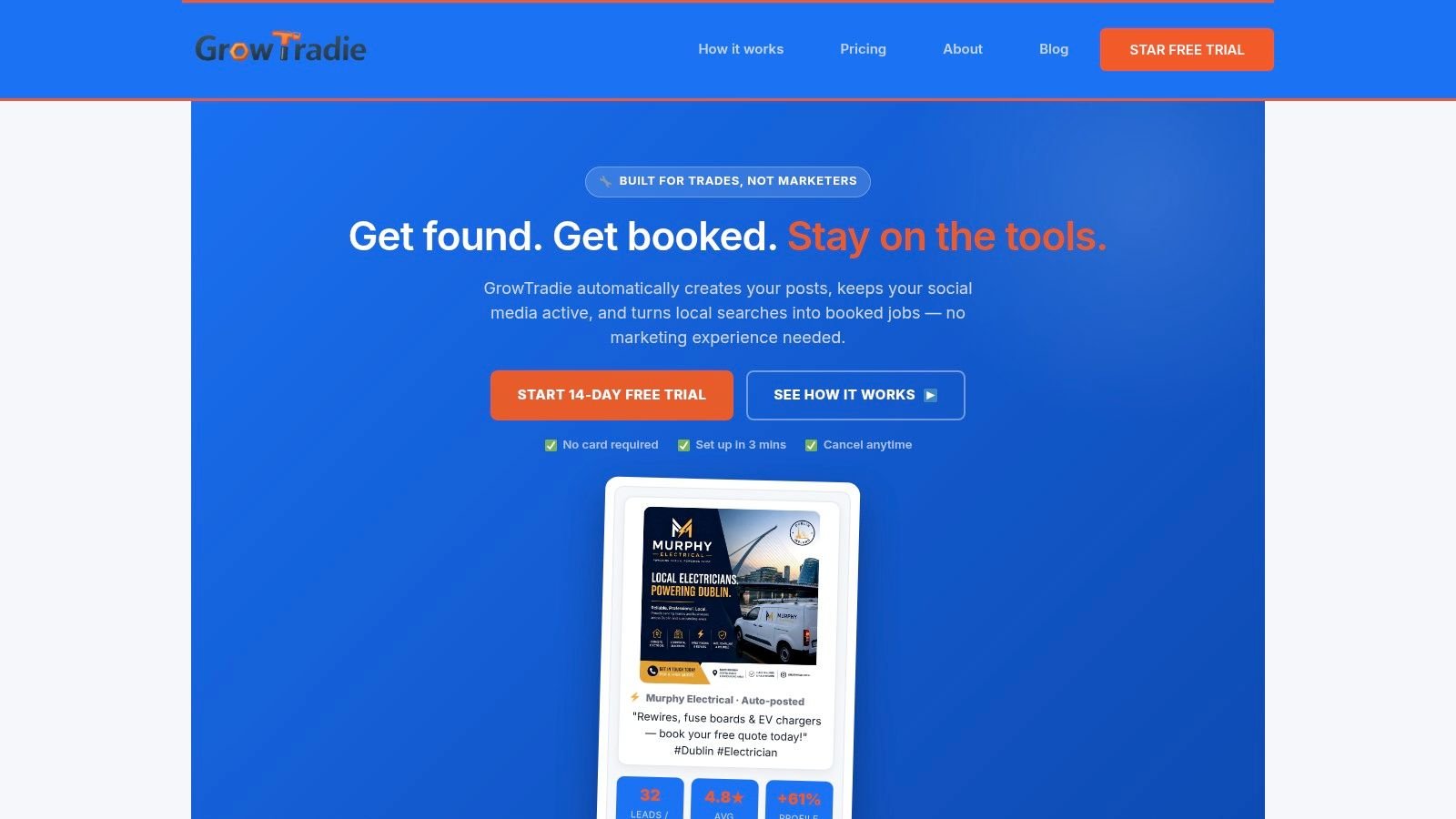
Automation helps when it preserves accuracy and your voice. GrowTradie generates trade-specific social posts, adapts them to services and local areas, and schedules publication across platforms including Instagram, Facebook, Google Business Profile, TikTok, LinkedIn, and X. Review wording and images before publication, especially where claims, pricing, guarantees, or safety instructions appear.
Tradespeople with active social profiles receive 35% more enquiries than those without, according to Direct Line Group's published research. Posting more does not automatically create better work. A visible, credible profile supports demand when each post gives a local customer a reason to enquire and the business follows up consistently.
Turning Enquiries Into Booked Jobs with Faster Response
An enquiry is only an opportunity until it becomes a confirmed appointment. The owner or coordinator must respond, qualify the work, build confidence, and offer a realistic next step. Lead volume looks useful in an advertising dashboard, but the number that pays the bills is booked work.
Set the first reply up to move the job forward. It does not need to contain a full quote. Confirm receipt, then ask for the location, service required, urgency, relevant photographs, access restrictions, and preferred appointment windows. An automatic acknowledgement can cover the gap while the team is on-site, provided it gives a clear time for personal follow-up.
Response standard: Every enquiry should receive a clear acknowledgement, a named next step, and an honest expectation about when a person will reply.
Build different routes for urgent work, standard jobs, and quote requests. A burst pipe should not sit behind a planned installation, while a quote request may need photos and site-visit options before anyone can price it. A service call may need immediate triage instead.
Templates keep responses consistent, but they still need to sound like the business. A practical first message should cover:
- Confirmation: “Thanks for contacting us. We've received your request.”
- Qualification: Ask for the job details and photographs needed to assess it.
- Expectation: State when the team will review the information.
- Action: Offer a call, site visit, or booking link.
Use an office coordinator or shared inbox to catch calls while the crew is working. If neither is available, the acknowledgement should explain the next contact window. Booking links suit defined services, but a conversation remains necessary when diagnosis or a site assessment affects the scope.
Industry evidence cited by JLL on the skilled-trades shortage and home-service demand reports that home-service businesses convert about 7.8% of leads into paying customers in 2026. The same source reports social advertising converting around 43% of answered calls into leads, compared with around 54% for display advertising. These figures describe different stages, so they are not one combined funnel rate. They do show why trust, answered calls, qualification, and follow-up matter after advertising creates attention.
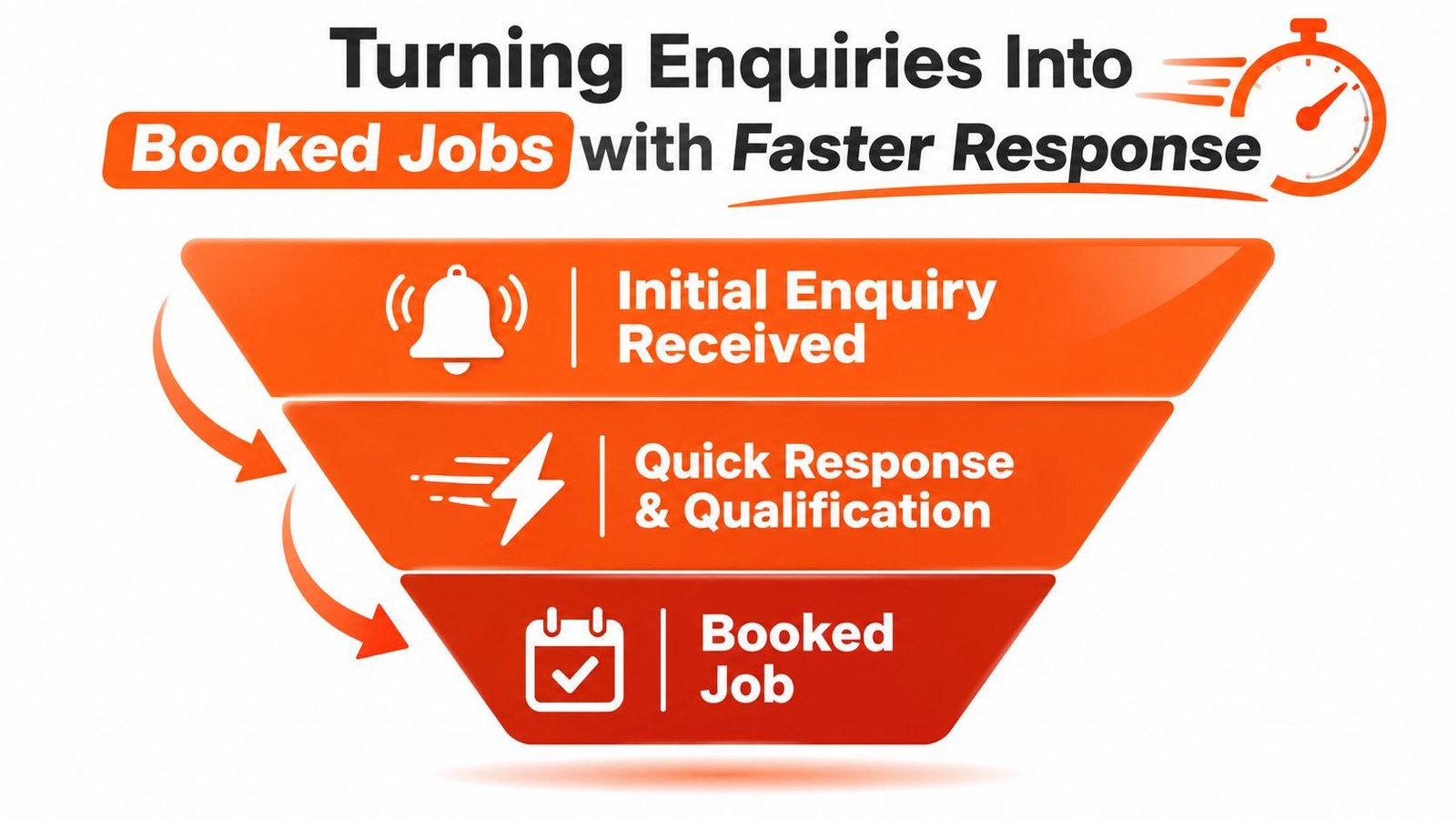
Keep the pipeline simple: new, contacted, qualified, quoted, booked, lost, or not suitable. Review lost enquiries each week. Repeated price objections may point to weak qualification or unclear positioning. Customers disappearing after a quote may indicate poor presentation or late follow-up, not a shortage of leads.
Scaling Without Outrunning Your Crew and Capacity
More enquiries can expose a trade business's weakest operating system. Accept every job, push the crew harder, postpone training, and capacity disappears before the owner sees the warning signs. Missed appointments, rushed workmanship, and poor communication then weaken the reviews and referrals that created the demand.
Labour shortages make capacity planning part of marketing. Skilled-trades roles are expected to remain difficult to fill, while demand for electricians and HVAC technicians is projected to grow faster than employment across all occupations, as noted earlier. A promotion campaign cannot solve a delivery constraint. It can make the constraint visible faster.
Match demand to delivery
Set a weekly capacity ceiling before increasing promotion. Allow for travel, quoting, material collection, callbacks, annual leave, training, and realistic job durations. A calendar filled with billable hours leaves no room for customer updates or crew preparation.
Use clear controls when the schedule fills:
- Raise prices carefully: A higher price can reduce low-margin demand and help fund staffing, provided the value and delivery standard are clear.
- Narrow the service mix: Prioritise work that fits your equipment, skills, service area, and target margin.
- Create a hiring pipeline: Keep conversations with apprentices and experienced workers active before an urgent vacancy appears.
- Document repeatable work: Checklists, photographs, quote templates, and handover standards help new team members work consistently.
- Use subcontractors selectively: Agree on scope, insurance, quality expectations, customer communication, and payment terms before work starts.
Apprenticeships build future capacity, but supervision takes time. A new apprentice is not instant production. Assign a named mentor, protect learning time, and measure progress through completed competencies.
Your marketing budget should follow operational readiness. If the next available appointment is already too far away, improve scheduling, pricing, and hiring before increasing promotion. A controlled waitlist with honest updates protects trust better than promising a date the crew cannot meet.
Capacity also determines which enquiries deserve attention. Track job type, location, required skills, expected margin, and preferred timing before accepting work. Consistent content and prompt follow-up help customers understand your service, but the booking system must still filter demand against the crew's real availability.
Sustainable growth measures how many jobs your crew can deliver well, at a margin that lets the business keep its promises, rather than how many jobs it can sell.
Review completion rates, callbacks, quote delays, complaint themes, enquiries, and bookings together. A durable trade business connects its visibility, follow-up, and delivery systems, so growth does not depend on the owner personally rescuing every gap.
GrowTradie turns completed work into social posts and schedules them automatically, helping profiles stay active while you handle jobs, calls, and site visits. Visit GrowTradie to support a steadier visibility and trust-building routine without adding a daily marketing task.