
You're probably sitting on the same mix of confidence and hesitation that stops a lot of good operators from getting moving. You know how to do the work. You know people need it. What feels foggy is everything around the work: the setup, the pricing, the quoting, the calls, the systems, and whether this can become a real business instead of a job you built for yourself.
That's where most new owners get stuck. They spend too long thinking about logos, websites, and perfect plans, then rush the parts that decide whether money comes in and stays in. A strong cleaning service business isn't built on complexity. It's built on a handful of boring disciplines done in the right order.
The good news is the field is still wide open. The service industry isn't dominated by massive corporations. 90% of businesses in this sector employ fewer than 10 people, and 99% are independently owned, according to IBISWorld's janitorial services industry profile. That matters because it means a focused local operator can still compete without a giant budget, a management team, or years of brand history.
If you're launching from scratch, adding a new service line, or formalizing work you've already been doing informally, the mechanics are the same. Protect the downside first. Keep costs lean. Quote fast. Price for margin, not ego. Build simple systems before you hire. Stay visible in your local area. Then repeat what works.
Table of Contents
- Introduction From Idea to First Invoice
- Building Your Business Foundation
- Gathering Your Essential Tools and Supplies
- Pricing Your Services for Profitability
- Managing Operations and Finding Good People
- Marketing That Gets You Seen Locally
- Winning Jobs with Smart Sales and Quoting
Introduction From Idea to First Invoice
A lot of people start with the wrong question. They ask, “How do I start a cleaning service business?” What they really need to ask is, “How do I get to the first invoice without making avoidable mistakes?”
That shift matters. Business ownership punishes disorder fast. A weak setup creates payment issues, quoting problems, and disputes. Overbuying gear drains cash before revenue is steady. Slow follow-up hands work to the next operator on the list. None of that is dramatic, but it's what kills momentum.
Start with the shortest path to paid work
The shortest path is simple. Pick a clear offer. Set up the business properly. Buy only what supports delivery. Create a quoting process you can repeat. Answer enquiries fast. Keep records from day one.
That doesn't sound exciting, but it works.
Practical rule: If a task doesn't help you get insured, get organized, get paid, or get repeat work, it probably doesn't belong in your first month.
Most beginners lose time on appearance instead of function. They polish branding while estimates go out late. They compare equipment while invoices sit unsent. They chase “growth” before they've made basic operations reliable. The better approach is to earn the right to expand.
The first invoice usually comes from clarity
Customers don't buy because a new business looks impressive. They buy because the operator sounds clear, organized, and easy to deal with. They want to know what's included, what it costs, when you can show up, and whether you'll do what you said.
That's why a good launch playbook is universal. It works whether you're a solo tradie adding a new revenue stream or a small crew trying to move from ad hoc jobs into a proper operation. The industry label matters less than the mechanics.
Use this article that way. Not as theory. As a field guide.
Building Your Business Foundation
Most operators want to get straight to paid work. Fair enough. But the part that feels slow at the start is usually the part that keeps the business alive later.
A staggering 95% of new service businesses fail within their first year, with poor planning and poor record-keeping cited as the primary causes. Initial startup costs can range from $2,000 for a lean model to over $15,000, according to The Cold Facts on Starting a Cleaning or Janitorial Service. If you're careless here, you'll feel it in cash flow, tax time, customer disputes, and insurance claims.
Start with legal and financial separation
If you're serious, separate yourself from the business immediately. That means choosing a legal structure that fits your risk tolerance and local rules, opening a dedicated bank account, and keeping every business expense out of your personal spending.
A practical first-pass checklist looks like this:
- Register the business name: Make sure you can trade under it legally and use it consistently on quotes, invoices, and insurance documents.
- Set up a separate bank account: This is one of the easiest ways to stop sloppy bookkeeping before it starts.
- Get the right insurance: Liability cover isn't optional. Buy it before the first job, not after the first problem.
- Create a simple estimating sheet: You need a standard way to price, describe scope, and record what was promised.
- Decide how money will be tracked: Xero, QuickBooks, Wave, or even a structured spreadsheet is better than memory and bank statement guesswork.
A sole proprietorship can be fast and simple. An LLC often gives clearer separation and can look more established. The right choice depends on your country, state, and accountant's advice. What matters most is that you choose deliberately instead of drifting into business by accident.
Treat record-keeping like part of the job
Poor record-keeping doesn't just create tax headaches. It causes underpricing, missed payments, lost receipts, confused scope, and arguments over what was agreed.
Use one system for:
- enquiries
- quotes sent
- jobs booked
- invoices issued
- payments received
- materials bought
- subcontractor or wage costs
If you can't see your numbers clearly, you're not running a business. You're reacting to it.
Keep six things attached to every job file: customer details, site address, written scope, quote amount, schedule, and payment status. That's enough to keep a small operation controlled without building a bureaucracy around yourself.
Gathering Your Essential Tools and Supplies
New owners often overspend because buying feels productive. It isn't, unless the item directly helps you deliver the job safely, consistently, and profitably.
The better approach is staged buying. Day one needs are different from month one upgrades. Year one purchases should be funded by actual demand, not optimism.
Buy for day one, not year three
Start with a lean setup. Think in categories instead of brands.
Here's a practical way to sort purchases:
| Phase | What belongs here | What to avoid |
|---|---|---|
| Day one | Core operating gear, PPE, transport basics, invoicing method, phone setup | Premium tools you haven't yet needed on a live job |
| Month one | Backup consumables, storage bins, branded workwear, better scheduling app | Niche equipment for rare jobs |
| Year one | Efficiency upgrades, specialty add-ons, team kits, better vehicle setup | Anything bought only because a competitor has it |
A lean start keeps cash available for insurance, fuel, admin, and the slow weeks every new business gets.
Separate operating gear from admin gear
Most operators think about physical tools and forget administrative ones. That's a mistake. Your phone, calendar, estimating template, invoice system, and customer notes are also tools. If they're messy, the whole business feels messy to the customer.
Build two kits.
The first is your field kit. That includes the gear needed to perform the work, safety items, basic spares, and vehicle organization. The second is your office kit. That includes Google Calendar or Outlook, a quoting template in Google Docs or Word, accounting software like Xero or QuickBooks, and a note-taking system such as Notion, Apple Notes, or a CRM if you already use one.
Field lesson: The cheapest tool is often the one you buy twice. The most expensive tool is often the one you bought before you had the work for it.
Keep a written inventory from the beginning. It sounds excessive when you're small. It isn't. Once jobs get busy, tools disappear, supplies run low at the wrong time, and no one remembers what was purchased or where it went. A one-page checklist in Google Sheets can save a surprising amount of money and frustration.
Pricing Your Services for Profitability
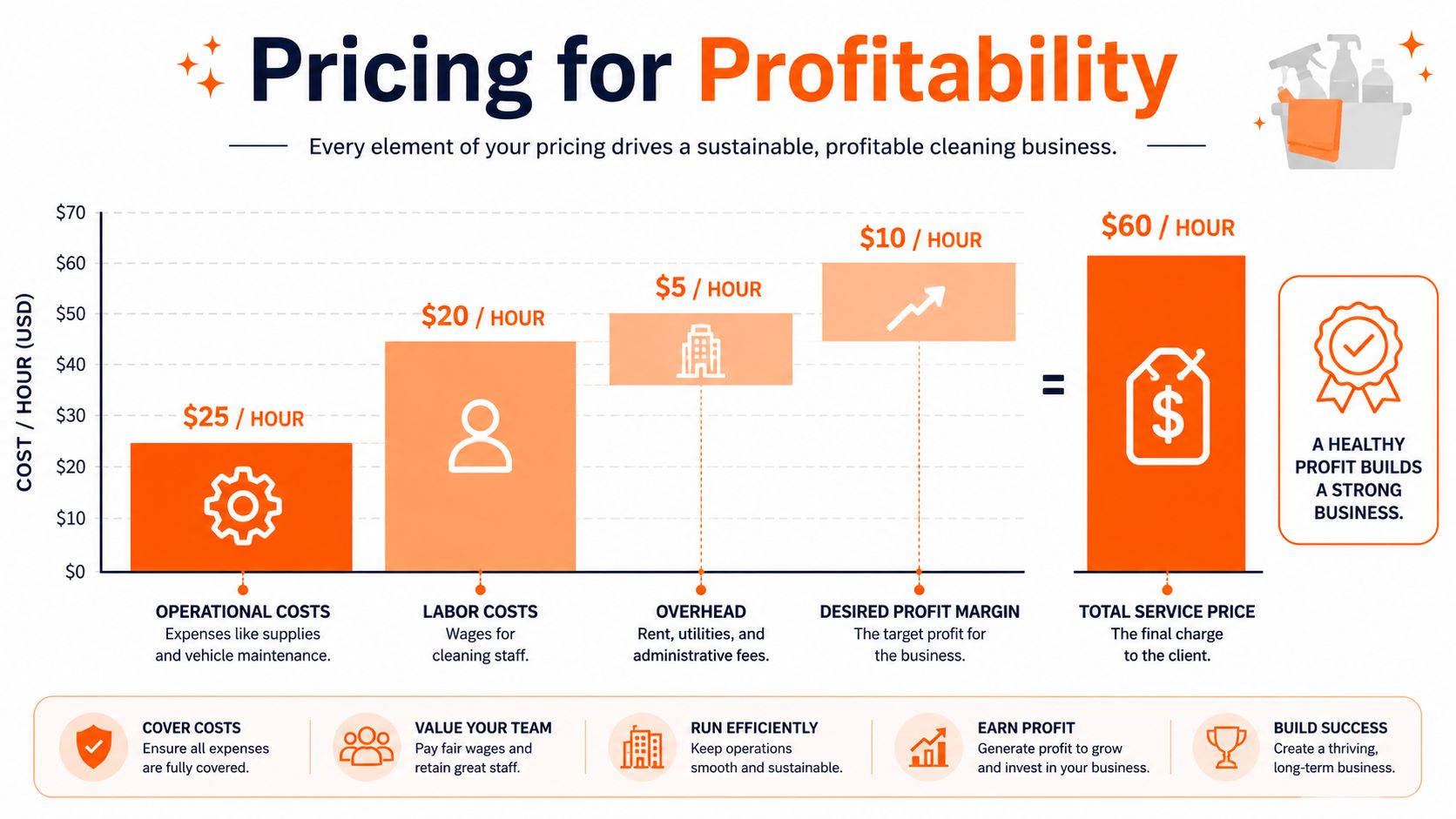
Pricing trips up almost every new operator because they treat it like a guessing game. They look at what others charge, shave a bit off to stay “competitive,” and hope there's margin left over. That approach creates busy businesses with weak cash flow.
The cleaner method is to build price from cost, capacity, and target profit.
The wrong way to price
The most common mistake is underestimating labor on add-on work. That's where a lot of “good” jobs turn out to be bad ones.
As explained in this guide to pricing a painting job, margins improve when you account for real labor allocation instead of just headline revenue. The same logic applies here. A common error is miscalculating labor costs for add-on jobs. If a crew paid $500/day spends 1.5 hours on a $300 add-on, many assume the labor cost is low. In reality, the true allocated labor cost can be over $90, revealing a hidden profit erosion of 15–20%, based on FieldCamp's breakdown of cleaning business ideas.
That's the trap. Owners see a short task and assume it carries high margin. But if the crew is already committed to a day rate, vehicle movement, setup time, and admin handling, the allocation is rarely as cheap as it looks.
A simple pricing structure that holds up
Use one of three pricing models depending on the job type:
- Hourly pricing: Best when scope is uncertain or conditions vary too much to quote tightly.
- Flat-rate pricing: Best for repeatable work with a clear scope and known labor pattern.
- Ongoing service agreements: Best when the work recurs and scheduling efficiency matters as much as unit price.
Build every quote from four components:
Labor
Start with the total cost of the person or crew doing the work, including the time around the task, not just the task itself.Materials and consumables
Count what gets used, replaced, or worn down. If each small job nibbles away at stock, that needs to be recovered somewhere.Overhead
Fuel, insurance, software, phones, admin time, and banking costs don't disappear because a quote is small.Profit
This is not whatever happens to be left over. Put it in on purpose.
A profitable price is one you can repeat without resentment.
If you're new, avoid sending prices from memory over text. Estimate on paper first. After enough jobs, you'll know where your numbers hold and where they drift. Until then, structure beats instinct.
Managing Operations and Finding Good People
The first phase of a business feels manageable because everything runs through one person. Then two jobs overlap, a customer changes access times, supplies run short, and someone calls asking where you are. That's when operations stops being a background issue and becomes the whole game.
Your first scheduling problem changes everything
Most owners build systems only after chaos shows up. That's normal, but don't wait too long.
A typical early problem looks like this: you book one job in the morning and another based on best-case timing. The first job runs long because access is delayed, the second customer expects punctual arrival, and now the phone starts driving the day instead of the schedule. That's when you need a proper operating rhythm.
Use this minimum standard:
- One calendar only: Google Calendar, Outlook, or job management software. Never split bookings across texts, memory, and paper.
- Travel buffers: Put space between jobs. Tight schedules look efficient until one variable goes wrong.
- Job notes on the booking: Access details, contact name, parking issues, scope exceptions, and anything the crew needs before arrival.
- End-of-day review: Confirm tomorrow's jobs, materials, addresses, and who's responsible for each one.
A simple system beats a clever one nobody follows.
Your first hire should reduce chaos
The first hire shouldn't just add hands. They should make the day more stable. That means reliability matters as much as technical ability.
Look for someone who:
- turns up on time
- communicates clearly
- follows checklists
- notices problems without panicking
- represents the business well in front of customers
You can teach methods. It's harder to teach judgment and consistency.
When they start, don't throw them straight into live work with vague instructions. Give them a written onboarding sheet. Include arrival standards, customer etiquette, equipment handling, what to do when scope changes, and who they call when something goes wrong.
Hire for steadiness first. Speed usually follows.
Quality control also needs to be visible. Use a simple completion checklist and require photos or notes where appropriate. That's not corporate overhead. It's how you keep standards from slipping when you're no longer standing on every job yourself.
Marketing That Gets You Seen Locally
Most local operators don't have a lead problem first. They have a visibility problem. People can't hire a business they never notice, never hear about, or can't verify quickly.
That's why the best local marketing is rarely flashy. It's consistent, simple, and tied to the area you serve.

Local trust beats clever campaigns
Think about how people choose a local service. They look for signs that you're active, real, and nearby. They check your profile, recent posts, photos, reviews, and whether your business looks current. If your last update was months ago, trust drops immediately.
That's why small operators get more from consistency than from one-off promotion bursts. A polished profile, recent activity, answered messages, and proof of completed work does more than a complicated campaign most owners won't sustain anyway. If you want a practical example of local ad thinking, these ads for cleaning services examples show the kind of direct, service-led messaging that tends to work better than generic branding.
Use this weekly baseline:
- One customer-proof post: Show a completed result, a process detail, or a site-ready setup.
- One trust post: Explain how you work, what customers can expect, or how quoting works.
- One local post: Mention the area, common property type, or practical issue people in that location deal with.
- One review or testimonial post: If a customer sends kind words, turn it into visible proof.
Don't overproduce. Repeat what's easy to maintain.
What to post when you have no time
When the week gets busy, default to evidence. Evidence always outperforms vague claims.
Good content for local service businesses usually falls into a few practical buckets:
- before and after job documentation
- short walkthrough clips from site
- common mistakes customers make before calling
- “what's included” explanations
- staff or vehicle photos that show the business is active
- short answers to common quoting questions
A quick video can often say more than a polished graphic. This example shows the kind of simple visual communication that keeps attention better than text-heavy posts.
You don't need to become a content creator. You need to become visible enough that local customers stop scrolling when they see your business name and recognize it.
Winning Jobs with Smart Sales and Quoting
Most owners think selling means persuading. In local service work, selling usually means responding fast, asking the right questions, and making it easy for the customer to say yes.
That starts before the quote.
Speed wins before persuasion does
If your phone handling is slow, nothing else matters much. Industry data shows that the first service company to respond to a customer inquiry wins the job 78% of the time, and a response window of under 15 minutes is the benchmark for success, according to AgentZap's cleaning business phone statistics.
That means your sales process needs to be built around speed, not just polish.
If you want more contract-style work, the same principle applies in formal quoting too. This guide to bidding for cleaning contracts is useful because it shows how structured responses help you look organized before price even becomes the deciding factor.
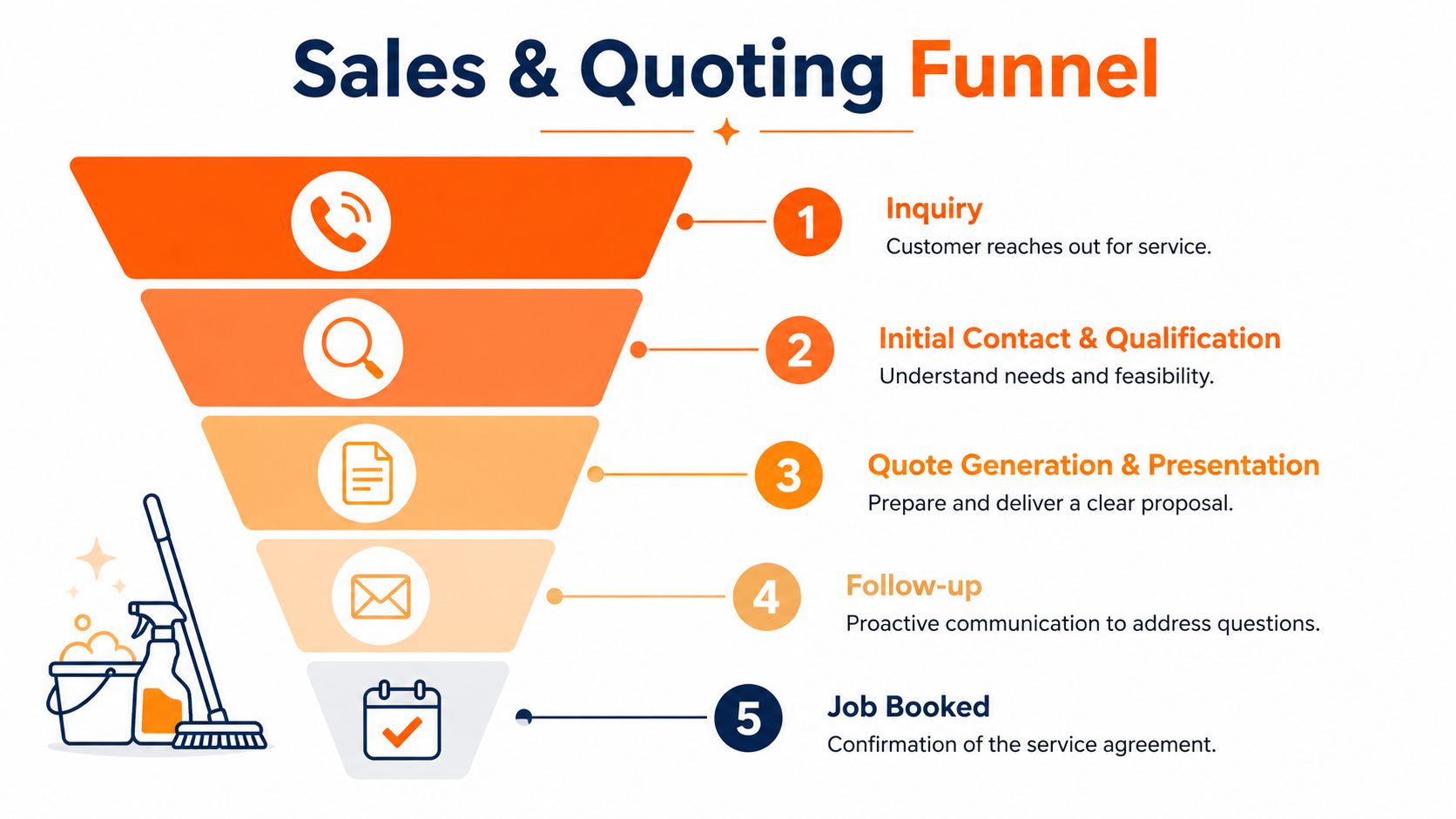
When a lead comes in, do this:
Acknowledge immediately
Even if you can't quote on the spot, confirm receipt and say when they'll hear back.Qualify fast
Ask for address, timing, site type, scope, and whether there are access or urgency issues.Decide the next step
Some jobs need a visit. Others can be quoted from photos and a clear written description.Send the quote while interest is high
Same day is best whenever possible.
The customer who contacts three businesses usually books the one who sounds easiest to deal with.
A quote should remove doubt
A strong quote isn't fancy. It's clear. It tells the customer exactly what they're buying and what happens next.
Use a template with these parts:
| Quote element | What to include |
|---|---|
| Client details | Name, address, best contact number, email |
| Scope of work | Clear description of what is included |
| Exclusions | Anything not covered, so there's no confusion later |
| Price | Total amount and any conditions attached |
| Timing | Proposed date, duration, or scheduling window |
| Terms | Payment timing, approval method, expiry of quote |
Keep your follow-up simple. If they haven't replied, send a short message asking whether they have any questions and whether they'd like the slot held. That feels professional. It doesn't feel pushy.
Track three things from the beginning: how many enquiries came in, how many quotes you sent, and how many of those quotes turned into booked jobs. Those numbers will tell you whether your issue is visibility, pricing, or sales handling.
If you want steady local visibility without having to write posts between jobs, GrowTradie is built for that. It helps tradies stay active online with done-for-you content, branded visuals, and auto-posting that keeps your business visible while you focus on the work.