
You’re probably in one of two spots right now. Either you’ve been working under someone else for a while and you’re tired of hitting the same ceiling, or you’re just getting serious about plumbing as a career and want a straight answer on what it takes to do it properly.
The big frustration is usually the same. You can do the work, solve problems on site, and handle customers, but you can’t legally step into the next level until the license is sorted. That means no pulling permits on your own, no taking certain jobs under your own name, and no real control over how you build your career.
The good news is that how to get your plumbing license follows a pattern almost everywhere. The details change by state, but the route stays familiar. Get into the trade properly. Build supervised hours. Keep records. Pass the exam. Finish the paperwork. Then, if your goal is to run jobs or run a business, keep moving toward master or contractor status.
Table of Contents
- Why a Plumbing License is Your Next Big Step
- Choosing Your Path Apprenticeship vs Formal Education
- The Grind Accumulating Your Required Hours
- Passing the Test Preparing for Licensing Exams
- Finalizing Your License Paperwork Checks and Fees
- Common Licensing Pitfalls and How to Avoid Them
Why a Plumbing License is Your Next Big Step
You see this all the time. A plumber has solid hands, good references, and plenty of work under someone else’s ticket. Then a better job comes up, a customer asks who can pull the permit, or the plumber wants to bid work directly. That is the moment the license stops feeling like paperwork and starts looking like the line between helping on a job and being responsible for it.
Across the trade, the pattern is pretty consistent. If you want to work legally at a higher level, sign permits where allowed, or move toward running work yourself, licensing is part of the path. The exact rules change by state and sometimes by city, but the journey is familiar. Start as an apprentice, build hours under supervision, pass the exam, file the paperwork.
That broader view matters more than memorizing a 50-state chart. One state may call the step journeyman first and another may put more weight on local licensing, but the progression largely stays the same. You prove experience, show you understand code and safety, and earn the authority to take on more responsibility.
What a License Enables
A license changes what you can do in the field and how people see your work.
- Permit responsibility: Many jobs require a licensed plumber to pull permits or stand behind the installation.
- Access to better work: Commercial jobs, remodels, and higher-value residential projects often screen for licensed tradespeople.
- A clear step up the ladder: In many places, licensing leads from apprentice to journeyman, then to master or contractor status.
- More trust from customers and employers: A license shows you met a standard. It is easier to win work when you can prove qualifications.
Here is the practical rule. If you want more control over your income and the kind of jobs you take, get the license as early as your hours and state rules allow.
Plenty of apprentices and helpers put it off because the weekly paycheck is still coming in. I understand that. The trouble shows up later. You cannot take certain jobs, you cannot sign for certain work, and you stay dependent on someone else’s license longer than you need to.
Licensing is also where the trade starts separating general labor from real plumbing responsibility. The process forces you to know code, document your experience, and answer for the quality of the work. That is good for the customer, but it is also good for your career.
If your long-term plan includes working for yourself, the shift is similar to learning how to start a handyman business properly. You stop thinking only about today’s service call and start thinking about permits, liability, reputation, and what you need in place to operate on your own name.
Choosing Your Path Apprenticeship vs Formal Education

Newcomers to the trade typically choose between two starting points. They either go into an apprenticeship and learn on real jobs, or they spend more time in formal education first and move into fieldwork after that.
Both can get you where you want to go. But they don’t feel the same day to day, and they don’t suit the same kind of person.
The earn while you learn route
Apprenticeship is the route most plumbers understand best because it lines up with how the trade works. You learn from licensed people, you carry tools, you make mistakes under supervision, and over time the work starts making sense.
The broad pattern is well established. The journeyman plumber path typically requires a 4 to 5 year apprenticeship with 4,000 to 8,000 hours, plus 144 to 576 classroom hours in safety, codes, and math. For people who complete that path, the employment success rate is reported at 75 to 85 percent in the Thryv overview of plumbing licensing requirements.
That matters because plumbing is hands-on. You can’t learn proper rough-in work, venting judgment, or service diagnostics from a chair alone.
The classroom first route
Formal education can still be a solid choice. If you learn well in a structured setting, trade school can help you build your code knowledge, calculations, safety habits, and terminology before you step onto a live site.
This route often suits people who want a stronger academic base before the pressure of jobsite expectations hits. It can also help if you need more confidence with measurements, reading plans, or understanding systems before you’re expected to move quickly.
The catch is simple. Classroom training on its own doesn’t make you a plumber. It makes you more prepared to become one.
Here’s a good primer if you want to hear the trade discussed more practically before deciding which route fits you.
What usually works better in the field
If you ask experienced plumbers what builds stronger tradespeople, most will lean toward apprenticeship with some classroom support rather than classroom-first with minimal field exposure.
That’s not because theory doesn’t matter. It does. But plumbing is a trade where context changes everything. The same fitting, fixture, or venting situation looks different depending on the age of the building, the material in front of you, local code adoption, and what the last installer left behind.
A simple comparison helps:
| Path | Best for | Main strength | Main drawback |
|---|---|---|---|
| Apprenticeship | People who learn by doing | Real jobsite judgment under supervision | Progress depends heavily on the quality of the plumber teaching you |
| Formal education | People who want structure first | Better early grasp of codes and concepts | Less direct exposure to live site problems |
| Blended path | Most serious candidates | Balances field skill and book knowledge | Requires discipline to stay organised |
The best setup is usually simple. Get onto real work as early as you can, and don’t neglect the classroom side that helps you pass the exam later.
What doesn’t work well is drifting. If you bounce between helper work, casual site labor, and untracked plumbing tasks without formal registration or supervision, you can spend years working hard and still come up short when it’s time to apply.
The Grind Accumulating Your Required Hours

A lot of apprentices hit the same point. They have been working for years, showing up early, carrying real responsibility, and they assume the license application will be straightforward. Then the state asks for verified hours by work type, signed records, and proof of supervision. That is where loose records and narrow experience start causing trouble.
Getting licensed is not just about spending enough time on the tools. States want documented, supervised experience, and some break that experience into categories. Minnesota is a good example. Journeyworker applicants need verified hours in several parts of the trade, including water distribution, drain, waste, and vent work, and fixtures. The point is clear. Time alone is not enough. You need time across the trade.
Your hours need range
The biggest trap is becoming dependable in one lane and staying there too long.
Shop owners do this for practical reasons. If you are quick on trim-outs, calm in occupied homes, or strong on underground rough-ins, they will keep sending you where you make the company money. That helps the business. It does not always help your license application or your long-term skill set.
A strong hour log usually includes exposure to work such as:
- Water distribution: sizing, routing, tie-ins, shutoffs, pressure issues, and clean installs
- Drain, waste, and vent systems: layout, grade, venting rules, rework, and inspection corrections
- Fixture installation: setout, final connections, testing, troubleshooting, and finish quality
- Plans and code use: reading drawings, checking clearances, and applying code on real jobs
If you spend two or three years doing one narrow task well, you can still end up short where it counts.
I have seen apprentices who were excellent service techs struggle later because they had almost no recorded rough-in or DWV time. I have also seen new construction apprentices move fast on layout but freeze when they had to diagnose a live system in an occupied building. Broad experience takes longer to build, but it makes you more useful and easier to license.
Chase qualifying hours, not convenient hours.
Keep records while the work is happening
Good apprentices lose credit every year because they treat documentation like office paperwork instead of part of the trade.
Do not wait until application season and then try to rebuild four years of work from memory, old text messages, and half-complete payroll records. Payroll proves you were on the clock. It often does not prove what kind of plumbing work you performed, who supervised you, or whether the work fits the categories your state wants.
Use a simple system and stay consistent:
- Log work every week. Write down the job, the type of plumbing work, and who supervised it.
- Sort hours by category. Separate water, DWV, fixtures, service, gas work, or whatever your state tracks.
- Get sign-off regularly. Monthly is far better than chasing signatures years later.
- Keep your own copies. Save photos, pay stubs, apprenticeship records, and signed logs in one place.
Paperwork problems are common, and they are avoidable. Supervisors retire. Companies close. Offices change software. Foremen forget details. Your records need to survive all of that.
The apprentices who get through this stage cleanly are usually the ones who work with intent. They ask for varied assignments, pay attention to how their state defines qualifying experience, and keep their records current from the first year onward. That is the practical side of how to get your plumbing license. You do the work, and you prove the work.
Passing the Test Preparing for Licensing Exams
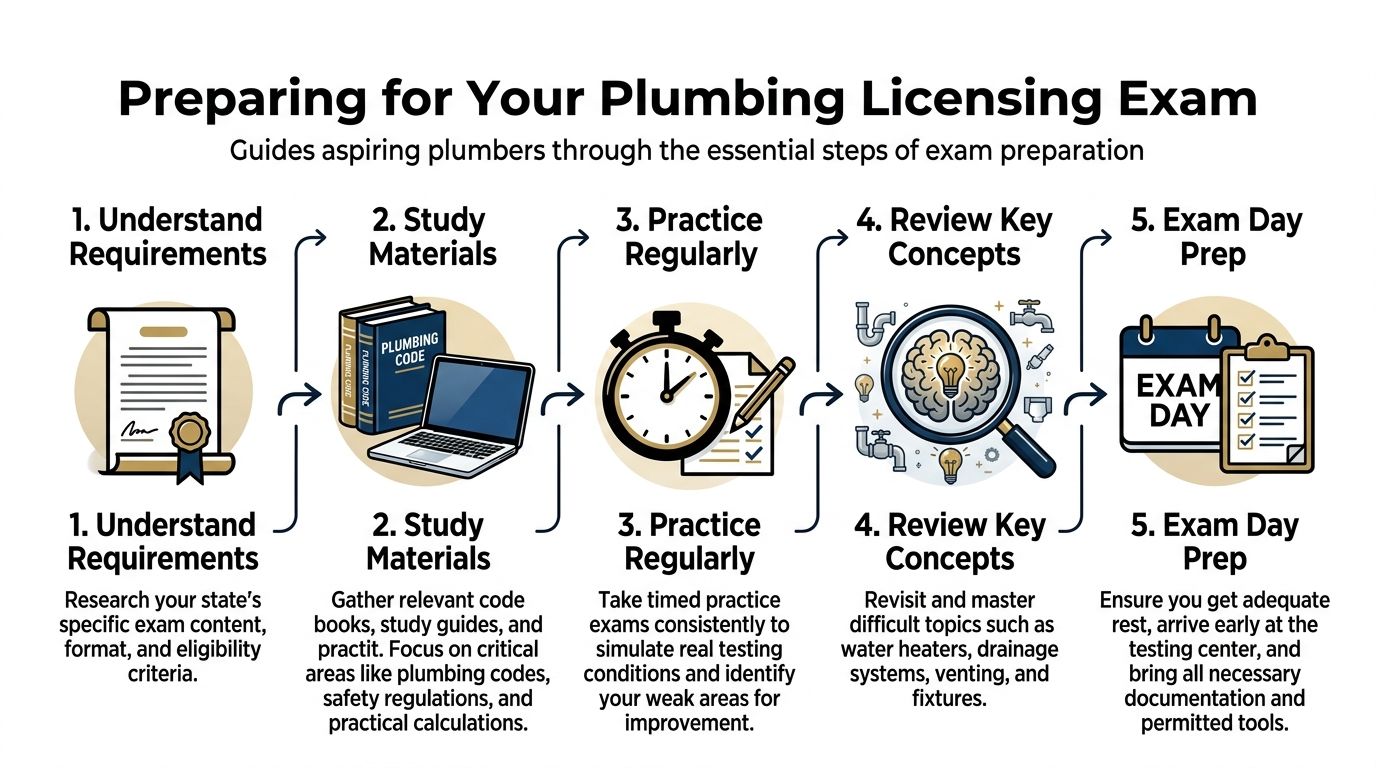
The exam scares a lot of good plumbers more than it should. Not because it’s easy, but because people often prepare for it the wrong way.
The usual mistake is thinking field experience alone will carry you. It won’t. Being able to solve a blocked waste line fast doesn’t automatically mean you can move through code questions, exam wording, and timed problem-solving.
What the exam is really testing
Most licensing exams are checking whether you can work safely, legally, and consistently within code. They’re not just testing whether you’ve been around plumbing work.
That means your study needs to cover more than fittings and fixtures. Expect attention on code books such as the IPC or UPC, safety practices, installation standards, and often business or contractor-level material depending on the license.
A few areas usually deserve extra effort:
- Code navigation: Learn the index, chapter layout, and how to find answers quickly.
- System fundamentals: Venting, drainage, water heaters, fixture requirements, and sizing concepts come up often.
- Safety and regulation: OSHA-related material and general jobsite compliance matter.
- Business knowledge: Contractor-level licensing can include insurance, law, and administrative duties.
Good plumbers sometimes fail because they study from memory. Good candidates pass because they study from the code book.
A study plan that actually helps
You don’t need a fancy method. You need a consistent one.
Start by finding out exactly which exam you’re taking and what books are allowed. Then build your preparation around the actual format, not around random online advice. If your test is open book, practice using the book fast. If there’s a practical component in your area, don’t ignore hands-on review.
A study routine that works in practice usually includes:
- Timed practice sessions: Simulate exam pressure so you don’t panic on the day.
- Codebook tabbing and indexing: Only if your jurisdiction allows it. Know the rules before you mark anything.
- Weak-topic review: Spend extra time on venting, drainage layouts, and calculations if those slow you down.
- Study with another plumber: Even one weekly session can expose gaps you missed.
The plumbers who tend to struggle are often the ones who “look over” material after work without testing themselves. Reading feels productive. Retrieval is what confirms whether you know it.
An Ohio example that shows the standard
Ohio gives a useful real-world example of how contractor-level licensing works. Applicants must pass the Pearson VUE National Standard Plumbing Contractor exam (F25-N), and the exam fee is $115, according to ServiceTitan’s Ohio plumbing license guide. That same source notes that prep-course students see an 80 percent pass rate, while the success rate for self-taught applicants is closer to 45 percent.
That gap is worth paying attention to.
It doesn’t mean self-study can’t work. It means unstructured self-study often leaves holes. If you already know you’re not strong with testing, there’s no shame in using prep materials, a code class, or a focused review course to tighten things up.
Here’s the practical takeaway:
| Approach | What tends to happen |
|---|---|
| Pure self-study with no plan | Knowledge gaps stay hidden until exam day |
| Structured prep course | You get repetition, likely exam topics, and accountability |
| Field experience plus disciplined code study | Often the strongest mix if you can stay consistent |
The test is beatable. But it respects preparation. Walk in organised, rested, and familiar with the material, and it becomes a professional hurdle instead of a mystery.
Finalizing Your License Paperwork Checks and Fees
Passing the exam feels like the finish line, but it usually isn’t. This last stretch is where people get sloppy because they’re relieved, and that’s exactly when delays creep in.
The paperwork phase is straightforward if you treat it like a job handover. Every document needs to be complete, current, and matched to what the licensing board specifically asked for. Not what a mate told you they asked for a few years ago.
What to gather before you submit anything
Your final package often includes more than just proof that you passed. Depending on your state and license level, you may need application forms, identity documents, background check materials, business registration details, and insurance paperwork.
Some states get very specific. In Ohio, for example, contractor applicants submit a notarized application with a $25 fee, then move through background checks, and later provide proof of $500,000 general liability insurance plus a $300 licensing fee, as outlined in the same Ohio guidance referenced earlier in the article.
A simple checklist helps:
- Application documents: Make sure names, dates, and business details match across every form.
- Exam confirmation: Use the official result or approval record required by your board.
- Insurance proof: If the board asks for coverage assigned to a contracting entity, give them exactly that.
- Background check items: Do these early if your state puts them in the sequence before final approval.
Why master status often matters
A lot of plumbers are surprised when they learn that getting licensed to work and getting licensed to operate a business aren’t always the same thing.
In many states, master plumber status is the level that is required for contractor licensing. The U.S. workforce data cited by ConsumerAffairs lists 212,969 master plumbers in the 2026 national workforce and notes that this tier is often required for contractor licensing in many states, according to its plumbing industry statistics summary. That same source gives a practical example from Minnesota, where master licensure requires at least 1 year or 1,750 hours as a licensed journeyworker.
Georgia is another useful reminder that business-side compliance matters too. The same source notes that Georgia requires insurance, including workers’ comp for businesses with 3 or more employees, before issuing a contractor license.
If your plan is to run your own shop, don’t think only in terms of passing one exam. Think in terms of moving from worker to responsible license holder.
A lot of plumbers also start thinking harder about visibility once they reach this point. That’s when practical ideas around plumbing advertising that brings in better jobs start mattering, because a license gives you the legal footing to go after work more confidently.
How to avoid delays at the finish line
The best move here is boring and effective. Build your full submission package before you send anything.
That means checking expiry dates, signatures, notarization requirements, naming consistency, and whether your insurance certificate is written in the exact way the board expects. One missing attachment can push your approval back while your file sits in a queue.
Administrative mistakes at the end feel small, but they can hold up the whole process longer than the exam did.
Keep copies of everything you submit. Save confirmations. If you post documents physically, track them. If you upload them, keep screenshots or receipts. This is one part of the process where being over-organised pays off.
Common Licensing Pitfalls and How to Avoid Them

Most plumbers don’t get knocked off track because they can’t do the trade. They get knocked off track because they assume the licensing path is forgiving.
It often isn’t.
The mistakes that cost people time
One of the biggest traps is poor timing. In Alabama, once your application is approved, you have only 30 days to schedule and take the exam. Miss that window and you forfeit the application and the $110 to $160 fee, then start again, according to ServiceTitan’s Alabama licensing guidance.
That kind of deadline catches busy tradies all the time. They’re on jobs, they think they’ll book the exam next week, and suddenly the testing window is gone.
Other common problems show up earlier:
- Weak hour records: You did the work but can’t prove it properly.
- Assuming all states work the same way: They don’t. One board may want affidavits. Another may want permit-linked experience.
- Underestimating the exam: Some of the best hands in the trade still struggle with formal testing.
- Leaving paperwork half-finished: Missing signatures and insurance details can stall approval.
The habits that keep your application moving
The good habits aren’t glamorous, but they work.
First, check the exam provider’s availability before you submit if your state uses a tight scheduling window. If appointments are limited in your area, you need that information before the clock starts.
Second, keep a licensing folder from day one. Put registrations, signed hour logs, course records, IDs, correspondence, and application receipts in one place. Paper copy, digital copy, or both. Just don’t rely on memory.
Third, prepare around your real work week. If you’re flat out on service calls, don’t tell yourself you’ll “fit in” exam study casually. Book it like a job.
A practical short list looks like this:
- Check deadlines early: Don’t wait for approval before looking at scheduling logistics.
- Keep duplicate records: If one document disappears, you won’t be scrambling.
- Get supervision signed off regularly: Old memories make weak verification.
- Use structured prep if tests aren’t your strength: Pride is expensive when reapplication is involved.
If you’re building toward your own operation, these same habits also help when you’re trying to keep work flowing. Systems matter. So does consistency. That’s true for licensing, and it’s true when you’re working on plumbing lead generation that keeps enquiries coming in.
The licensing path rewards the plumber who stays organised before problems show up. That’s usually the difference between a clean application and a frustrating one.
Once you’ve got the license sorted, the next challenge is staying visible enough to win the right work consistently. GrowTradie helps trade businesses stay active online with done-for-you content and posting, so your business keeps showing up professionally even when you’re too busy on the tools to think about marketing.