

You’re probably in one of two spots right now. You’ve been fixing things for years and you’re tired of making someone else money, or you’ve become the person everyone calls when a door won’t close right, a toilet keeps running, or shelves need hanging properly the first time.
That’s usually how this starts. Not with a polished business plan or a fancy logo. It starts with skill, reliability, and the feeling that if you’re already doing the work, you may as well build something of your own.
Starting solo is more realistic than a lot of people think. The U.S. handyman services market is projected to reach $355.3 billion in 2026, supported by approximately 550,000 businesses, which points to steady demand for minor repairs and maintenance and a practical entry point for solo operators, according to IBISWorld’s U.S. handyman services industry overview. That doesn’t mean it’s easy. It means there’s room for someone who answers the phone, shows up, prices work properly, and does solid jobs without drama.
If you want to start a handyman business, the play is simple. Set it up legally. Keep your services tight. Price like a business owner, not like a guy doing favors. Get your first customers from places that already trust you. Then build systems before the admin mess catches up with you.
Table of Contents
- From Good with Your Hands to Your Own Boss
- Laying the Foundation for a Real Business
- Pricing Your Work and Estimating with Confidence
- Essential Tools and Your Work Vehicle Setup
- How to Get Your First Handyman Customers
- Running Your Business with Smart Systems
- Key Takeaways and Frequently Asked Questions
From Good with Your Hands to Your Own Boss
A lot of good handyman businesses begin the same way. Someone spends years on site, learns how houses really behave, gets fast at problem solving, and gets fed up with low control over time, money, and standards. Being good with your hands is the base. Building a business on top of that is the shift.

The first thing to understand is this. Going solo doesn’t mean you need to become a general contractor overnight. Most new operators do better when they start with the work they can complete confidently, profitably, and without exposing themselves to licensing trouble. That usually means common repair and maintenance jobs, not every task under the sun.
There’s also a mindset change that matters. A job pays you for your time. A business pays you for your time, your judgment, your systems, and your reputation. If you start a handyman business the right way, each good job can lead to repeat work, referrals, and a local name people remember.
Practical rule: Don’t build your first year around the idea of taking every job. Build it around becoming known as the person who handles a specific set of jobs well.
That’s what moves the needle early on. Not trying to be everything. Not buying every tool in the catalog. Not talking like a big company before you’ve finished your first twenty jobs.
The upside is that homeowners aren’t looking for a superhero. They’re looking for someone dependable who can turn up, diagnose the issue, explain the fix in plain English, and leave the place better than they found it. If you can do that consistently, you’re already ahead of plenty of people in this trade.
Laying the Foundation for a Real Business
The first time a customer asks, “Are you insured?” or “Can you send an invoice with your business name on it?” you find out fast whether you’re running jobs or running a business. Good hands get you through the work. A proper setup keeps one mistake from wiping out a month of profit.
Start by drawing a hard line around the services you offer. New handymen get into trouble when they say yes too often, then end up in jobs that need a license, specialist tools, or more experience than they have. A tight service list makes your quoting cleaner, your marketing clearer, and your days easier to control.
A practical starter list usually includes:
- Minor carpentry: doors, trim repairs, shelving, hardware installs
- Drywall patching and paint touch-ups: small damage, not full renovation work
- Fixture replacement: simple swaps that stay inside what your local rules allow
- Assembly and adjustments: furniture, curtain rods, blinds, wall-mounted items
That kind of list does real work for you. It tells customers what to call you for, and it tells you what to decline before a small job turns into a big problem.
You do not need a polished business plan. You need clear decisions.
| Question | What you need to decide |
|---|---|
| Who do you serve | Homeowners, landlords, small property managers, seniors, busy professionals |
| What jobs do you want | Short repair work, half-day jobs, punch lists, recurring maintenance |
| What jobs do you avoid | Anything outside your skill set or local legal limits |
| How will you get paid | Deposit policy, invoice timing, accepted payment methods |
That table looks simple because it should be simple. If you can answer those four questions without hesitation, you’re already ahead of a lot of people who start with a logo and no real plan.
Handle the legal setup before the first invoice
A handyman business gets expensive when the paperwork is wrong. You can do clean work, treat people well, and still get hit with fines, rejected claims, or payment problems if you skipped the setup.
Durable’s guide to starting a handyman business points out that legal requirements vary by state, and some places set strict limits on the type or dollar value of work you can do without a contractor license. California is a common example. Jobs over $500 can trigger licensing rules.
Check these four items before you advertise anything:
Local licensing rules
Check city, county, and state requirements. Then check task-specific restrictions. Basic handyman work may be allowed while electrical, plumbing, roofing, or larger structural work is not.Business registration
Set up your business name and entity the right way for your location. A lot of one-person operators choose a structure that separates business activity from personal finances, but this is worth confirming with an accountant or tax pro in your state.Insurance
General liability coverage matters the first time a ladder slips, a fixture leaks, or you damage a customer’s floor. Skill helps prevent problems. Insurance helps pay for them when they still happen.A dedicated business bank account
Keep business money separate from day one. Mixed accounts make bookkeeping harder, taxes messier, and customer records harder to track when you need them.
One rule has saved plenty of headaches. If a job sits in a legal gray area, decline it until you verify the rules.
The same goes for startup spending. Spend in the order the business needs, not the order your ego wants. Registration, insurance, a clean way to get paid, and the core tools for your service list come first. Extra gadgets, branding upgrades, and specialty equipment can wait until the work is paying for them.
Pricing Your Work and Estimating with Confidence
You finish a full day of work, the customer is happy, and then you realize the job barely paid. That usually comes down to pricing, not workmanship.
A handyman business gets profitable when you quote with enough discipline to cover the hours on site, the materials in the truck, the time spent driving, and the jobs that take longer than they should. New operators often miss those last two.
Hourly or fixed price
Both can work. The right choice depends on how clear the scope is before you start.
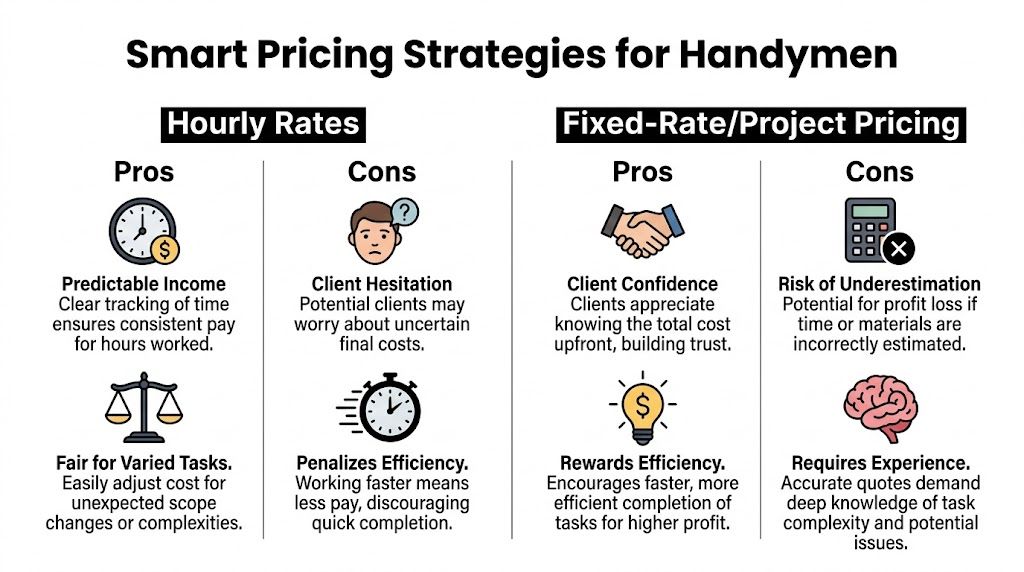
Use hourly pricing for troubleshooting, repair lists, and older homes where opening one problem can reveal two more. Leak tracing, damage investigation, and odd-job visits fit this model well because the final time is hard to predict. Hourly pricing protects your downside, but some customers get nervous if they do not know the total up front.
Use fixed pricing for work you can repeat with confidence. Shelf installation, lock replacement, faucet swaps, drywall patching, and simple paint touch-ups are good examples. Customers usually prefer a fixed number. You carry the risk if you miss something in the quote.
Here is the practical split:
| Pricing model | Best for | Main drawback |
|---|---|---|
| Hourly | Unknown scope, fault-finding, mixed repair visits | Customer may hesitate without a firm total |
| Fixed price | Repeat jobs, clear scope, standard installs | Your margin disappears fast if you underestimate |
Early on, hourly is safer. After you have done the same kind of job enough times to know the common surprises, fixed pricing starts paying better.
Build your price from the job, not from guesswork
A solid estimate needs four parts:
- Labor
- Materials
- Overhead
- Profit
Labor is not just tool-in-hand time. Count loading, travel, setup, cleanup, dump runs, and the half hour spent chasing parts. Materials include the obvious items and the small consumables that disappear every week, such as screws, anchors, caulk, blades, sanding discs, and drop sheets.
Overhead is where many small operators undercharge. Fuel, insurance, phone bills, software, vehicle wear, card fees, quoting time, and admin time all need to be paid for by the work. If your price only covers labor and materials, you bought yourself a job, not a business.
Profit has to stay in the number too. Fast work should raise your earnings. It should not punish you for getting efficient.
If painting is one of your regular services, this guide on how to price a painting job does a good job of breaking down labor, materials, prep, and scope in a way that matches real quoting.
A simple way to avoid underquoting
For small jobs, I like to run the estimate through a quick check before sending it:
- How long will the work take if everything goes right?
- What usually goes wrong on this type of job?
- What will I spend before I make a dollar?
- If this runs 20 percent over time, am I still covered?
That last question matters. Jobs rarely go over because of one huge problem. They go over because of parking delays, extra trips to the supplier, hidden damage, bad access, missing hardware, customer add-ons, and waiting around for a property manager or tenant.
What a solid estimate should include
The estimate needs to be specific enough that both sides know what is being bought.
Include:
- Client details: name, address, contact number
- Clear scope: exactly what you will do, written in plain language
- Exclusions: what is not included
- Materials: whether you supply them or the client does
- Price and payment terms: total price, deposit if needed, and when payment is due
- Timeframe: expected start date and likely duration
Details prevent arguments. “Bathroom repairs” is vague and weak. “Remove existing toilet, install replacement toilet supplied by contractor, reconnect and test, and dispose of old unit if site access allows” is much better.
A good estimate also makes room for change. If rotten timber, hidden water damage, or out-of-code work turns up after you start, the quote should say extra work will be priced separately and approved before it goes ahead.
That one sentence saves a lot of grief.
Essential Tools and Your Work Vehicle Setup
You finish a small repair job, head to the next call, and realize the fasteners you need are buried under a pile of rarely used gear. Then you lose another twenty minutes hunting for a charger. That kind of mess eats profit fast. Tools make you money, but only if you can reach them, trust them, and replace them without drama.

Early on, a lot of handymen buy for the jobs they wish they were doing. The better move is to buy for the work you can already win this month. If your bread and butter is fixture swaps, door repairs, patching, trim, hanging shelves, and basic carpentry, build around that. Leave the specialty gear for later, when a specific type of job pays for it.
Buy around your service mix
A practical starter kit covers common repair and maintenance work without filling the van with dead weight. In real terms, that usually means:
- Cordless drill and impact driver
- Circular saw
- Oscillating multi-tool
- Jigsaw
- Quality hand tools
- Tape measures, levels, square, stud finder
- Step ladder
- Extension leads and work lights
- Caulking gun, patching knives, sanding gear
- Tool bags, bins, and small parts organizers
Spend more on the tools you touch every day. Cheap ladders, weak batteries, and poor hand tools cost more than they save. On the other hand, specialty cutting tools, heavy demolition gear, and trade-specific kits can wait until the work is regular enough to justify them.
I also recommend keeping spare consumables in the van at all times. Extra blades, common screws, wall anchors, utility knives, pencils, charger cords, and a backup tape measure save more jobs than people think.
Your vehicle setup affects speed and professionalism
The van or truck is part workshop and part storage. If it is disorganized, every job takes longer. If it is packed too tightly, materials get damaged and tools go missing. If it is clean and simple, you move better all day.
Set it up by category and by frequency of use. Daily tools go closest to the door. Fasteners stay together. Patch and paint items stay contained so they do not leak onto everything else. Plumbing odds and ends should not be mixed in with general hardware. The goal is simple. Open the vehicle and know where everything is without thinking.
A basic setup works fine at the start:
- One area for core power tools
- One bin system for screws, anchors, and fixings
- One bag for plumbing and fixture-swap items
- One box for patching, caulk, fillers, and sanding supplies
- One open space for job-specific materials
That beats an expensive fit-out you cannot afford yet.
If you want ideas for keeping the admin side of mobile trade work under control, it helps to look at simple field-friendly systems and apps tradies use to stay organized on the road. The same principle applies here. Keep it easy to use, easy to restock, and easy to maintain.
Here’s a useful look at practical van setup thinking in action:
You do not need a fully fitted showroom van. You need a setup that cuts wasted trips, protects your gear, and helps the customer see that you run a tidy operation. Clients notice that stuff. So do property managers, real estate agents, and repeat customers.
How to Get Your First Handyman Customers
The first customers rarely come from clever branding. They come from trust. Someone knows you, has seen your work, or has heard you’re reliable.
That’s why the early stage is less about trying everything and more about doing a few basic things well, over and over.

Your first jobs usually come from people who already know you
Start with your existing circle. Former clients. Friends. Family. Ex-coworkers. Local suppliers. Property managers you’ve crossed paths with. Let them know what jobs you take and what kind of customer is the right fit.
Keep the message short. “I’m now taking on small repair and maintenance jobs in the area. Shelving, patching, fixture swaps, doors, trim repairs, punch lists.” That works better than a vague “I’ve started my own business.”
Then do these offline moves:
- Ask directly for referrals: not “keep me in mind,” but “if you know anyone who needs small repair work, send them my number”
- Leave behind simple cards: at supply counters, with landlords, with friendly local agents
- Talk to repeat-contact trades: plumbers, electricians, tilers, and painters often get asked for handyman recommendations
- Make each early job count: clean clothes, clear communication, on-time arrival, tidy finish
Your first ten customers are worth more than the first hundred strangers. They teach you what people actually ask for, what they object to, and what they tell their neighbors.
Keep your online presence simple and useful
You do need a basic online footprint. Not because you need to chase trends, but because people will look you up before they book.
A practical setup is enough:
- Google Business Profile with service area, photos, phone number, and job categories that match what you do
- A small photo portfolio showing before-and-after work where appropriate
- A social profile that stays active with finished jobs, short captions, and local relevance
- A review habit where you ask happy customers while the result is still fresh
Don’t overthink the posting side. Use it as proof of work, not as entertainment. A repaired gate, a patched wall, a neatly fitted shelf, a door that finally closes properly. That’s the content that wins local trust.
If you want a practical view of how steady posting supports local service businesses, this piece on content marketing for local businesses gives a straightforward overview without drifting into theory.
One more thing. Answer the phone, or return calls quickly. Plenty of decent trades lose work before they’ve even looked at the job because they’re slow to respond. Early on, responsiveness is a competitive advantage.
Running Your Business with Smart Systems
Friday afternoon is when weak systems show up. You finish a small drywall patch, realize you never sent Tuesday’s estimate, can’t find the receipt for the faucet parts, and remember too late that a customer texted asking to add two more jobs. None of that is hard work. It still costs money.
A handyman business runs better when the admin is boring and repeatable. If every job gets booked, quoted, approved, billed, and recorded the same way, fewer things fall through the cracks and your head stays clear for the work that pays.
Build one simple workflow and stick to it
You do not need fancy software. You need one process that you can follow from the first phone call to final payment.
A practical setup looks like this:
- One calendar for all jobs and site visits: no split system between texts, paper notes, and memory
- One quoting method: same format every time, with scope, exclusions, price, and expiry date
- One invoicing routine: send it before you leave site, or at a set time that day
- One expense capture habit: photograph or upload receipts as you buy materials
- One place for approvals and job notes: especially when the customer adds work halfway through
That consistency matters because small admin misses create real problems. Late invoices slow down cash flow. Missing receipts eat into your margin. Verbal scope changes turn into arguments because each person remembers the job differently.
If you are comparing tools, this guide to trade apps for scheduling, quoting, and invoicing is aimed at electricians, but the same day-to-day problems apply to a handyman working out of a van.
Keep records that help on the next visit
Good customer notes save more time than people expect. After each job, write down what you fixed, what materials or parts you used, and anything that will matter next time. Keep it short, but keep it useful.
| Record | Why it helps |
|---|---|
| Paint color, filler type, or patch location | makes touch-ups and return visits faster |
| Hardware brand, size, or fitting used | helps you match parts without guesswork |
| Small issues spotted nearby | gives you a legitimate reason to suggest follow-up work |
| Access instructions, pets, parking, or preferred times | makes repeat bookings easier for both sides |
These notes also help when the business starts getting busy enough to bring in help. Hiring too early creates its own mess. Hiring too late burns you out and hurts quality. The right time is when work stays steady for a while, your pricing is already working, and your systems are clear enough that another person can step into part of the job without constant hand-holding.
A small operation with clean systems usually makes more money than a busy one held together by memory.
Key Takeaways and Frequently Asked Questions
Starting well is mostly about restraint. Take the right jobs. Set the business up properly. Buy the tools you need now. Charge enough to stay in business. Keep records before you think you need them.
Key takeaways
- Stay inside your lane early on: offer services you can complete confidently and legally
- Sort the business basics first: registration, insurance, banking, and clear paperwork
- Price with overhead in mind: not just labor and visible materials
- Use estimates to control scope: clear wording prevents bad assumptions
- Get first customers through trust: personal network, local contacts, and a simple online presence
- Build systems early: calendar, quoting, invoicing, expense tracking, and client notes
A small handyman business becomes stable when the work is good, the pricing is disciplined, and the admin doesn’t depend on memory.
Frequently asked questions
Do I need to be an expert in every trade
No. That’s one of the fastest ways to get into trouble. You need to be very good at the work you offer and honest about the work you don’t.
What should I do when a job is beyond my skills
Say so early. Don’t bluff your way through unfamiliar work in someone’s home. Refer it to the right trade, and the client will usually respect you more for it.
How do I deal with difficult customers
Keep everything in writing. Confirm scope, price, exclusions, and timing before the job starts. Stay calm, stick to the agreed terms, and don’t argue emotionally.
Should I start broad or niche down
Start narrower than you think. A tighter service list makes pricing, setup, tools, and referrals much easier. You can expand later once the first part of the business runs smoothly.
When should I hire help
When the workload is consistently there, your margins support it, and your systems are good enough that another person won’t create more confusion than capacity.
If you want your business to stay visible while you’re busy on the tools, GrowTradie is built for that. It helps trade businesses keep their social profiles active with professionally designed posts specific to their services and local area, without needing to write everything yourself or stay on top of posting between jobs.