

You finish a long day on site, toss the tools in the ute, and check your phone. A local competitor has posted a clean before-and-after, a happy client comment, and a quick job update. Meanwhile, your last post was weeks ago, even though your work is better.
That’s where most contractors get stuck with social media marketing for contractors. Not because they don’t have good work to show, but because they don’t have spare hours to think like a marketer. They’re quoting jobs, ordering materials, chasing suppliers, and trying to get home at a decent time.
The good news is social media doesn’t need to be complicated to bring in work. You don’t need to dance on camera, post every hour, or build some polished brand identity. You need a simple system that shows real work, builds trust, and keeps your name in front of local people before they need to call someone.
Table of Contents
- Why Social Media Matters Even When You're Busy
- Choosing Your Battlegrounds Without Wasting Time
- Content That Builds Trust and Wins Jobs
- Getting Seen in Your Service Area
- The Automation Advantage for Staying Consistent
- Your Simple Path to More Local Jobs
Why Social Media Matters Even When You're Busy
Most contractors don't ignore social media because they think it has no value. They ignore it because it feels like one more job at the end of an already full day. That’s fair. But being too busy to post doesn’t change how customers look for trades.
In 2025, 96% of people learn about local businesses online, including contractors and construction firms, according to Oceanfront’s construction social media marketing data. If your business is hard to find, quiet, or looks inactive, people often move on to the next name.

Visibility matters before the call
A lot of jobs are won before the phone rings. People check your photos, read comments, scan your recent posts, and decide whether you look established, reliable, and active in their area. They’re not looking for a celebrity. They’re looking for signs that you do solid work and turn up.
That’s why social media marketing for contractors works best as digital proof, not entertainment. A basic feed with real projects, useful updates, and the occasional client result does more for trust than a silent profile.
Practical rule: Your social pages should answer one question fast. “Does this contractor look like someone I’d trust at my property?”
It saves time later
A strong social presence also filters leads. When people have already seen your work style, job quality, and type of projects, the enquiry starts warmer. You spend less time explaining who you are from scratch.
Use social media for three things:
- Show the work: Before-and-afters, progress shots, finished details.
- Show the standard: Clean sites, tidy installs, quality materials, clear workmanship.
- Show the business is active: Recent posts tell people you’re still operating and still in demand.
A quiet profile creates doubt. An active one reduces it.
Choosing Your Battlegrounds Without Wasting Time
Most contractors make the same mistake at the start. They try to be everywhere, then keep up with none of it. That’s how social media turns into a chore you drop after two weeks.
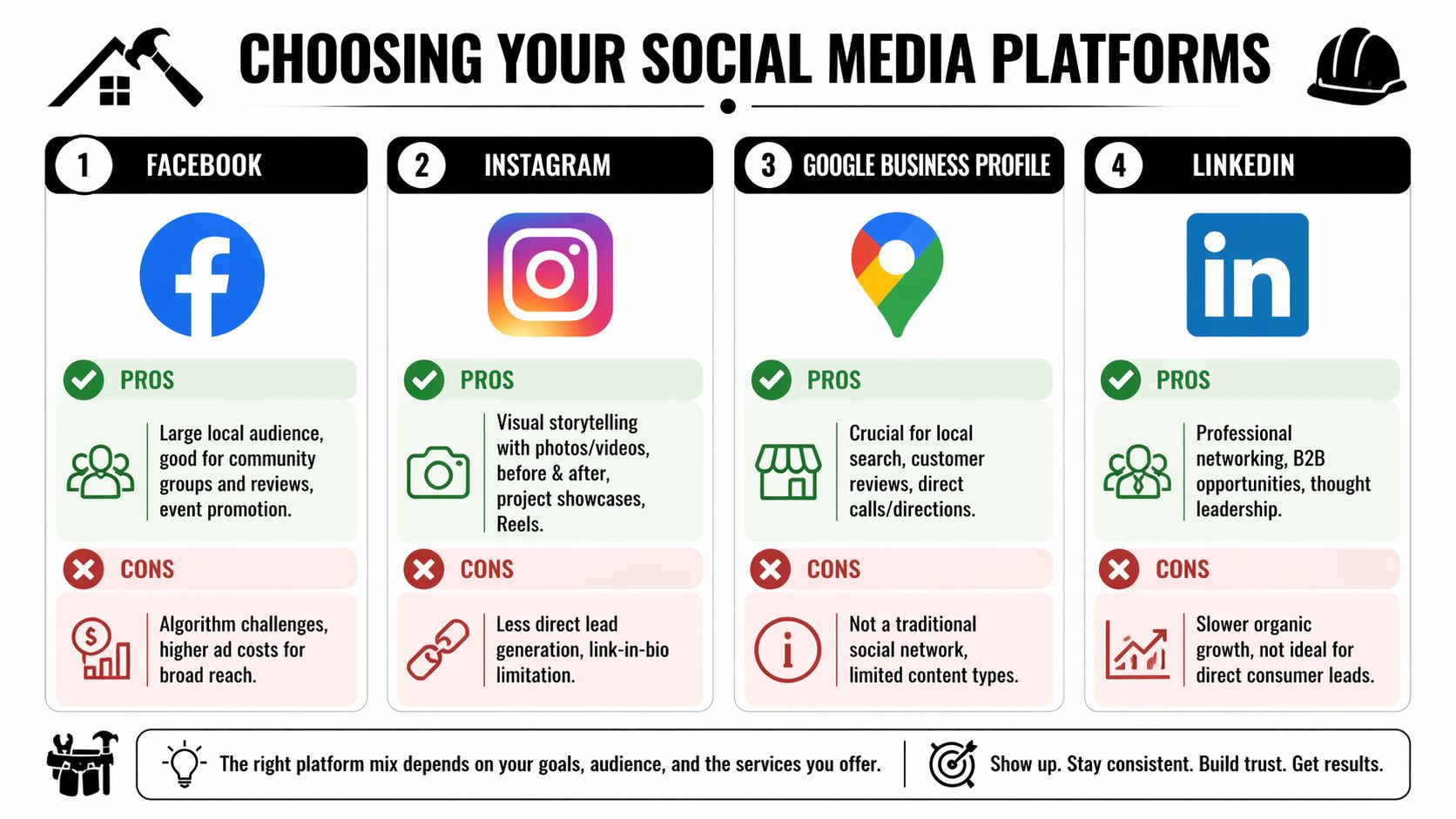
For most local trade businesses, Facebook and Instagram are enough to start. They cover the two things that matter most. Local visibility and visual proof. That’s where you should spend your limited time.
While 53% of contractors use social media, 71% of homeowners actively seek recommendations there, based on this breakdown of social media use for general contractors. If homeowners are already looking there, you don’t need a broad strategy. You need to show up well in the places they already check.
Why Facebook still pulls weight
Facebook is useful because local people use it to ask for trade recommendations. Community groups, suburb pages, and comment threads still generate real jobs. It’s also where referrals travel well. Someone tags your business, the homeowner clicks your profile, and now your recent work matters.
Facebook is a good fit if you want to:
- Reach nearby homeowners: Local groups and shares help your name spread in a service area.
- Collect visible feedback: Comments and recommendations add trust fast.
- Promote simple offers or updates: Availability posts, seasonal reminders, and recent jobs work well.
Why Instagram works as your portfolio
Instagram is simpler than many contractors think. It’s a visual record of your work. If you’re a plumber, electrician, carpenter, roofer, or HVAC tech, your camera roll already contains most of what you need.
Instagram works best when your feed answers these questions:
| What people want to know | What your posts should show |
|---|---|
| Can they do the kind of job I need? | Finished projects and in-progress work |
| Do they care about quality? | Close-up details and tidy outcomes |
| Are they legitimate and active? | Recent posts, team shots, job updates |
If you're in a specific trade and want to see how this plays out at a narrower level, this guide on social media marketing for plumbers is a useful example of how local trade content can stay practical.
Pick one main platform and one support platform. If you can keep Facebook and Instagram updated, that's enough for most contractors.
Content That Builds Trust and Wins Jobs
Most contractors don’t need more content ideas. They need fewer ideas that generate enquiries. The best posts are usually the least clever ones. Real work, real problems, real results.
As of early 2025, organic social media remains the primary strategy for 73% of businesses aiming to build authentic engagement and trust, according to Statista’s social media marketing findings. That lines up with what works in the trades. Authentic beats polished when the work is solid.
Post proof before polish
A clean phone photo from a real job usually beats a generic graphic. Homeowners want to see what you build, fit, repair, or install. They also want to see consistency. One great post is nice. A feed full of proof is what gets remembered.
Good trade content usually falls into a few repeatable categories.
A simple content mix that works
Use this as your core rotation:
- Project showcases: Post before-and-after photos, progress shots, or a finished result with a short explanation of what was done. A carpenter might show a rotten deck replaced with new framing and boards. An electrician might show a switchboard upgrade with a note about safety and neatness.
- Quick tips: Keep these short. One useful point is enough. An HVAC contractor might post a reminder about checking airflow before peak season. A plumber might explain when low water pressure points to a larger issue.
- Team and behind-the-scenes posts: Show the van, the tools, the setup, the apprentice learning properly, or the site being left tidy. This makes the business feel real.
- Client feedback: A short testimonial with a job photo is strong because it combines proof with reassurance.
- Common question posts: Answer the things customers ask every week. Price ranges don’t always need to be discussed, but process, timing, and what to expect are all useful.
Here’s a useful example format to aim for:
“Replaced damaged exterior timber, rebuilt the stair section, and sealed the finished deck. Client wanted something safe, clean, and built to last.”
That style works because it’s direct. It sounds like a contractor wrote it.
A lot of businesses overthink captions. Keep them simple. Say what the job was, where it was, what problem you solved, and who should message you if they need similar work.
For more practical ideas on building that kind of repeatable post library, this resource on content marketing for local businesses is a useful companion.
Video also helps when you keep it straightforward. A short walkthrough, a time-lapse, or a quick explanation from the site can do more than a long scripted clip.
A few content rules save time and improve quality:
- Take photos as you go: Before, during, after.
- Write captions like you speak: No jargon unless your customers use it.
- Show detail: Straight cuts, neat pipework, clean finishes, tidy cable runs.
- Ask for the testimonial while the client is happy: Right after the job is done is usually best.
If a post helps a homeowner feel more confident calling you, it’s doing its job.
Getting Seen in Your Service Area
Good content still needs local signals. If you post strong work but don’t connect it to your service area, you’ll get views from the wrong people or no useful reach at all.
That part is simpler than many contractors think. Start with the basics and do them every time.
Use local signals on every post
If you serve a specific city, suburb, or region, make that obvious. Don’t assume people know where you work.
Use:
- Location tags: Add the suburb, city, or nearby area to each post.
- Local wording in captions: Mention the area naturally. “Finished this bathroom renovation in North Lakes.”
- Trade-and-location hashtags: Keep a small saved list. Examples might include your service area plus trade type.
You don’t need dozens of hashtags. A short, relevant list is enough. Keep one note in your phone with your standard local tags and reuse it.
A simple caption formula works well:
| Part | Example |
|---|---|
| Job type | Switchboard upgrade |
| Area | Completed in Geelong |
| Outcome | Safer setup and cleaner layout |
| Call to action | Message us if you need similar work |
Boost only the posts that already look strong
Paid reach doesn’t need to be complicated. For most contractors, the easiest move is to boost a post that already shows clear work and has a straightforward message.
Contractors who use social media advertising achieve a 34% higher lead conversion rate compared to those relying on traditional marketing methods alone, based on GBIM’s contractor social media guide. That matters because a boosted post puts your best proof in front of more local people instead of waiting for them to find you by chance.
The posts worth boosting usually have these traits:
- Clear job photos: No clutter, no dark shots, no confusing angles.
- Simple service message: People can tell what you do in seconds.
- Local relevance: The area and job type are obvious.
- A direct next step: Call, message, or request a quote.
If you're comparing lead sources and trying not to rely too heavily on marketplace platforms, this breakdown of websites like Thumbtack can help you think through the trade-offs.
Don’t boost a weak post and hope money fixes it. Boost the post that already proves your work.
The Automation Advantage for Staying Consistent
The biggest reason social media marketing for contractors fails isn’t bad content. It’s inconsistency. A contractor posts three times in one week, gets busy, disappears for a month, then starts again when work slows down.
That stop-start pattern makes the business look patchy. People check your profile and see a gap. They wonder if you’re still active, still taking work, or still paying attention.
Consistency beats short bursts
One real example proves the point. Consistent posting on visual platforms like TikTok helped Ken White Construction grow to over 200,000 followers, according to Graphic Machine’s construction social media strategy guide. The lesson isn’t that every contractor needs a huge following. The lesson is that steady activity compounds.
For local trades, consistency does a few practical things:
- Keeps your business looking active
- Builds a record of completed work
- Creates more chances for referrals and shares
- Stops you from having to restart from zero every time
What to automate and what to keep human
Automation earns its keep. Not as a gimmick. As a way to make sure your pages don’t go silent when site work gets busy.
The parts worth systemising are simple:
- Scheduling posts: Batch a few posts and line them up in advance.
- Reusing proven formats: Before-and-after, job update, testimonial, tip.
- Keeping branding clean: Same business name, same service areas, same contact details.
- Maintaining a steady rhythm: Even when you’re flat out.
The parts that should stay human are the ones that need you. Replying to messages. Answering comments. Taking fresh photos from jobs. Those moments build trust because they show there’s a real contractor behind the account.
The best system is the one that still works when you're busy, not the one that looks impressive on paper.
Your Simple Path to More Local Jobs
If you strip away the fluff, this is what works.
Pick Facebook and Instagram. Post real jobs, not generic filler. Show before-and-afters, answer common questions, and share proof that you do clean, reliable work. Add your service area to every post so the right people see it. If one post clearly represents the kind of work you want more of, put some money behind that post instead of trying to advertise everything.
That’s the practical version of social media marketing for contractors. It isn’t about chasing likes. It’s about staying visible long enough and clearly enough that local people remember your name when they need the job done.
If you want to start small, start with one move. At your next job, take three photos. One before, one during, one after. Write one sentence about what you fixed, built, or installed. Post it the same day.
If even that feels like another task you won’t keep up with, don’t ignore the channel altogether. Use a system that keeps your profiles active while you stay focused on quoting, site work, and getting paid.
If you want the benefits of steady posting without handling it yourself, GrowTradie is built for exactly that. It creates trade-specific social posts, tailors them to your services and area, and auto-posts them so your profiles stay active between jobs. That means less time thinking about content and more time doing billable work while your business stays visible to local customers.