

If you're looking up plumbing business for sale, you're usually in one of two spots. You've either built a company and you're wondering what it's worth, who'd buy it, and how to get out without the wheels falling off. Or you're a plumber, manager, investor, or competitor looking at acquisition because starting from scratch sounds slower, riskier, and more expensive than buying something with trucks, phones, customers, and cash flow already in motion.
Both sides tend to focus too hard on the deal itself. Price. terms. bank approval. legal docs. Those matter, of course. But in trade business deals, the first 90 days after closing often decide whether the purchase was smart or painful. Staff can get nervous. Customers can drift. Suppliers can tighten terms. The handover can either protect what was bought or chip away at it.
This is the practical version. The kind of advice you'd want before you sign, and the kind you'd be glad you had the week after settlement when everyone expects answers.
Table of Contents
- Why Buy or Sell a Plumbing Business Now
- Where to Find a Plumbing Business for Sale
- How to Accurately Value a Plumbing Business
- Your Due Diligence and Financing Playbook
- Finalizing the Deal and Planning the Transition
- Quick Wins for the New Business Owner
Why Buy or Sell a Plumbing Business Now
It is 7:15 on a Tuesday morning. The owner is answering the first service call, a tech is waiting on pricing approval for a water heater replacement, and the office manager is asking whether to squeeze in one more same-day job. That scene tells you a lot. Some plumbing businesses are still good businesses. They are just too tied to one owner. Those are often the sellers coming to market. The buyers are usually experienced plumbers, service managers, or small operators who want cash flow and a customer base on day one instead of spending three to five years building from scratch.
That is why this market keeps moving. Plumbing is local, repeat-driven, and hard to replace with a new app or a cheap online competitor. If a company has a known name, a staffed schedule, and customers who call back, it already owns something that takes time to build.

What buyers are really buying
A serious buyer is buying momentum and a transition they can manage in the first 90 days.
That usually means:
- Customers who already trust the company
- Technicians and office staff who know the daily routine
- Vendor accounts and supply relationships already in place
- Open jobs, recurring work, and inbound calls from an established local presence
The trade-off is simple. Buying a plumbing business can save years of trial and error, but only if the operation can survive the handoff. A shop with steady call volume and no middle management can still turn into a mess after closing if the seller was the dispatcher, estimator, recruiter, and rainmaker all at once. Buyers who miss that point often overpay for revenue that drops the minute the seller steps out.
What sellers are really selling
Sellers get better prices when they sell a business that another operator can step into without breaking it.
I saw this play out with a seller who spent six months tightening the handoff before going to market. He documented his quoting process, trained his lead tech to handle common estimate approvals, and moved key customer history into the CRM instead of keeping it in his head and phone. The revenue did not suddenly spike. The business became less owner-dependent, and that gave buyers more confidence on day one. In a deal like that, confidence shows up in price and terms.
That is the part many owners underestimate. Clean books matter. So do service agreements, call tracking, payroll records, truck lists, and a clear answer to one question: who handles what after closing? If the answer to every important function is still "the owner," buyers get cautious fast.
Why timing matters
A good plumbing business is attractive right now because the next owner can get operating cash flow faster than they can with a startup, and the outgoing owner can still find buyers who understand the trade.
Timing also matters after the ink is dry. Closing is not the finish line. The first 90 days decide whether the techs stay, whether customers accept the change, and whether booked work turns into collected cash. Sellers who prepare for that transition tend to protect their price. Buyers who plan for it tend to protect their investment.
That is the practical reason to act now. A plumbing business with decent systems, stable people, and a realistic transition plan is easier to finance, easier to sell, and far easier to own once the deal closes.
Where to Find a Plumbing Business for Sale
Most buyers start in the wrong place. They start by searching listings and assuming the deal is in the ad. It isn't. The ad is only a lead. The work involves sorting decent opportunities from dressed-up problems.
The main places buyers look
You'll usually find a plumbing business for sale in four places.
Business brokers
This is still the cleanest channel for many serious buyers. A broker usually has basic financial screening done, seller expectations managed, and documents gathered well enough to start a proper conversation.Online marketplaces
Sites like BizBuySell, BusinessesForSale.com, and BusinessBroker.net can surface a lot of listings fast. They also surface plenty of weak ones. Expect mixed quality.Direct outreach
Some of the best acquisitions never hit the open market. A competitor, retiring owner, or small operator may respond to a direct approach if the timing is right.Industry relationships
Accountants, lawyers, equipment reps, and trade suppliers often hear who's slowing down, who's burned out, and who's considering a sale.
How to read between the lines
Listings have patterns. Learn the language and you'll save yourself months.
| Listing language | What it can mean in real life |
|---|---|
| Motivated seller | Seller may want speed, but there may also be pressure behind the scenes |
| Huge growth potential | Business might be underperforming, poorly managed, or thin on systems |
| Owner retiring | Often a legitimate reason, but test how dependent the company is on that owner |
| Turnkey operation | Sometimes true. Sometimes it just means trucks and phones are included |
| No experience necessary | Usually means the buyer will need strong staff already in place |
A short listing isn't always bad. Some sellers protect confidentiality. But if the summary tells you nothing about customer mix, staffing, service lines, or owner involvement, assume you'll need to verify everything.
If a listing sounds easy, make it prove itself.
Early red flags worth paying attention to
I don't mind imperfect businesses. Most good acquisitions need some cleanup. What I avoid are problems the seller minimizes or can't explain.
Watch for:
- Messy financial presentation that changes each time you ask a question
- Heavy owner dependence where the seller is estimator, dispatcher, sales lead, and senior tech
- Vague answers about staff because key people may be planning to leave
- Customer concentration hidden behind one or two strong accounts
- Deferred maintenance on vehicles, tools, and equipment
Build a shortlist, not a fantasy list
A serious shortlist has only a few businesses on it. That's normal.
When I help buyers narrow options, I push them to score each target on a few practical questions:
- Can this run without the current owner every hour of the day?
- Is there a lead technician or office manager worth retaining?
- Does the revenue look diversified enough to survive a rough patch?
- Will the handover be straightforward or chaotic?
- Is this business a fit for your skills and risk tolerance?
That last point gets missed. A good plumbing business for sale isn't automatically a good fit for you. Some buyers are suited to owner-operator businesses. Others need a stronger team in place from day one. Be honest about which one you are.
How to Accurately Value a Plumbing Business
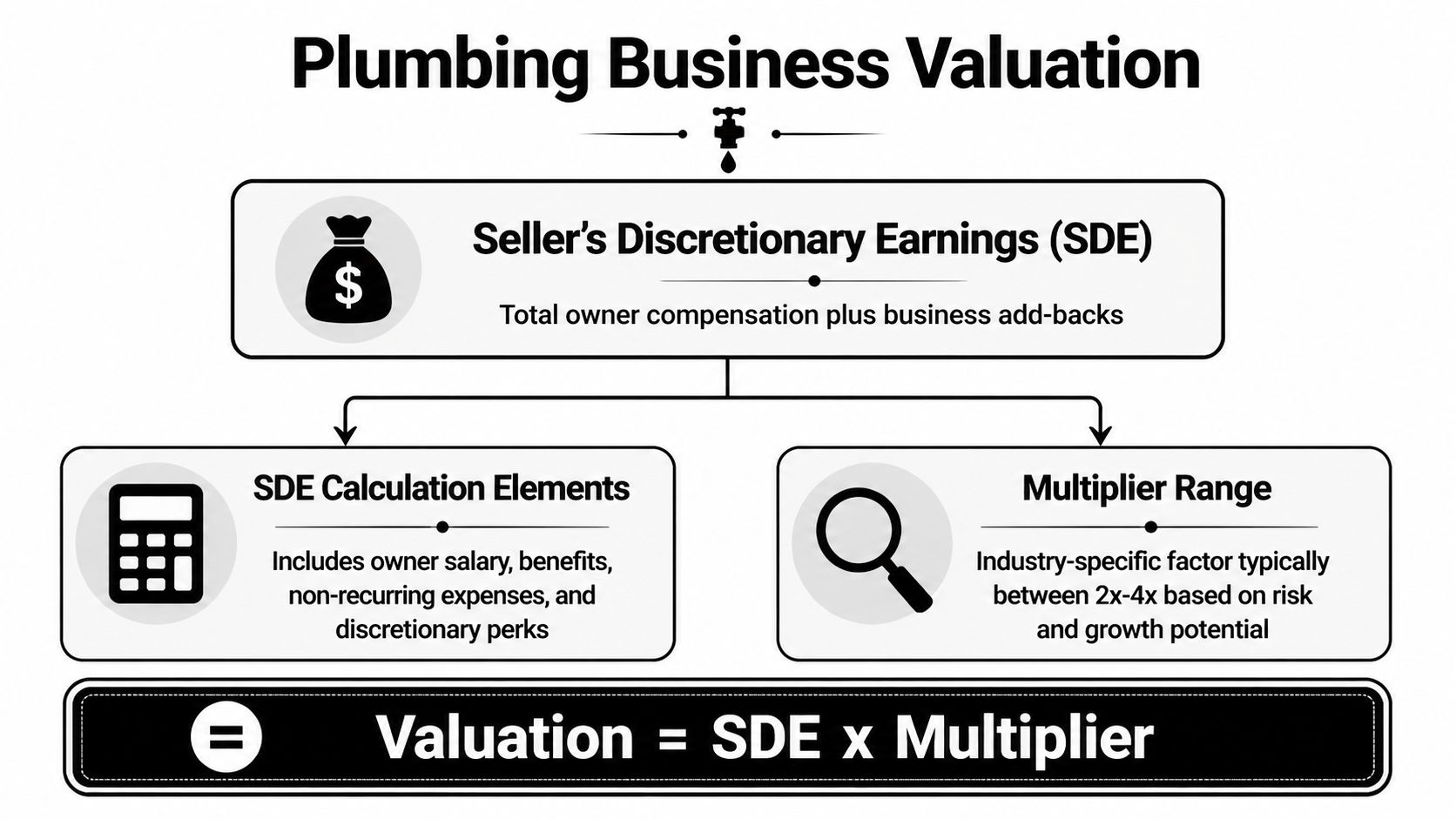
Most trade business valuations come down to a simple starting point. Earnings times a multiple. The trouble starts when buyers and sellers both pretend the formula settles everything. It doesn't. The formula gives you a range. The business itself decides where inside that range the deal should land.
According to BizBuySell's 2025 plumbing valuation benchmarks, the median sale price for plumbing businesses was $837,500, with businesses typically selling for 2.49 times owner's discretionary earnings and 0.67 times annual revenue.
Start with SDE, not hope
For many smaller plumbing companies, the common measure is Seller's Discretionary Earnings, or SDE. In plain terms, that's the financial benefit available to one working owner.
You usually start with net profit, then adjust for items that won't continue the same way under new ownership.
Common add-backs include:
- Owner salary and draws if a buyer will step into the role
- Personal expenses run through the business
- One-off costs that don't reflect normal trading
- Interest, taxes, depreciation, and amortization where relevant in the books
The mistake I see all the time is aggressive add-backs. If a seller adds back half the P&L, the number may look flattering but it won't survive scrutiny from a lender, accountant, or experienced buyer.
A valuation should be defendable, not optimistic.
Why the multiple moves
The multiple is where judgment enters. Two plumbing companies with similar earnings can deserve different prices.
A stronger multiple usually comes from lower perceived risk. Buyers pay more when they believe the cash flow will hold after the handover.
Here are the factors that move value up or down:
Team quality
If the business has licensed, reliable technicians, a capable office function, and someone other than the owner who can solve field issues, risk drops. If everyone relies on one founder's memory and phone, risk rises.
Revenue quality
Recurring maintenance work, repeat customers, and a balanced mix of jobs are generally more attractive than revenue that swings around one-off projects.
Asset condition
Vehicles don't need to be shiny, but they do need to be honest. A fleet that looks fine in photos and then turns out to be overdue for replacement changes the economics quickly.
Documentation
A business with quoting procedures, supplier records, customer history, and job workflows written down is easier to transfer. Buyers pay for clarity.
Revenue multiples are useful, but incomplete
The revenue multiple helps as a sense check. It can be handy when comparing listings quickly. But revenue alone hides too much.
A business with solid pricing discipline and stable gross profit is different from one doing plenty of turnover with weak job control. That's one reason I tell buyers to treat revenue-based pricing as a screen, not a conclusion.
If you want a simple way to think about pricing discipline inside a trade business, the same logic shows up in job quoting. This guide on how to price a painting job is about a different trade, but the core lesson carries across. Clean inputs produce better pricing decisions. Messy assumptions produce trouble.
What buyers should pay extra for
Not every good feature appears neatly in the accounts.
A buyer can reasonably pay more for:
- A respected local name
- Strong review history and repeat business
- A service manager or lead tech likely to stay
- Clean books with few surprises
- A seller willing to support transition properly
Sellers should understand the flip side. If the business depends heavily on personal relationships, has unclear numbers, or has neglected vehicles and systems, buyers will discount for that even if the seller feels the company is worth more.
Your Due Diligence and Financing Playbook
Once an offer is accepted, the tone changes. At this stage, good deals stay good, and weak deals start to unravel. Due diligence isn't about mistrust. It's about checking whether the story matches the records.

Financial checks that matter
Start with the basics and reconcile them. If tax returns, profit and loss statements, and bank records tell different stories, stop and find out why.
Review these first:
- Tax returns for consistency with internal financials
- Profit and loss statements by month, not just yearly summaries
- Balance sheet for debt, old liabilities, and unusual entries
- Accounts receivable aging to see what's collectible
- Accounts payable aging to see who is waiting to be paid
Then go deeper. Look at job type mix, gross margins by service line if available, and whether margins have been propped up by deferred spending.
Operational checks buyers skip too often
A plumbing company can look profitable on paper and still be operationally fragile.
Ask for:
- Vehicle maintenance logs
- Equipment and tool lists
- Supplier agreements and credit terms
- Service agreement records
- Dispatch, invoicing, and software workflows
- Staff roles, pay structures, and tenure
If the owner says, "We just know how things work around here," that's not a system. That's tribal knowledge. It often disappears at closing.
Legal and licensing review
Trade businesses carry licensing and compliance issues that general buyers often underestimate. Verify exactly how the business is currently qualified to operate, and who holds what responsibility.
For buyers sorting out licensing requirements, this plumbing license guide is a useful practical reference point. The key issue in a deal is simple. You need a clear post-closing plan for licensed work, permit responsibilities, and who legally stands behind the operation.
Check:
- Entity documents and ownership records
- Licenses and permit history
- Employment agreements
- Lease terms
- Pending disputes or claims
- Any non-compete or non-solicit obligations already in place
The best time to find a legal problem is before the wire goes out.
Customer review without guesswork
Buyers either get smart or get lazy at this point. Don't settle for "We've got loyal customers."
Look at:
- Top accounts by revenue
- Repeat versus one-off work
- Service contracts or maintenance agreements
- Any account tied closely to the owner personally
A business with decent spread across customers is usually safer to take over than one depending on a handful of relationships the seller has carried for years.
Financing routes and their trade-offs
There isn't one right funding path. There is only the right fit for the deal and the buyer.
| Financing option | Strength | Trade-off |
|---|---|---|
| Bank or SBA-style lending | Often structured and disciplined | More paperwork, more lender scrutiny |
| Seller financing | Flexible and useful when banks hesitate | Terms can get messy if expectations aren't clear |
| Buyer cash plus debt | Cleaner close, stronger negotiating position | Ties up buyer capital |
| Partner or investor capital | Can help secure a larger acquisition | More voices, more expectations |
Seller financing often helps bridge valuation gaps. It also keeps the seller partly exposed, which can reassure a buyer. But write the terms carefully. Payment timing, default triggers, security, and support obligations all need to be clean.
Finalizing the Deal and Planning the Transition
Friday afternoon, the funds clear. By Monday at 7:00 a.m., a dispatcher needs access, two techs want to know who approves overtime, a supplier has the old owner's mobile number, and a long-time commercial client is asking whether their service agreement still stands. That is the actual handover.
Closing documents matter because they decide who owns what, who is responsible for loose ends, and how much help the seller gives once the money has changed hands. In plumbing deals, value gets lost after closing more often than during negotiation.
The documents that actually matter
Lawyers can draft thick agreements fast. The useful ones match how the shop runs on a Tuesday morning.
Pay close attention to:
- Purchase agreement that states exactly what is included and excluded
- Allocation of price across goodwill, vehicles, equipment, inventory, and other assets where relevant
- Non-compete and non-solicit clauses that limit the seller from taking staff or customers back out of the business
- Training and transition terms that spell out how long the seller stays involved, how often, and for what tasks
- Employment or retention arrangements for key staff if their staying put is part of the reason for the purchase
- Open jobs, deposits, warranties, and callbacks so there is no argument later about who carries the cost
If you're the buyer, vague language costs money. "Seller to assist as needed" is weak. Write down the hours, the weeks, the customer introductions, the supplier handoffs, and the system access that must be delivered.
If you're the seller, clear transition terms protect you too. They stop the buyer from expecting six months of unpaid consulting because no one defined the line.
The first 90 days need a written plan
A plumbing business changes hands in one day. Trust does not.
The first 90 days decide whether the revenue you bought holds up. Good buyers treat that period like a managed handoff, not a victory lap. Good sellers stay engaged long enough to transfer relationships, habits, and the little bits of operating knowledge that never made it into a manual.
First 14 days
The job is stability.
Keep the office calm, keep the schedule full, and keep the team from filling gaps in communication with their own guesses. Staff want to know who they report to, whether pay and benefits stay the same, and whether the new owner plans to clean house. Customers want to know the phone will still be answered and booked work will still be done.
Focus on:
- meeting the office staff and technicians together, then one-on-one with key people
- introducing the ownership change to top accounts, property managers, builders, and repeat commercial customers
- calling major suppliers and confirming account contacts, payment authority, and trading terms
- securing access to dispatch software, phones, email, banking, job history, and password managers
- reviewing every unfinished job, outstanding quote, deposit held, and warranty issue
- making it clear who approves pricing, credits, callbacks, vehicle use, and purchases from day one
A simple script helps here. Same service. Same phone number. Same crew where possible. New owner. Clear point of contact.
Days 15 to 45
Now verify what you bought.
This is the stage where the buyer learns which processes are real and which ones lived in the seller's head. It is also where preventable problems show up. A disorganized parts inventory that sends techs back to the supplier mid-job. A CSR who knows every customer by memory but nothing is documented in the system. Maintenance agreements that renew late because no one owns the follow-up. Jobs quoted too cheaply because the old owner never updated labor assumptions.
Start fixing the issues that hit service delivery or cash collection first:
- clean up parts and truck stock if poor inventory control is causing return trips and lost billable time
- tighten invoicing and collections if completed work is sitting unbilled
- confirm which technicians can sell, which only install well, and which need closer scheduling support
- review gross margin by job type to catch drain cleaning, water heater, or excavation work that is priced wrong
- identify customer relationships tied closely to the seller and schedule joint handoffs before they fade
- decide what customer-facing messages need to go out, including any social media marketing for plumbers that reassures local clients the business is active and under control
This is also the point where sellers earn their transition support. A seller should be making warm introductions, backing the buyer in front of staff, and explaining why certain customers need a softer touch than others.
Days 46 to 90
By now, the buyer should know the difference between a quirk and a real problem.
This is the window to tighten the operation without shaking it up for the sake of it. Update weak workflow steps. Standardize quoting where pricing is inconsistent. Remove duplicate tools and dead subscriptions. Set a weekly reporting rhythm for sales, booked jobs, invoice lag, callbacks, and technician productivity. If dispatch is messy, fix dispatch. If one van is always down, replace or retire it. If the old website or Google Business profile still points to the seller's email, correct it.
Do not try to rebuild everything at once. Early wins usually come from a handful of fixes that reduce friction every day.
Customers can handle a change in ownership. They do not handle confusion well.
Sellers have work to do after signing
Strong sellers do not vanish once the funds hit. They help transfer confidence.
That usually means:
- introducing the buyer to staff as the right next owner, not "the person who bought me out"
- confirming to customers and suppliers that the buyer has full authority
- staying available for practical questions about pricing history, problem accounts, and field habits
- handing over undocumented knowledge about recurring issues, key properties, and staff strengths
- resisting the urge to second-guess the buyer in front of the team
I've seen decent deals turn sour because the seller kept taking calls from staff and giving side instructions. One chain of command matters after closing. If that is not agreed before the deal is signed, it becomes a problem fast.
Quick Wins for the New Business Owner
The new owner who wins early usually doesn't do anything flashy. They settle the team, reassure customers, keep the phones answered properly, and make the business look active and trustworthy in public from week one.

Start with continuity, not reinvention
Customers don't care that you've bought a business. They care whether someone answers, shows up, fixes the issue, and stands behind the work.
Your first moves should be simple:
- Keep the phone experience steady so callers don't feel a sudden drop in professionalism
- Introduce the new ownership clearly without making it sound like everything is changing
- Keep familiar staff visible because customers trust continuity
- Review pending quotes and unfinished jobs fast so nothing slips during handover
I've seen buyers hurt themselves by trying to "put their stamp on it" in the first week. New logo, new process, new pricing, new office rules. That's too much, too early. Stability first. Improvement second.
Make your presence visible locally
A lot of acquired plumbing businesses go quiet right after the sale. That's a mistake. Silence creates doubt.
You don't need a massive campaign. You need consistent proof that the business is active, reliable, and still serving the local area.
Useful content in the first 90 days includes:
- A simple ownership announcement introducing the team and confirming continuity
- Photos of completed work with short, plain explanations
- Technician spotlights that reinforce familiarity and trust
- Seasonal reminders tied to common plumbing issues
- Customer-friendly before-and-after updates where appropriate
For plumbers who want a practical example of what steady posting looks like, this guide to social media marketing for plumbers gives a useful baseline.
Quick operational wins that build confidence
New owners often chase big strategic moves and miss the easy wins sitting in front of them.
Focus on the items that customers and staff feel immediately.
Tighten follow-up
Call back unsold quotes. Confirm tomorrow's jobs. Check in on recent work. These are not glamorous tasks, but they tell customers the business is organized.
Clean up customer records
Merge duplicates, update phone numbers, and flag top accounts. Better records make dispatch, follow-up, and service history easier right away.
Meet your top suppliers
A short conversation can prevent account friction, delivery issues, and credit surprises. Suppliers notice ownership changes quickly.
Here's a useful walkthrough on steady local visibility and customer trust in service trades:
What not to do in the first 90 days
Some mistakes are common enough that they're worth naming directly.
- Don't cut staff too quickly: You may remove people who hold critical relationships or process knowledge.
- Don't change pricing blindly: You need job-level understanding before major pricing moves.
- Don't ignore the seller handover window: Questions always come up. Use that access while you have it.
- Don't vanish from public view: Customers notice when a business suddenly stops communicating.
- Don't assume repeat customers will automatically stay: Retention still needs attention.
Early momentum comes from reliability people can see, not promises they have to trust.
A bought business rarely needs a dramatic overhaul on day one. It needs competent ownership, steady communication, and visible signs that the company is in good hands. Do that well, and the rest gets easier.
If you've bought a plumbing business, or you're preparing one for sale, GrowTradie helps keep your business consistently visible without adding more work to your day. It creates and posts trade-specific content for your local area, so your profiles stay active, your business looks credible, and more of that attention can turn into real enquiries and booked jobs.