

You’re probably in one of two spots right now. Either you’re a plumber who’s tired of building someone else’s book of business, or you already run jobs and crews and you’re wondering whether buying an existing shop is faster than grinding from zero.
That’s the right question. A lot of buyers focus on the listing first and the handover second. In the trade businesses I work on, that’s backwards. Finding plumbing businesses for sale is the easy part. Buying one at a fair price, inheriting a team that can keep operating, and keeping customer enquiries steady after the seller walks out, that’s where deals work or fall apart.
Table of Contents
- Why Buy a Plumbing Business Instead of Starting One
- Where to Find Quality Plumbing Businesses for Sale
- How to Value a Plumbing Business Accurately
- Your Due Diligence and Legal Checklist
- Securing Funds and Negotiating the Purchase
- Your First 90 Days and How to Keep Enquiries Flowing
Why Buy a Plumbing Business Instead of Starting One
Starting from scratch sounds cheaper until you live through it. You need vehicles, tools, insurance, office systems, a phone line that gets answered, and enough cash to survive the slow stretch while people in your area figure out you exist. Good plumbers can still fail at business ownership because they run out of time or working capital before the customer base is deep enough.
Buying an existing operation changes the starting point. Instead of waking up with no calls and no booked work, you may be stepping into a business with repeat customers, branded vans, supplier accounts, admin processes, and techs who already know the service area. That doesn’t make it easy. It makes it real.

The timing matters too. The plumbing industry is seeing a wave of M&A activity in 2026, driven by aging founders who built their companies over the last 30 years and are now ready to retire, while private equity and strategic buyers are also competing for strong home service businesses, according to this plumbing market overview. If you’re an ambitious tradie, that means more sellers are coming to market, but better businesses won’t sit around forever.
What you get on day one
A solid acquisition can give you things that take years to build on your own:
- Existing revenue: Not a hope, an actual book of work with invoices, customers, and history.
- Known name in the local area: Even a modest local reputation beats being the new guy with no track record.
- A team that already functions: Dispatch, invoicing, field work, quoting, supplier ordering.
- Assets already in use: Vehicles, drain gear, stock, office setup, software logins, phone numbers.
Practical rule: Buy a business for the systems and relationships, not because the seller has nice trucks.
There’s also a personal angle most buyers don’t admit out loud. They don’t want to spend two years proving they can own a business when they’ve already spent years proving they can do the trade. That’s fair. Ownership doesn’t have to start at zero.
If you’re weighing an acquisition against building a trade business from the ground up, it helps to compare the startup path with adjacent service models too. This guide on how to start a handyman business makes one thing clear: getting the first steady flow of customers is usually the hardest part.
What buying does not fix
Buying doesn’t solve a bad handover, weak books, poor staff culture, or an owner-dependent operation. If the seller is the brand, the lead tech, the estimator, and the relationship manager, you’re not buying a business. You’re buying a job with a larger payment attached to it.
That’s why smart buyers don’t just ask, “How much does it make?” They ask, “What keeps this thing moving on a Tuesday when the owner isn’t around?”
Where to Find Quality Plumbing Businesses for Sale
Most buyers begin on listing sites, and that’s fine. Just don’t stop there. The best plumbing businesses for sale are not always the ones with the prettiest headline or the longest description.
In practice, I’d split the market into three buckets: public listings, brokered off-market opportunities, and quiet word-of-mouth deals. Each has a different rhythm, and each attracts a different kind of seller.
Public listings give you volume, not always quality
Sites like BizBuySell, BizQuest, and BusinessesForSale are useful because they show what’s actively on the market. You can compare asking styles, service mix, geography, and how sellers describe their numbers. They also help you learn what a weak listing looks like.
Common problems show up fast:
- Vague earnings language: “Strong cash flow” with no explanation of owner add-backs.
- Thin asset detail: No mention of vehicle count, equipment condition, or software systems.
- Soft reason for sale: “Owner retiring” may be true, but you still need to know who currently runs the daily work.
- No operational context: A listing that tells you revenue but not whether work is residential, commercial, service, remodel, or contract-based is incomplete.
A public listing is an invitation to ask better questions, not a reason to get excited.
Specialized brokers save time if they know the trades
A broker who understands service businesses can shorten the process a lot. They know how to normalize owner earnings, spot weak recast financials, and pressure-test claims around staff, licenses, and recurring work. A generalist broker may still get a deal done, but trade businesses have their own landmines.
When I look at a broker package, I want to see whether they understand field operations. Do they mention call handling, dispatch, maintenance customers, licensed staff, fleet age, and seller involvement? If not, the business may be presented like a generic small company instead of a plumbing operation.
The listing should answer basic operational questions before you ever ask for a meeting.
Quiet deals often come through suppliers and local relationships
Some of the best opportunities never hit a big marketplace. Owners talk to supply houses, local accountants, attorneys, and other contractors long before they formally list. If you’re serious, tell the people in your orbit what you want.
Useful channels include:
- Supplier reps: They know which owners are slowing down, stressed, or thinking about retirement.
- Trade associations: Good for meeting owners who aren’t ready to list publicly.
- CPAs and attorneys: They often hear about an exit before the broader market does.
- Adjacent trades: HVAC and electrical owners sometimes know plumbing operators who want out.
This route takes longer, but it can produce cleaner conversations and less auction pressure.
How to filter junk listings quickly
You don’t need a week to decide whether a listing deserves attention. You need a disciplined first pass.
Ask for these items early:
- Profit and loss statements
- Tax returns
- Equipment and vehicle list
- Staff roster with roles
- Breakdown of service lines
- Seller involvement summary
If a seller or broker won’t share reasonable information after an initial screen and confidentiality process, move on. Serious businesses prepare for buyer questions.
A quality listing doesn’t need to be flashy. It needs to be documentable.
How to Value a Plumbing Business Accurately
A lot of buyers confuse price with value. The asking price is what the seller wants. Value is what the business can support based on earnings, transfer risk, and how dependent the operation is on the current owner.
In small trade deals, the starting point is usually SDE, or Seller’s Discretionary Earnings. In plain language, that’s the financial benefit a single owner-operator could expect to take from the business. A simple way to think about it is net profit, plus owner pay, plus personal or one-off expenses that won’t continue under new ownership.
Understand what you’re really buying
SDE matters because many plumbing businesses are still owner-involved. The buyer isn’t just acquiring trucks and invoices. They’re stepping into the owner seat. So the essential question becomes, “What does this business generate for the person running it?”
That’s where buyers get tripped up. They look at revenue first because it feels concrete. But revenue alone can hide a lot. Two plumbing companies can produce similar top-line numbers and have very different value because one has clean margins, stronger systems, and less owner dependency.
As of 2025, the median sale price for a plumbing business was $638,730 and median owner earnings were $311,598, while small plumbing businesses at $500K to $1.5M revenue typically sold for 2.5x to 3.5x SDE and mid-market companies at $2M to $5M revenue commanded 3.0x to 4.0x SDE, based on plumbing business sale price benchmarks.
Use revenue tiers to frame the multiple
Revenue tiers don’t value the business by themselves, but they give you a practical lane. Here’s the quick-reference version I’d use when screening plumbing businesses for sale.
| Annual Revenue | Typical SDE Multiple |
|---|---|
| $500K to $1.5M | 2.5x to 3.5x |
| $2M to $5M | 3.0x to 4.0x |
| $5M+ | 4.0x to 5.5x SDE or 5x to 8x EBITDA |
For smaller businesses, SDE is usually the cleaner lens. For larger companies with management depth, buyers may also look at EBITDA. That becomes more relevant when the owner is less central to day-to-day operations.
If you want a simple parallel, think about how trade jobs are priced in the field. You don’t just throw out a number because a bathroom remodel “feels like” a certain amount. You use a structure. This article on how to price a painting job isn’t about plumbing, but the discipline carries over. Good pricing starts with components, not gut feel.
What pushes the multiple up or down
A multiple isn’t a reward. It’s a risk adjustment.
When buyers pay toward the top of the range, they usually see a business that looks transferable and stable. When they pay toward the bottom, they’re pricing in future headaches. The same company can move across that range depending on how it’s run and documented.
Here’s what I see move deals most often:
- Recurring service revenue: Maintenance plans, repeat service work, and contract-style revenue make buyers more comfortable.
- Licensed team depth: One strong owner with no backup is fragile. Multiple licensed people create options.
- Documented systems: Dispatch workflow, quoting process, call handling, invoicing, and job closeout should live somewhere other than the seller’s head.
- Customer spread: A broad base of work is healthier than dependence on one or two major accounts.
- Seller involvement: If the business can function when the owner leaves for a week, that matters.
Buyers pay more for a business that behaves like a business, not a personality.
One caution. Don’t overvalue “potential.” Sellers love to say a business could grow fast with more attention, better pricing, or more marketing. That may be true. But buyers pay for proven earnings and reduced risk, not for a to-do list.
Your Due Diligence and Legal Checklist
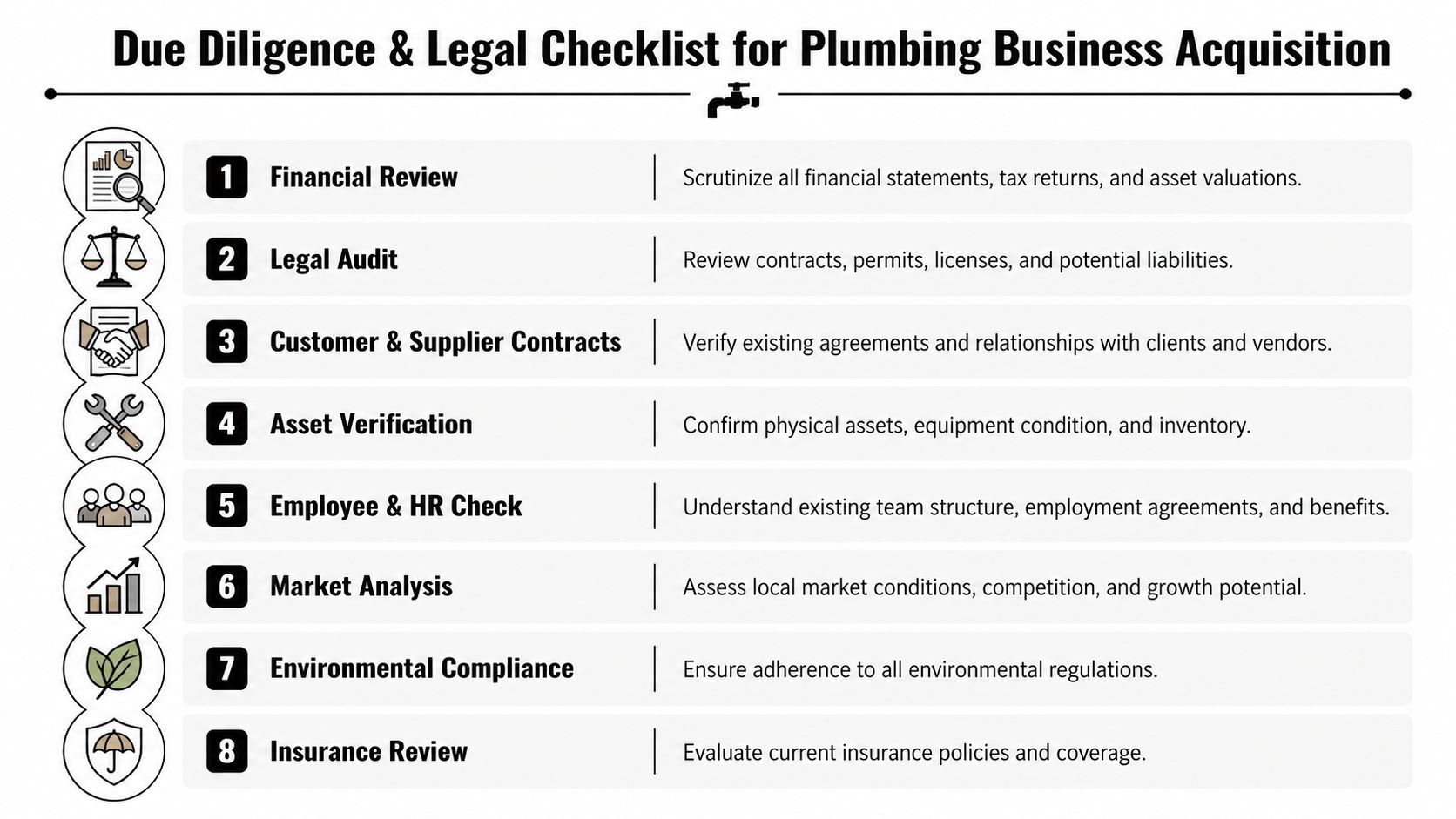
Buyers either protect themselves or get burned politely during this critical phase. Due diligence is not paperwork for the sake of paperwork. It’s the stage where you verify that the business you’re buying is the one you were shown.
A plumbing company can look solid in a summary sheet and still have major transfer issues hiding underneath. The worst surprises usually show up around licensing, staff dependence, poor records, and customer relationships that belong to the seller personally rather than the business.
Financial checks that catch trouble early
Start with the books. Not the seller’s verbal explanation. The actual records.
I want to see enough history to understand whether earnings are consistent, whether margins swing for a reason, and whether cash flow makes sense for the type of work they do. You’re looking for pattern, not perfection.
Check these items carefully:
- Profit and loss statements: Match them against tax returns and bank activity where possible.
- Owner add-backs: Make sure discretionary expenses are real add-backs, not fantasy adjustments.
- Accounts receivable: Old receivables may not be collectible.
- Job mix by type: Service work, commercial, residential, remodel, emergency, maintenance.
- Large customer exposure: If too much revenue sits with a small number of clients, that’s risk.
If something changes sharply year to year, ask why and ask for support. A clean explanation usually comes with records. A weak explanation usually comes with a story.
Operational and legal issues that can wreck a handover
One of the biggest traps in plumbing acquisitions is licensing dependence. A primary pitfall that can reduce valuation by 1x to 2x multiples is over-dependence on the owner’s license. If the seller is the sole licensed technician, transfer risk gets much higher, while businesses with licensed technician redundancy and documented systems can justify stronger valuations, according to this breakdown of plumbing valuation risks.
That means your diligence list needs to go beyond the books.
Review:
- Licenses and permits: Whose name are they tied to, and what has to happen at closing for continuity?
- Insurance policies: General liability, vehicle coverage, workers’ comp, and any claims history.
- Employee records: Roles, tenure, pay structure, and who the key people are.
- Fleet and equipment: Ownership, lease status, maintenance logs, and condition.
- Customer database: Whether the records are complete and whether contact history is usable.
- Contracts: Service agreements, commercial accounts, leases, vendor terms, and phone or software contracts.
- Complaints and reputation issues: Patterns matter more than one bad review.
If the seller says, “Don’t worry, my lead guy knows everything,” worry anyway until you’ve met that lead guy and confirmed he’s staying.
A non-plumber buyer can still do this well, but only if they respect the technical side and bring in help where needed. I’ve seen novice buyers do fine when they hire the right legal and accounting support and spend real time understanding the operation before closing.
Securing Funds and Negotiating the Purchase
Most trade buyers don’t buy with cash alone. They use a mix of lending, seller support, and personal equity. That’s normal. The trick is to structure the deal so the business can still breathe after closing.
A lender is not only judging the business. They’re judging you. They want to know whether you understand the operation, whether you can manage the transition, and whether the debt load fits the earnings.
How buyers usually fund these deals
Three routes come up most often.
Bank or SBA-style lending works well when the books are clean and the buyer has a credible background. A lender gets more comfortable when the company has stable earnings, transferable operations, and a clear transition plan.
Seller financing can bridge the gap when the buyer and seller disagree on risk or when a lender won’t cover the full amount. It also keeps the seller invested in a clean handover. If I’m representing a buyer, I usually like seeing some seller carry when the business is highly owner-involved.
Buyer cash or collateral still matters. Even when financing is available, buyers usually need some skin in the game. That helps with lender confidence and working capital after closing.
What doesn’t work is draining yourself dry to win the deal. If every available dollar goes into the acquisition, the first rough month becomes a crisis.
Negotiate the deal, not just the price
Too many buyers treat negotiation like a number-only contest. Price matters, but terms often matter more.
Here are the terms I’d press on:
- Transition period: Get a clear handover timeline. Who introduces you to key staff and top customers? For how long?
- Training scope: Define what the seller teaches. Dispatch? Estimating? Supplier ordering? Commercial account history?
- Vehicle and equipment inclusion: List every asset specifically. Don’t leave “tools and equipment” vague.
- Inventory treatment: Decide what’s included, what’s counted separately, and how it’s valued.
- Non-compete language: You don’t want the seller taking calls from old customers three months later.
- Working capital: Confirm what cash, receivables, and payables stay with the business or move with the seller.
A short example. I’ve seen buyers overpay slightly on price but win because they locked in a stronger transition, cleaner asset schedule, and better seller carry. I’ve also seen buyers “win” on price and then spend months untangling missing inventory, unclear customer ownership, and staff confusion.
The smoothest deals usually come from boring clarity. Specific schedules, written expectations, named assets, defined dates.
Don’t negotiate like you’re buying a used van. You’re buying continuity.
Your First 90 Days and How to Keep Enquiries Flowing
Most new owners worry about two things after closing. First, whether the team will stay. Second, whether the phone will keep ringing once the old owner is no longer the face of the company.
That second concern is justified. A lot of plumbing businesses coast on reputation, repeat work, and old customer memory. That works until the ownership change creates uncertainty, posting goes quiet, reviews stop, and the business becomes less visible than it used to be.
What needs to happen in the first month
The first month is not the time to reinvent everything. It’s the time to stabilize.
Start with people and continuity:
- Meet the team early: Field staff, office staff, dispatch, estimators, key supervisors.
- Call top customers: Introduce yourself and make continuity clear.
- Protect call handling: Missed calls after a sale create immediate damage.
- Keep scheduling and invoicing steady: New systems can wait until you understand the old ones.
- Map decision makers: Find out who keeps the operation moving.
The best handovers keep the outside world calm while the inside gets organized. Customers should feel confidence, not turbulence.
Why visibility drops after a sale
Here’s the hidden problem. The new owner is busy learning payroll, service history, staff personalities, supplier habits, and customer expectations. The public-facing side of the business often gets neglected because it doesn’t feel urgent compared with jobs on the board.
But it is urgent.
A major gap for new owners is sustaining leads post-acquisition. Industry surveys show 70% of small trade firms get fewer than 20% of their leads from social media because they post sporadically, which creates a real risk that a business loses visibility under new ownership if nobody keeps the profiles active, as noted in this listing-market analysis.
That doesn’t mean social profiles replace referrals, repeat customers, or local trust. It means silence is expensive. When a business stops showing signs of life, people notice.
A useful overview of what steady posting looks like for this trade is this guide to social media marketing for plumbers.
Before you build your own routine, watch this for a practical look at staying visible without adding more admin to your week.
A simple system for staying visible
You do not need to become a full-time marketer to protect enquiries. You need a repeatable system.
For most buyers, that means:
Keep profiles current
Make sure business details, service area, contact details, and branding stay accurate after the ownership change.Post consistently
Not perfectly. Consistently. Customers want evidence that the business is active, professional, and local.Show actual work
Service call snapshots, team introductions, common plumbing issues, maintenance reminders, and local project updates all help build familiarity.Track enquiry quality
Don’t get distracted by vanity metrics. Pay attention to calls, form fills, messages, and booked work.Assign ownership
If nobody owns visibility, it doesn’t happen. That owner can be internal, outsourced, or automated, but it must be assigned.
A bought business can keep its revenue base and still lose momentum if the new owner goes invisible in the market.
The strongest post-acquisition operators treat visibility the same way they treat dispatch or invoicing. It’s a business function. It needs a process. If you leave it to spare time, it won’t get done.
If you’re buying a plumbing business and you know you won’t have time to write posts, design graphics, and keep profiles active every week, GrowTradie is built for that exact gap. It helps trade businesses stay visible with customized content, professional post design, and auto-posting that keeps your profiles active while you focus on running jobs, managing staff, and settling into ownership.