
You're probably at the point where the work itself doesn't scare you anymore. You can rough in a house, swap a water heater cleanly, troubleshoot a stubborn drain line, and get through a service call without someone holding your hand. But you've also noticed the ceiling. You can do the work, yet you can't always sign for it, permit it, or build something bigger around it.
That's where the master license starts to matter. Not as a trophy, and not just as the next exam, but as the point where a plumber stops being known only for tools in hand and starts being trusted for judgment, responsibility, and direction. If you're serious about how to become a master plumber, you need more than a checklist. You need a roadmap for the shift from worker to authority.
Table of Contents
- From Journeyman to Master What It Really Means
- Laying the Foundation Your Apprenticeship Path
- The Journeyman Years Gaining Essential Experience
- Preparing for the Master Plumber Examination
- Beyond the License Operating as a Master Plumber
- Frequently Asked Questions About Master Plumber Licensing
From Journeyman to Master What It Really Means
A journeyman proves he can perform. A master proves he can answer for the work.
That difference changes everything. Once your name is tied to permits, inspections, apprentices, and system decisions, people stop judging you only by whether the fixture drains or the leak is gone. They judge your code knowledge, your paperwork, your crew standards, and whether you can keep a job moving without creating problems three walls later.
In a trade this large, that level matters. U.S. employment for plumbers, pipefitters, and steamfitters was about 504,500 in May 2024, with a median annual wage of $62,970, and employment is projected to grow 4% from 2024 to 2034, with about 44,000 openings per year on average according to master plumber workforce data. That tells you two things. First, plumbing isn't going anywhere. Second, the people who can lead work, not just perform it, will keep carrying weight.
The license changes your role
When plumbers ask me what a master license is really for, I keep it simple:
- Authority: You're often the person who can pull permits and stand behind the installation.
- Supervision: Apprentices and journeymen may work under your oversight, which means their mistakes can become your problem.
- Business Advantage: In many markets, you need master-level standing to move from good employee to owner or qualifying license holder.
Practical rule: If you want more control over your income, schedule, and reputation, you need more than technical skill. You need the legal authority and judgment that come with master status.
A lot of plumbers spend years being the one everyone calls for difficult jobs, but still stay boxed in because they never make the jump. If you want to see where that road can lead, spend time around master plumber career insights and pay attention to the common pattern. The best masters aren't just faster with tools. They think ahead, write things down, and make decisions that protect the customer, the crew, and the business.
Laying the Foundation Your Apprenticeship Path
Before you worry about master exams and contractor responsibility, you need a base that can carry all of it. Weak apprenticeships create shaky journeymen. Shaky journeymen make dangerous masters.
In the U.S., the usual path starts with a high school diploma or equivalent, then an apprenticeship lasting about four to five years with roughly 2,000 hours of paid on-the-job training per year, according to the Bureau of Labor Statistics plumbing career overview. That structure is one reason plumbing is such a solid trade. It forces repetition, supervision, and gradual responsibility.

Two ways most people enter the trade
Most apprentices come in through one of two doors.
| Path | Best for | Trade-off |
|---|---|---|
| Technical school first | People who want classroom structure and a formal intro to systems, tools, and code language | You may get theory early, but theory alone won't make you productive on a live job |
| Direct apprenticeship | People who learn fastest by working under experienced plumbers from day one | You earn while learning, but the quality of training depends heavily on who teaches you |
Neither path is magic. A school can help you understand fittings, venting logic, reading plans, and safety expectations before you're under pressure. A direct apprenticeship gets you field habits quickly. If you go straight into the field, make sure you're attached to plumbers who explain the why, not just bark the next task.
What separates a strong apprentice from a passenger
The apprentices who move fastest all do a few things the same way.
- They carry a notebook: Write down material lists, code references, common mistakes, and installer preferences. Memory gets sloppy after a long day.
- They learn the names first: If you can't name the fittings, valves, tools, and parts correctly, you slow everyone down.
- They watch sequence, not just tasks: Good apprentices notice job flow. Shutoff, drain down, cut, prep, fit, test, inspect, patch. That order matters.
- They ask better questions: “Why are we venting it this way?” is useful. “What am I doing?” every ten minutes is not.
- They keep the site clean and stocked: Masters notice who protects materials, keeps fittings organized, and doesn't create avoidable callbacks.
A plumber who learns only how to copy motions stays limited. A plumber who learns system logic becomes useful everywhere.
Your first years should expose you to service work, new installs, remodels, and code-driven corrections whenever possible. If all you ever do is one narrow slice of the trade, you'll struggle later when an exam asks you to think beyond your routine.
A final point that younger plumbers often miss. Your apprenticeship is not just time served. It's where you build your reputation. Show up early, own mistakes fast, and stop acting like small tasks are beneath you. The master watching you today may be the one signing off on your future experience.
The Journeyman Years Gaining Essential Experience
Getting your journeyman status feels big, and it should. You've earned room to work with less supervision. But this is also where a lot of plumbers stall out. They spend years staying busy without becoming broader, sharper, or more reliable on paper.
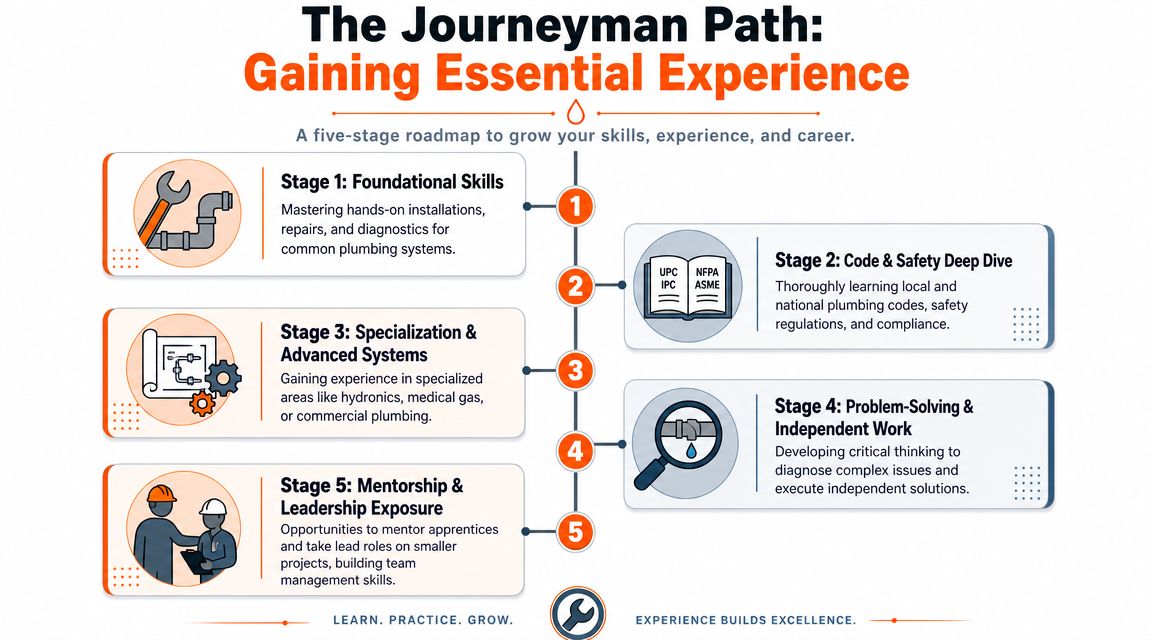
The usual path to journeyman is often cited as about 4 to 6 years, and master-plumber eligibility commonly starts at roughly 7+ years total experience, depending on the jurisdiction. The bigger obstacle isn't only the exam. It's documented supervised hours and meeting the exact local prerequisites, as noted in this master plumber timeline guide.
Stop chasing hours and start chasing range
A newly licensed journeyman usually starts by taking on more independent calls, small installs, and tighter deadlines. That's good, but don't confuse independence with growth. If you want to know how to become a master plumber, your journeyman years should be deliberate.
Here's the kind of work that pays off later:
- Diagnostic service work: This sharpens your thinking. Anyone can replace what's obviously broken. A future master finds the actual cause.
- Complex remodels: Remodel work teaches adaptation. Existing structures rarely cooperate.
- Commercial work when you can get it: Even limited exposure helps you think in terms of system scale, coordination, and inspection pressure.
- Lead tasks on smaller jobs: Ordering materials, sequencing work, and keeping others productive is master-level training in disguise.
The broadest plumbers become the best candidates. One year under a master who runs clean residential service teaches one set of lessons. Time under someone strong in commercial tenant improvements or code-heavy correction work teaches another.
What to document before you forget it
Most plumbers are better at work than paperwork. That becomes a problem later.
Keep your own file, even if your employer keeps records too. Include the dates you worked, the company name, license details of the supervising plumber if required in your area, and the kind of projects you handled. Save pay records, affidavits, certificates, and anything else that proves continuity.
A simple tracking habit works:
- Log major job types monthly
- Save license and supervisor information
- Keep copies of any training or code classes
- Store records in both paper and digital form
The best time to organize your experience file is before you need it.
I've seen capable plumbers delayed not because they lacked experience, but because they couldn't prove it cleanly. Employers change offices. Records go missing. Supervisors retire. Start early and you won't have to reconstruct years of your life from memory.
The leadership test starts early
You don't become a leader the day the license arrives. People start judging that long before.
A future master can teach an apprentice without humiliating him. He can explain why a layout changed. He can spot when a helper is about to make a bad cut and correct it before money gets burned. He doesn't create drama on site, and he doesn't dump blame downhill.
Look for chances to act one level up from where you are. Run a small section of a job. Walk through a punch list before the boss does. Read the plans at lunch instead of waiting to be told what changed. If another journeyman avoids difficult calls, take them.
That's the defining journeyman test. Not whether you can work alone, but whether others can trust your judgment when things get messy.
Preparing for the Master Plumber Examination
Most plumbers talk about the master exam like it's one hard test standing between them and the next level. That's only half true. The exam matters, but the application can wreck you before you ever sit down in the chair.
Master-level applicants typically need proof of experience, written and sometimes practical exams, and in some places extra requirements such as business-and-finance testing. One benchmark example is Florida's certified plumbing contractor path, which requires at least 4 years of documented plumbing experience, including 1 year as a licensed journeyman or equivalent, plus both a trade exam and a business/finance exam, according to this plumbing licensing overview from NEIT.

Study what the license actually tests
A lot of journeymen study for the master exam the wrong way. They review what they already do well. That feels productive, but it won't close gaps.
Most master-level testing leans into three areas:
- Code interpretation: Not just memorizing sections, but applying them under pressure.
- Business and law: Contracts, responsibilities, supervision, and the rules tied to operating legally.
- Practical judgment: Material selection, installation sequence, safe decisions, and what passes inspection.
Use your codebook actively. Tab it. Highlight recurring sections. Practice finding answers fast, because some exams reward knowing where the rule lives as much as knowing the rule itself.
Field reminder: The exam doesn't care that you've “always done it this way.” It cares whether you can defend the work under the code in force.
If you need a broader perspective on the value of career certifications for professionals, it helps to think of the master license in the same way. It isn't just a credential on paper. It signals verified competence, accountability, and readiness for higher responsibility.
Build your application package before exam season
Organized plumbers pull away from everyone else in this situation.
Your application package may require experience verification, affidavits, prior license copies, exam forms, identification, continuing education records, or other supporting documents depending on the state or local board. Don't wait until your exam window opens to begin collecting that.
A practical checklist looks like this:
| What to gather | Why it matters |
|---|---|
| Work history records | Proves your timeline and experience level |
| Supervisor verification | Confirms qualifying work under proper oversight |
| Existing licenses or cards | Shows your progression and status |
| Training and CE documents | Helps where education or renewal records matter |
| Application deadlines and board instructions | Prevents avoidable delays |
If you haven't already, review a practical licensing walkthrough like how to get your plumbing license and compare it against your own state board requirements. Don't assume one checklist fits every jurisdiction.
A lot of failed applications aren't really failed. They're stalled, returned, or kicked back for missing proof. That's still lost time.
Use prep resources with a purpose
You don't need every prep product on the market. You need the right mix of repetition and realism.
Join an exam prep class if your area offers a solid one. Work practice questions if they match your jurisdiction's code basis. Study with one or two serious plumbers, not a crowd that turns every session into complaints and war stories.
After you've put real time into studying, it helps to watch someone work through code reasoning in a different format:
The best study plan usually looks boring. Same chair, same codebook, same schedule, repeated until you stop guessing. That's how most plumbers pass difficult exams. Not with tricks. With organized preparation.
Beyond the License Operating as a Master Plumber
Once you hold the master license, the trade changes again. You're no longer just trying to prove you belong. Now you have to decide what kind of master you're going to be.
Some stay in the field and lead crews. Some become the qualifying or responsible master for a company. Some build their own shop. All three paths are legitimate, but each one asks for different strengths.

Running crews without becoming the bottleneck
A strong field master doesn't hover over every fitting. He sets standards, checks critical points, and keeps the job from drifting.
That means you need to get good at:
- Delegation: Give clear scope, not vague orders.
- Inspection readiness: Catch code and quality issues before the inspector does.
- Training: Teach apprentices and younger journeymen in a way they can repeat.
- Decision speed: Crews lose money when the master is unreachable or indecisive.
A master who has to touch everything personally usually built a weak team, not a strong company.
Becoming the responsible master for a company
In many operations, one master carries serious legal and operational weight. If your license is attached to the business, your judgment has to cover more than field work. You may be reviewing permits, overseeing standards, handling compliance questions, and making sure other plumbers don't create risk under your name.
This role suits plumbers who like systems. You need to think about documentation, training consistency, and how work gets approved from estimate through final inspection. It's less about being the best wrench on site and more about making sure ten jobs are being run correctly at once.
For shops trying to stay visible and credible while they grow, a steady public presence also starts to matter. That's where tools aimed at plumbing company marketing support can help a business stay active without pulling the master off operations to write posts at night.
Starting your own shop with your eyes open
A lot of journeymen think the hard part is passing the master exam. For many, the harder part is the first year after opening the doors.
Owning a plumbing business means quoting work, handling unhappy customers, managing call volume, keeping paperwork clean, hiring carefully, and protecting your license every day. If you're serious about going out on your own, study practical home service pro plumbing startup tips from people focused on service businesses, then compare that advice against your local licensing rules.
Before you launch, answer these questions:
- Can you price work profitably without guessing?
- Can you manage paperwork as well as pipework?
- Do you have the patience to train people and enforce standards?
- Are you prepared to say no to work outside your control or licensing scope?
The master license opens the door. It doesn't run the business for you. The plumbers who thrive after licensure are the ones who accept that leadership is a separate skill set. You still need technical authority, but now you also need discipline, communication, and business sense.
Frequently Asked Questions About Master Plumber Licensing
Can I use my master license in another state
Sometimes, but don't count on it.
Licensing is a patchwork. Requirements vary by state, and reciprocity is limited. Colorado is a good example of how specific things can get. Its master route can require 8,500 to 9,780 hours of experience, depending on the pathway described, and that kind of variation shows why moving across state lines can delay hiring or expansion, as outlined in this Colorado plumbing licensing guide.
If you're relocating, contact the new jurisdiction first. Ask about endorsement, reciprocity, exam requirements, proof of experience, and whether your current license lets you supervise, permit, or contract there.
What's the difference between a master plumber and a plumbing contractor
A master plumber is a trade credential. A plumbing contractor is usually the business entity or business license structure required to operate, bid, advertise, or contract work legally in that market.
Sometimes the same person holds both roles. Sometimes the business relies on a master plumber as the qualifying individual. Don't assume that earning the master license automatically gives you every business right you need.
Do master plumbers need continuing education
Often, yes.
Some jurisdictions require continuing education for renewal, and even where it isn't the main hurdle, staying current is part of the job. Code updates, business requirements, and administrative rules don't stand still. If you treat the exam as the end of your education, you'll drift behind faster than you think.
Keep a renewal file. Save course certificates, license renewals, and board correspondence in one place. That habit prevents a lot of last-minute panic.
If you're building toward master status or already running a plumbing business, GrowTradie helps trade businesses stay visible without having to stop and create content by hand after hours. It's built for tradies who want consistent, professional posting that supports trust and local enquiries while they stay focused on the work.