
You already know how to solve comfort problems. You can diagnose a bad capacitor fast, trace an airflow issue without guessing, and finish a clean install that won't come back on warranty. What usually stops a good tech from going out on their own isn't the trade. It's everything around the trade.
The office side feels messy because it's unfamiliar. Licences, insurance, pricing, supplier accounts, quoting, chasing payment, keeping the phone ringing while you're still on the tools. That's where most new owners get dragged into avoidable mistakes.
If you're serious about how to start an hvac company, keep it simple at the start. Build a legal business, buy only what you need, price work like an owner, and create a small set of systems that stop chaos before it starts. That's the difference between owning a job and building a company.
Table of Contents
- From The Tools To The Office A Practical Introduction
- Crafting Your Business Plan and Legal Structure
- Navigating HVAC Licensing and Insurance Requirements
- Managing Startup Costs and Pricing for Profit
- Equipping Your Van and Essential Toolkit
- Scaling from Solo Tech to Business Operator
- Winning Local Jobs and Building Your Reputation
- Frequently Asked Questions About Starting an HVAC Business
From The Tools To The Office A Practical Introduction
Most techs don't struggle with the work. They struggle with the switch in identity. One day you're focused on refrigerant charge, static pressure, controls, and callbacks. The next day you're deciding what to charge, how to register the business, what insurance to buy, and whether you can afford another van.
That shift is uncomfortable because nobody trains you for it on site.

The good news is that starting an HVAC business doesn't need a polished corporate playbook. It needs clear decisions in the right order. Sort the legal side. Decide what work you'll take. Know your real costs. Set up a van that helps you finish jobs in one trip. Put basic admin in place so quotes, invoices, and customer communication don't fall apart once you get busy.
Practical rule: Don't build for the company you hope to have in five years. Build for the first year of work you can reliably win and deliver well.
A lot of tradies overcomplicate the early stage. They spend too much on branding, too much time on low-value admin, and not enough time getting the foundations right. A lean start is usually better. If you've looked at guides for other trades, the same principle shows up in this practical take on starting a service business as a solo operator. Start with work that pays, systems you can maintain, and overhead you can survive.
Crafting Your Business Plan and Legal Structure
A business plan sounds like office work. In practice, it's just a short document that stops you making expensive decisions on gut feel.
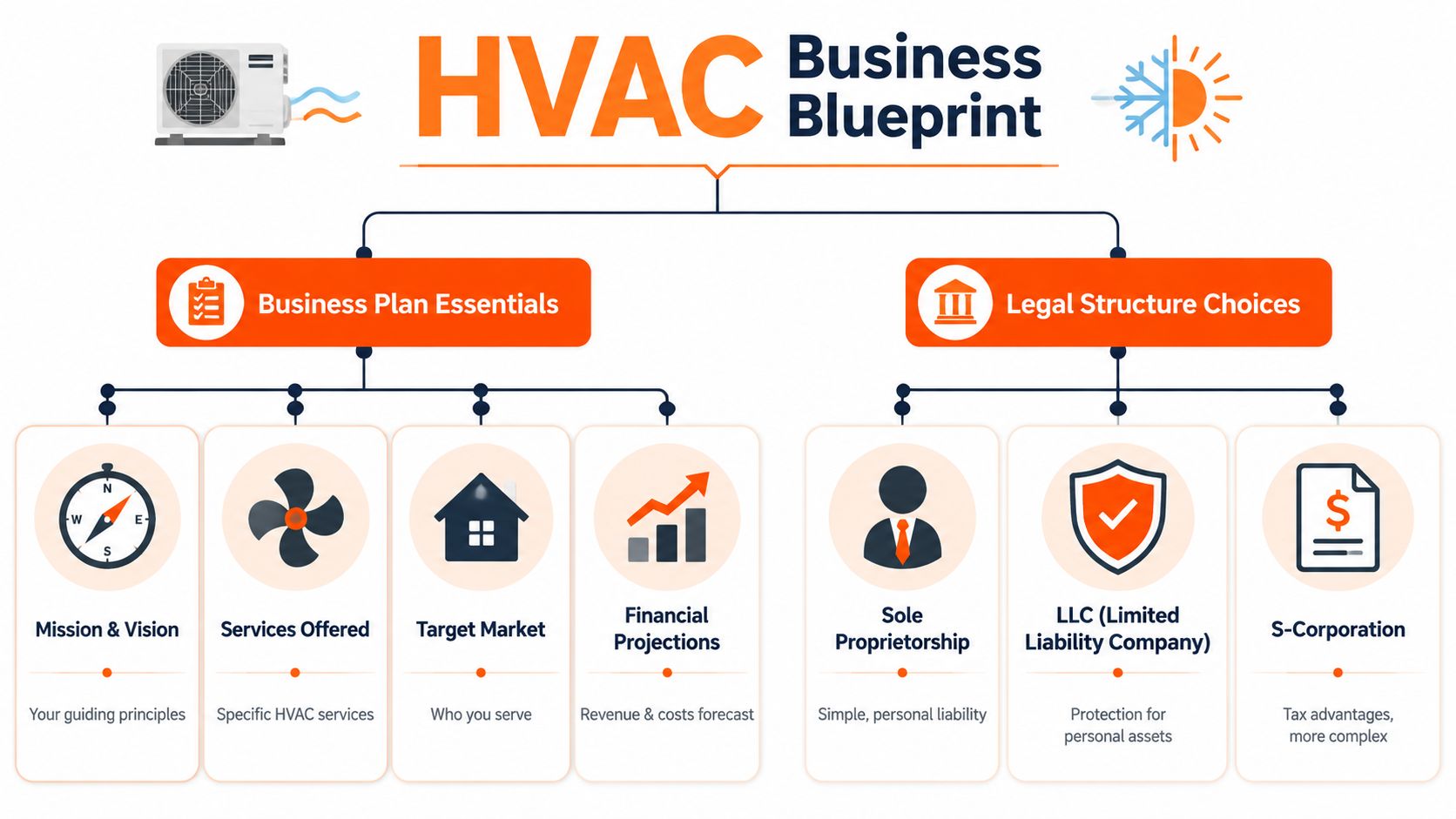
According to Kickserv's HVAC startup guide, businesses with robust plans achieve a 25% higher survival rate after their first year, compared to the 50% failure rate for unplanned startups. That's reason enough to write one.
Build a plan you will actually use
Keep it to one page if that's what you'll review. A useful HVAC startup plan should answer five things:
What work are you taking
Residential service, changeouts, maintenance, light commercial, or a mix. If you try to do everything from day one, you'll buy the wrong gear and price jobs inconsistently.Who are you serving
Homeowners, property managers, builders, or commercial sites all buy differently. A homeowner cares about trust and speed. A facility manager cares about documentation and reliability.Where are you working
Tight service areas beat wide ones when you're starting. Shorter drive times mean more billable hours and fewer fuel and scheduling headaches.How will money come in
List your likely job types and how often you need to book them. Don't guess with optimism. Use the sort of work you already know you can win.What will money go out on
Put every cost bucket in writing. Vehicle, fuel, tools, licences, insurance, software, parts float, uniforms, phone, and marketing.
A plan also helps if you need funding. Lenders want to see that you've thought through registration fees, payroll, and operating setup before you ask for money.
If you want another trade-business example of this technician-to-owner transition, this guide on turning plumbing skills into a business is worth a read because the same ownership pressures show up across the trades.
Choose a structure that protects you
Most new owners compare sole proprietorship and LLC first.
A sole proprietorship is simple. It's quick to start, and there's less paperwork. The downside is personal exposure. If the business gets hit with a claim, there isn't much separation between you and the company.
An LLC creates that separation. For a tradesperson, that matters. Your personal assets should not be sitting in the blast zone of a business dispute, vehicle accident, or property damage claim.
Use this quick comparison:
| Structure | What it's good for | Main downside |
|---|---|---|
| Sole proprietorship | Fast and simple setup for a solo operator | Personal liability exposure |
| LLC | Better protection between personal and business liabilities | More setup and admin |
| S-corporation | Can make sense later as the business grows | More complexity than most starters need |
If you're hesitating between simple and protected, protected usually wins for a contracting business.
Also separate your banking from day one. One business account. One card for business purchases. Clean records make pricing, tax time, and cash flow much easier to manage.
Navigating HVAC Licensing and Insurance Requirements
This is the part you can't improvise. Good intentions don't help if you're unlicensed, underinsured, or handling refrigerant without the right certification.
According to SNARSCA's guide on starting an HVAC business, licensed firms win 40% more bids and enjoy a 65% customer trust premium. The same source says 35% of startups face fines from $5,000 to $50,000 for non-compliance. That isn't a paperwork problem. That's a business-killer.
Handle the credentials first
Start with the credentials tied directly to the work you'll perform.
EPA Section 608 certification is mandatory if you'll handle refrigerants. That's federal. It's separate from your state or local contractor licensing.
Then check your state and local requirements for operating as an HVAC contractor. These vary, so don't rely on what another tech in another county told you. Go straight to the licensing board or local authority and verify what's required for:
- Contractor licensing for the type of HVAC work you plan to perform
- Business registration under your chosen entity
- Permits for installs and replacements
- Local operating rules such as vehicle markings or municipal registration
If you're bringing on another tech, verify whether their role changes your compliance obligations. Some owners assume they can “sort that later.” Later usually arrives when a permit issue, inspection, or customer complaint forces the problem.
Unlicensed work might bring in cash today. It can shut the whole operation down tomorrow.
Buy insurance for real jobsite risk
Insurance makes more sense when you stop thinking of it as a formality and start matching policies to actual field risk.
Here's the simple version:
- General liability covers the kind of damage claim that can happen during normal work. You cut into something you shouldn't. A leak damages finishes. A client says your work caused property damage.
- Commercial auto covers the van and business use on the road. Personal cover usually isn't enough once the vehicle is being used for work.
- Workers' compensation matters once you hire. If someone gets hurt loading equipment, climbing, lifting, or working around electrical components, you need proper cover.
- Tool or equipment cover helps when expensive gear disappears from the van or gets damaged in transit or on site.
Don't just buy the cheapest package. Read what is and isn't covered. Ask direct questions. If tools are stolen overnight from the van, are they covered? If an employee drives the service vehicle, is that covered? If you sub out part of the work, what does the insurer require?
A tight insurance setup does two things. It protects cash flow when something goes wrong, and it gives customers confidence that they're dealing with a legitimate contractor.
Managing Startup Costs and Pricing for Profit
Most new owners don't fail because they can't do the work. They fail because they run out of cash or price jobs like they're still earning wages.
According to ServiceTitan's 2026 HVAC startup guide, startup costs for an HVAC company typically range from $10,000 to $50,000 for a lean operation, and that can reach $100,000 if you buy substantial equipment like trucks, tools, and protective gear upfront. The same source says underestimating capital needs is a primary reason 50% of small startups fail within the first year.
What you need to spend first
Your first budget should separate one-time startup costs from ongoing monthly costs. That sounds basic, but a lot of techs mix them together and get a false sense of runway.
| Expense Category | Lean Startup Cost | Full Setup Cost |
|---|---|---|
| Licences, permits, and registration | Included within the typical $10,000 to $50,000 startup range | Included within the possible up to $100,000 full setup range |
| Tools and diagnostic gear | Included within the typical $10,000 to $50,000 startup range | Included within the possible up to $100,000 full setup range |
| Vehicle | Included within the typical $10,000 to $50,000 startup range | Included within the possible up to $100,000 full setup range |
| Insurance and protective gear | Included within the typical $10,000 to $50,000 startup range | Included within the possible up to $100,000 full setup range |
| Software, salaries, website, advertising, and marketing | Ongoing monthly cost | Ongoing monthly cost |
A lean start usually means one vehicle, core tools, a tight service area, and no unnecessary fixed overhead. A full setup means buying more gear up front, carrying more cost before the work volume is proven, and burning cash faster if the phone stays quiet.
Consider this approach instead:
- Spend early on revenue tools. Core diagnostics, safe transport, legal setup.
- Delay nice-to-haves. Fancy office fitout, excess stock, branding extras.
- Protect cash. You'll need room for slow payers, rework, seasonal dips, and surprise repairs.
If you need a practical way to think about job costing logic, this guide on how to build a price for field work is from another trade, but the structure carries across well.
Price jobs like an owner not an employee
A technician often thinks in hours. An owner has to think in hours plus overhead plus risk plus profit.
Your price has to cover:
- Labour: Your time on site, plus non-billable time for travel, quoting, parts pickup, and admin.
- Materials: Equipment, parts, consumables, fixings, and disposal.
- Overhead: Insurance, software, fuel, phone, accounting, uniforms, and vehicle wear.
- Profit: Money left after everything is paid. Not wages disguised as profit.
Owner mindset: If a job only covers your time and materials, the business didn't make money. You just bought yourself a shift.
For common service work, flat-rate pricing often helps because it keeps quoting fast and avoids awkward “the clock is still running” conversations. For installs and replacements, you need a proper written estimate with clear inclusions, exclusions, equipment details, and payment terms.
One more trap. Don't use cheap pricing as your main strategy. Low prices attract the wrong jobs, the fussiest customers, and the thinnest margins. Clean work, clear communication, and dependable service are easier to sustain than being the cheapest truck in town.
Equipping Your Van and Essential Toolkit
The first van tells the truth about a new HVAC business. You can spot the owner who planned it and the owner who just threw tools in the back and hoped for the best.

A good setup isn't about having everything. It's about carrying the tools that let you diagnose, repair, and complete the work you've chosen to sell.
Stock the first van for revenue
Think about your first service mix. If you're focused on residential service and light installs, start with the tools that support those jobs every week.
Core gear usually includes your manifold gauges, vacuum pump, recovery machine, multimeter, leak detector, thermometers, hand tools, extension leads, PPE, drills, and basic install gear. Those tools earn their place because they directly support billable work.
What can often be bought used depends on condition and reliability. Shelving, storage bins, some hand tools, and even the van itself can be good used buys if inspected properly. What I'd be more careful with is anything that affects accuracy, safety, or job completion when it fails unexpectedly.
A practical tax angle matters too. If you're buying tools for the business, keep records from day one. This plain-English breakdown from EndureGo Tax's tool claim guide is useful because it shows how to think about documentation before tax time becomes a scramble.
Here's a useful van-stocking mindset:
Buy first for diagnostics
If you can't diagnose quickly, you lose time and confidence.Buy second for completion
Carry the parts and tools that help you avoid a second trip.Buy third for comfort and polish
Nice organisers and extras come later.
For a visual walkthrough of van setup ideas, this video is worth a look before you start bolting shelves in place.
Organise for speed not looks
A clean van isn't just professional. It saves minutes on every job.
Put your most-used tools where you can reach them without unloading half the van. Group by task, not by brand. Diagnostics together. Refrigerant handling together. Electrical testing together. Fasteners and consumables in labelled bins. PPE where you can grab it before stepping onto site.
The van is your moving workshop. Every extra minute spent hunting for gear is unpaid time.
Also think about replenishment. Keep a short stock list of common parts and consumables you burn through regularly. Review it weekly. That habit matters more than having an elaborate inventory system in the beginning.
Scaling from Solo Tech to Business Operator
The first real growth problem isn't usually getting work. It's handling work without breaking your quality, your schedule, or yourself.
A lot of HVAC owners start solo, and that's often the smartest way to begin. According to Next Insurance's guide for starting an HVAC business, 77% of small service businesses start with personal savings. The same source says a 2024 FieldEdge survey showed 62% of first-year solo HVAC owners turned a profit without debt by starting lean, focusing on repeat residential clients, and scaling to $150K/year revenue before their first hire.
Stay lean until the work pattern is clear
The mistake is hiring because you're busy for two weeks.
Short bursts happen. Heat waves happen. One builder or property manager can make the phone look busier than it really is. Don't add wages and payroll pressure until you can see a stable pattern of booked work and enough margin to support someone properly.
A lean owner-operator model works well when you:
- Keep the service area tight so you aren't losing hours in the van
- Focus on repeatable work you already diagnose and complete efficiently
- Protect cash instead of chasing fast expansion
- Use subcontractors carefully for overflow or specialist work rather than permanent wages too early
That last point matters. A good subcontracting arrangement can help you handle install spikes or niche jobs without committing to a full-time wage bill before the business is ready.
Build simple systems before the first hire
Hiring a tech without systems just means two people can create confusion instead of one.
Before your first employee, set up a basic workflow for:
Quotes
Every estimate should follow the same structure. Scope, price, inclusions, exclusions, and approval method.Scheduling
Don't run everything from memory and text messages. Use a calendar or job management app that lets you see the week clearly.Invoicing
Send invoices as soon as work is done. Delays here hurt cash flow fast.Job notes
Record what you found, what you did, what parts were used, and what the customer was told.Customer follow-up
Keep records clean enough that you can book maintenance, answer questions, and handle warranty concerns without guessing.
The point isn't to become “systems-driven” in some corporate sense. The point is to stop every job from living in your head.
A new hire should walk into a business with standards already in place. What does a finished invoice look like? How are photos stored? What gets quoted on the spot and what gets reviewed first? If you answer those questions early, growth gets a lot less painful.
Winning Local Jobs and Building Your Reputation
Plenty of excellent techs stay invisible. That's a business problem, not a skill problem.
When homeowners or property managers need HVAC work, they don't just choose the most technical contractor. They choose the one they trust to show up, communicate clearly, and look established enough to stand behind the job.

Trust wins before price does
Your early reputation is built from basic things done consistently:
- Answering the phone professionally
- Turning up when you said you would
- Sending clear quotes
- Leaving jobs tidy
- Explaining the problem in plain English
- Following up when parts are delayed or timelines shift
That sounds obvious, but a lot of contractors leak work because they're unreliable in the customer's eyes even when the technical work is solid.
You also need visible proof that the business is active. Reviews, recent project photos, branded vehicles, clean uniforms, and a consistent online presence all help. If you want a broader contractor-focused view on what helps generate enquiries, The Cherubini Company's guide for contractors is a useful outside perspective.
For owners who are flat out on the tools, staying visible is hard to maintain manually. A practical approach is to use systems that keep your business active without asking you to write posts at night after service calls. If that's an area you want to improve, this article on digital marketing for HVAC contractors gives a grounded overview.
Customers don't need you to look famous. They need you to look present, active, and trustworthy.
Specialise where demand is shifting
General HVAC work can keep you busy. Specialisation can make you easier to choose.
According to InterCoast's article on HVAC business opportunities, the U.S. government has added $8B in rebates for heat pumps, and early adopters who marketed their expertise in this area saw a 35% revenue bump compared to those with a traditional AC focus.
That doesn't mean every new company should chase every green trend. It does mean you should pay attention to what customers are now asking about. Heat pumps, ductless systems, efficiency upgrades, and rebate-related replacement work can create a stronger offer than “we do HVAC” if your market is responding to those services.
A smart reputation strategy is usually this:
| What works | What doesn't |
|---|---|
| Clear local service focus | Trying to serve everyone immediately |
| Strong reviews and communication | Relying on price alone |
| Photos of real work | Empty profiles and outdated pages |
| A service specialty customers understand | Generic “we do everything” messaging |
If you do good work and stay visible often enough, your name starts coming up before the emergency call happens. That's when reputation starts lowering your customer acquisition effort.
Frequently Asked Questions About Starting an HVAC Business
Should I subcontract before I hire
Often, yes. Subcontracting can help with overflow, specialist install work, or short-term peaks without locking you into wages too early. It works best when you vet the subcontractor carefully, define scope clearly, and make sure the customer experience still matches your standard.
What should I name the business
Choose a name that sounds credible on the phone, looks good on a van, and is easy to remember. Avoid clever names that are hard to spell or explain. A simple local-service name often ages better than something gimmicky.
Should I start with residential or commercial work
Start where you already have skill, confidence, and a path to work. For many technicians, that's residential service and replacement because the sales cycle is shorter and the setup is simpler. If your background is strongly commercial and you already know facility contacts, that can be your lane. The wrong move is forcing a niche because it sounds bigger on paper.
Do I need software right away
You need a reliable way to quote, schedule, invoice, and keep records. That can start simple. What matters is consistency. If jobs, pricing, and customer communication live across random texts, notes, and memory, you'll eventually lose money through missed details.
A basic setup should let you do these things every time:
- Record customer details without hunting for old messages
- Send quotes clearly and track approvals
- Issue invoices fast once the work is complete
- Store job notes and photos for future service or disputes
When should I hire my first employee
Hire when the work volume is steady, margins are healthy, and your workflow is documented enough that another person can step in without drama. If you still don't know your real costs, your quoting is inconsistent, or your schedule only looks busy because of one temporary rush, wait.
Your first hire should remove pressure from a stable business. They shouldn't be a gamble that rescues a messy one.
Starting an HVAC company is less about one big leap and more about getting the basics right in the right order. Register properly. Get licensed. Buy the gear that earns money. Price work to leave margin. Stay lean until the workload justifies growth. Then build a reputation that keeps work coming in without you constantly scrambling for the next job.
If you want help staying visible while you're busy on the tools, GrowTradie is built for trade businesses that need consistent social posting without having to write, design, or schedule everything themselves. It creates and auto-posts trade-specific content so your business keeps showing signs of life online while you focus on running jobs.