
You know the feeling. The phone rings while you're under a sink. A customer wants a price right now. Your supplier says a part is delayed. Payroll is due. Two jobs were booked in the same slot, and the apprentice forgot to update the notes. You're good at plumbing, but running the company feels like a second trade nobody properly taught you.
That's usually the point where owners start looking for a plumbing business coach. Not because they've failed, but because winging it stops working once the business gets bigger than one person and one van. The actual job changes. You're no longer just fixing leaks. You're pricing work, managing people, making calls on overhead, and trying to keep jobs coming in without living in permanent catch-up mode.
A good coach helps you stop reacting to everything. A great one helps you build a business that doesn't depend on your stress level to function.
Table of Contents
- Beyond the Tools When Good Plumbers Need Great Business Advice
- From Chaos to Control Core Services of a Plumbing Coach
- The Real ROI What Success Looks Like with a Coach
- Key Signs Your Plumbing Business Needs a Coach
- Choosing Your Guide Finding the Right Coach for Your Business
- Pairing Coaching with Content Automation for Steady Growth
Beyond the Tools When Good Plumbers Need Great Business Advice
The typical owner who looks for coaching isn't lazy, clueless, or chasing some silver-bullet business hack. He's usually the opposite. He works too much, carries too much in his head, and keeps the whole operation moving through effort alone.
That works for a while. Then the cracks show up. Quotes go out late. Pricing gets inconsistent. You take work you shouldn't have taken, pass on work you should have booked, and spend evenings trying to work out where the money went. That's when business advice stops being optional and starts becoming practical.
Plumbing business coaching has become much more specialized in recent years. What used to be generic contractor advice has turned into a trade-specific service, with dedicated coaching brands appearing in the 2020s and some programs publicly stating they've coached 70+ companies through data-led sales and operations systems, as noted by The Plumbing Sales Coach. That matters because plumbing companies don't need broad motivation. They need help with calls, pricing, teams, and capacity.
A lot of owners make the mistake of thinking they need one thing. More jobs. Better staff. Higher prices. Less chaos. In reality, they usually need a better operating model. If you're also trying to tighten up how your business gets found locally, this practical guide to plumbing business SEO strategies is worth reading alongside coaching advice, because demand and delivery have to improve together.
Practical rule: If you're still solving every problem personally, you don't have a scalable business yet. You have a job with overhead.
The shift happens when you stop asking, "How do I get through this week?" and start asking, "What system would stop this problem repeating?" That's where a coach earns their keep. They help you build from the outside of the van inward, not from panic outward.
If your biggest issue is that the business feels invisible whenever you get too busy to market it, that's a separate problem from operations. It's worth understanding how a proper marketing system for a plumbing company supports the work a coach does, because the cleanest operations in town won't help much if the pipeline keeps drying up.
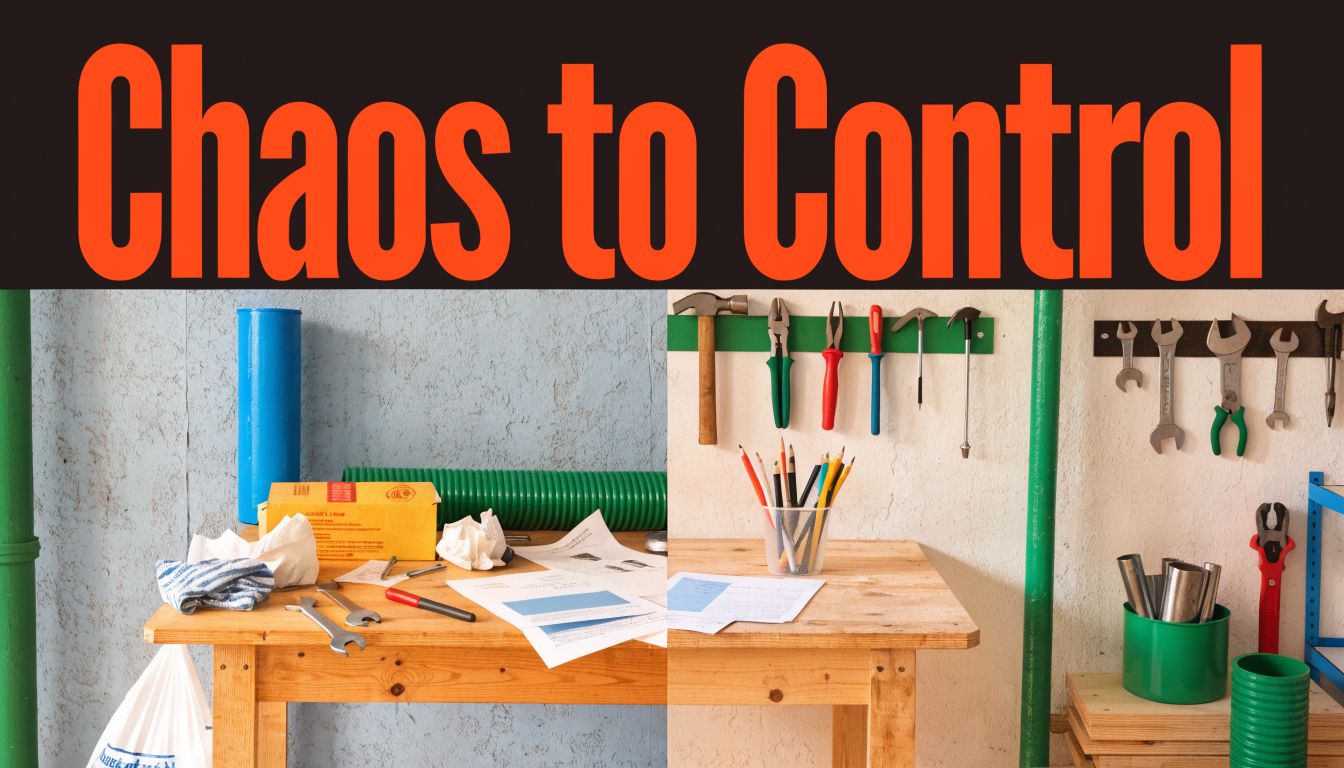
From Chaos to Control Core Services of a Plumbing Coach
A proper coach doesn't just hop on a call and tell you to "work on leadership." They get into the guts of the business. They look at how work is priced, how jobs move from booking to completion, how staff perform, and where time and margin are leaking out.
Operations that stop the daily mess
This is usually the first place good coaching pays off. If every estimator, technician, or office staff member handles work differently, your results will always bounce around. One person remembers to confirm parts. Another doesn't. One tech documents the job properly. Another leaves the office guessing.
Trade guidance on plumbing management makes a strong point here. A coach should treat SOPs as an operations-control system, not as paperwork for a folder. Documenting estimating, ordering, installation, inspection, and follow-up reduces wasted time from technicians reinventing the wheel and lowers process variance that eats margin, as explained by Trade Mastermind.
In plain terms, SOPs do three things:
- They protect quality: Jobs get done the right way more often.
- They save office time: Staff aren't chasing missing details after every visit.
- They reduce owner dependence: The business doesn't stall when you're unavailable.
Pricing that protects margin
Most plumbing owners undercharge in more complex ways than they realize. They don't always price too low across the board. More often, they miss overhead, fail to account for non-billable time, or let inconsistent quoting wipe out good revenue.
A coach helps set pricing rules, not just prices. That means knowing what goes into a callout, how to recover overhead, when to push flat-rate options, and when custom work needs tighter estimating discipline. Good coaches don't leave pricing to gut feel after a long day.
One of the better outside reads on this broader topic is Service Business Management: A Founder's Playbook. It helps owners think beyond isolated fixes and see how pricing, admin support, delegation, and process control connect.
Sales and customer handling
A lot of plumbers hear "sales coaching" and think scripts, pressure, and cringe. That's not the useful version. The useful version is teaching your team how to explain the work clearly, present options without fumbling, and book the job while trust is high.
That starts before the tech arrives. How calls are answered matters. How options are framed on site matters. How follow-up is handled matters. If your team is technically strong but awkward at the handoff from diagnosis to recommendation, you're leaving booked work behind.
For owners who need to fill the top of the funnel as they improve close rates, a focused lead generation plan for plumbers can complement coaching work on call handling and conversion.
Hiring and team structure
Hiring is where many owners drift into survival mode. They recruit when they're overloaded, train informally, then get frustrated when standards slip. A coach brings structure into that mess.
That might include:
- Clear role definitions so everyone knows what good performance looks like.
- Onboarding steps that don't rely on memory.
- Accountability rhythms for checking work, not just hoping for it.
- Basic leadership habits so foremen and senior techs actually lead.
If the only person who can keep standards high is the owner, the team isn't trained yet. It's supervised by force of personality.
The Real ROI What Success Looks Like with a Coach
Owners usually ask the wrong question first. They ask, "How much does coaching cost?" The better question is, "What bad habits, poor decisions, and weak systems are already costing me every month?"
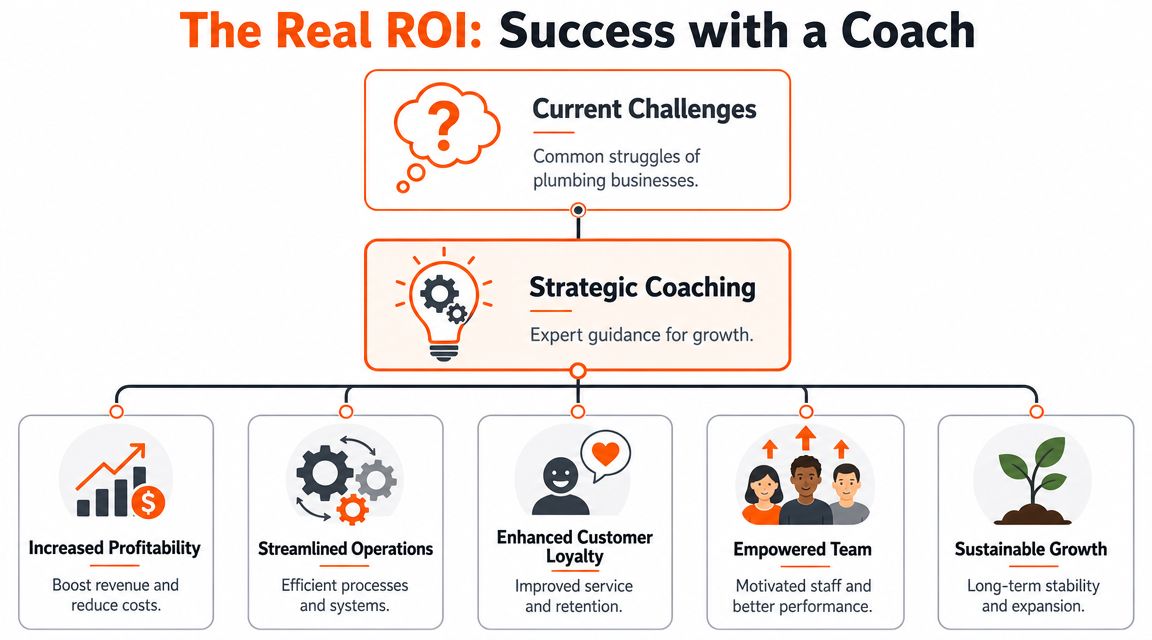
The numbers that show if coaching is working
Strong coaching is KPI-led. Not in a corporate, spreadsheet-for-the-sake-of-it way. In a practical trades way. You need to know whether the business is healthier or just busier.
Trade benchmarks show that leading plumbing firms can produce about $200,000 to $300,000 in annual revenue per technician, and qualified lead conversion rates in the 60% to 80% range can indicate whether response time, pricing, or sales process is helping or hurting booked work, according to Trade Linked.
Those numbers aren't there to make small operators feel behind. They're there to give context. If your revenue per tech is weak, a coach starts asking better questions. Are your technicians underutilised? Are they quoting poorly? Is scheduling patchy? Are too many leads going cold before anyone responds?
The same goes for conversion. If qualified work is coming in and too little of it gets booked, the issue usually sits in one of these places:
- Slow response: The office doesn't call back quickly enough.
- Poor presentation: Options aren't explained in a way customers understand.
- Wrong pricing structure: Jobs are either overpriced for the market or under-explained.
- Weak follow-up: Nobody closes the loop on undecided customers.
A good coach doesn't chase vanity. They tie each number back to a behaviour.
The return owners feel day to day
Not every return shows up first on a report. Some show up when your phone stops owning you.
You notice it when the office can answer basic questions without calling you from the job. You notice it when a technician handles a standard service call properly without needing rescue. You notice it when the schedule doesn't collapse because one person took a day off.
That kind of return is easy to dismiss until you've lived without it. Less owner stress isn't a soft outcome. It's operational proof that decisions, communication, and accountability are finally moving through the business instead of bottlenecking at you.
The best sign coaching is working is simple. The business gets more predictable before it gets bigger.
Profit matters. Cash flow matters. But calm matters too, because calm usually means the business is becoming repeatable. And repeatable is what gives you room to grow without breaking everything else.
Key Signs Your Plumbing Business Needs a Coach
Some owners need a coach because they want to grow. Others need one because the current setup is draining them. Both are valid. The issue isn't whether you're ambitious enough. The issue is whether the business keeps forcing expensive decisions onto you when you don't have enough visibility.

The warning signs are usually operational first
A lot of plumbing companies don't look broken from the outside. Vans are moving. Jobs are getting done. Money is coming in. But underneath, the owner is carrying too much and guessing too often.
You probably need a plumbing business coach if several of these sound familiar:
- Revenue is up but cash still feels tight: More work isn't turning into enough retained profit.
- Every important decision lands on you: Pricing, complaints, scheduling exceptions, supplier issues, all of it.
- Staff performance varies too much: One crew looks sharp, another burns time and creates callbacks.
- You don't trust your numbers: You know roughly what's happening, but not enough to make clean decisions.
- You keep fixing the same problems: Late quotes, missed parts, awkward customer conversations, uneven follow-up.
One of the strongest practical reasons for coaching is decision quality. Mammoth for Plumbers says coached clients are "far more likely" to avoid costly errors in critical decisions, especially when the coach brings tools like overhead calculators, market rate checks, and profit planning into the business through plumbing coaching guidance from Mammoth for Plumbers.
That phrase matters. Not because it gives you a neat percentage, but because it points to something every owner knows from experience. Bad decisions in plumbing are expensive fast. One pricing mistake repeated across jobs can do damage for months. One poor hire can drag down standards and morale. One casual guess on overhead can leave you busy and underpaid.
Bad decisions usually start with bad visibility
Sometimes seeing another owner talk through these pressures helps more than another checklist. This conversation is worth a watch if you're trying to decide whether outside guidance would sharpen the business or just add another expense.
A coach won't do the work for you. But the right one will stop you making the same expensive call three different ways in three different weeks.
Choosing Your Guide Finding the Right Coach for Your Business
Not every coach is a good fit. Some are strong on mindset but weak on numbers. Some understand trades generally but not plumbing specifically. Some are great if you're already at scale and useless if you're still owner-led and stretched thin.
Picking the right coach comes down to whether they can diagnose your real bottleneck and help you fix it in a way your business can implement.
What to look for before you sign anything
Start with experience that matches your reality. A coach doesn't need to have run your exact business, but they should understand service work, field teams, quoting pressure, overhead, and the messiness of local demand. If they talk like every business problem is solved with vision boards and positivity, keep moving.
Look for these signs:
- Trade fluency: They understand how plumbing jobs flow from call to invoice.
- Operational thinking: They talk about processes, handoffs, accountability, and margin control.
- Financial discipline: They care how pricing, overhead, and labour decisions affect real profit.
- Implementation focus: They can turn advice into checklists, scoreboards, meetings, and routines.
- Fit with your style: If you need direct feedback, don't hire someone who only speaks in vague encouragement.
Hire the coach who can explain your current mess clearly within one conversation. That's usually the person who has seen it before and knows where to start.
A useful coach should also be honest about sequencing. If your phone isn't ringing consistently, they shouldn't pretend internal systems alone will solve everything. If your demand is strong but delivery is chaotic, they shouldn't distract you with surface-level promotion ideas.
Questions worth asking on the first call
The first call shouldn't feel like a motivational seminar. It should feel like a diagnosis.
Ask questions like these:
What kinds of plumbing businesses do you work best with?
You want to hear specifics, not "any business that wants to grow."How do you usually find the first bottleneck?
Strong coaches will mention data, workflow, pricing, team behaviour, or call handling.What does the first month of work look like?
If they can't describe the early process clearly, they may not have one.How do you track whether the coaching is working?
They should be able to talk about measurable business indicators and operating discipline.What happens if my main issue is lack of leads, not team performance?
This question exposes whether they understand demand generation as part of the bigger picture.What support do you give between sessions?
Good advice is one thing. Real implementation support is another.What kind of owner struggles most in your program? A serious coach will answer this directly.
Common Plumbing Coach Pricing Models
Coaching fees vary a lot, but the pricing structure matters as much as the price itself. Here's a practical comparison of the models you'll run into most often.
| Pricing Model | How It Works | Best For |
|---|---|---|
| Monthly retainer | You pay a fixed monthly fee for regular calls, reviews, and ongoing support | Owners who want consistent accountability and long-term operational change |
| Performance-based fee | The coach's compensation is tied in some way to agreed business outcomes or improvement targets | Businesses comfortable with shared incentives and clear measurement |
| Hourly rate | You pay for individual sessions or ad hoc advisory time | Owners with a specific issue to solve or those testing fit before a deeper engagement |
Monthly arrangements usually work best when the business needs systems, staff management, pricing discipline, and owner accountability over time. Hourly work can help if you need a sharp second opinion. Performance models can sound attractive, but only if both sides agree on what success means and how it'll be measured.
The wrong coach isn't just a waste of money. They cost momentum. You spend months hearing ideas that sound smart but never make it into the way your business runs.
Pairing Coaching with Content Automation for Steady Growth
A coach can help you fix pricing, tighten systems, and stop making expensive decisions in the dark. That's the internal side. But plenty of plumbing businesses still hit the same wall after that. They've improved the engine, but work still comes in unevenly.
Fix the engine and feed it properly
This is the gap a lot of coaching content skips. It talks about profit, systems, and leadership, but doesn't spend enough time on how small plumbing businesses keep demand steady when the owner is out on jobs and too busy to market consistently.
That's a real issue because local visibility matters a lot in urgent service work. Google data referenced by BT Academy shows that 76% of people who search for something nearby on a smartphone visit a business within a day, and 28% of those searches result in a purchase, as discussed in this piece on plumbing business coaching and lead generation gaps.
Those numbers tell a simple story. If your business isn't showing up consistently where locals look, someone else gets the call. Not because they're better plumbers, but because they're more visible at the right moment.
Why this combination works better than either one alone
Coaching and content automation solve different problems.
A coach helps you:
- Improve decision-making
- Build repeatable systems
- Tighten pricing and margins
- Develop staff accountability
Content automation helps you:
- Stay visible while you're working
- Keep your business active without manual posting
- Build trust through consistent presence
- Support steadier enquiry flow over time
Owners who ignore the first side often stay chaotic. Owners who ignore the second side often build a well-run business that still suffers from patchy lead flow.
If you're trying to think more clearly about modern visibility without turning into a full-time marketer, this guide to a 2026 social media marketing strategy is useful for understanding how automation changes the workload. The point isn't to become a content creator. The point is to stop disappearing between jobs.
A practical next step is to look at how content marketing for plumbers can support a business that's already improving internally. That combination is hard to beat. Better operations give you capacity. Consistent visibility helps fill it.
If you're tired of carrying the whole business in your head, GrowTradie can help take the visibility side off your plate. It keeps your plumbing business active online with trade-specific content and auto-posting, so you can focus on running jobs, leading your team, and getting the most out of the systems you're building.