
Some weeks the phone won't stop. Other weeks, you look at the calendar and wonder where the next solid run of jobs is coming from. Most plumbers know that feeling. Referrals and repeat customers keep a business alive, but they don't always show up on a schedule that suits payroll, vans, and rising overhead.
That's where content marketing for plumbers earns its keep. Not as some fancy marketing project. Just as a practical way to stay visible, show your work, answer the questions customers already have, and make it easier for the next local customer to trust you enough to call.
Table of Contents
- Beyond Word of Mouth Why Content Matters
- What to Post Content Ideas That Attract Customers
- Planning Your Content A Simple Schedule That Works
- Getting Your Content Seen by Local Customers
- Measuring What Matters From Posts to Booked Jobs
Beyond Word of Mouth Why Content Matters
Word of mouth is still gold. A customer telling a neighbour, builder, or family member to call you is hard to beat. The problem is that referrals come in waves. You can't control when they happen, and you can't build a steady pipeline on hope alone.
Content fills the gaps between those referrals. In practice, that means posting proof of your work, sharing useful advice, and showing people what kind of jobs you handle. It isn't about sounding clever. It's about helping a customer think, "These people know what they're doing. I'll call them."

A lot of plumbers overcomplicate this. They assume content means writing long articles every week, filming polished ads, or hiring an agency before they're ready. It doesn't. The most effective content usually looks simple. A clear photo from a completed job. A short video showing where the shut-off valve is. A quick explanation of what causes low hot water pressure. That's the sort of thing customers do pay attention to.
Practical rule: If a post helps someone trust you, understand a problem, or see the quality of your work, it counts.
The shift is mental as much as practical. Stop thinking of content as "marketing stuff" and start treating it as digital proof that you're active, capable, and local. If someone checks your page or website and sees recent work, useful advice, and real customer feedback, you've already made the call easier.
What doesn't work is silence. Quiet profiles, outdated photos, and months with no activity make even a good plumbing business look unreliable. People judge fast online. If they can't tell whether you're active, they move on.
What to Post Content Ideas That Attract Customers
Most plumbers don't need more ideas. They need simpler ones. The easiest win is to turn the work you're already doing into posts people can understand at a glance.
Show real jobs, not stock images
Before and after posts work because they're proof. They show a problem, your fix, and the finished result without much explanation.
A few examples:
- Under-sink repair: Show the damaged pipework first, then the tidy finished install.
- Hot water system replacement: Take one photo before removal and one after the new unit is in.
- Bathroom rough-in or fit-off: Post the clean final result with a short caption explaining what was done.
Keep the caption plain. Name the job, mention the area, and say what the customer needed. Don't write like an ad.
Use short how-to videos
This is one of the most useful formats in content marketing for plumbers because it builds trust fast. How-to plumbing videos generate 53% more engagement than promotional service videos, while 77% of plumbing customers say video improves trust in the provider, according to plumbing video marketing statistics compiled here.
That lines up with what works in the field. A phone video explaining how to shut off water to a toilet or what to check before calling about no hot water is more convincing than a generic "we offer great service" post.
Good topics include:
- Main shut-off valve: Show people where to find it and when to use it.
- Running toilet basics: Explain the first thing to check before the issue gets worse.
- Low water pressure: Give a simple list of possible causes.
- Leaking tap signs: Show when a small drip points to a bigger problem.
Keep the video short. Clear beats polished.
After you've seen a few examples, the format gets easier to copy:
Turn everyday questions into posts
Every plumbing business hears the same questions again and again. Those questions are content. If customers ask them on the phone, other people are wondering the same thing before they call.
Turn questions into simple posts such as:
- "Why does my water take so long to heat up?"
- "What should I do if a pipe bursts?"
- "Why does my toilet keep refilling?"
- "When should I replace a water heater instead of repairing it?"
The best plumbing content usually starts with a real customer question, not a marketing brainstorm.
You don't need to answer everything in full technical detail. Give enough to be useful, then tell people when it's time to bring in a professional.
Make reviews visible
A good review hidden on a third-party platform is wasted. Turn strong customer feedback into a graphic or a short post with a job photo attached. That gives future customers two things at once. Proof of the work and proof that the customer was happy with it.
Use reviews carefully:
- Keep them specific: "Fixed our leaking pipe the same day" is stronger than "Great service."
- Match review to service: Pair a drain job review with a drain job photo.
- Ask permission for names or photos: Keep it professional.
If you want one rule for what to post, use this. Show the problem, show the fix, and show that a real customer was satisfied.
Planning Your Content A Simple Schedule That Works
A plumber gets back to the van after the last job, knows they should post something, and ends up doing nothing because it feels like one more task. That is usually the primary problem. Lack of time matters, but lack of a simple routine is what kills consistency.
The fix is to stop deciding from scratch every day. Set a repeatable schedule, keep it light, and make it easy enough to stick to during a busy week. A basic plan posted regularly will beat a clever plan you drop after two weeks.
Use theme days to cut the mental load
Theme days work because they remove choices. Monday always has one job. Wednesday has another. Friday has another. Once the pattern is set, posting takes a few minutes instead of becoming something you keep putting off.
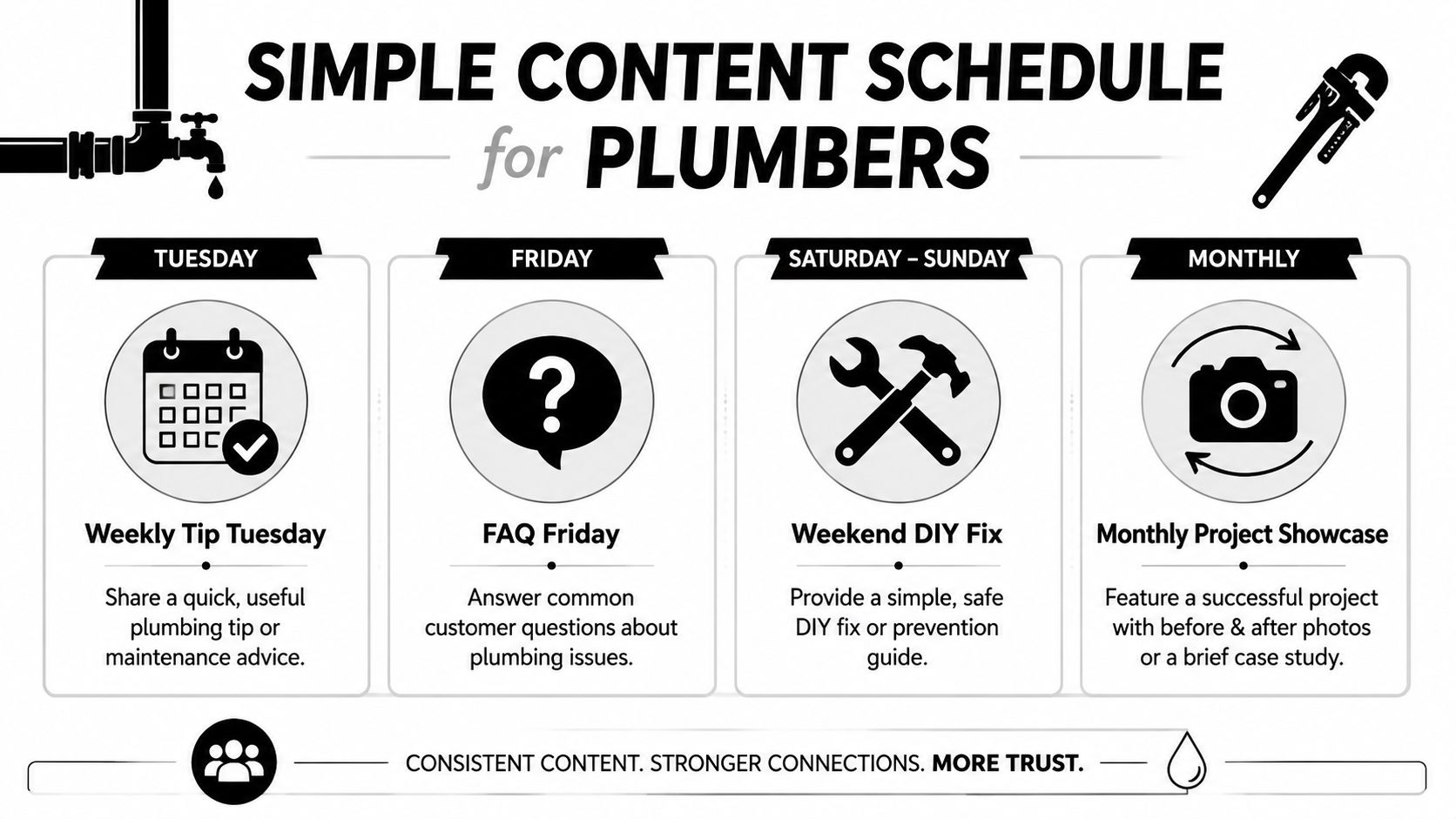
A weekly rhythm like this is realistic for most plumbing businesses:
- Monday tip: Share one practical tip a homeowner can use or watch for.
- Wednesday project: Post a finished job, a before-and-after, or a short explanation of what was fixed.
- Friday review or FAQ: Share a customer comment or answer one common question.
If you want another practical example for trade businesses, this guide on content marketing for contractors is worth a look.
A schedule only works if you can keep it going during your busiest month, not your quietest week.
Batch content while you are already on site
The following method saves plumbers the most time. Do not create a separate "content day" unless someone in the business is responsible for marketing. For most plumbing companies, the faster option is to collect a few simple pieces while the job is already happening.
On one callout, you can usually capture:
- A before photo
- A finished photo
- One short video clip
- A quick note about the issue
- A customer comment, if they are happy to give one
That gives you several posts from one job without adding much time on site. A hot water system replacement can become a project post, a maintenance tip, a short FAQ, and a review graphic. The job is already done. You are just getting more mileage from it.
Keep the monthly plan repetitive on purpose
Plumbers do not need a different idea every time they post. Repetition helps. Customers are not studying your content calendar. They are checking whether you look active, local, trustworthy, and capable of fixing their problem.
A simple monthly plan can look like this:
| Week | Monday (Meet the Team / Tip) | Wednesday (Project Showcase) | Friday (Customer Review / FAQ) |
|---|---|---|---|
| Week 1 | Meet the team at morning callout | Leaking mixer replacement | Customer review from emergency job |
| Week 2 | Tip on isolating water quickly | Toilet install before and after | FAQ on low water pressure |
| Week 3 | Tool spotlight and what it solves | Hot water system replacement | Review from repeat customer |
| Week 4 | Tip on signs of hidden leaks | Kitchen pipework upgrade | FAQ on when to call a plumber |
If three posts a week feels too heavy, start with two. One job post and one FAQ post each week is enough to build momentum. The best schedule is the one your business can keep running without turning it into another headache.
Getting Your Content Seen by Local Customers
A good post is useless if the wrong people see it. Plumbers don't need broad reach. They need the right local reach.
That's why local detail matters so much. 46% of all Google searches are for local services like plumbing, and 97% of consumers use online searches to find local plumbers, according to these plumber marketing statistics. That means people are already looking by area. Your posts should make your service area obvious.

Local detail beats generic posting
Compare these two captions.
"Another plumbing job completed today."
"Replaced a failed tempering valve for a customer in Northwood this morning."
The second one does more work. It tells a local customer where you operate, what kind of work you handle, and that you're active now. That's the kind of detail that helps someone in the same area recognise you as relevant.
Generic posting is one of the biggest mistakes I see. Plumbers post decent photos with captions that say almost nothing. The job is real, but the caption wastes the opportunity.
Simple ways to make posts more local
You don't need jargon to improve local visibility. You just need to be specific.
Try this checklist:
- Name the suburb or town: Mention where the job happened, as long as the customer is comfortable with that level of detail.
- Mention the service clearly: Say "burst pipe repair," "hot water replacement," or "blocked toilet callout."
- Use local hashtags carefully: Keep them relevant and readable, such as suburb and service combinations.
- Reference familiar landmarks or area types: Older homes, coastal properties, new estates, and apartment buildings often have different plumbing issues.
- Repeat your service area naturally: Your profile bio, captions, and project posts should all reflect the same local footprint.
For a practical overview of local posting ideas, this guide to social media marketing for plumbers is worth bookmarking.
If your content never names where you work, local customers have to guess whether you serve them.
The goal isn't to game anything. It's to remove doubt. People hire nearby trades who look active, relevant, and familiar with the area.
Measuring What Matters From Posts to Booked Jobs
A plumber can post three times a week, get a handful of likes, and still have an empty diary on Thursday. That happens when you measure attention instead of enquiries.
The job of your content is simple. Bring in calls, quote requests, and messages from local people who need plumbing work. If a post gets seen but never leads to contact, it may still help with trust, but it should not be treated like a win on its own.
Track enquiries, not applause
Use a scorecard that matches how customers book:
- Phone calls: Check whether calls increase when you post consistently.
- Quote requests: Count form fills, website enquiries, and booking requests.
- Direct messages: These often come from people ready to ask about price, timing, or availability.
- Website clicks that turn into contact: A click matters if it leads to a call, form, or booking.
- Lead quality over time: Pay attention to whether you're getting better jobs, better suburbs, or less time-wasting enquiry traffic.
This keeps your marketing grounded in what pays. A bathroom renovation lead is worth more than twenty passive likes from people outside your service area.
If you want a clearer system for turning online attention into actual enquiries, this guide on getting better plumber leads is worth reading.
Ask one question on every new call
The simplest tracking habit is also one of the most useful. Ask, "How did you hear about us?"
Write the answer down straight away. Put it in your CRM, job system, spreadsheet, or even your call notes if that's what you use. The method matters less than doing it every time.
After a month or two, useful patterns show up:
- Project photos may bring in renovation enquiries.
- Short videos may lead to more direct messages.
- Review posts may help cautious customers trust you enough to call.
- Suburb-specific posts may start pulling work from the areas you want more of.
That is the level to watch.
You will not trace every booked job back to one post perfectly, and that's fine. Content usually works as a series of reminders. People see the job photo today, check your profile next week, then call when their hot water system fails a month later. The businesses that stay visible tend to be the ones people remember when the problem becomes urgent.
Judge content by calls, quote requests, and booked work. Those numbers tell you whether posting is helping the business.
GrowTradie helps trade businesses stay visible without having to write posts, design graphics, or remember to publish anything after a long day on the tools. It creates and schedules content specific to your trade and local area, so your business keeps showing up consistently and professionally. If you want a simpler way to turn online visibility into real enquiries, take a look at GrowTradie.