

You know the pattern. One week the phone won't stop. You're quoting jobs at night, chasing materials, juggling crew issues, and telling yourself you'll sort the pipeline out later. Then two weeks after that, the diary looks thin and you're back relying on referrals, old contacts, and whoever rings first.
That cycle wears good operators down. It also makes planning almost impossible. You can't staff properly, you can't forecast cash flow, and you end up saying yes to work that doesn't really fit just to keep things moving.
That's why bidding for cleaning contracts matters to small trade businesses. Not because every contract is a golden ticket. Plenty aren't. But a repeatable bidding process gives you a way to chase steadier work on purpose instead of waiting for luck. It turns random enquiries into a proper pipeline.
Table of Contents
- Moving Beyond Inconsistent Word-of-Mouth Work
- Finding and Qualifying the Right Contract Opportunities
- How to Scope the Work and Calculate Your Costs Accurately
- Crafting a Proposal That Stands Out from the Pile
- Navigating Compliance and Submitting a Flawless Bid
- The Professional Follow-Up Strategy That Wins Future Work
Moving Beyond Inconsistent Word-of-Mouth Work
Word-of-mouth is great until it's your only system. Referrals usually bring warmer leads and less selling, but they also arrive when they arrive. If you want steadier work, you need another lane running beside it.
That's where bidding comes in. Formal bids force you to get sharper on scope, pricing, paperwork, and follow-up. They also push you into markets where buyers already expect to compare suppliers properly, instead of picking whoever was mentioned in a local Facebook group.
Public and institutional work is competitive. In procurement data on site service tender competition, win-rates for small-to-medium firms average around 15–25%, and 60–70% of advertised contracts receive six or more bids. That tells you two things. First, losing some bids is normal. Second, cheap pricing alone won't carry you.
Why contracts change the game
A contract gives you something referrals don't. Visibility over future workload. Even if the margin is tighter than a quick reactive job, regular scheduled work lets you plan labour, route work better, and buy with more confidence.
It also makes your business look different to buyers. A contractor who can price accurately, submit on time, and handle formal requirements comes across as safer than someone who only works off verbal quotes and text messages.
Practical rule: Don't treat bidding as a one-shot sales effort. Treat it as an operating system for winning repeat work.
If you're still building your operation from scratch, this guide on starting a service business with the basics in place helps you tighten the foundations before you push harder into contracts.
What works and what doesn't
Some operators burn out on bidding because they chase every opportunity. That usually ends with rushed numbers, half-read tender packs, and poor follow-up.
The better approach is simpler:
- Pick a lane: Go after sites and job types you can service reliably.
- Price from real delivery: Build your number from labour, access, materials, and admin. Not gut feel.
- Submit like a pro: Clean documents, clear scope, no missing forms.
- Track outcomes: Every lost bid should teach you something about fit, price, or presentation.
A lot of contract work is won before the final number is compared. Buyers notice who turned up prepared, asked smart questions, understood the site, and sent a bid that made sense. That's the part small operators can control, even against bigger firms.
Finding and Qualifying the Right Contract Opportunities
Most small crews waste more time on bad-fit opportunities than they lose on strong competitors. That's the drain. You can't afford to spend half a day pricing a contract that sits outside your area, needs credentials you don't have, or was never profitable to begin with.
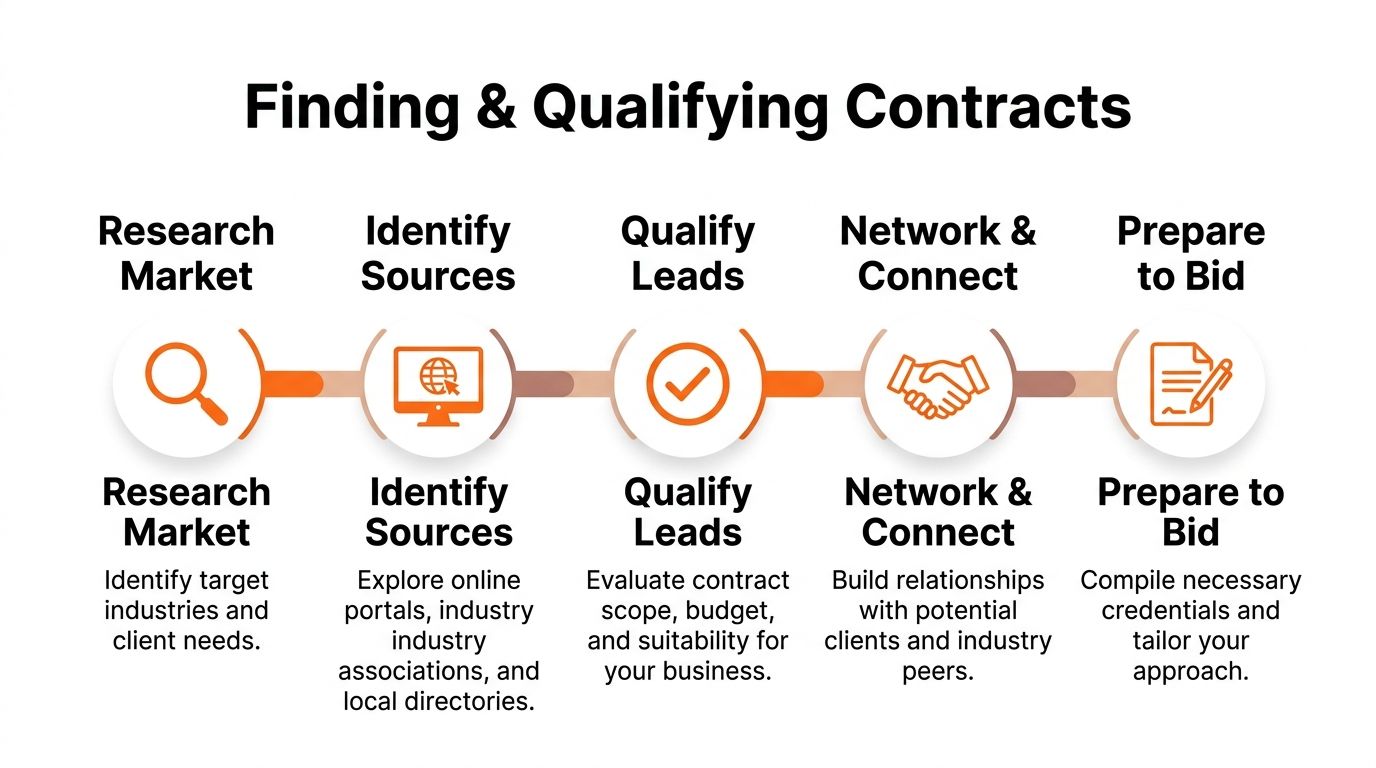
Start by building two lists. One is where opportunities appear. The other is what makes an opportunity worth chasing.
Where small operators should look
Public portals are obvious, but they're not the only source. Local councils, school districts, health facilities, strata groups, commercial landlords, and facility managers all buy through some form of tender or request-for-quote process.
You'll also find work through local directories, trade networks, and by staying visible where property managers already look for contractors. If you're comparing lead sources, this roundup of platforms similar to Thumbtack for service businesses is useful for widening the top of the funnel.
A practical search routine usually includes:
- Local procurement portals: Good for structured opportunities with clear documentation.
- Property and facilities contacts: Often better for repeat private-sector work where relationships matter.
- Industry associations and directories: Useful when buyers want established operators, not random one-off quotes.
- Existing clients: Ask who else manages their portfolio. One site often leads to another.
Qualify before you quote
If you don't have admin support, the fix isn't fancy software. It's a repeatable filter. In guidance on systematising the bid process for small businesses, a simple pre-bid questionnaire and a 3-email follow-up sequence are recommended for firms that need structure without complexity. That same guidance notes that only 36% of micro-businesses in services use any form of CRM, which is why a lightweight process beats waiting until you can “set up the perfect system.”
Use a quick go or no-go checklist before you spend real time on a bid:
- Service area fit: Can your crew get there without wrecking the day?
- Scope fit: Does the work match what you're set up to deliver well?
- Compliance fit: Are the required documents, insurance, and policies already in place?
- Decision fit: Is there a real buyer, a real deadline, and a real budget?
- Commercial fit: If you win at a sensible price, is the job still worth carrying?
Some of the best bids you'll ever win are the ones you never submit, because you spotted early that the job was wrong for your business.
Keep a lean bid pipeline
You don't need a full CRM to stay organised. A spreadsheet, shared folder, and calendar reminders are enough if you use them consistently.
Track four things only:
| Item | What to note | Why it matters |
|---|---|---|
| Opportunity | Site, contact, due date | Stops missed deadlines |
| Qualification | Go, no-go, and why | Prevents repeat mistakes |
| Submission status | Walk-through booked, draft sent, final lodged | Keeps the process moving |
| Follow-up | Dates and responses | Helps you learn what converts |
That level of structure is enough for most small operators. The goal isn't admin for its own sake. The goal is to stop winging it.
How to Scope the Work and Calculate Your Costs Accurately
Monday starts with a site that looked fine on paper. By Friday, your cleaner is overrunning, the supervisor is covering shifts, and the margin you thought you had is gone. That usually traces back to one thing. The scope was guessed, not measured.
The number on the front page only works if the hours underneath it are honest. In job-costing guidance for profitable contract bids, labour is identified as the biggest cost in most cleaning contracts. That lines up with what happens on real jobs. If your labour allowance is light, the rest of the bid rarely saves you.
Scope the site before you price it
For a small operator, this does not need fancy estimating software. A printed floor plan, a site walk-through sheet, and a spreadsheet are enough if you use them the same way every time.
Break the building into zones first. Offices, amenities, reception, kitchens, corridors, glass, and any specialist areas should each stand on their own. That matters because each zone cleans at a different speed, at a different time, and sometimes with a different person.
Then note what changes the work:
- Access and security: keys, codes, alarm procedures, restricted rooms
- Layout: stairs, lifts, long walks between areas, split buildings
- Site use: public traffic, staff density, medical or food areas, peak times
- Surface mix: carpet, hard floors, glass, stainless, showers, touchpoints
- Restocking: bins, liners, paper, soap, sanitary units
- Timing: after-hours only, early starts, short access windows
That list sounds basic. It is also where small crews either protect their margin or give it away.
Use production rates, but use your own
Square metres alone do not price a cleaning contract. Production rates do. Swept's walk-through bidding guide gives example cleaning rates for different area types, which is useful as a check. The answer still comes from your crew, your standard, your equipment, and the condition of the site.
A tidy office with open access cleans quickly. A restroom block with heavy use, locked dispensers, and poor ventilation does not. Treating those areas as if they take the same effort is how a quote looks competitive and then bleeds cash.
If you have no historic job data yet, start simple. Time a few regular tasks on existing jobs. Empty bins in an office zone. Clean one toilet block properly. Mop and detail one kitchen. Build your own rough benchmarks from actual work, then adjust after the first month of a new contract.
Build your cost from the bottom up
Once the scope is clear, calculate the job in layers. Small businesses get into trouble when they jump straight to a monthly figure because that is what the client asked for. Work from labour upward instead.
Use this order:
- Direct labour: hours per visit x visits per week x loaded hourly wage
- Consumables and variable costs: liners, chemicals, paper goods, equipment wear
- Overheads: supervision, travel, insurance, admin time, uniforms, software
- Profit margin: set on purpose, not whatever survives at the end
Here's a simple format you can use internally.
| Cost Component | Calculation | Example Amount |
|---|---|---|
| Direct labour | Hours per visit × visits × loaded hourly cost | To be calculated from your walk-through |
| Consumables | Materials, liners, paper goods, wear items | To be calculated from scope |
| Fixed overhead | Supervision, insurance, admin, uniforms, software | To be calculated from your business |
| Overhead and profit markup | Applied after realistic labour costing | Use your target markup |
| Final bid price | Total of all layers above | Your submitted amount |
Keep overhead visible. Do not bury it inside labour and hope it works out. On small contracts especially, travel, quoting time, cover shifts, and client communication can chew through profit faster than the cleaning itself.
If you want another trade example of building price from labour and overhead instead of guesswork, this guide on how to price a painting job properly uses the same discipline.
Price the awkward parts properly
Plenty of bids go wrong because the cleaner's on-site time gets counted, but the awkward bits do not.
Include time for:
- opening and locking up
- setting alarms
- moving between separated areas
- refilling stock cupboards
- carrying equipment in and out
- induction or sign-in procedures
- periodic work the client mentions casually during the walk-through
Those jobs are still labour. If they happen every visit, they belong in the base contract price.
Check the scope for gaps before you submit
A clean spreadsheet can still hide a bad estimate. Run one last check before you finalise the number.
Look for four common misses:
- Labour that is too tight: the schedule only works if everything goes perfectly
- Missed frequency details: daily bins, weekly glass, monthly detail tasks
- Thin overhead recovery: admin and supervision are real costs, even for owner-operators
- Unclear exclusions: the client assumes extras are included because you never stated otherwise
One clear scope beats a cheap guess. If the site needs more time, say so in the bid and show why. You will lose some jobs on price. You will also avoid winning the sort of contract that keeps your crew flat out and your bank balance stuck.
Crafting a Proposal That Stands Out from the Pile
You walk a site on Tuesday, send a price on Wednesday, and hear nothing back. A month later, you find out the job went to someone dearer. That usually means the buyer did not trust the cheaper bid to run cleanly.
A proposal has one job. Make it easy for the client to say, "These people understand the building, the service, and what can go wrong."
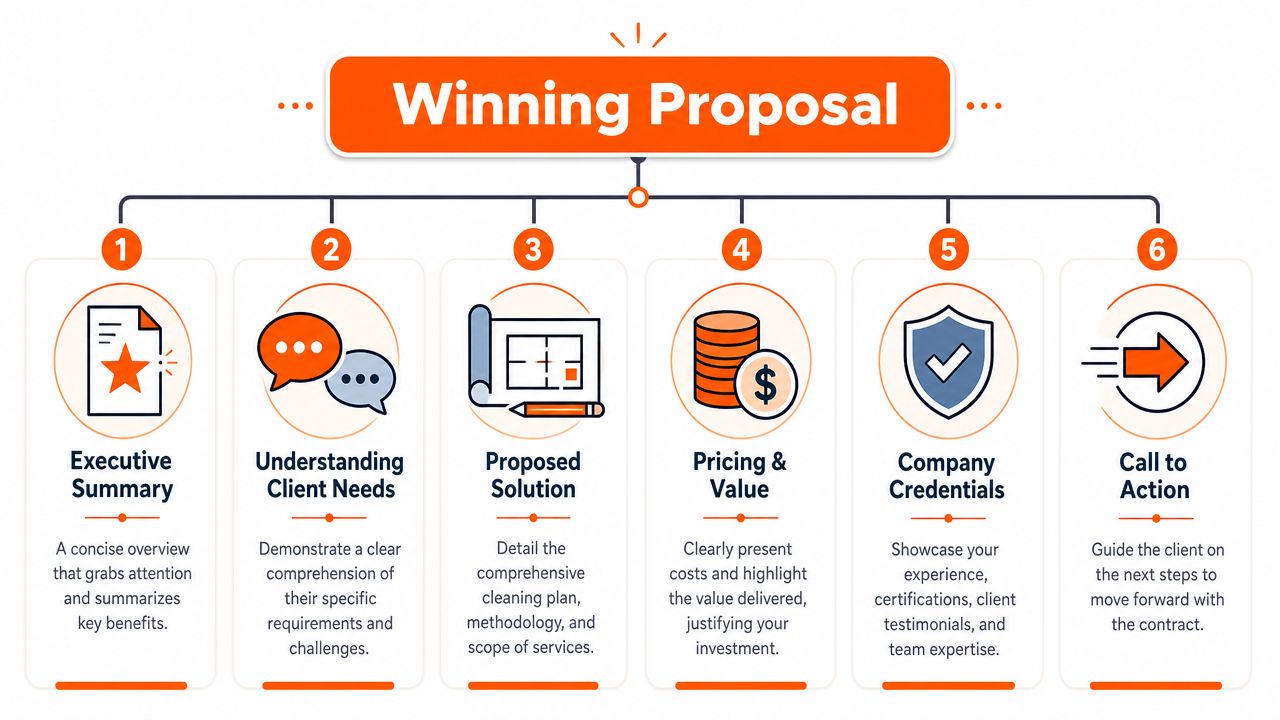
For a small operator or a two-to-five person crew, that does not require polished corporate fluff or expensive proposal software. It requires a repeatable template you can fill out properly in an hour. If your proposal process depends on starting from scratch every time, you will rush it, miss details, or both.
Write for the person reviewing six other submissions
The buyer is usually scanning for three things first. Did you understand the brief, did you answer it clearly, and does your service sound manageable?
Make their job easier. Put the site name, contract term, service hours, and key inclusions near the top. If the job is for a medical clinic, childcare site, strata block, or office with after-hours access rules, say that back to them in plain English so they can see you paid attention during the walk-through.
A solid proposal usually includes:
- A short cover note: Name the site and summarise the service you are pricing.
- A scope table: Areas, tasks, frequencies, and anything specifically excluded.
- A service plan: Who attends, what shifts are proposed, how supervision or quality checks happen.
- Proof you can do the work: Insurance, licences if relevant, safety documents, and similar site experience.
- Commercial terms: Start date, quote validity, invoicing terms, assumptions, and variation process.
Keep the company background tight. One short paragraph is enough. Buyers of cleaning contracts care far more about how you will handle their building next Monday than how long ago you bought your first vacuum.
This walkthrough video does a good job showing how stronger submissions are structured in practice.
Show the price in a way that reduces doubt
A single lump sum creates work for the client. They have to guess what is included, what you allowed for, and whether you have undercooked the labour.
Break the number into a simple commercial summary. You do not need to show every internal margin calculation, but you should show enough that the buyer can follow the logic. As noted earlier, stronger bids usually separate the service scope, key assumptions, and commercial terms instead of dropping one total at the bottom of the page.
Use a format like this:
| Proposal Element | What the buyer should see |
|---|---|
| Scope summary | What areas and tasks are covered under the contract |
| Service assumptions | Access times, site conditions, consumables, equipment, exclusions |
| Pricing summary | Monthly or weekly contract rate, periodic works if separate, GST position |
| Commercial terms | Quote validity, payment terms, commencement conditions, variation method |
That level of detail helps in two ways. The buyer can compare your bid properly, and you protect yourself if the client later assumes extras were included.
Make the proposal feel low-risk
Clients do not only buy a cleaning result. They buy reliability, communication, and fewer headaches.
That is why the strongest proposals deal with practical issues before the contract starts. State how keys, alarms, missed access, complaints, consumables, and scope changes will be handled. If the site has touchpoints that matter, such as washroom presentation, entry glass, rubbish overflow, or infection-control areas, mention your approach directly instead of hiding behind generic promises.
One sentence can do a lot of work here. For example: "Any work outside the agreed scope, including emergency spill response or additional attendance after events, will be quoted and approved before being carried out." That tells the client you run an orderly job and tells you where the line is if the scope starts creeping.
A simple proposal process you can actually keep up
Small crews win work by being organised, not by pretending to be a national company.
Build one master template in Word or Google Docs. Keep standard sections for cover note, scope, service plan, credentials, and terms. Then customise only the parts that must change: site details, frequency, risks, exclusions, and pricing summary. Save a checklist with it so every proposal goes out with the same core attachments.
That system is plain, but it works. It saves admin time, keeps your bids consistent, and stops small mistakes from making you look careless.
A proposal stands out when it sounds like the contractor has already thought through the first month of the job. Prepared beats polished every time.
Navigating Compliance and Submitting a Flawless Bid
A lot of good bids die in admin. Not because the price was wrong. Not because the scope was weak. Because someone missed a mandatory form, uploaded the wrong file, or treated a compliance item like a minor attachment.
That's avoidable if you handle submission like site prep. Checklist first. Assumptions second.
Treat the tender pack like a checklist, not a brochure
Read the full pack once without filling anything in. Then read it again and mark every mandatory document, signature, declaration, and format requirement.
One compliance issue worth taking seriously is modern slavery documentation. In 2026 tender guidance covering required submission elements, failing to submit a compliant Modern Slavery Act statement is described as a common reason for disqualification. That tells you exactly how buyers treat these documents. They are not optional extras.
Build a pre-submission checklist that covers:
- Mandatory forms: Signed exactly where required.
- Insurance and supporting documents: Current and matching the legal business name.
- Policy attachments: Safety, labour, and statutory compliance documents.
- Commercial schedules: Pricing sheets completed in the buyer's format.
- File naming and upload method: Especially important in portal-based submissions.
Submission mistakes that kill solid bids
Some errors are boring, but expensive.
One example comes from a municipal bid notice that required on-site registration attendance. The notice states that the bidder's representative must provide identification at registration and remain present for the duration of the opening process. Rules like that aren't rare in formal procurement. If you skim the instructions and assume attendance is optional, you can lose before your number is even considered.
Use this quick final review before you lodge:
- Match every requirement to a document.
- Check dates, names, and signatures.
- Confirm whether physical attendance is mandatory.
- Upload early if using a portal.
- Save the final submitted version exactly as sent.
The cleanest bid in the world still fails if it doesn't meet the submission rules.
For physical submissions, print one extra full copy for your records. For digital submissions, save the confirmation email or portal receipt immediately. When a buyer says they didn't receive something, you'll want proof, not a guess.
The Professional Follow-Up Strategy That Wins Future Work
Once the bid is sent, most operators either go silent or get awkward. Neither helps. Good follow-up is steady, brief, and useful. You're not pestering the buyer. You're making it easy for them to move the process forward.
The biggest mistake is treating follow-up as something you do only when you're desperate for the result. It works better as part of the bid itself.
A simple follow-up rhythm
Keep it clean and low-pressure.
- Right after submission: Confirm receipt and ask whether anything else is needed.
- After the stated review window starts to close: Send a short check-in asking if they have any questions on scope or assumptions.
- After the decision date passes: Follow up once more, politely, and ask whether an outcome has been made.
That earlier guidance on bid systematisation for small operators recommended a 3-email follow-up sequence centred on service differentiators rather than price. That's smart because buyers often need reassurance on delivery, communication, and reliability more than another reminder that you exist.
What to do when you lose
A lost bid is only wasted if you learn nothing from it. Ask for feedback professionally and keep the questions tight.
Don't send, “Why did we lose?” Send something like this instead:
Thanks for the update. If you can share any brief feedback on scope, price position, or submission quality, I'd appreciate it. We're always looking to improve future tenders.
That wording gives them easy categories to respond to. Sometimes you'll hear that you were too expensive. Sometimes the winner had more relevant experience. Sometimes your submission was fine and the incumbent stayed in place. All of that is useful.
Keep a record of what you hear. Over time, patterns show up. You may find you're strongest on smaller private contracts, or that your pricing is good but your documentation needs tightening.
What to do when you win
Winning creates its own admin. Move quickly while the buyer's confidence is high.
Your first actions should be practical:
- Confirm scope in writing: Make sure the agreed version matches the submitted version.
- Lock in start details: Access, inductions, contacts, and timing.
- Clarify billing: Purchase order requirements, invoicing process, and payment contacts.
- Prepare handover notes: So whoever delivers the work starts with the same assumptions used in the bid.
A won contract can still go wrong if the ops side never sees the detail behind the proposal. The handover matters. A lot.
Bidding for cleaning contracts gets easier once the process leaves your head and becomes repeatable. You qualify harder, scope better, submit cleaner, and follow up without guessing. That's what turns bidding from a random effort into part of how your business grows.
If you want steadier enquiry flow alongside contract bidding, GrowTradie helps trade businesses stay visible without having to write posts, design content, or remember to publish anything. It's built for busy operators who need a simple way to stay active online and keep their business in front of local buyers between jobs.