

July hits Houston. Two vans are out. One tech is stuck on an emergency call in Katy, another is finishing a condenser swap in The Heights, and your phone is either going wild or dead quiet. That up and down cycle wears on every owner. You know potential customers are looking for help on their phones all day, but most online advice feels built for marketers, not for someone trying to keep a crew moving and parts ordered.
The good news is that getting found by local customers doesn't have to turn into a second full-time job. The businesses that win in Houston usually aren't the ones chasing the broadest phrase. They're the ones that show up in the map pack, match the exact service a homeowner needs, and look trustworthy enough to call right now.
Table of Contents
- Your Guide to Winning More Work in Houston
- Become the First Call on Google Maps
- Target the Right Houston Neighborhoods and Services
- Build a Website That Turns Visitors into Jobs
- Show Up Consistently with Automated Content
- Your Simple Plan for Steady Work
Your Guide to Winning More Work in Houston
A lot of Houston contractors run their visibility the same way they run slow-season cash flow. They guess, react, and hope the next weather swing fixes things. One week a heatwave fills the board. The next week, estimates slow down and the office starts asking where the next run of jobs is coming from.
That usually leads to broad, expensive thinking. Owners chase citywide phrases, rebuild pages that didn't need rebuilding, or pay for disconnected tactics that don't tie back to calls. Then they get frustrated because none of it feels predictable.
Houston SEO for HVAC works better when you narrow the target instead of widening it. A homeowner in River Oaks with a dead unit doesn't want a general contractor directory. They want someone who handles their issue, serves their area, and looks available. A property manager in Pearland searching for a replacement quote behaves differently from a family in Montrose needing emergency help. Your online presence should reflect that difference.
Practical rule: Stop trying to look relevant to everyone in Houston. Look like the best option for the exact service and area you actually want.
That means four things matter more than everything else:
- Map visibility: If you're not easy to find in map results, you're invisible during urgent searches.
- Service plus area matching: Pages should reflect combinations like AC repair in River Oaks or furnace installation in Katy.
- A site that converts: Fast load times, obvious phone numbers, and clear service pages beat fancy design.
- Consistent activity: Fresh updates, recent photos, and active profiles make the business look alive.
This is the practical side of Houston SEO for HVAC. Not theory. Not vanity metrics. Just the pieces that help the phone ring more often from the parts of town you want to serve.
Become the First Call on Google Maps
When a system fails in a Houston summer, consumers don't compare ten companies. They search on their phone, scan the map results, and call one of the few businesses that look credible. That's why your Google Business Profile is often more important than your homepage.
Start with the basics, but do them thoroughly.
Treat your profile like your front desk
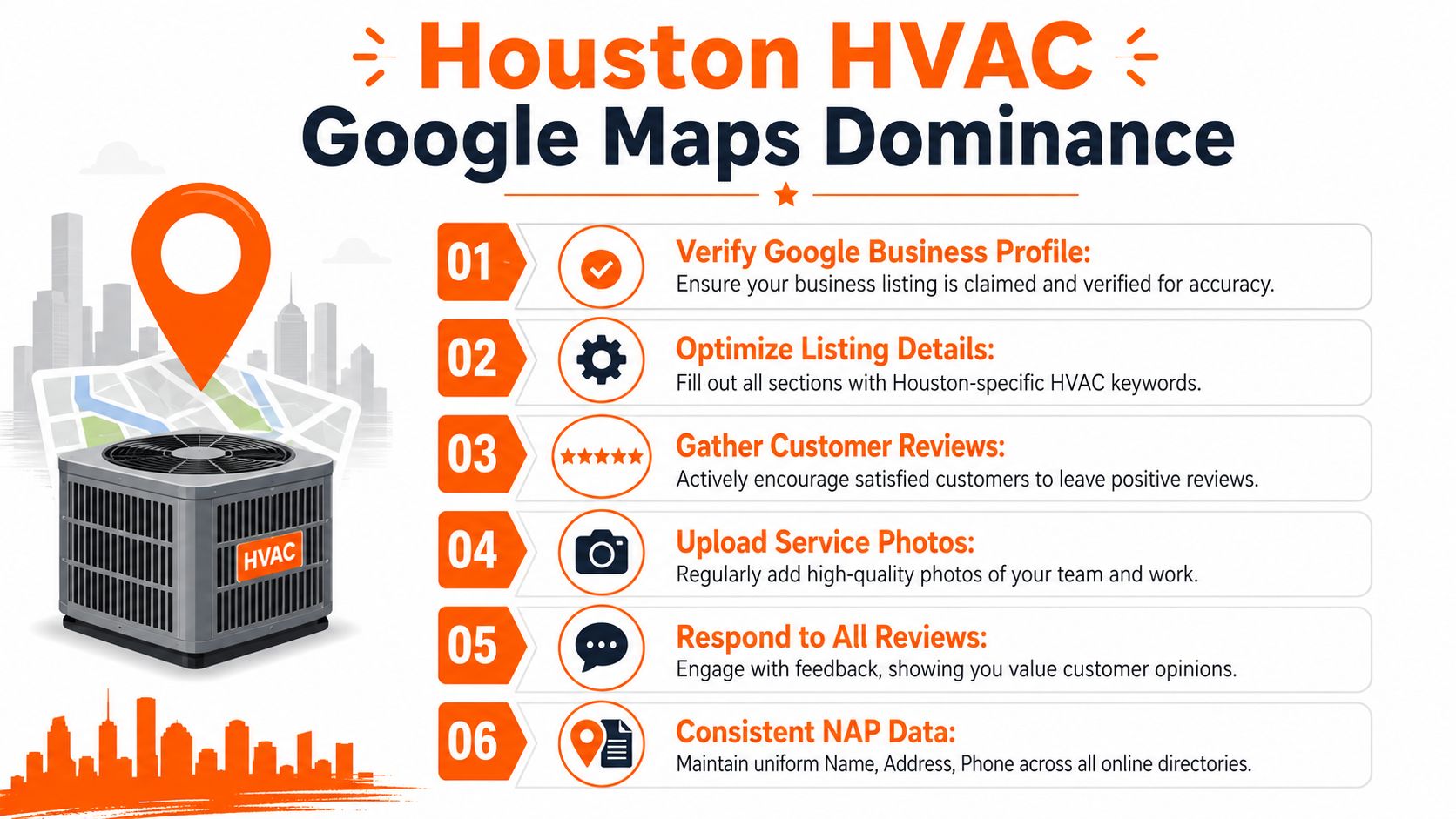
Every field in your profile should help a customer decide, fast. Use your correct business name, primary phone number, business hours, and service areas. Add every service you offer. If you handle emergency repair, ductless installs, furnace replacement, indoor air quality, and seasonal tune-ups, list them clearly instead of hiding everything under one generic description.
Service areas matter in Houston because the market is spread out. If you work The Woodlands, Pearland, Sugar Land, Cypress, Katy, Montrose, and The Heights, reflect that in the profile and on the site. Don't leave customers guessing whether you serve them.
A strong profile also needs visual proof. Add team photos, truck photos, jobsite photos, equipment installs, and before-and-after shots from real work. A profile with recent activity looks maintained. A profile with six old photos looks neglected.
For contractors that want a broader local visibility framework, this guide on local visibility for contractors is useful background reading.
After the profile basics, watch how strong operators approach map visibility in practice:
Reviews decide who gets the call
Reviews aren't a nice extra. They're the trust layer that makes the customer choose you over the next listing. According to this Houston local visibility guide, HVAC businesses must aim for at least a 4.7 average rating on their Google Business Profile, and if a local rival has 20 reviews, the goal should be to secure 100 reviews to establish stronger authority and trust.
That changes how you ask for feedback. Don't ask once in a while. Build it into the job process.
- After a completed repair: Have the office text the review link while the job is still fresh.
- After an install walkthrough: Ask when the homeowner tells your tech they appreciate the work.
- After a maintenance visit: Request a short review that mentions the service and area naturally.
Most contractors chase website tweaks first. In local map results, the faster win is often a better profile and a stronger review engine.
Detailed reviews help more than one-line comments. A review that mentions AC repair, fast response, professionalism, and the Houston-area neighborhood gives both search platforms and future customers more context.
What to fix this week
If your map performance feels weak, don't overhaul everything at once. Fix the obvious gaps first.
- Claim and verify the profile if you haven't already.
- Choose the closest matching categories for your real work.
- Add all service lines instead of only listing one core offer.
- Upload fresh photos from recent jobs.
- Set up a repeatable review request process through your office staff.
- Respond to every review, good or bad, with clear language and no canned fluff.
A clean, active profile turns Houston SEO for HVAC into something practical. It helps you show up where urgent searches happen and gives people enough confidence to call.
Target the Right Houston Neighborhoods and Services
A lot of contractors think the goal is to show up for the biggest citywide phrase possible. That's usually the wrong fight. Broad phrases look attractive, but they often pull you into crowded results and mixed intent. Someone searching a generic city term may still be researching. Someone searching a specific service in a specific area is usually much closer to booking.
Generic phrases waste time
The better play is to build around service and neighborhood combinations. Think less about one giant page trying to rank for all of Houston, and more about useful pages like emergency AC repair in River Oaks, furnace installation in Katy, mini-split repair in Montrose, or system replacement in Sugar Land.
That approach isn't just common sense. Data from analyzing $100M HVAC companies shows that landing pages targeting specific neighborhoods and services drive significantly higher lead conversion than generic service pages, because they capture customers with high local intent.
In practice, it looks like this:
| Service | Houston-Area Location | Example Search Phrase |
|---|---|---|
| AC repair | River Oaks | AC repair in River Oaks |
| Emergency HVAC service | Montrose | emergency HVAC service in Montrose |
| Furnace installation | Katy | furnace installation in Katy |
| Air conditioner replacement | Sugar Land | air conditioner replacement in Sugar Land |
| Ductless mini-split repair | The Heights | ductless mini-split repair in The Heights |
| Heat pump installation | Pearland | heat pump installation in Pearland |
| Seasonal tune-up | Cypress | HVAC tune-up in Cypress |
| Commercial HVAC repair | The Woodlands | commercial HVAC repair in The Woodlands |
A generic city page says, "We serve Houston." A focused local page says, "We do this exact job in your area." The second one usually wins the call.
If a contractor serves ten neighborhoods well, ten strong local pages usually beat one broad page trying to cover the whole metro.
How to build pages that match real jobs
Start with your best service lines. Don't create pages for every possible task. Build them around the jobs that move revenue and keep the crew busy.
Then match those services to the areas you want more work from. Not every page needs the same layout, but each should include:
- A clear headline: Example, AC Repair in River Oaks.
- Proof you know the area: Mention the neighborhood naturally and talk like a local operator, not a template writer.
- Specific service detail: Describe what problems you solve, such as no cooling, weak airflow, frozen coils, or replacement decisions.
- A direct next step: Call now, request a quote, or book service.
Avoid copying the same text across every location page with only the suburb swapped out. Thin pages don't help much. Write each one around common job types, nearby service realities, and the kind of customer in that area.
For Houston SEO for HVAC, this neighborhood-first structure is often the difference between getting traffic and getting booked jobs. It aligns your pages with real searches from River Oaks, Montrose, The Heights, Katy, Pearland, and other areas where homeowners need someone nearby and available.
Build a Website That Turns Visitors into Jobs
A contractor website doesn't need clever design. It needs to answer three questions fast. Do you handle the job, do you serve the area, and how do I contact you right now? If the site gets in the way of those answers, it loses work.

Mobile comes first in Houston
Most local customers aren't researching from a desktop at a desk. They're standing in a hot hallway, sitting in a parked car, or trying to solve a problem between meetings. The site has to load quickly, look clean on a phone, and make tapping to call easy.
According to Authority Solutions' Houston HVAC guidance, 43% of websites in Houston's mobile-heavy market suffer from poor Core Web Vitals, which creates a worse user experience and lowers visibility. The same source notes that page title tags should be 50–60 characters and meta descriptions 120–155 characters.
That sounds technical, but the fixes are usually simple:
- Trim oversized images: Huge files slow service pages down.
- Keep the header practical: Phone number, service area, and a contact button should be obvious.
- Use readable spacing: Tiny text and crowded layouts lose mobile users fast.
Make each page do one job
A strong site structure is boring in the best way. One page for each core service. One page for each important service area or service-area combination. Clear contact paths on every page.
If you offer repair, replacement, maintenance, ductless systems, and indoor air quality work, each should have its own page. If River Oaks and Katy are priority areas, those pages should exist too. Don't bury everything on one services page and hope customers sort it out themselves.
This overview of digital marketing for HVAC companies lines up with that practical structure.
A good service page usually includes:
- The exact problem you solve
- Common signs the customer is dealing with it
- What happens when they call
- Why your company is a safe choice
- An obvious phone and form option
A website visitor shouldn't have to hunt for your number, guess whether you serve their area, or scroll past filler to understand what you do.
Small technical fixes that matter
There are a few details owners ignore because they seem minor. They aren't.
| Site element | What to do |
|---|---|
| Title tag | Keep it within the recommended character range and include the service plus location naturally |
| Meta description | Write a plain-English summary that gives a reason to click |
| Contact forms | Keep fields short. Name, phone, suburb, and job type are enough for many pages |
| Service pages | Give each one a unique focus instead of repeating the same copy |
| Trust signals | Use real reviews, real photos, licensing details, and clear service-area language |
Houston SEO for HVAC gets stronger when the site behaves like a dispatcher, not a brochure. It should route people to the right service, show that you work in their area, and make contacting you effortless.
Show Up Consistently with Automated Content
A stale online presence creates doubt. If your last update was months ago, your last photo is old, and your profiles look half-finished, customers notice. They may not say it out loud, but they read that silence as a business that might be hard to reach.
Quiet profiles lose trust
The easiest updates are usually the most effective. A photo from a completed install in Cypress. A short note about a maintenance visit in Pearland. A quick seasonal reminder when demand shifts. These posts don't need to be polished campaigns. They just need to prove the business is active, local, and working.
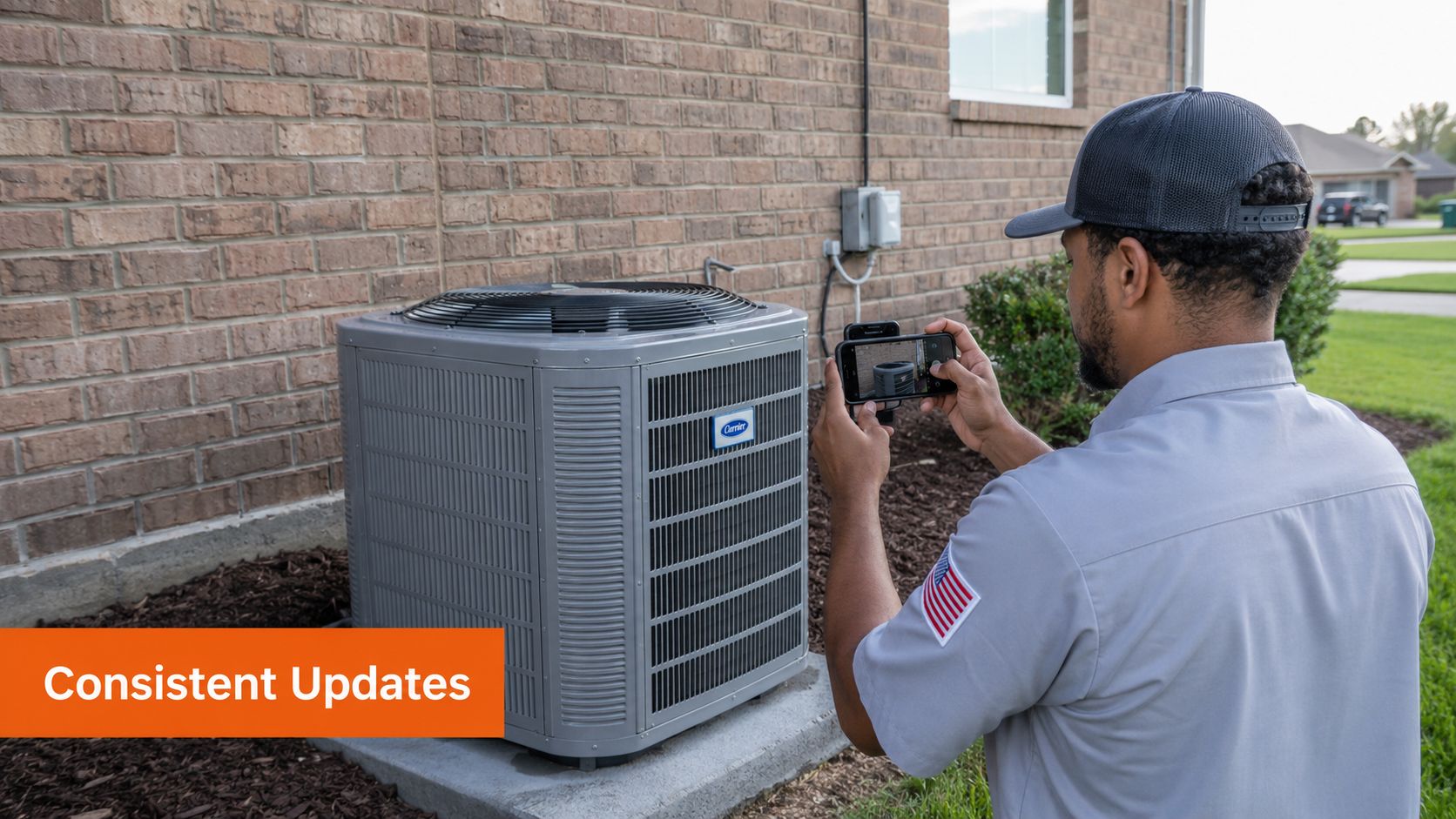
The problem is time. CI Web Group's HVAC guide notes that DIY online marketing requires 15–20 hours weekly, which most owners can't sustain. That's why profiles often start strong and then go quiet once the phones pick up again.
You don't need daily essays. You need a repeatable rhythm. If the office can gather photos and the field team can flag simple job updates, the business can maintain a steady stream of local proof without turning every tech into a marketer.
A useful reference point is this tag page on content marketing for contractors, especially if you're trying to keep posting practical rather than promotional.
What to automate and what to keep human
Automation works best on the repetitive parts. Humans should still handle the pieces that affect trust directly.
Use automation for:
- Scheduling routine posts
- Reformatting job photos into simple updates
- Keeping publishing consistent across platforms
- Reusing seasonal topics when demand changes
Keep these human:
- Review responses: Customers can spot robotic replies.
- Photo selection: Bad photos make good work look average.
- Service claims: Only publish what you offer and where you work.
Consistency beats bursts. An active profile every week does more for trust than a flood of posts followed by silence.
You can also create a light content system around the jobs you're already doing:
- Tech snaps one photo at the end of a completed job.
- Office logs the suburb and service type.
- A simple post goes out later with a plain description.
- The profile stays active even when the team is flat out.
Houston SEO for HVAC isn't only about pages and profiles. It's also about the signals that show a real business is still active in real neighborhoods. Consistent posting supports that without adding another impossible task to the owner's week.
Your Simple Plan for Steady Work
The contractors who stay visible in Houston don't always have the biggest crews or the flashiest branding. They usually have a tighter system. Their map listing looks active, their pages match the services and neighborhoods they want, their site makes it easy to call, and their profiles don't sit silent for months.
That consistency matters because Searchlight Digital reports that over 70% of HVAC searches include local modifiers like "near me". In other words, local intent drives the search. If your business isn't showing strong local signals, you're missing people who are ready to book now.
Houston SEO for HVAC works when you stop treating it like a side project and start treating it like part of operations. Not complicated. Just consistent. Tighten the map listing. Build the right local pages. Fix the mobile experience. Keep your profiles active even when the schedule gets busy.
Most owners don't need more marketing theory. They need fewer gaps. Close those gaps, and the quieter weeks get a lot less unpredictable.
If you want a simpler way to keep your business visible without handling every post yourself, GrowTradie helps trade businesses stay active with professionally generated local content and auto-posting. It's built for busy contractors who need steady awareness, stronger trust, and more real enquiries without turning content into another job on the list.