

One week the phone won't stop. The next week it's quiet, and you're wondering whether to spend your evening chasing leads, posting on Facebook, or just getting tomorrow's jobs sorted. Most tradies don't have a marketing problem in the abstract. They've got a consistency problem caused by real life. Quotes, site visits, staff issues, suppliers, weather, late payments. Content gets pushed to the bottom of the list.
That's why random posting rarely helps. A photo goes up when a job looks good. A quick offer gets posted when work slows down. Then nothing for two weeks. From the customer side, that silence looks like inactivity. From your side, it feels like marketing doesn't work.
A small business content strategy fixes that, but not in the way most guides talk about it. For trades, the point isn't to build an audience across the country. It's to stay visible in the suburbs and towns where you want work, so local people remember your business when they need a quote.
Table of Contents
- From Guesswork to Guaranteed Visibility
- Define Your Goals and Local Audience
- Build Your Content Pillars and Choose Your Platforms
- A Toolkit of Ready-to-Use Content Ideas
- Automate Your Schedule and Measure Real Results
- Your Path to Consistent Local Work
From Guesswork to Guaranteed Visibility
A lot of trade businesses run on reputation, referrals, and whatever work comes in from being known locally. That's fine until the flow becomes uneven. You get a busy stretch, stop posting because you're flat out, then hit a quiet patch and try to restart from scratch. The pattern keeps repeating.

Why random posting fails
Most tradies aren't lazy with marketing. They're busy. The usual setup looks like this:
- Work comes first: Jobs, quotes, invoicing, and admin always beat writing a post.
- Posting happens reactively: You post when work is slow or when you remember.
- Results stay patchy: Some posts get attention, others do nothing, so the whole thing feels unreliable.
That pattern has a cost. The majority of small businesses operate without a documented plan, and those with an irregular posting schedule suffer a 40% lower average reach compared to those who post consistently, according to 2025 research summarised here.
Practical rule: If your content only appears when you've got spare time, your visibility will always rise and fall with your workload.
The issue isn't creative quality. It's the absence of a repeatable system. A tradie who posts useful local content every week will usually stay more visible than a tradie who posts ten times in a burst and then disappears.
What reliable visibility looks like
Reliable visibility is simple. People in your service area keep seeing proof that you're active, local, and trustworthy. They see photos from recent jobs, short bits of advice, a team update, maybe a post about a suburb you work in often. Then when something breaks or needs quoting, your business feels familiar.
That's what a small business content strategy should do for a trade business. Not turn you into a full-time marketer. Not create complicated campaigns. Just build a steady presence between jobs.
A workable plan usually has three parts:
- Clear targets: Know which services and areas matter most.
- Repeatable topics: Stop inventing new ideas from scratch every time.
- A set schedule: Make posting happen whether you remember or not.
If you've ever thought “we do good work, we're just not visible enough,” you're probably right. The fix is usually less about doing more and more about doing the basics every week.
Define Your Goals and Local Audience
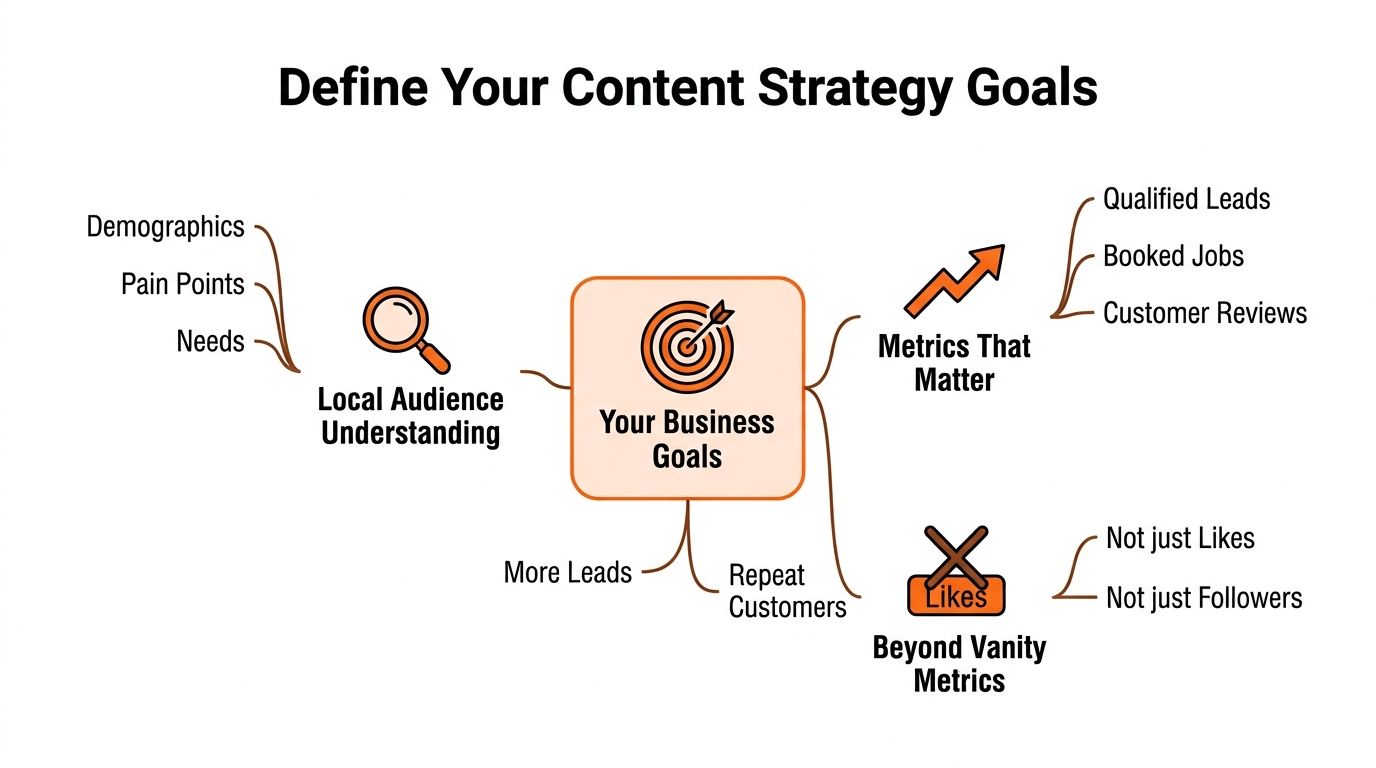
Before you pick platforms or content ideas, decide what success means. For a trade business, that's not more followers for the sake of it. It's more of the right local enquiries.
Start with booked jobs, not attention
Plenty of tradies get distracted by numbers that don't pay the bills. Likes feel good. A post that gets shared around locally feels even better. But if that attention doesn't turn into calls, messages, quote requests, or repeat work, it's noise.
Use these questions instead:
- Which jobs do you want more of? Emergency callouts, higher-margin installs, maintenance work, larger renovation jobs.
- Which areas matter most? The suburbs, towns, or postcodes where you can win profitable work.
- Which customers are the right fit? Homeowners, property managers, builders, landlords, small commercial clients.
- What action should content drive? Call now, message for a quote, book an inspection, ask about availability.
When you answer those questions, your content gets sharper. A post about a switchboard upgrade in a target suburb does more for an electrician than a generic “happy Monday” graphic ever will.
Good trade content should answer one question before it's posted. Will this help the right local person trust us enough to get in touch?
Map the people and places you want
The best local content starts with what customers ask. Look through recent messages, call notes, and comments. Notice the repeat patterns. People usually ask the same things in different words. Cost concerns. Timing. What's involved. Whether you service their area. Whether a problem is urgent.
Build a simple audience sketch around that:
| What to define | Useful example |
|---|---|
| Primary service area | North Brisbane suburbs you already service weekly |
| Best-fit customer | Homeowners with older properties |
| Common problem | Faulty wiring, old fittings, safety concerns |
| Content angle | Show recent local jobs and explain fixes in plain English |
That local detail matters. Trade businesses using localized content, such as mentioning specific neighborhoods or posting photos from local jobs, generate three times more inbound calls than those using generic posts, according to this 2025 summary.
That's why a local-first small business content strategy works better for tradies than broad brand content. You don't need to reach everyone. You need the right people in the right area to recognize your name when the need shows up.
A quick test helps. Read your last five posts. If they could have been written by a trade business anywhere in the country, they're too broad. If they mention real places, real services, and real customer problems, they're moving in the right direction.
Build Your Content Pillars and Choose Your Platforms
Once you know who you want to reach, stop thinking post by post. Build a small set of themes you can repeat without running out of ideas.
Pick a small set of repeatable themes
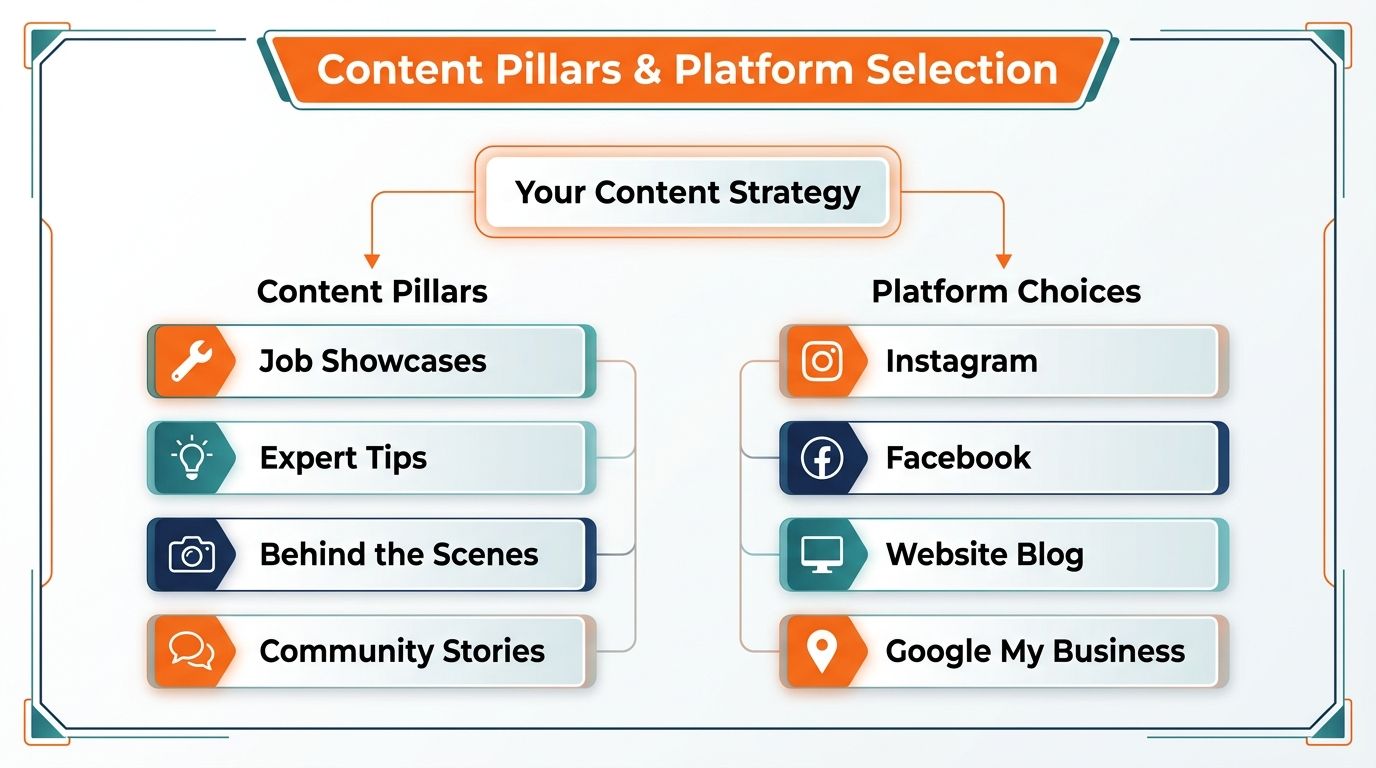
A successful strategy requires establishing 3 to 5 content pillars and committing to 3 months of consistent posting before measuring results. Businesses that do this avoid the “3-month drop-off,” where 70% of small businesses abandon their strategy too early, according to this expert summary.
For tradies, the strongest pillars are usually practical, not clever. Good examples:
Job showcases
Before-and-after photos, progress shots, finished installs, repaired faults, project highlights from real local work.Expert tips
Short advice posts that answer common customer questions. What to do before calling. Warning signs to watch for. What a process involves.Behind the scenes
Team on site, tools in use, vans, materials, prep work, site safety, workshop activity. This makes the business feel active and real.Community stories
Work completed in a local suburb, support for a local event, a quick mention of seasonal local demand, or a thank-you to a nearby supplier.Trust builders
Customer feedback, licences, qualifications, warranties, process explainers, and what customers can expect when they book.
If you need help shaping those themes into a practical posting system, this guide on social media marketing for contractors is a useful companion.
Choose platforms you can actually maintain
Most tradies don't need to be everywhere. They need a couple of channels they'll keep updated.
I'd usually keep it tight:
- Google Business Profile for visible updates tied to local searches and customer trust.
- Facebook for community familiarity, local groups, comments, and messages.
If you already enjoy taking good photos or short videos, Instagram can support the same content. But don't build your whole small business content strategy around channels you hate using or won't keep current.
The strongest platform is usually the one your team can feed every week without drama.
Posting across too many channels creates admin, not momentum. One clear photo posted in the right place with a local caption beats five half-hearted reposts.
Later in the week, this short video helps make the platform choice issue practical rather than theoretical.
Commit long enough to judge it properly
Many tradies quit content because they expect instant proof. That's the wrong test. Customers often need to see your business more than once before they call. Local trust builds through repetition.
So judge your setup on questions like these:
- Are we posting regularly enough to stay visible?
- Are our posts tied to the jobs and areas we want?
- Are people messaging, calling, or mentioning that they've seen our work?
If the answer is no, don't scrap the whole thing. Tighten the pillars, simplify the platforms, and keep going long enough to see a pattern.
A Toolkit of Ready-to-Use Content Ideas
Many tradies struggle at this stage. Not because they don't understand the strategy, but because they don't know what to post on a Tuesday afternoon when they've just finished a job and need something quick.
Job spotlight posts
These are the easiest win because you're already doing the work. You just need to document it.
Use a simple format:
- Where was the job? Mention the suburb or local area.
- What was the issue? Keep it plain.
- What did you do? Explain the fix or install.
- What should the customer do next? Prompt a call or message.
Example template:
Finished a hot water replacement in [suburb] today. The old system had been unreliable for weeks and finally gave out. We removed the existing unit, installed the new system, tested it properly, and made sure everything was running as it should. If you're dealing with the same issue in [service area], send us a message to book a quote.
A few things make these posts work better:
- Use real photos: Wide shot, close-up, finished result.
- Name the service clearly: Don't make people guess what you do.
- Keep the caption grounded: Write like a tradie, not a brand manager.
Expert tip posts
Tip posts help when you don't have a fresh project photo or want to show authority without sounding salesy.
Good prompts for trades:
- What problem do customers ignore too long?
- What should a homeowner check before calling?
- What mistake costs people more later?
- What question do you answer every week?
Example template:
Quick tip for homeowners in [area]. If your lights are flickering in more than one room, don't assume it's just a bulb issue. It can point to a bigger electrical problem that needs checking properly. If you've noticed that happening, get it looked at before it turns into a more expensive repair.
These posts work because they lower the barrier to contact. A customer sees that you understand the issue and explains it clearly.
For more examples in this style, these ideas for behind-the-scenes content fit trades especially well because they build trust without requiring polished production.
Team and trust posts
Not every post needs to show a finished job. Sometimes people just want proof that there are real people behind the business.
Try posts like:
- A van loaded up for the day's work
- A team member on site
- Tools and materials prepped for a specific job
- A short note on how you handle quotes, communication, or scheduling
- A customer review turned into a simple graphic
Short example:
Big day across [local area] today. The team's out handling maintenance jobs and a new install. If you've been meaning to organise work before the week fills up, now's a good time to get in touch.
Using tools to keep content moving
Writing and posting everything manually is where most good intentions die. That's especially true if you're a small crew and the owner is also the estimator, scheduler, and problem-solver.
One practical option is GrowTradie, which creates trade-specific posts based on your services and location, designs them, and schedules them automatically. That suits businesses that want a consistent presence without writing every caption from scratch.
You can also keep it manual with a notes app, a shared photo folder, and a basic scheduling routine. Either way, the standard is the same. Content has to keep going out even when work gets busy.
Automate Your Schedule and Measure Real Results
If content depends on spare time, it won't last. The only setup that survives busy periods is one that's planned ahead and scheduled.
Build a schedule you can stick to
Don't start with an unrealistic posting target. A simple weekly rhythm is enough if you can maintain it. The point is to stay present, not flood people's feeds.
Here's a sample structure for a plumbing business:
| Day | Platform | Content Pillar | Example Post Idea |
|---|---|---|---|
| Monday | Job Showcase | Recent hot water system replacement in a local suburb | |
| Tuesday | Google Business Profile | Expert Tip | Signs your pipes need attention before a bigger issue develops |
| Wednesday | Behind the Scenes | Van stocked for the day with a short note on the week's jobs | |
| Thursday | Google Business Profile | Trust Builder | What customers can expect when booking a quote |
| Friday | Community Story | Finished work in a nearby area and a thank-you to the client |
That kind of plan is much easier to maintain when you batch it. Set aside a small block of time once a week. Pick your photos, write your captions, load them in, and let the schedule handle the rest.
If you want a broader view of how tradies can systemise this process, this article on content marketing for contractors adds useful context.
Track actions that lead to work
A lot of businesses stop at “that post did well.” That's too vague. You need to know whether content is creating contact.
Useful things to watch:
- Calls from your business profile
- Direct messages asking about availability
- Quote requests through your site
- Customers mentioning a suburb-specific post or recent job they saw
- Repeat patterns in the posts that bring the best enquiries
Measure this instead: Which posts make local customers contact you, and which ones get attention without action?
That's the difference between content as activity and content as a sales support tool.
Know if the effort is paying off
You don't need a complicated reporting setup to judge results, but you do need to count the cost of content. Content ROI is calculated with the formula (Revenue from content – Content costs) / Content costs × 100, as explained in this guide to content ROI measurement.
For a trade business, content costs usually include:
- Your time: Writing, reviewing, posting, or gathering photos
- Tools: Scheduling or content software
- Design or admin help: If someone else handles part of the process
Then compare those costs against jobs you can reasonably connect to content activity. Not every job will have a perfect trail, but the trend becomes clear if you're paying attention. If local posts drive calls and calls turn into quotes and booked work, the system is doing its job.
Your Path to Consistent Local Work
The strongest small business content strategy for tradies is usually the simplest one. Pick the local jobs you want more of. Focus on the areas that matter. Create a handful of repeatable content themes. Put them on a schedule that doesn't depend on motivation.
You don't need to become a marketing expert. You need a process that keeps your business visible when you're on the tools, driving between jobs, or catching up on admin after hours.
Start small if that's what makes it doable. One or two useful posts a week is far better than a burst of effort followed by silence. Stay local, stay clear, and make every post answer a customer question, show real work, or build trust.
That's how content stops being fluff and starts helping you win more work nearby.
If you want a simpler way to stay visible without writing every post yourself, GrowTradie is built for trade businesses that need consistent local content and automatic posting while they focus on the actual work.