
You’re probably doing what most tradies do. You finish a job, answer calls in the ute, chase invoices at night, and tell yourself you’ll sort marketing later. Then a quiet patch hits and suddenly “later” feels expensive.
That’s why content marketing for contractors matters. Not because you need to become a marketer. Because you need a simple system that keeps your business visible while you’re busy doing actual work. If your online presence goes quiet every time the phone rings, you’re not marketing. You’re disappearing.
Table of Contents
- Why Most Marketing for Contractors Falls Short
- The Five-Minute Content Plan for Your Trade
- Creating Content Without Wasting Time
- A Simple Schedule to Stay Consistently Visible
- Turning Local Attention into Booked Jobs
- How to Know If Your Content Is Actually Working
Why Most Marketing for Contractors Falls Short
Most marketing advice for contractors is built for people with time, staff, and spare budget. That’s not you. You’re quoting jobs, managing work, fixing problems, and trying to keep the week full.
So the usual options fall apart fast. Traditional ads cost money upfront. Random posting takes time you don’t have. And word-of-mouth only works when the pipeline is already warm.

Here’s the part most tradies miss. Contractors who invest in content marketing generate 54% more leads than those relying on traditional advertising methods, according to contractor marketing statistics compiled here. That should change how you think about marketing.
The real problem isn't effort
The problem usually isn’t that you’re lazy. It’s that the plan is wrong.
A lot of contractors treat marketing like a one-off push:
- Run ads when work is slow
- Post a few photos after a big job
- Update the page when someone reminds you
- Stop as soon as the schedule gets busy
That approach creates a feast-or-famine cycle. Quiet month, panic marketing. Busy month, silence. Then the pipeline drops again.
Practical rule: If your marketing only happens when you’re desperate, it will always feel expensive.
What actually works for busy tradies
You don’t need a grand brand strategy. You need a basic presence that keeps showing people three things:
| What people want to know | What your content should prove |
|---|---|
| Can this contractor do the job? | Show finished work and simple explanations |
| Can I trust them in my home? | Show professionalism, reviews, and clear communication |
| Are they active in my area? | Mention locations, job types, and real local work |
That’s why content marketing for contractors works better than the old stop-start approach. It builds trust before the call. It gives people proof. It keeps your business visible between referrals.
The goal isn’t to become famous online. The goal is to stay present, look credible, and make it easy for the right local customer to contact you.
The Five-Minute Content Plan for Your Trade
Most contractors get stuck on one question. “What do I even post?”
You don’t need endless ideas. You need a short list of repeatable topics. Good content marketing for contractors is boring in the best way. It runs on the same reliable themes, over and over, because customers ask the same questions, want the same proof, and make the same checks before they hire.
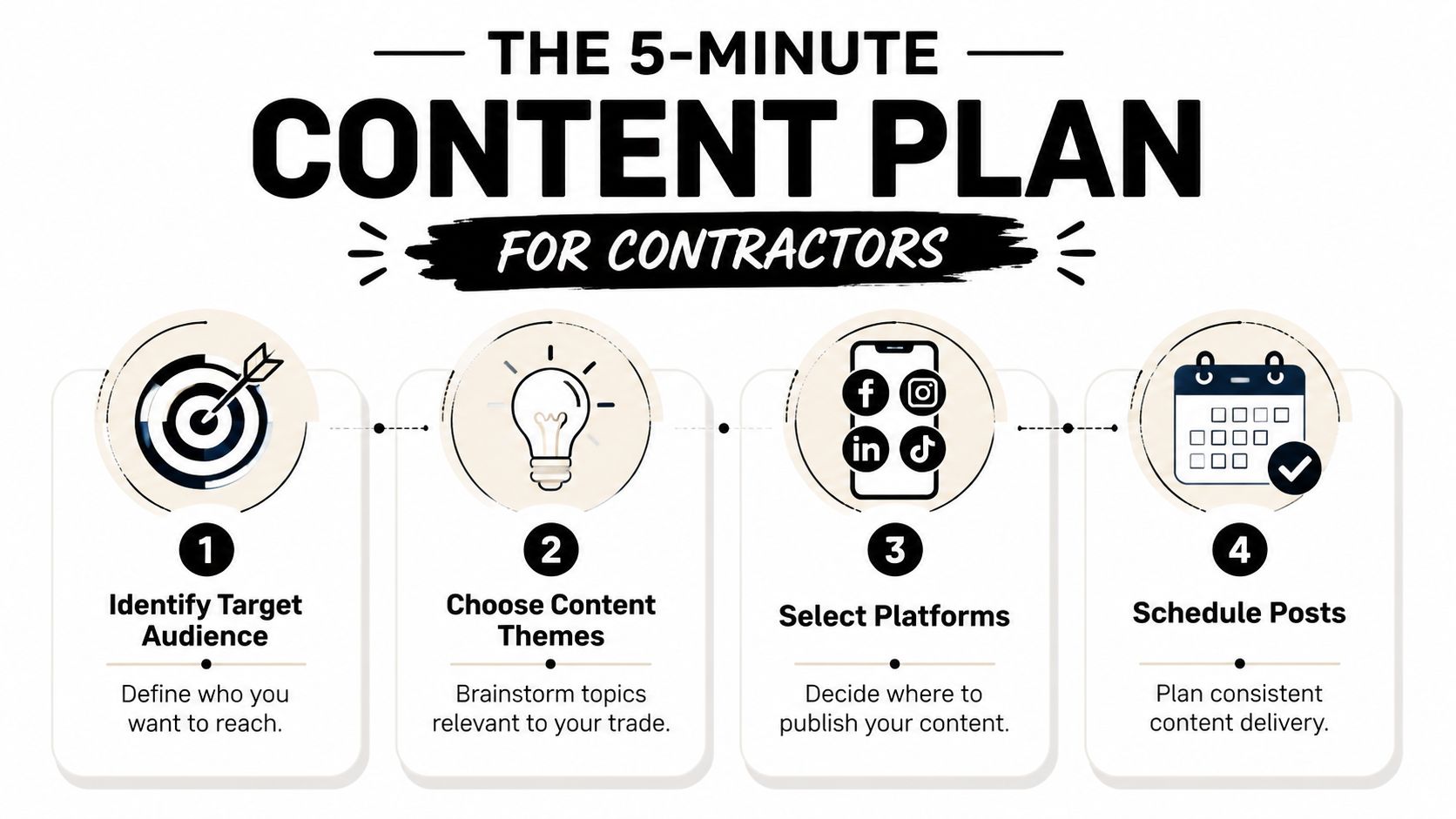
The four post types that cover almost everything
Use these four pillars and stop overthinking it.
Common questions
Take the things customers ask on calls every week and turn them into short posts. “How long does a hot water system replacement take?” “What causes power points to stop working?” “What should you do before an HVAC service visit?”Finished work
People trust what they can see. Post before-and-after shots, progress photos, or one clean image from a completed job with a plain-English caption.Your way of working
This is where you show the human side. Turn up on time. Clean handover. Good communication. Respect for the client’s home. Don’t write fluff. Show what makes dealing with you easy.Customer proof
If a client says, “Great job, fast turnaround, very easy to deal with,” that’s content. A screenshot, a short quote, or a quick summary is enough.
The best posts usually come from work you already did and questions you already answered.
Build your backlog once
Don’t make a fresh decision every day. Sit down once and write 10 to 15 post ideas across those four pillars. Keep them in your notes app, Google Docs, or Trello.
Here’s a simple version:
- Three FAQs from recent calls
- Three job highlights from completed work
- Three trust posts about how you work
- Three customer comments or review-based posts
That’s enough to get moving without staring at a blank screen.
Keep the ideas dead simple
A good post idea for a contractor sounds like this:
- Plumber: Why your hot water keeps running cold
- Electrician: What to do when a safety switch keeps tripping
- Carpenter: Three details that make a deck last longer
- HVAC tech: Signs your system needs servicing before summer
Bad ideas sound like brochures. Good ideas sound like things a customer would ask.
If you want content marketing for contractors to stay sustainable, build the list once, then reuse the themes. You’re not trying to entertain the internet. You’re trying to answer buyer questions before they pick up the phone.
Creating Content Without Wasting Time
Most tradies think content means sitting down to write. That’s the wrong model. The fastest content comes from the work itself.

A single job already gives you the raw material. According to this construction content guide, one jobsite visit can generate up to 10 assets. That includes photos, a video, social posts, and a case study. That’s the right mindset. Capture once. Reuse often.
Use the job you already did
Stop trying to invent content from scratch. Use this quick capture checklist on site:
- One before photo
- One after photo
- One close-up detail
- One short video clip
- One note on the problem
- One note on what you fixed
That’s enough for several posts without adding real work to your day.
Here’s a useful reference if you want more ideas for social media marketing for contractors.
Simple post templates that work
You do not need to be a copywriter. Use fill-in-the-blank captions.
Quick job post
“Finished this [job type] in [suburb]. The main issue was [problem]. We fixed it by [solution]. If you need help with [service], get in touch.”
FAQ post
“We get asked this a lot. [Question]? Short answer: [answer]. If you’re seeing [problem], it’s worth getting it checked before it gets worse.”
Before-and-after post
“Before, this [area/item] had [issue]. After the work, it’s now [result]. Clean job, solid finish, done properly.”
A short video can help too. Keep it practical, not polished.
Don't chase perfect
Most contractors delay posting because they think it has to look slick. It doesn’t. It has to look real, clear, and trustworthy.
Use your phone. Stand in good light. Keep captions short. Mention the actual service and suburb. Then move on.
Here’s a simple workflow that saves time:
| Step | What you do |
|---|---|
| Capture | Take a few photos and a short video on site |
| Note | Write one line about the problem and fix |
| Store | Drop it into a folder by job type or suburb |
| Reuse | Turn it into multiple posts over the next few weeks |
That’s how content marketing for contractors becomes manageable. You don’t create more work. You document the work you already do.
A Simple Schedule to Stay Consistently Visible
Brilliant posts won’t save you if you disappear for weeks at a time. Consistency matters more than creativity.
That’s not a theory. Inconsistency in posting can drop online visibility by 50%, and 80% of small contractors cite “no time” as their main barrier to marketing, according to this guide for contractors. If you only post when you remember, people stop seeing you.
Consistency beats clever
Most local customers won’t study your business. They’ll do a quick check. They’ll look at your recent activity, your work, and whether you seem active and reliable.
If your last post was months ago, that sends the wrong signal. It makes a solid business look half-asleep.
That’s why the best system is a boring one. Set a schedule. Batch the content. Let it run.
A quiet profile makes people wonder if you’re still in business.
Your set-it-and-forget-it rhythm
You do not need to post every day manually. You need a manageable rhythm you can maintain without thinking about it.
A practical weekly mix looks like this:
- One job post from recent work
- One FAQ post answering a common question
- One trust post showing how you work or sharing a review
- One optional extra if you’ve got a good photo or quick update
That gives your profile life without turning you into a full-time content machine.
Build once and schedule ahead
The easiest way to stay visible is to work in batches. Spend a short block of time gathering photos and writing rough captions. Then schedule them.
Use a simple process:
- Choose your next few posts
- Write short captions in one sitting
- Load them into a scheduling tool
- Let them publish while you get back to work
You’ll get better results from a plain system you stick with than a clever plan you abandon.
For content marketing for contractors, this is the line that matters. If it depends on daily motivation, it won’t last. If it runs in the background, it can keep bringing in attention while you’re on site, quoting, or off the tools for the night.
Turning Local Attention into Booked Jobs
Posting is only half the job. If people like what they see but don’t know where you work, what you do, or how to contact you, the post is wasted.
Local service businesses win when the next step is obvious. That means every piece of content should help a nearby customer decide, “Yep, this is the one I’ll call.”
Every post needs a local signal
Don’t write captions like a generic brand. Write like a local contractor.
Include things like:
Your service area
Mention suburbs, regions, or the local area you cover.The exact service
Say “switchboard upgrade,” “deck repair,” or “air conditioner installation.” Don’t hide behind vague wording.A real-world problem
Tie the post to what the customer was dealing with before you fixed it.
If you want your local presence to support more enquiries, this guide to local visibility for contractors is a useful next step.
Make the next step obvious
Visual content matters, but clarity matters more. As noted earlier, display ads can achieve 5% click-through rates compared with 3% for search ads, which shows that visual content with a clear call to action can pull stronger engagement. The lesson is simple. Show the work, then tell people what to do next.
Use direct calls to action:
- Call for a quote
- Message us to book
- Send a photo for advice
- Get in touch for availability in your area
If someone has to guess how to contact you, you’ve added friction you didn’t need.
Reply like a professional
A lot of booked jobs come from small moments. Someone comments on a post. Someone sends a message after seeing a project photo. Someone asks if you cover their suburb.
Reply clearly. Reply fast. Reply like someone people would trust in their home.
Good content marketing for contractors doesn’t stop at visibility. It turns local attention into action by removing doubt, making contact simple, and showing that you’re active, nearby, and ready to help.
How to Know If Your Content Is Actually Working
Most contractors look at likes and assume that’s the result. It isn’t. Likes don’t pay wages.
A lot of advice in this space is weak on measurement. Many guides fail to give trades a simple way to track return, leaving up to 70% of small businesses without clarity on whether online activity leads to booked jobs, according to this contractor content strategy article.
Ignore vanity metrics
A post can get attention and still bring in nothing. What matters is whether your content creates real conversations with real local buyers.
You don’t need a complicated dashboard. You need a few plain signals you can track.
Track these three things instead
Use this short scorecard:
| What to track | Why it matters | How to track it |
|---|---|---|
| Enquiries that mention your posts | Shows content is starting conversations | Ask every lead how they found you |
| Calls or messages after posting | Connects activity to response | Note the days good posts go live |
| Quotes and jobs from social activity | Shows business impact | Mark leads in a spreadsheet or CRM |
Ask one question every time: “How did you hear about us?”
If someone says they saw your work online, that counts. If they mention a project photo, a tip video, or your business page, that counts. Over time, patterns show up.
For contractors who want to tighten that pipeline, this page on lead generation for contractors is worth a look.
Bottom line: track enquiries, not applause.
If your content brings more messages, more quote requests, and more familiar “I’ve seen your work online” comments, it’s doing the job.
If you want a simpler way to stay visible without writing posts yourself, GrowTradie is built for that. It creates and posts trade-specific content for your business automatically, so your profiles stay active while you stay focused on the work. That’s the right setup if you want more consistent local attention without adding another job to your day.