
You're probably reading this between jobs, with one eye on a quote, one eye on your phone, and a customer waiting for an answer. This is often the case for many in the trades. You might spend the morning fault-finding a switchboard, replacing pipework, framing a wall, or servicing a unit. Then the afternoon gets eaten by pricing, scheduling, chasing suppliers, and replying to messages.
That's why the question what is a tradesman matters more than it sounds. It isn't just a dictionary definition. It's about what the job demands now. A tradesman is still judged by the quality of the work on site, but success also depends on how well the work gets quoted, organized, explained, and delivered.
Table of Contents
- What a Tradesman Really Is
- The Foundation of Skill and Craft
- Common Types of Trade Professions
- The Path to Becoming a Qualified Tradesman
- Understanding Key Industry Terms
- Thriving as a Tradesman in the Modern World
What a Tradesman Really Is
A customer calls about a leaking sink at 4:30 p.m. The fix itself might take half an hour. The rest of the job is harder. You need to diagnose it properly, protect the customer's home, explain the cause in plain language, price the work, source the right part, and keep the next booking from blowing out. That is what a tradesman does.
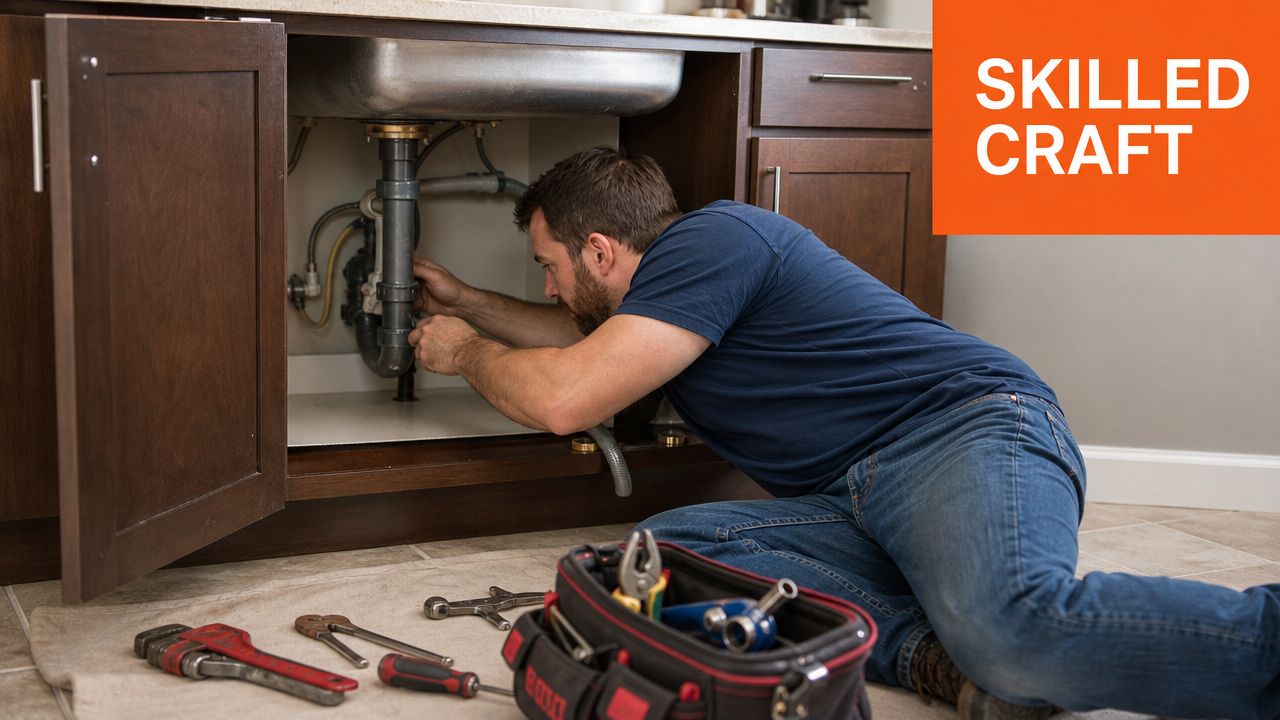
Plenty of people still reduce the role to manual work. That misses how the job works in practice. A tradesman is a skilled worker in a specific craft, but the role also carries responsibility for time, money, communication, safety, and customer trust.
The trade and the business
On site, the standard shows up in visible ways. The work is done properly. Risks are handled before they become callbacks. Problems get explained clearly, not hidden behind jargon. Good tradesmen do not just complete tasks. They make decisions that protect the customer, the property, and the business.
That business side matters more than many people expect.
A plumber, sparkie, chippy, or HVAC tech may spend part of the day on the tools and the rest quoting, ordering materials, chasing payments, updating schedules, or dealing with a customer who wants the job done faster than the job can safely be done. Even sole operators wear both hats. They are tradespeople and business operators at the same time.
That is where many good workers get caught out. Strong technical ability can win work. It does not guarantee profit, repeat customers, or a week that runs on time.
A modern tradesman needs a few things working together:
- Craft skill: The work meets standard and holds up.
- Judgment: Shortcuts get spotted early and avoided.
- Responsibility: Safety, compliance, and property damage are treated seriously.
- Customer handling: Expectations are set clearly before small issues turn into disputes.
- Basic business control: Quotes, scheduling, invoicing, and cash flow are managed properly.
Older definitions focus heavily on the craft itself. The craft still sits at the centre of the role. But in the current market, a tradesman is also the person accountable for how the work is sold, delivered, documented, and followed up.
That broader definition reflects how the job works.
The Foundation of Skill and Craft
A homeowner points to a wet ceiling. A site manager wants the fix done before the next trade arrives. The problem looks simple for about thirty seconds.
Then the main work starts.
A tradesman has to find the cause, not just the symptom. Water stains can come from failed flashing, a split pipe, bad fall, poor sealing, or work done out of sequence by someone else. Skill starts with diagnosis. Craft is applying the right fix so the job holds up after handover, not just on the day of the repair.
How real trade skill gets built
Trade skill is built the hard way. Repetition. Supervision. Training. Mistakes caught early by someone who already knows where jobs go wrong.
That process matters because site conditions are rarely clean or predictable. Materials vary. Access is poor. Previous work can be wrong. Plans do not always match what is behind the wall or under the slab. A qualified tradesman learns how to adjust without drifting outside the standard.
Experience also changes how work is approached. New hands often focus on the task in front of them. Good tradesmen think two or three steps ahead. They know which checks to do before cutting, isolating, fixing, or signing off. That saves time, limits rework, and reduces the kind of mistakes that turn a profitable job into a warranty call.
Specifications are part of the craft
Skill on the tools is only part of the job. A tradesman also has to read the job properly.
Specifications set the rules for materials, installation methods, tolerances, finishes, and performance. Some jobs tell you exactly what product and method to use. Others set the required outcome and leave more room for judgment. The UK government's technical specifications guidance outlines that distinction clearly.
Here is what that means on site:
| Type of specification | What it means on site | Why it matters |
|---|---|---|
| Prescriptive | Use the stated material, fitting, product, or method | Keeps work aligned with contract requirements and reduces avoidable disputes |
| Performance | Meet the required outcome, even where method choice is flexible | Calls for stronger judgment, better product knowledge, and clear documentation |
The trade-off is simple. Prescriptive specs limit freedom but lower decision risk. Performance specs allow better solutions in the right hands, but they can expose weak judgment fast.
What skill looks like in practice
A labourer can follow instructions. An apprentice can carry out work under guidance. A tradesman understands why the detail matters.
That difference shows up in ordinary moments. An electrician checks load, protection, and testing requirements before closing up. A plumber looks at pressure, fall, access, and future maintenance, not just the leaking joint. A carpenter checks level, movement, fixing points, and the finish that comes after their part of the job.
Neat work helps. It is not the standard.
A clean install can still fail inspection, cause damage, or create a callback if it ignores the spec, the sequence, or the actual use of the system. That is why craft still sits at the centre of the trade. It is technical skill applied under pressure, with real consequences for safety, reputation, and margin.
The best tradesmen know one more thing. Good workmanship does not stop at doing the job right. It includes documenting changes, protecting the next stage of the build, and leaving no mess for the customer or the next trade to sort out. That is craft with professional discipline attached to it.
Common Types of Trade Professions
When people ask what is a tradesman, they're usually thinking of a handful of familiar jobs. In reality, the term covers a wide group of skilled professions. Each one has its own tools, training path, and standards.
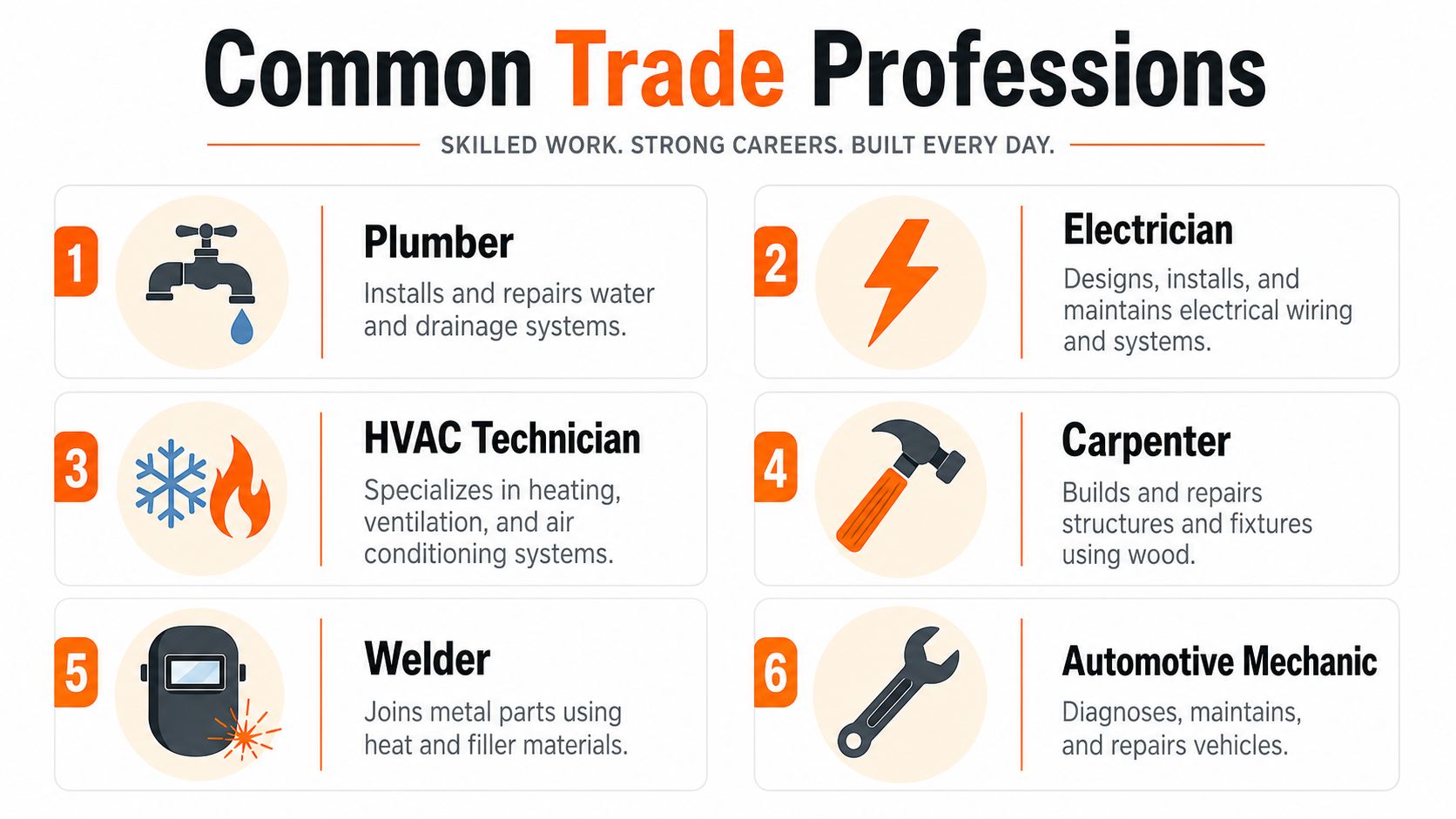
This visual gives a quick snapshot of some of the most common ones.
The trades most people deal with directly
Some trades are highly visible because customers deal with them in homes, workplaces, and job sites all the time.
- Plumbers handle water supply, drainage, fixtures, valves, and pipe systems. Their work often combines fault-finding with installation.
- Electricians install and maintain wiring, panels, circuits, fittings, and electrical components. Precision matters because safety is always on the line.
- HVAC technicians work on heating, ventilation, and air conditioning systems. Their jobs often mix mechanical, electrical, and diagnostic work.
- Carpenters build, repair, and fit structural and finish elements using wood and related materials.
A short video can help make that variety more concrete.
Other skilled trades that matter just as much
Not every trade is front-of-mind for the average customer, but the work is no less specialized.
- Welders join metal parts using heat and filler materials. Their work shows up in fabrication, structural steel, repairs, and industrial settings.
- Automotive mechanics diagnose, maintain, and repair vehicles. That means working with mechanical systems, electronics, and troubleshooting procedures.
- Bricklayers, roofers, painters, tilers, glaziers, and plasterers all sit under the broader skilled trades umbrella too.
The common thread isn't the material. It's the level of competence required.
What ties these professions together
The trade itself may change, but the standard doesn't. Across different professions, the tradesman has to interpret requirements properly and deliver work that meets safety and performance expectations. That's why the earlier point about specifications matters so much in real trade work.
The trade changes. The discipline doesn't. Skilled workers still have to read the job properly, choose the right method, and finish to standard.
If you're hiring, that's what you're paying for. If you're entering the trades, that's the bar you're stepping up to.
The Path to Becoming a Qualified Tradesman
Nobody becomes a tradesman by picking up a tool belt and calling themselves one. The path is structured. It takes time, supervision, formal learning, and proof of competence.
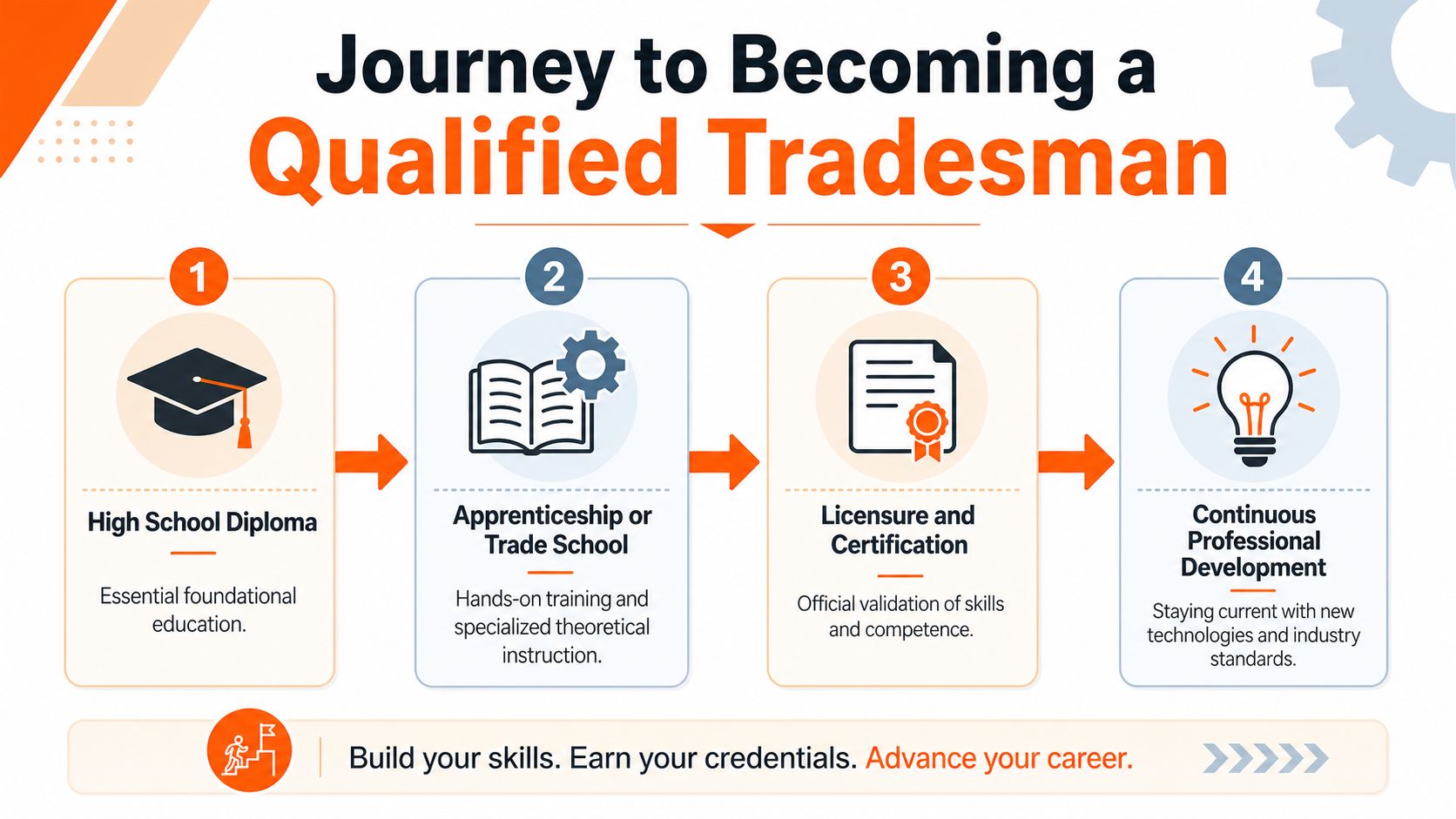
The usual route into the trade
In the United States, skilled tradesmen qualification guidance states that the median annual wage for skilled tradesmen was $48,610, and all professions require the worker to be at least 18 years old and possess a high school diploma or equivalent as a baseline qualification before entering apprenticeship or trade school programs.
After that, the route usually looks like this:
Start with the basics
School-level education matters more than some people admit. Reading plans, measuring accurately, understanding instructions, and doing calculations all depend on it.Choose training that leads somewhere
Trade school can give you structured theory. Apprenticeships give you supervised job experience. The best route depends on the trade and local licensing rules.Build hours and competence on real jobs
Practical application tests theory. Faults don't appear in tidy textbook format on site.Get licensed or certified where required
In many trades, especially regulated ones, credentials aren't optional. They're part of operating legally and professionally.
For anyone looking at a plumbing route specifically, this guide on how to become a master plumber shows how the progression develops over time.
Qualification is more than paperwork
Credentials matter because customers, builders, and commercial clients want proof that the person doing the work is competent. In some jurisdictions, the legal definition is very specific. For example, Hong Kong recognizes a qualified tradesman through approved trade certification or apprenticeship pathways under formal regulatory frameworks, as detailed in the works bureau technical circular.
That legal framing gets to the heart of the issue. Qualification isn't just a badge. It draws a line between someone who is still developing and someone trusted to carry the responsibility.
What serious operators don't skip
The strongest tradesmen treat professionalism as part of the trade, not an add-on.
- Insurance: Protects the business when work, property, or liability issues arise.
- Documentation: Quotes, variations, records, and sign-offs protect both sides.
- Ongoing development: New products, updated rules, and new systems mean the learning never stops.
A reliable tradesman doesn't only know how to do the work. He knows how to prove it, document it, and stand behind it.
That's what turns a skilled worker into a dependable professional.
Understanding Key Industry Terms
A lot of confusion comes from people using trade terms loosely. On site, in contracts, and in customer conversations, those differences matter. If you use the wrong word, you can end up misunderstanding someone's skill level, role, or legal responsibility.
Tradesman and tradesperson
The word tradesman is still common, especially in construction and building contexts. Cambridge describes it in the skilled manual work sense in its tradesman dictionary entry. Tradesperson is the broader and more inclusive term, but in practice both usually point to someone working in a skilled trade.
For everyday use, the distinction is mostly about language rather than capability. The more important question is whether the person is trained, qualified, and operating within the scope of their trade.
Apprentice and journeyman
The job title matters more here because it signals where someone sits in the training ladder. As discussed in the HVAC community explanation of trade terms, a journeyman specifically refers to an individual who has finished their training and fulfilled the required work hours, and an apprentice is the trainee still in school and working under supervision. Tradesman is often used as a general term for anyone practicing in a skilled trade field.
A simple comparison helps:
| Term | What it usually means |
|---|---|
| Apprentice | A trainee learning under supervision |
| Journeyman | A worker who has completed training and required hours |
| Tradesman | A general label for someone practicing in a skilled trade |
That's why a person can be a tradesman and a journeyman at the same time, depending on how the term is being used.
Tradesman and contractor
This is another one that gets mixed up all the time. A tradesman does the skilled trade work. A contractor is often the person or business that holds the contract, manages delivery, and may hire multiple trades to complete the project.
If you want a practical breakdown of the licensing side, this guide on what a general contractor license means is a useful reference.
Don't assume the best person on the tools is also the right person to manage a whole project. Those are related skills, but they aren't the same job.
A sole operator can be both. A larger contractor may not personally do the trade work at all. That distinction matters when you're hiring, subcontracting, or setting customer expectations.
Thriving as a Tradesman in the Modern World
A tradesman used to be judged almost entirely by what happened on site. The work still comes first. Bad workmanship ruins everything else. But that old model no longer covers the full job.
Today, the tradesman who stays busy usually does more than skilled work. He runs a pipeline of quotes, responds quickly, keeps jobs organized, manages customer expectations, and keeps the business visible enough that the phone keeps ringing.

The role has widened
That change isn't just a feeling. The modern tradesman discussion states that the modern tradesman is now a hybrid professional: 40% of their day is spent on non-technical admin like marketing, booking, and quoting, a significant shift from the 15% historical average. Trades with active local social profiles receive 3.5x more inbound enquiries than those relying solely on word-of-mouth.
Those numbers match what many operators already know from experience. You can be excellent on the tools and still have slow weeks if people don't remember your name, can't see your work, or don't hear back from you fast enough.
What works and what doesn't
Some habits help a trade business grow. Others drain time and create chaos.
What works
- Clear quoting: Customers respond better when the scope is obvious and exclusions are stated upfront.
- Fast follow-up: A delayed reply loses good jobs.
- Consistent posting of real work: Before-and-after photos, project updates, team shots, and job insights build trust over time.
- Simple systems: Shared calendars, templates, and standard job notes stop details from slipping.
What doesn't
- Relying only on referrals: Referrals are valuable, but they're hard to control.
- Posting once, then disappearing: Inconsistent activity makes the business look inactive.
- Overcomplicating admin: If your system takes too long to maintain, you won't keep using it.
- Treating communication like a side issue: Customers notice silence faster than you think.
For tradies building a business from the ground up, this guide on starting a handyman business shows how operational basics shape long-term stability.
Craft still comes first, but visibility keeps it alive
There's no shortcut around competence. The market still filters out poor workmanship. But strong work alone doesn't guarantee a full schedule. People need a reason to trust you before they call, and a reason to remember you when they're ready to book.
The modern tradesman isn't just selling labor. He's selling confidence. Confidence that the job will be done right, explained clearly, and handled professionally from first contact to final invoice.
That's the answer to what is a tradesman now. A skilled specialist, yes. But also a business operator who can turn trade ability into repeatable, dependable work.
If you're good on the tools but struggle to stay consistently visible between jobs, GrowTradie helps trade businesses keep showing up without having to write posts, design graphics, or manually publish content. It's built for tradies who need a practical way to stay active, look credible, and turn attention into real enquiries.