

You've just finished a job, your van's packed, your phone is buzzing, and you remember your last post is three weeks old. That gap is bigger than it feels. For local customers scrolling after hours, quiet profiles look like a quiet business, and that usually sends them to the tradie who looks active, steady, and easier to trust.
That's why professional social media posts matter for trade businesses. They're not about chasing likes or trying to go viral. They're about staying visible in the places customers already spend time, which is significant when there are 5.79 billion social media user identities worldwide as of early April 2026, and people spend about 2 hours 21 minutes to 141 minutes per day on social media according to DataReportal's global social media statistics DataReportal's global social media statistics. For plumbers, electricians, carpenters, and other field-based trades, that kind of attention is valuable only when the business shows up consistently and looks like it's open for work.
Table of Contents
- Why Consistent Professional Posts Matter for Trade Businesses
- The Anatomy of a High-Performing Trade Post
- Caption Templates and Content Ideas for Tradies
- Image and Design Tips That Build Local Trust
- Scheduling and Automation for Busy Tradies
- Putting It All Together Into a Weekly System
Why Consistent Professional Posts Matter for Trade Businesses
A common pattern plays out after a long day on site. The job's done, the customer's happy, and then someone opens Facebook or Instagram to check the business profile. The last post is from six weeks ago, the logo photo is blurry, and the feed doesn't say much about what the company does.
That silence costs more than most tradies realise. People often use social profiles as a trust check, even if they never say so out loud. If a profile looks abandoned, it can make a solid local business feel smaller, busier, or less established than a competitor with a steady stream of professional social media posts.
Visibility works when it stays in motion
Trade work is local, which means the audience is local too. When your posts keep appearing in the feed, your business stays in the mix while homeowners, landlords, and property managers are still deciding who to call. The value here is repeated exposure, and it matters because familiar names get more consideration when the enquiry finally happens.
Practical rule: a business profile should feel like the workshop door is open. Not noisy, not pushy, just present.
Frequent posting has become normal across major platforms, with Hootsuite's 2025 guidance showing recommended cadences such as 3–5 Instagram posts per week, 1–2 Facebook posts per day, 2–3 X posts per day, 1–2 LinkedIn posts per day, and at least 1 Pinterest post per week. That does not mean every trade business needs to post at full speed, but it does show the standard has moved well beyond the occasional update.
Consistency beats bursts of effort
The businesses that win attention usually do not post in frantic bursts and then disappear. They settle into a rhythm that customers can recognise. A finished-job photo, a short tip, a team update, and a reminder about service areas all do more work than a once-a-month announcement ever will.
The best trade profiles also make contact easy. A customer should not have to guess whether to phone, message, or comment. Each post should give them a simple next move, because the point of visibility is enquiry, not decoration. If the feed looks active and the contact path is clear, the business feels easier to hire.
The Anatomy of a High-Performing Trade Post
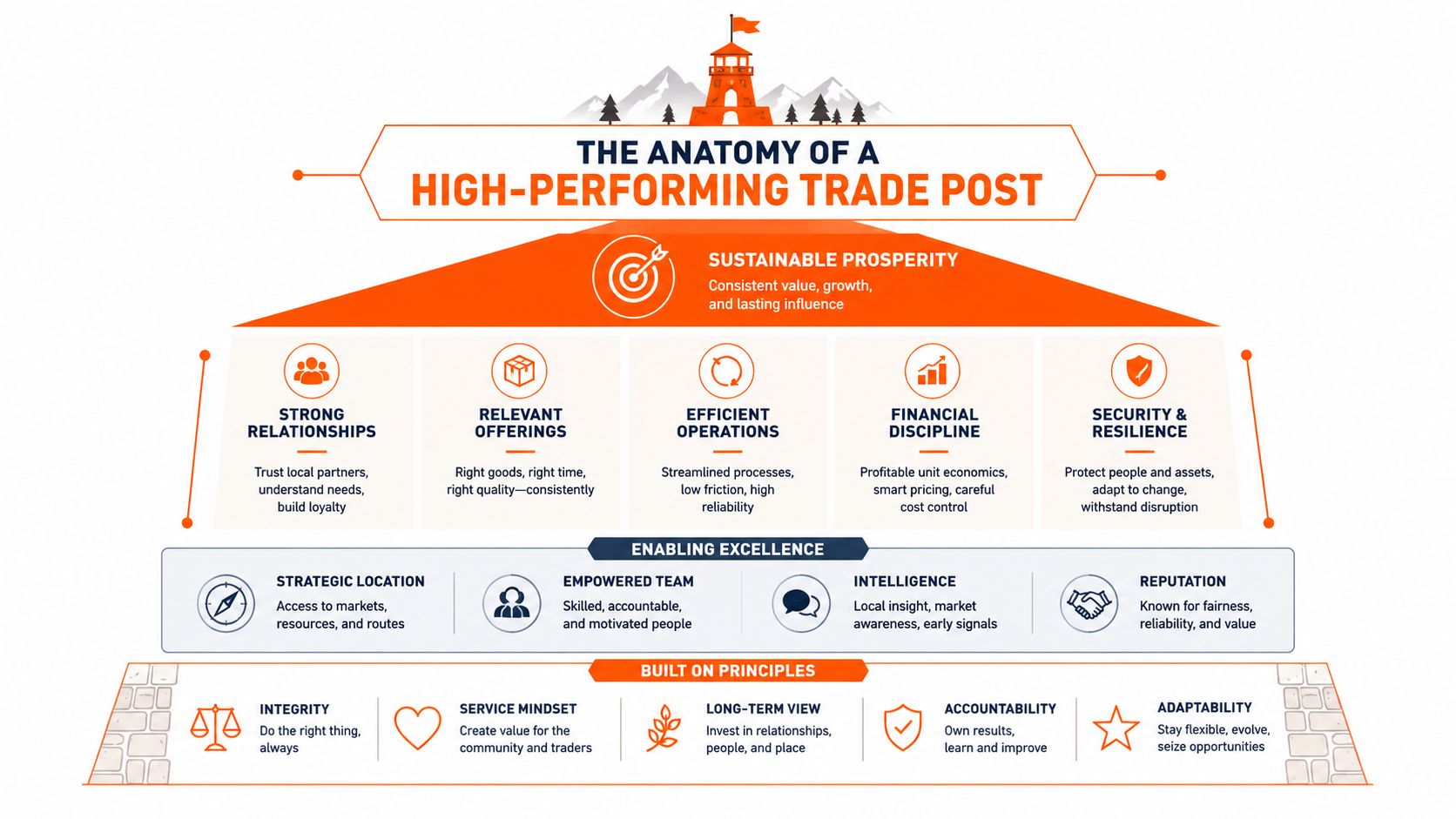
A strong trade post has a simple job. It needs to stop the scroll, prove the work is real, and tell people what to do next. If one of those pieces is missing, the post might still look nice, but it won't pull its weight.
Start with a hook that sounds like a real job
The opening line should feel useful, specific, and local. “New switchboard upgrade in Penrith today” is far stronger than a generic “Another great project completed.” The first version tells the reader what happened and hints at the area, which helps the post feel grounded in the business's actual work.
The hook doesn't need to be flashy. It needs to create context fast. For a carpenter, that might be a repair to weathered decking. For a plumber, it could be a hot water issue on a cold morning. The more immediately recognisable the situation, the more likely the right customer keeps reading.
Prove the result, don't just announce it
Every high-performing trade post needs some evidence. That could be a before-and-after photo, a short note about the fault found, or a quick explanation of the fix. The point is to show competence without turning the caption into a technical report.
A useful structure is straightforward:
- What was the problem? State the issue in plain language.
- What did you do? Mention the work completed.
- Why does it matter? Explain the practical outcome for the customer.
That proof element is what separates a real working business from a feed full of stock-style noise. It gives people a reason to believe the post reflects actual trade quality.
End with a local call to action
A good call to action is specific. “Call for same-week bookings in Geelong” works better than “Get in touch today.” The reader needs a next step that feels easy and relevant to where they live.
For service businesses, local wording matters because it filters for the right audience. If you work across several suburbs, include the ones you want to attract most often. If you're focused on one area, say so clearly. That small detail makes professional social media posts feel more intentional and less generic.
A final point on tone. Captions work best when they sound like the person doing the job wrote them, not a marketing agency trying too hard. Short, direct, and practical usually wins.
Caption Templates and Content Ideas for Tradies
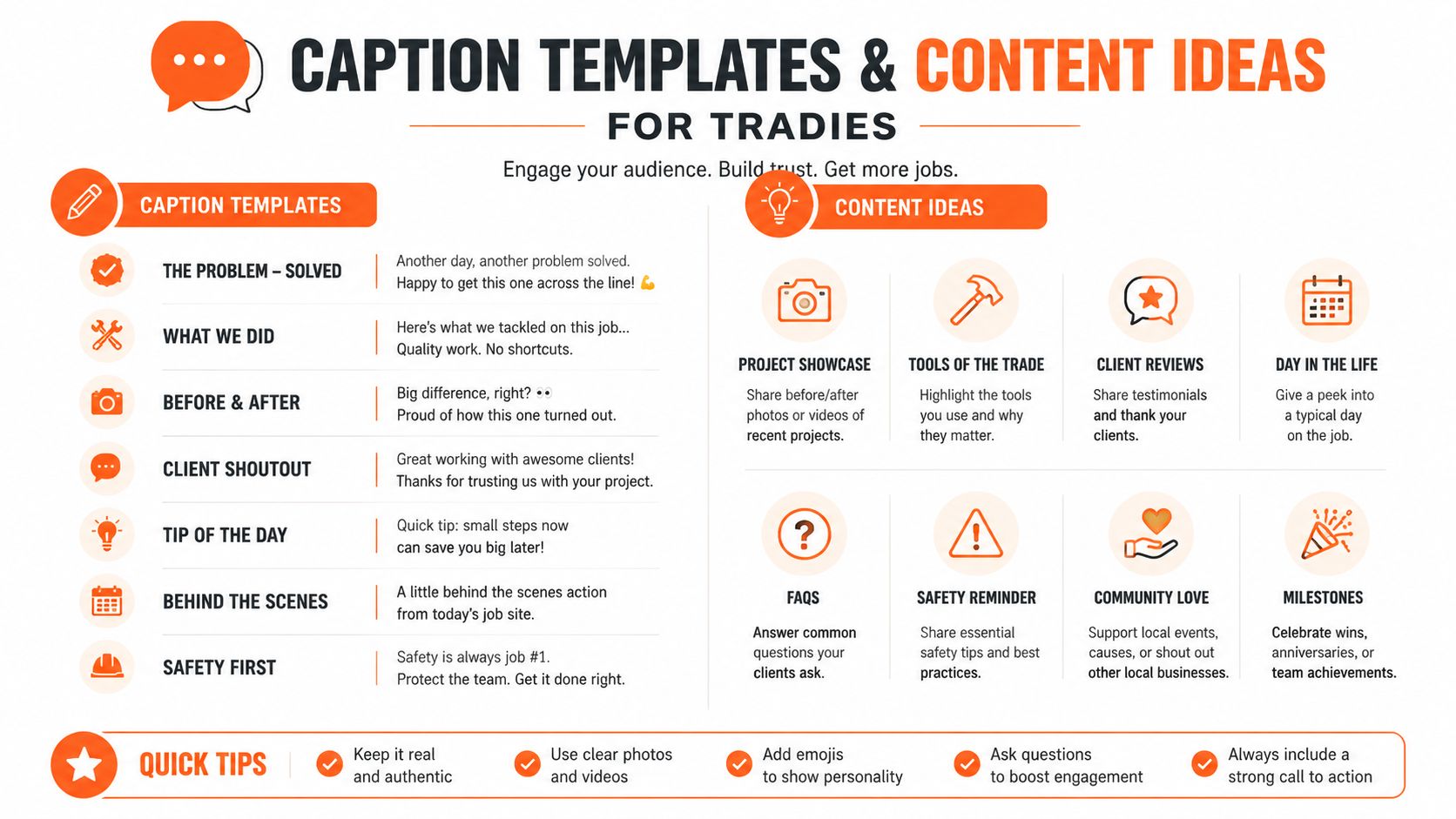
A feed gets stronger when the content has range. If every post says “job done” in a slightly different way, people stop noticing. A trade business needs a few repeatable content types that make posting easier without making the page feel stale.
One useful framework is the four content pillars model, which Hootsuite uses to help teams organise posts by different goals rather than treating every post the same Hootsuite's content pillar guidance. For tradies, that usually maps cleanly to education, proof, community, and promotion.
Ready-to-use caption shapes
Here are practical caption patterns that fit real trade work:
- Completed job showcase: Open with the job and location, then explain the issue solved, finish with a clear booking prompt.
- Tip post: Start with a homeowner problem, give one useful pointer, then invite questions in the comments or by message.
- Behind-the-scenes update: Lead with what the team is doing today, mention the tools, vehicle, or site setup, then keep it human and brief.
- Customer feedback post: Summarise the result in your own words, quote the outcome without inventing wording, then thank the customer.
- Seasonal reminder: Point to a likely issue people forget about, explain why it matters now, then ask them to book before it becomes urgent.
These are simple formats, but they work because they match how people read on mobile. They don't ask for much effort from the audience.
Ten post ideas you can use immediately
A mixed feed keeps local customers interested. Use ideas like these:
- A small fix that prevented a bigger problem
- A tool you used on site and why it helped
- A before-and-after photo of a finished repair
- A common customer question answered clearly
- A short clip of the team setting up for the day
- A project milestone from a longer job
- A local area you service this week
- A reminder about booking ahead for busy periods
- A post about tidy workmanship and what it says about your standards
- A thank-you post after a completed job
The useful part is not the idea itself. It's the repeatability. Once the team gets used to these patterns, writing posts becomes faster and less forced.
A helpful tool if you want to speed that up is this free AI content creation resource for tradies, which can support idea generation without making the content feel generic.
Image and Design Tips That Build Local Trust
A trade feed lives or dies on visuals. Customers may not read every caption, but they do notice whether the images look real, clear, and easy to trust. The sweet spot is polished enough to look organised, but not so polished that it feels like a corporate brochure.
Use real work first, designed graphics second
Real job-site photos usually outperform generic visuals because they prove the business does the work. A straight photo of a completed install, a repaired frame, or a tidy van at a job site feels honest. Stock photos of polished workers in hard hats often have the opposite effect, because people can tell they're not from the business itself.
Designed graphics still matter. Quote cards, service reminders, and simple tip graphics can make a profile look structured, especially when the business has a few core services to repeat. The key is to use them as support, not as the whole identity.
Keep the design clean enough that a homeowner can understand it in a glance.
That usually means one focal point, strong contrast, and limited text. It also means consistency across the feed, so the business looks like one operation rather than a random collection of unrelated posts.
Take better photos with the phone you already have
Good phone photos come down to a few habits. Stand where the light works best, keep the frame uncluttered, and show enough of the job that the viewer understands what's happening. Wide shots help with context, while closer shots show craftsmanship and detail.
Avoid framing that cuts off the most important part of the work. A half-visible switchboard, a cramped corner shot, or a blurry angle can make good work look average. If the image is too messy to trust, people will assume the job was messy too.
A simple rule is to photograph the result, the process, and one detail. That gives you options later and prevents every post from looking identical.
Use design to reinforce local trust
Brand colours, readable type, and repeatable layouts help a feed feel deliberate. That doesn't mean making every graphic look expensive. It means making each post easy to scan and recognisably yours. For trade businesses, that balance matters because customers usually want reassurance, not a glossy campaign.
The question behind every visual should be simple, does this look like a real local business people can call with confidence? If the answer is yes, the post is doing its job. If it looks overproduced, or like a template that could belong to any company anywhere, the trust signal gets weaker.
For a practical example of how behind-the-scenes visuals can feel human without looking sloppy, see this trade-specific behind-the-scenes content guide.
Scheduling and Automation for Busy Tradies
A trade page usually goes quiet for one reason. The worksite wins the day. Quotes run long, jobs overrun, and posting gets left until the week is already full.
Build a batch workflow that fits real trade life
The cleanest way to stay active online is to work in short, focused blocks. Set aside one session to collect photos, another to write captions, and a third to load everything into a scheduler. That keeps the page moving without asking someone to post between calls, site visits, and paperwork.
The goal is simple, take manual posting out of the daily routine. Once the content is written and queued, the system handles the publishing while you stay on clients, sites, and invoices. For a trade business, that matters because consistency builds trust, but constant hand-posting burns time you need elsewhere.
A sensible pace still matters, but it does not need to be rigid. Match the volume to the platform and the people you want to reach, then keep the rhythm steady enough that the page does not look abandoned. UC Santa Barbara's social media best practices point to spacing posts according to channel use, with Facebook handled less often than fast-moving platforms and Twitter used more frequently UC Santa Barbara social media best practices. The exact mix should follow your customer base and the channels that already bring in calls, messages, or quote requests. For that, a small business content strategy helps you decide where to post, what to post, and what to leave out.
Keep the process simple enough to repeat
A weekly rhythm works best when it feels boring in a good way. Collect job photos as soon as the work is done. Draft several captions while the details are still fresh. Schedule the posts ahead so the feed keeps moving during a packed week. Then leave space to check comments and messages before they turn cold.
That kind of system reduces decision fatigue. You are not trying to invent a new post every morning, and you are not relying on memory after a long day on the tools.
A few habits make the whole thing easier to keep up. Save the strongest images in one folder, keep a few caption formats ready, and use the same publishing window each week so the job fits around real trade work instead of fighting it.
Practical rule: if a post takes more than a few minutes to publish, the process is too manual.
A scheduling system should make consistency easier, not add another task to chase. The right one is the one your team will use when the job list is full.
Putting It All Together Into a Weekly System
A simple weekly system keeps professional social media posts from turning into a chore. Plan the content, collect the images, write the captions, schedule the posts, and check the messages. That's the core loop.
The businesses that struggle usually make one of three mistakes. They post only promotions, they ignore comments and enquiries, or they vanish whenever the job list gets long. Each of those problems is fixable, but only if the process is treated like part of operations rather than an afterthought.
A lean weekly checklist
- Pick the next few topics. Use a mix of proof, education, and promotion so the feed doesn't feel repetitive.
- Choose the best visuals. Real job photos usually do more for trust than polished but disconnected graphics.
- Write captions in your own voice. Keep them short, direct, and useful.
- Schedule the posts. Consistency matters more than doing everything on the day.
- Reply to messages and comments. A quiet inbox makes the whole feed feel less effective.
- Review what led to enquiries. Look at profile visits, direct messages, and phone calls, not just follower counts.
LegalVision's content mix rule is a useful guardrail here, 30:70 promotional to non-promotional content LegalVision's social media post guidance. That ratio helps stop the page from feeling like one long sales pitch.
For a broader planning structure that supports this kind of workflow, this small business content strategy resource can help you connect posting with the rest of the business.
Keep the system tight, the visuals honest, and the tone local. That's usually enough to make a trade business look professional without losing the authenticity customers expect from someone who turns up and gets the job done.
If you want consistent posting without spending your evenings writing captions, set up GrowTradie, load in your services and service area, and let it keep your profiles active with clean, trade-ready posts that help turn local attention into real enquiries.