

TL;DR: In 2026, the average cost of rewiring a home for a full rewire typically ranges from $4,000 to $15,000, with a national average around $10,000, and costs often run about $4 to $10 per square foot for complete projects according to iBuyer’s 2026 rewiring cost guide. Labor is usually the biggest part of the bill, accounting for 50-70% of the total.
If you're reading this, there's a good chance something has pushed electrical work from “someday” to “I need to look into this now.” Maybe lights are flickering when the microwave kicks on. Maybe breakers keep tripping. Maybe you're buying an older home and your insurer wants answers before they agree to cover it. Or maybe you're opening walls for a renovation and realizing this is the moment to deal with wiring that hasn't been touched in decades.
Most homeowners start with the same question. What will this cost?
That’s a fair question, but the number only makes sense once you understand how an electrician builds the quote. A rewiring estimate isn't pulled from thin air. It comes from the layout of the house, how accessible the wiring paths are, what condition the existing system is in, and how much skilled labor it will take to do the job safely and cleanly.
Table of Contents
- Why You Might Need to Rewire Your Home
- Understanding Your Project Scope Full vs Partial Rewire
- Decoding the Price Tag A Breakdown of Rewiring Costs
- Key Factors That Influence Your Final Price
- Sample Costs and What a Real Quote Includes
- Smart Ways to Manage Your Rewiring Budget
- Frequently Asked Questions About Home Rewiring
Why You Might Need to Rewire Your Home
A lot of rewiring jobs start the same way. A homeowner calls because one room keeps losing power, or the lights dim when a larger appliance starts up. Sometimes the trigger isn’t even a fault. It’s a home purchase, an insurance question, or a renovation where old wiring finally becomes visible.
The concern is usually bigger than the symptom. People want to know whether they’re looking at a local repair or a whole-house problem, and whether the final bill is going to be manageable or painful.
The common situations that lead to rewiring
Older homes are the most frequent candidates. If a house still has outdated wiring, limited circuits, or a system that was never designed for modern appliances, a rewire often becomes the practical fix instead of a string of small repairs.
Renovations also bring this to the surface. Once walls or ceilings are already being opened, it makes sense to ask whether the electrical system should be updated at the same time. That doesn’t mean every remodel needs a full rewire, but it does mean the wiring should be looked at as part of the bigger project.
A few warning signs usually push homeowners to make the call:
- Recurring breaker trips: Not a one-off nuisance, but a pattern.
- Flickering or dimming lights: Especially when loads change.
- Outdated outlets or sparse outlet placement: A clue the system may be behind current needs.
- Insurance or sale requirements: Older electrical systems often raise questions during underwriting or inspection.
A rewire isn’t just about replacing wire. It’s about bringing the whole system back to a standard you can trust.
Why the quote can feel confusing
Homeowners often compare rewiring estimates the way they’d compare appliance prices. That rarely works. Two houses with similar square footage can price very differently because the electrician isn’t only pricing materials. They’re pricing access, time, patching requirements, circuit planning, and the difficulty of working through an existing finished home.
That’s why understanding the quote matters as much as knowing the average cost of rewiring a home. Once you know what drives the price, you can compare estimates with a lot more confidence.
Understanding Your Project Scope Full vs Partial Rewire
The first thing I look at when pricing a rewiring job is scope. Before anyone talks dollars, we need to know whether the house needs a full rewire or a partial rewire. That one decision changes everything about the estimate.
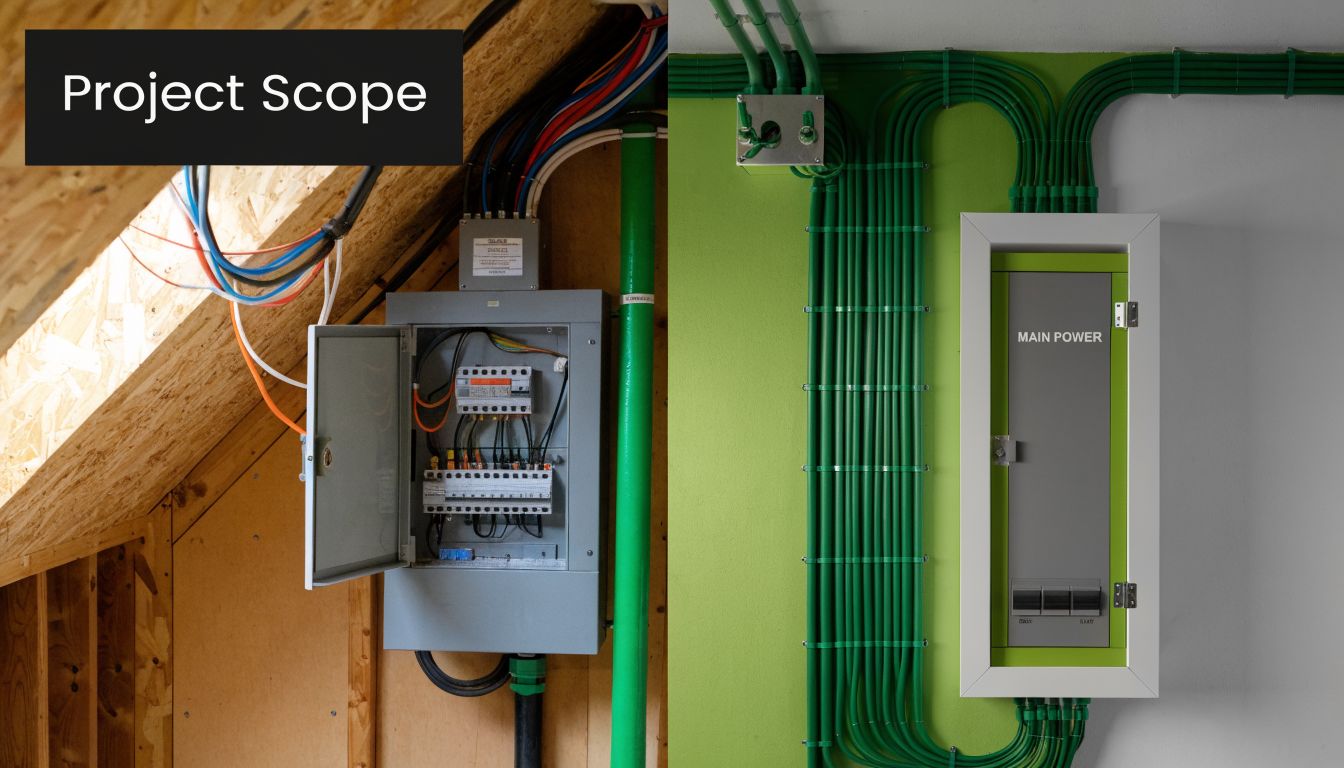
A simple way to think about it is plumbing. Fixing one leaking section is one job. Replacing the whole system because it’s old, undersized, or failing in multiple places is a different job entirely. Electrical works the same way.
When a full rewire makes sense
A full rewire means replacing the wiring throughout the home rather than addressing one isolated area. This is usually the right call when the problems are widespread, the wiring is outdated throughout the property, or the home is being renovated extensively enough that broad access is possible.
A full rewire is often the smarter long-term decision when:
- The home has system-wide age issues: Not just one bad circuit.
- Multiple rooms show electrical problems: That points to a broader infrastructure issue.
- You’re planning major upgrades: New appliances and modern loads can expose old limitations fast.
- The existing wiring standard is no longer something you want to build around: Patching onto weak infrastructure rarely ages well.
In practical terms, full rewires cost more upfront, but they also remove the uncertainty that comes with trying to preserve sections of an old system that may become the next problem.
When a partial rewire may be enough
A partial rewire targets one area, one set of circuits, or one clearly defined problem. That can work well when the rest of the system is in serviceable condition and the issue is limited.
Typical examples include a kitchen being remodeled, a specific damaged circuit, or one older section of the house that needs updating while newer work elsewhere can stay.
This video gives a useful visual sense of what electricians deal with during rewiring work:
A partial rewire can be a good choice, but only when the scope is honest. The mistake homeowners make is assuming partial always means better value. Sometimes it does. Sometimes it just delays the day you pay for the rest.
Practical rule: If one problem area is connected to a larger pattern of old wiring, a “small fix” can become the expensive option over time.
Decoding the Price Tag A Breakdown of Rewiring Costs
A rewiring quote makes more sense once you know how an electrician builds it. The total is usually a combination of labor, materials, permit-related costs, and any repair work needed to access and close walls. HomeAdvisor’s house rewiring cost guide places the typical range for a full house rewire at $1,500 to $10,000, with larger or more complex homes running higher. That range is broad for a reason. Two houses with similar square footage can take very different amounts of time to rewire.
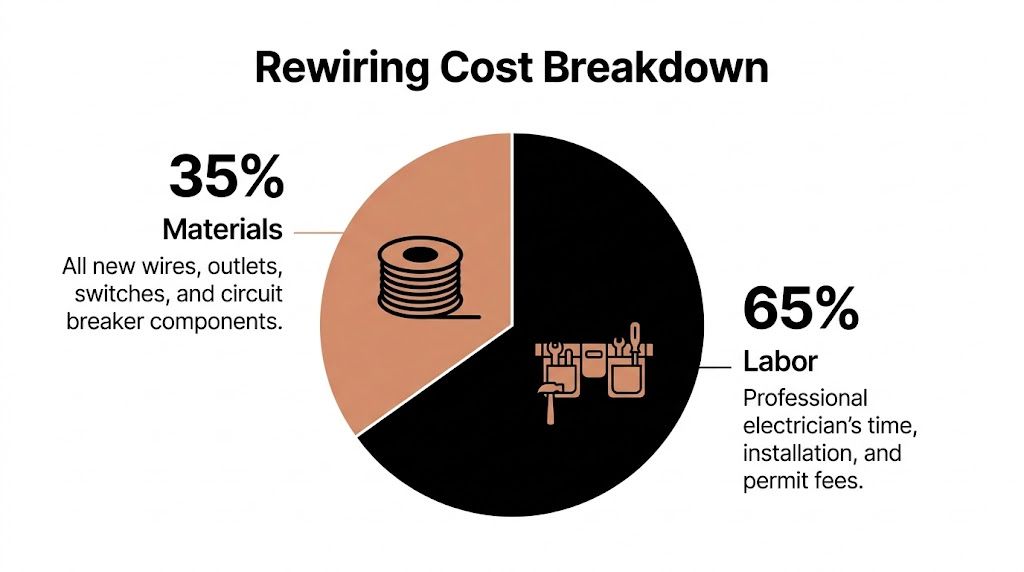
Labor is usually the biggest part of the quote because the work is slow and methodical. In a finished home, the hard part is rarely pulling cable by itself. The hard part is getting new wiring from point A to point B without unnecessary damage, keeping circuits organized, and leaving behind a system that passes inspection and works the way it should.
A proper labor estimate often includes:
- Mapping existing circuits: Identifying what stays live during the job and what needs to be removed or isolated
- Running new cable: Feeding wires through attics, crawlspaces, wall cavities, and other tight routes
- Installing boxes and devices: Setting outlets, switches, and junction points in the right locations
- Terminating the system: Making up connections at devices, breakers, and fixtures
- Testing and verification: Checking polarity, grounding, circuit continuity, and overall safety before final sign-off
- Permit and inspection coordination: Handling the steps required for legal, code-compliant work
It's common for cheap quotes to fall apart. If one contractor gives you a number with almost no detail, there is a good chance the missing detail becomes a change order later.
Materials are easier to list, but they still need to be clear. A quote should show whether the price covers just basic branch wiring or a wider replacement of devices and protection components too.
Common material categories include:
| Material item | What it covers |
|---|---|
| Cable and conductors | New branch wiring throughout the home |
| Devices | Outlets, switches, and related hardware |
| Boxes and connectors | The components that support safe installation |
| Protection components | Breakers and other required electrical hardware |
The material total can shift more than homeowners expect. Standard devices cost less than tamper-resistant or decorative-grade devices. AFCI and GFCI protection can add cost. Panel-related parts, smoke detectors, and hardwired code upgrades may also be included in one quote and excluded in another.
That is why the question is not just, "What does a rewire cost?" It is, "What is this electrician including in the price?"
If a quote does not spell out what is being replaced, what is being reused, and what is excluded, you do not have enough information to compare it properly.
The average cost of rewiring a home is not one fixed number. It is the result of many small scope decisions, and the better quotes make those decisions visible.
Key Factors That Influence Your Final Price
Two homeowners can both say, "I need a rewire," and get very different prices. The reason is simple. Electricians do not build a quote from square footage alone. We price the access, the condition of the existing system, the number of circuits the house needs, and how much patching and coordination the job will create.

The National Association of Home Builders notes that construction costs vary by region because labor, permitting, and local market conditions vary by area, which is one reason national averages only go so far when you are reviewing bids for your own home. See the NAHB breakdown of construction cost differences by metro area.
House size and layout
Size still matters. Bigger houses usually mean more cable, more outlets and switches, more time tracing routes, and more circuits to balance properly.
Layout can change the labor just as much as square footage. A straightforward ranch with a basement or attic is usually faster to rewire than a house with additions, split levels, flat-roof sections, or finished spaces that block every easy path. From a quoting standpoint, that affects hours. Hours are often where two estimates start to separate.
A few layout conditions regularly push labor up:
- Additions built at different times: They often leave mismatched framing, hidden junctions, and awkward transitions.
- Limited attic, crawlspace, or basement access: Fewer routes usually mean more cutting and slower wire pulls.
- Finished lower levels and dense wall construction: These reduce access and increase the care needed to avoid unnecessary damage.
- Long runs between panel and living areas: More distance means more time and more material.
Age of the home and type of existing wiring
Older homes are harder to price tightly because they carry more unknowns. Once walls are opened, it is common to find mixed wiring methods, abandoned cables, undersized circuits, or earlier alterations that were acceptable at the time but do not fit current standards.
The type of wiring matters too. Knob-and-tube, cloth-insulated cable, and aluminum branch wiring each create different decisions about replacement, access, and what else has to be corrected while the work is open. The Consumer Product Safety Commission guidance on aluminum wiring hazards is a good example of why existing wiring type affects scope, not just price.
This is also where experience shows up in a quote. A careful electrician will leave room for investigation instead of pretending every wall hides the same conditions.
Accessibility behind walls and above ceilings
Accessibility is one of the biggest labor drivers on a rewire. If we can fish new cable through open attic space, accessible crawlspace, or unfinished basement areas, the work moves faster. If the house has plaster walls, tile backsplashes, built-ins, closed soffits, or no usable ceiling voids, every run takes longer.
Homeowners usually feel this part of the estimate as labor, patching, and cleanup. Electricians feel it as time. The quote reflects both.
Good contractors also spend time planning routes before they start. Many use apps for electricians that help organize site notes, scheduling, and job documentation so fewer details get missed during estimating and installation. That does not make the job cheaper by itself, but it can make the scope clearer and reduce surprises.
Permits, inspections, and local pricing
Permit and inspection costs vary by jurisdiction, and so does the amount of coordination required. Some areas have simple permit processes. Others require multiple inspections, panel upgrades to meet current service rules, or utility coordination before reconnecting service.
Labor rates also move a lot by region. The U.S. Bureau of Labor Statistics tracks wage differences for electricians across states and metro areas, which is one reason the same rewire can price very differently in two markets. You can see that in the BLS occupational wage data for electricians.
The practical takeaway is straightforward. A useful quote explains why your house falls where it does on the price range. If two estimates are far apart, look first at access assumptions, existing wiring conditions, permit responsibility, and how much repair work each contractor expects to trigger.
Sample Costs and What a Real Quote Includes
A homeowner gets two rewire quotes for the same house. One says $6,500. The other says $11,800. The useful question is not which number looks better. It is what each electrician assumed about access, repairs, devices, permits, and what extent of the old system is replaced.
Sample pricing helps set expectations, but it only becomes useful when you can see how the quote was built.
Estimated home rewiring costs by house size 2026
Industry cost guides still put full-house rewiring in a broad range because house size is only one part of the job. HomeGuide’s current pricing summary places a full house rewire at roughly the national range shown in its house rewiring cost guide, with smaller homes often landing lower and larger or more complex homes moving well above that.
Here’s a practical reference point homeowners can use before requesting bids:
| Home Size (Square Feet) | Average Cost Range |
|---|---|
| 1,500 | Often lands near the lower end of the national range |
| 2,500 | Commonly falls in the middle of the range, depending on access and service work |
| 3,000+ | Often pushes toward the top of the range or beyond |
| Full rewire national typical range | Varies widely by layout, finish level, and local labor rates |
Those numbers are only a starting point. A 1,500-square-foot house with easy attic and basement access can price very differently from a similar-size house with finished walls, limited crawlspace access, and a panel that also needs work.
That is why a real quote matters more than a table.
What to expect in a professional quote
A proper estimate shows the electrician’s thought process. It should let you see what is being replaced, what is being reused, and what extra work may be triggered once walls are opened.
A good quote usually includes:
- Defined scope: Full rewire, partial rewire, or specific circuits and rooms.
- Panel and service notes: Whether the panel stays, gets upgraded, or needs code-related changes.
- Device count: Outlets, switches, hardwired smoke alarms, GFCI and AFCI protection, and light points.
- Wire routing assumptions: Whether the crew expects access through attic, basement, crawlspace, or wall fishing only.
- Permit and inspection costs: Included, excluded, or listed as allowances.
- Repair exclusions: Drywall patching, painting, trim repair, and fixture replacement if those trades are not part of the contract.
- Testing and labeling: Final circuit testing, panel directory updates, and cleanup.
The best quotes also spell out allowances and unknowns. If an electrician suspects brittle insulation, hidden junction boxes, or unsafe DIY work, that should be written down before the job starts. That does not guarantee the final bill stays identical, but it does show the contractor is pricing transparently instead of hoping to sort it out later.
I also look for whether the estimate is organized well enough to compare line by line. Contractors who use estimating and job documentation apps for electricians often present cleaner scopes because their notes, photos, and device counts are less likely to get lost between the site visit and the formal quote.
A lower price can still be fair. It just needs to be clear. If one bid includes new devices, permit handling, smoke detector updates, and final patch prep, and another leaves those items vague, the difference is probably scope, not profit.
Smart Ways to Manage Your Rewiring Budget
The cheapest rewiring job is rarely the best-value rewiring job. If you want to manage the cost well, the goal is to reduce waste, avoid rework, and make decisions that hold up for years.
Where to save wisely
The best savings usually come from timing and planning, not from stripping the scope down to the bare minimum.
- Bundle work with renovations: If walls are already being opened, wire access improves and labor often becomes more efficient.
- Plan future electrical needs now: If you know the home is heading toward heavier usage, it’s better to account for that while the work is underway than to reopen the same areas later.
- Get multiple detailed quotes: The earlier verified guidance recommends obtaining multiple estimates from licensed electricians. That matters because detail reveals value, not just cost.
- Keep decisions organized before work starts: Last-minute changes almost always create extra labor.
One practical mistake homeowners make is approving a quote before they’ve thought through outlet locations, switch changes, or room use. Those decisions are easier and cleaner when they happen before rough-in work starts.
Where cutting corners usually backfires
Trying to “save money” by avoiding needed scope often leads to a more expensive second round of work. The usual trouble spots are leaving obviously old sections untouched, skipping work in hard-to-access areas that are already opened, or choosing a vague low bid that doesn’t spell out what’s included.
Another budget problem is poor project coordination. If the rewire overlaps with other trades and nobody has a clear sequence, electricians lose time waiting for access or revisiting areas that should have been ready.
For contractors thinking about how they explain this kind of planning to homeowners, the same principle applies to communication. Clear education builds confidence before the quote even lands. Resources on content marketing for local businesses can help trade businesses explain value before price becomes the only thing a customer sees.
Good rewiring budgets come from smart sequencing, not wishful pricing.
Frequently Asked Questions About Home Rewiring
Homeowners usually have a few practical questions after they understand the numbers. Most of them come down to disruption, timing, and whether the investment is worth making.
How disruptive is a rewiring job
A rewire is disruptive, but the level of disruption depends on the house and the access routes available. If the electrician can work through an attic, crawlspace, or basement with limited wall opening, the job is more controlled. If access is poor, expect more cuts for routing and more follow-up repair work afterward.
You should expect crews to move room by room or circuit by circuit. Power interruptions are normal during active stages of the work. A good contractor will explain how they plan to keep the house usable while the job is underway.
How long does a full rewire take
The exact timeline depends on the scope, access, and whether the home is occupied during the work. A small straightforward house moves differently than a large older property with difficult access and mixed existing wiring.
The best answer comes from a site visit, not a generic promise. If a contractor gives you a timeline without looking at the structure, I’d treat that as a rough placeholder, not a commitment.
Does rewiring help with resale and insurance
In practical terms, yes. Buyers, insurers, and inspectors all pay attention to electrical systems because outdated wiring raises concerns quickly. A modern, properly documented rewire removes a lot of uncertainty.
That doesn’t mean every rewiring dollar comes back directly in sale price. It means the house is easier to insure, easier to explain during a sale, and easier for a buyer to trust.
If you run an electrical business and want more of the right kinds of enquiries, visibility matters long before someone is ready to book. Consistent online presence is one part of that, and electrician lead strategies often start with showing homeowners you can explain complex work clearly.
GrowTradie helps tradies stay visible without adding more admin to the day. If you want a practical way to keep your business active online with done-for-you content built for trade businesses, take a look at GrowTradie.