
You're probably good at the work already. You can hang a door properly, sort out a warped frame, build a run of cabinets that fits like it belongs there. Then you sit down to write a business plan and it suddenly feels like you've stepped into someone else's trade.
That's where most carpenters get stuck. They think a carpentry business plan is something you write for a bank manager, file away, and never read again. In practice, the useful version is much simpler. It tells you what work you'll take, what you'll stop taking, how much capacity you have, when you can afford another tool or vehicle, and whether your pricing leaves room for profit after materials, travel, callbacks, and admin.
For a small shop, the plan matters most when things get busy. Busy is where a lot of good carpenters get into trouble. They underquote, say yes to the wrong jobs, lose evenings to paperwork, and mistake revenue for a healthy business. A solid plan fixes that by forcing the hard decisions early.
Table of Contents
- Why a Business Plan Is More Than Just Paperwork
- Defining Your Carpentry Services and Pricing Strategy
- Analyzing Your Local Market and Competition
- Structuring Your Operations Staffing and Equipment
- Building Your Financial Projections
- Creating Your Marketing and Sales Plan
- Assembling Your Plan and Final Checklist
Why a Business Plan Is More Than Just Paperwork
It's 4:30 on a Thursday. You've got one job running late, a fresh enquiry that sounds good on the phone, and a supplier telling you materials will slip into next week. If you don't have a clear plan, you make the call on instinct. That's how small carpentry shops end up busy, stressed, and thinner on margin than they realise.
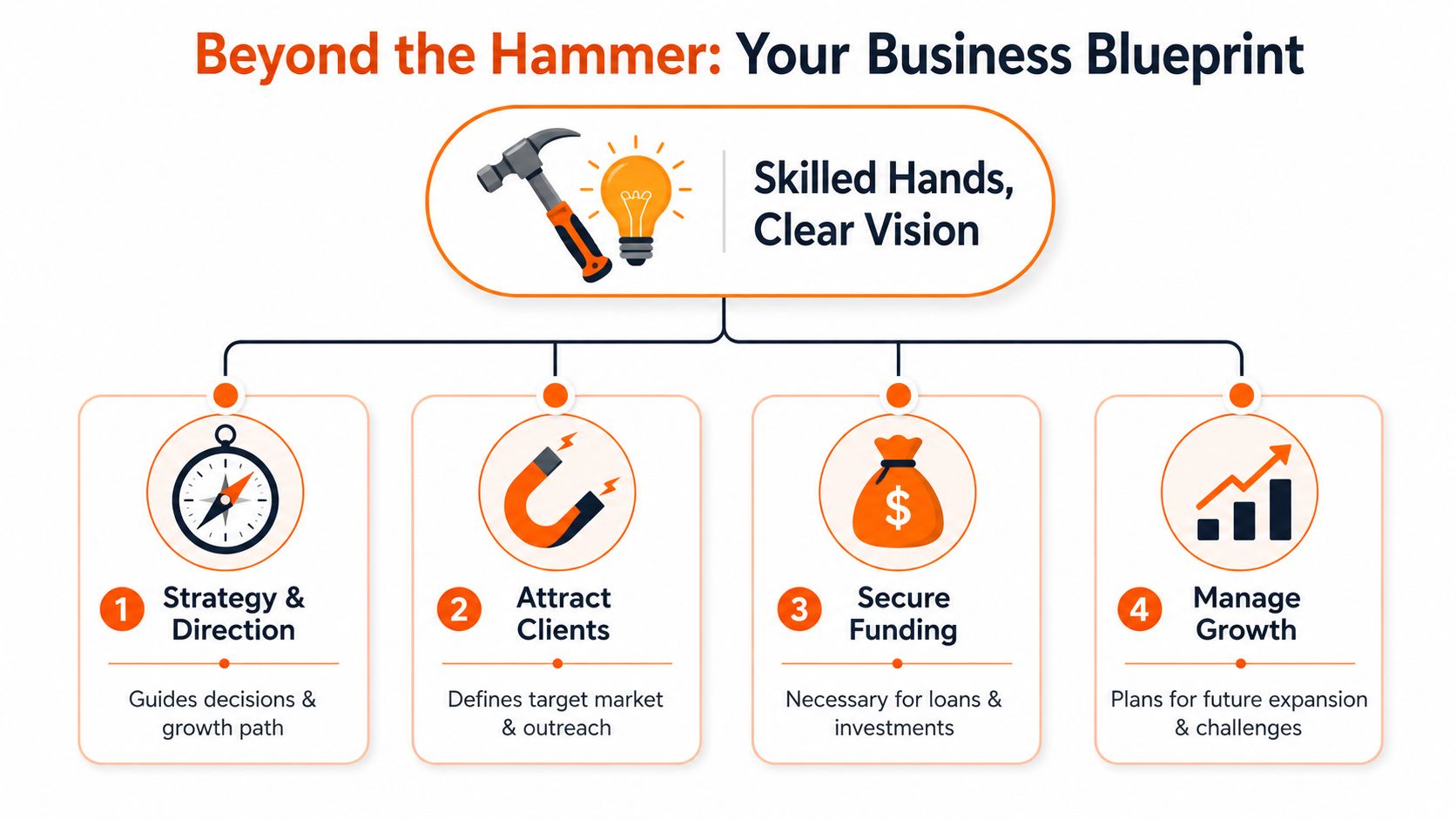
A useful business plan gives you a way to make those calls properly. It helps you decide whether a job fits your capacity, whether the price covers the actual effort, and whether taking it on will protect or strain the rest of the month. That matters more than having a polished document sitting in a folder.
The plan should help you make site decisions
For a small carpentry business, planning is operational. It should help with the jobs in front of you. Which enquiries to quote. How much work the team can carry without blowing out lead times. Whether buying another saw, ute, or trailer will improve output, or just add repayments to a business that already has patchy cash flow.
That's where many tradies get caught. They write a plan once for finance or a grant, then never use it again. A working plan gets revisited because it answers real questions. Can the current setup handle another custom job this month? Are small repair jobs filling gaps profitably, or are they wrecking the schedule for better work? Is it time to hire, or do you first need tighter quoting and job tracking?
Practical rule: If your plan doesn't help you decide what to quote, what to charge, and when to hire, it's paperwork.
A solo finish carpenter needs one kind of plan. A two-person framing crew needs another. A small joinery shop with workshop time, installs, and design revisions needs something else again. The difference is not branding. It's how work flows through the business, where delays happen, and what mistakes cost.
What belongs in a working plan
Keep it tight enough to use. For most small shops, a practical carpentry business plan template and guide should cover six things clearly:
- Service focus: The work you want more of, and the work you will stop chasing.
- Capacity limits: How many jobs you can run at once without delays, rework, or weekend admin blowouts.
- Pricing rules: How labour, materials, travel, subcontractors, and variations get priced.
- Operations setup: Suppliers, equipment, vehicles, workflow, scheduling, and who handles quoting and paperwork.
- Financial controls: Sales targets, cash flow timing, job margin, overhead recovery, and break-even point.
- Growth triggers: The numbers or workload level that justify hiring, outsourcing, or adding equipment.
That last point matters. Growth in carpentry often looks healthy before it is healthy. More enquiries can mean more bad-fit work. More staff can create supervision problems before they create profit. More equipment can lift output, but it can also lock you into repayments that only work if every month stays full.
A good plan keeps you honest about those trade-offs. Skilled work gets you through the door. A plan that reflects real capacity, real margins, and real operating constraints is what turns that work into a stable business.
Defining Your Carpentry Services and Pricing Strategy
The fastest way to build a messy business is to offer everything. It feels safe at first. You take framing one week, flat-pack fixes the next, then a deck repair, then a built-in wardrobe, then some trim work for a builder who pays late and argues every variation. You stay busy, but the business never gets traction.
A stronger carpentry business plan starts by deciding what kind of carpenter you're going to be in the market. Not in theory. In the jobs you quote every week.
Choose a service mix you can deliver well
There's nothing wrong with being broad early on, but broad and unfocused aren't the same thing. You need a core service mix that matches your skills, your tools, and how you want your weeks to run.
A simple way to sort it is to divide work into three buckets:
| Type of work | Best for | Main risk |
|---|---|---|
| Custom finish work | Carpenters with strong detail, design coordination, and client communication | Quoting too low on fiddly installs and changes |
| Structural or framing work | Teams that can move fast and coordinate with builders | Margin gets squeezed when schedules slip |
| Small repairs and one-off jobs | Solo operators who want quick turnaround and local repeat work | Travel and setup time can eat profit |
Custom cabinetry, built-ins, stair details, and trim packages often suit carpenters who are strong on precision and client-facing work. Framing, decks, pergolas, and site carpentry suit people who prefer volume, production rhythm, and builder relationships. Smaller repairs can be profitable too, but only if you price them to cover travel, setup, and interruption.
The best service menu is the one you can quote confidently, deliver cleanly, and repeat without chaos.
If you want a practical reference point for shaping your offer, this guide on starting a carpentry business is a useful companion.
Pick pricing methods that match the job
A lot of quoting problems start because carpenters try to use one pricing method for every job. That doesn't work. Different work needs different pricing logic.
Use hourly rates when the scope is unclear, repairs are exploratory, or there's a real chance of hidden issues. Use fixed-price quotes when the scope is clear, drawings are settled, and you know the sequence. Use a more value-aware fixed price on specialist custom work where the client is buying fit, finish, and problem-solving, not just labor time.
Here's the trade-off:
- Hourly pricing: Safer for uncertainty, harder for some clients to budget.
- Fixed pricing: Easier to sell, but dangerous if you miss labor, waste, or site delays.
- Premium fixed pricing for specialist work: Protects margin if your process and finish justify it.
When pricing a deck repair, hourly often makes sense because rotten framing, hidden fixings, and access can change the job fast. When pricing a full cabinet installation from approved plans, fixed price is usually cleaner. The scope is tighter, the sequence is known, and the client wants certainty.
Build your rates from actual production reality. Include setup, pack-down, travel, estimating time, consumables, supervision, and defects risk. If your price only covers hands-on tool time, it isn't a business price. It's a wage with extra stress attached.
Analyzing Your Local Market and Competition
Most local market analysis gets overcomplicated. You don't need a thick report. You need a grounded read on who buys carpentry in your area, what they care about, and where other operators are leaving money on the table.
That starts with the client, not the competition. If you try to be the cheapest or the broadest, you'll blend into the middle and compete on headaches.

Start with the customer, not the competitor
Pick the type of buyer you want to work with most often. That choice shapes almost everything else, from the photos you show to how you quote and how much hand-holding the job requires.
Common customer groups include:
- Homeowners wanting custom upgrades: Built-ins, wardrobes, shelving, decks, feature timber work.
- Builders and general contractors: Framing, fix-out, overflow labor, package pricing, deadline discipline.
- Property managers and landlords: Repairs, maintenance, quick turnarounds, dependable communication.
- Design-led clients: Cabinet details, bespoke joinery, finish quality, coordination with architects or designers.
Each group buys differently. Homeowners often care about trust, clarity, and finish quality. Builders care about reliability and whether you hold up the program. Property managers care about responsiveness and low friction. A good plan makes that choice explicit.
Look for gaps in how work gets served
Then study the market at ground level. Check who's showing completed work, what kinds of jobs they highlight, how they position themselves, and where the gaps are. You're not looking for perfection. You're looking for patterns.
One common gap appears when most local carpenters chase larger renovations and new builds. Smaller but still valuable jobs get ignored because they interrupt bigger schedules. That creates room for a specialist who handles repairs, upgrades, and one-off custom work professionally. Another gap appears when lots of operators can build, but few communicate well, quote cleanly, or turn up consistently.
Use this short test when reviewing competitors:
- What are they known for: Decks, framing, cabinetry, renovations, or general work?
- Who do they seem to serve: Builders, homeowners, or commercial clients?
- What do they avoid: Small jobs, design-heavy work, maintenance, premium custom pieces?
- Where do they look weak: Slow communication, poor presentation, unclear scope, inconsistent finish photos?
If everyone local says they do everything, the opportunity is usually in doing one thing more clearly and more reliably.
A useful local position isn't always glamorous. “Reliable carpenter for small high-quality residential jobs” can be more profitable than a vague promise to handle any timber job that comes along. Clear positioning wins because clients know when to call you, and just as important, when not to.
Structuring Your Operations Staffing and Equipment
Operations is where the plan stops being theory. This is the part that decides whether the business runs calmly or feels like a weekly recovery exercise. Most carpenters don't fail because they can't build. They struggle because the work behind the work starts swallowing the day.
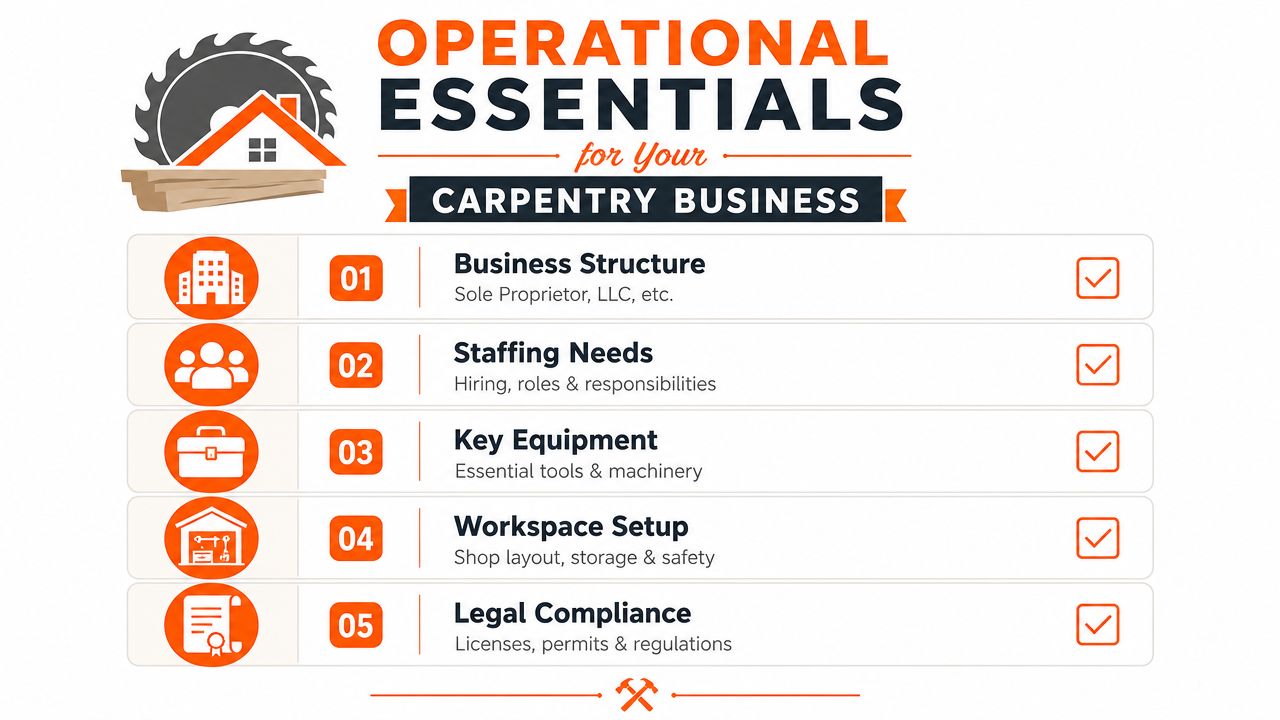
The first decisions are straightforward enough. Pick a business structure that suits your situation, sort the licenses and insurances your area requires, and set up your paperwork so quoting, invoicing, variations, and supplier records don't live in a pile on the passenger seat. If you need context on licensing pathways, this overview of general contractor license basics can help frame the compliance side.
Build the business around real capacity
The biggest planning mistake in a small carpentry shop is assuming every working hour is billable. It isn't. Time disappears into quoting, driving, material pickups, client calls, site setup, invoicing, defects, and rework. If your plan ignores that, your revenue forecast will look healthy while your calendar tells a different story.
This matters even more because labor supply is tight. Tradify's discussion of starting a carpentry business points to persistent craft-skills shortages and argues that a strong plan has to quantify the owner's billable capacity and answer the key question: what staffing mix lets you grow without killing utilization or cash flow?
That question should sit at the center of your operations section.
A practical way to think about staffing is by role pressure, not ego. Don't hire because you're “busy.” Hire because specific work keeps pulling you off higher-value tasks.
Here's what to watch:
- You're buried in site labor: A subcontractor or employee may free you to quote, supervise, and handle clients.
- You're buried in estimating and admin: Office support or tighter systems may solve the problem better than another pair of boots.
- Quality starts slipping: Growth has outrun supervision, not labor supply.
- Cash gets tight when jobs pile up: You may have a sequencing problem, not a sales problem.
A one-person shop doesn't become scalable by adding people randomly. It becomes scalable by protecting the owner's best use of time.
Set up equipment and staffing to protect margin
Equipment planning deserves the same discipline. Buy the tools that improve speed, quality, or job access regularly. Be cautious with expensive purchases that only suit occasional work. A mitre saw station, track saw, dust extraction, trailer setup, and reliable work vehicle can all make sense if they support your core service mix. Specialist gear that sits idle doesn't.
Use this comparison when deciding whether to buy, hire, or subcontract capability:
| Decision | Best use case | Warning sign |
|---|---|---|
| Buy equipment | You use it often enough to improve delivery and margin | You're justifying the purchase with “future jobs” |
| Hire equipment | You need it occasionally for defined jobs | Repeated short-term hire means ownership may now make sense |
| Subcontract the work | The task needs expertise you don't perform often | You're outsourcing core parts of your own service too often |
Staffing follows the same logic. Apprentices can help build long-term capability, but they require supervision and slow the owner down before they speed anything up. Subcontractors offer flexibility, but they can create inconsistency if you rely on them for key client-facing work. Employees can stabilize production, but only if there's enough repeatable work and enough gross margin to carry them through quieter patches.
That's why the best operations section in a carpentry business plan doesn't just list headcount. It maps how work flows through the shop, site, and office.
Building Your Financial Projections
This is the section many carpenters dread, mostly because they think financial projections have to be complicated. They don't. What they do need to be is honest. A simple forecast tied to real jobs is more useful than a polished spreadsheet full of hopeful assumptions.
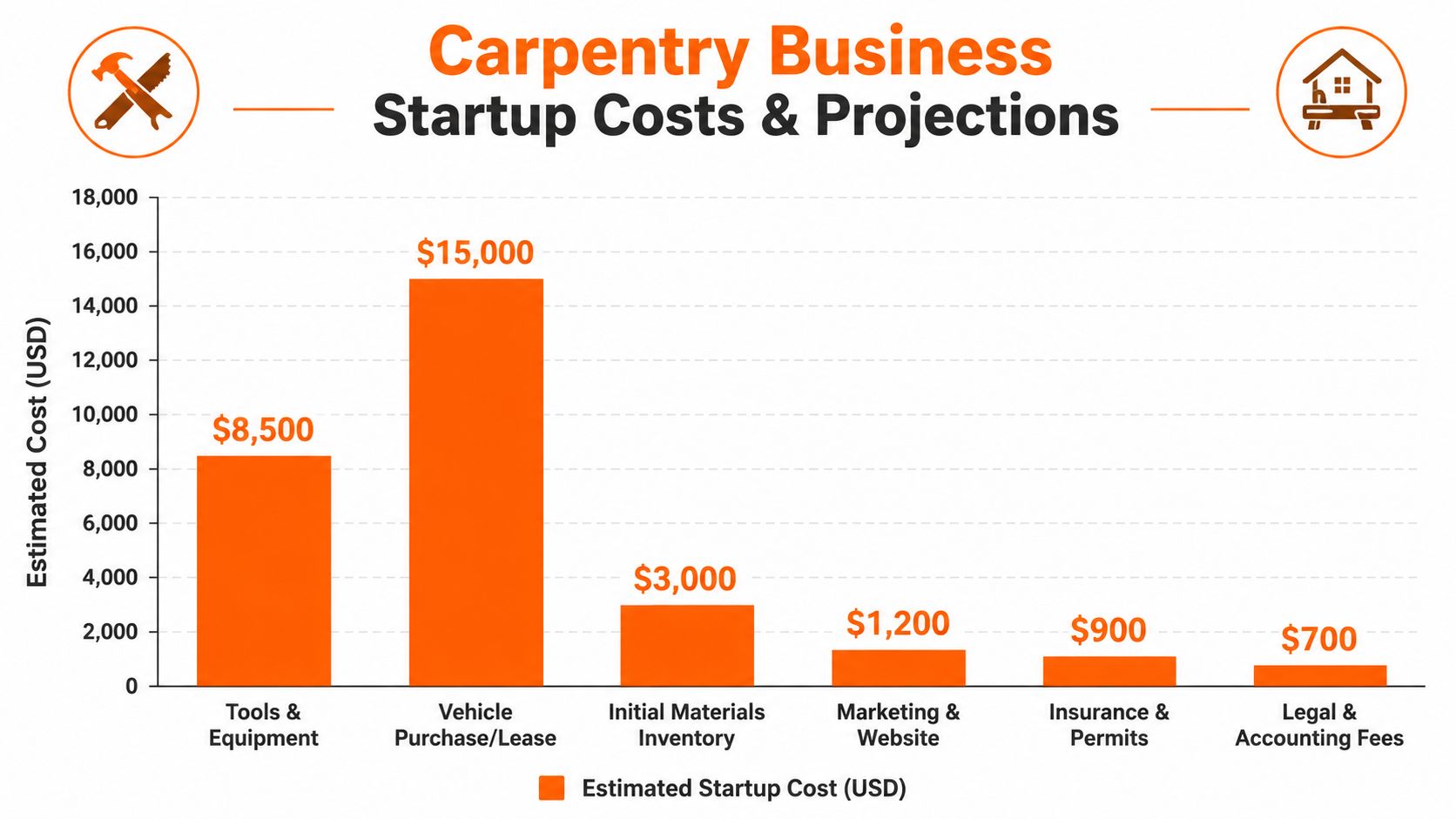
Start by grounding the numbers in your own operating model. What do you sell, how often can you deliver it, how long does cash stay tied up, and what has to be paid before the client's money arrives? If you can answer that clearly, the rest gets easier.
A visual summary can help when you're sketching out startup needs:
Forecast from jobs, not wishful thinking
Build the sales forecast from the service mix you defined earlier. If you do custom work, forecast from realistic job flow rather than broad monthly targets. The cleaner method is to estimate how many jobs your actual capacity allows, what those jobs tend to be worth, and how much non-billable time sits around them.
One useful benchmark comes from a carpentry business plan sample discussed by BSB Consulting. It cites that 87.9% of carpentry businesses are profitable, reports average revenue of $278.4 thousand in 2019, and notes an average job value of $3,000 for a custom carpentry firm. That doesn't replace your own pricing model, but it does give you a reality check when you're building projections for custom work.
Use that kind of benchmark carefully. Don't copy it into your plan as if it guarantees anything. Use it to test your assumptions. If your forecast depends on job values far below your actual workload needs, or far above what your market will support, something is off.
A practical forecast usually includes:
- Core job types: Built-ins, deck repairs, framing packages, trim installs, or maintenance work.
- Expected mix: Which jobs are frequent, which are occasional, and which are premium.
- Production capacity: What you can deliver without overrunning the calendar.
- Payment timing: Deposits, stage payments, final invoices, and supplier terms.
Here's the trap to avoid. Revenue can look fine while the business still feels broke. That happens when materials are paid early, invoices are paid late, and every active job creates more admin than expected.
This video gives a useful overview of how small business planning ties numbers together in practice:
Use three simple financial views
You don't need to become an accountant, but you do need three views of the business.
Profit and loss
Your profit and loss statement shows whether the work is making money over a period. It tracks sales against direct job costs and overhead. This tells you whether your pricing works.
If your P&L looks thin, check these first:
- Underquoted labor: The common culprit in custom work.
- Materials leakage: Waste, forgotten items, and unbilled extras.
- Overheads spread too lightly: Vehicle, software, rent, insurance, phone, and admin time still need to be recovered.
Cash flow
Your cash flow projection shows whether the business can pay its bills on time. Even profitable shops often struggle with timely payments. You might be winning work and invoicing correctly, but if supplier payments hit before client money lands, pressure builds fast.
Healthy carpentry businesses watch cash weekly, not just profit monthly.
List expected inflows and outflows in the order they happen. Materials, wages, subcontractors, fuel, and operating costs usually arrive with much less patience than clients do.
Break-even thinking
A formal break-even model doesn't need to be fancy. It just needs to answer one blunt question. How much work has to be sold and completed before the business covers its standing costs?
That calculation changes how you quote. Once you know the business has a minimum revenue requirement before it produces any real return, you stop pricing jobs like a wage earner and start pricing them like an owner.
Keep this section clear in your carpentry business plan. Lenders may read it, but you especially need to understand it. The financial model is there to protect decision-making, not impress anyone.
Creating Your Marketing and Sales Plan
A small shop can be flat out for six weeks and still have a weak sales plan. That happens when the phone rings from scattered one-off jobs, the quote pipeline is inconsistent, and there is no clear target for the kind of work you want more of.
A usable marketing plan for a carpentry business does one job. It keeps enough profitable work coming in to match your crew size, your cash needs, and the type of jobs you can deliver well. If you are quoting everything for everyone, marketing becomes expensive and sales gets messy fast.
Market for the work you want to repeat
Start with the jobs that fit your operation. If your margins are better on finish carpentry than small repair callouts, your marketing should show finished interiors, not handyman work. If deck builds keep one crew productive with fewer site changes, push that service harder than fiddly one-day jobs that fill the diary but wear out your admin time.
Good marketing is tied to capacity. There is no point generating twenty leads a week if you only have room to quote six properly and deliver three jobs without blowing out timelines. A steady flow of the right enquiries beats a flood of poor-fit work.
Referral work still matters, but treat it like a system, not luck. Ask for reviews when the client has seen the finished result. Keep in touch with past clients. Build relationships with builders, designers, property managers, and real estate contacts who can send work that suits your shop, not just any work.
Build trust before the first call
Clients judge reliability early. They look at your photos, how clearly you describe services, whether you return calls, and whether your quote looks organised. A clean vehicle, tidy site habits, and professional communication all support the sale because clients read those signals as a sign of how the job will run.
Your online presence only needs to answer the questions that stop someone from making contact:
- What kind of carpentry work do you take on?
- What does your finished work look like?
- Which areas do you service?
- How do people contact you?
- How quickly do you respond?
That usually means a simple website or gallery, an updated business profile, recent project photos, and clear service pages. If local search is part of the plan, this guide on local SEO for contractors is useful because it focuses on how tradies get found in nearby service areas.
Make sales practical, not polished
A sales plan for a carpentry shop is usually straightforward. Enquiry comes in. You qualify it. You inspect or discuss scope. You quote. You follow up. You either win the job, lose it, or park it.
Write that process into the business plan with enough detail that you can manage it. Decide who responds to new leads, how quickly quotes go out, what information must be collected before pricing, and when follow-up happens. If that part stays vague, work slips through the cracks, and the jobs you do win often start with poor scope control.
The best sales process for a small carpentry business is the one your team can repeat without chaos.
Clarity helps close work. Homeowners should know whether to call you for custom cabinetry, second-fix carpentry, decking, or renovation joinery. Builders should know whether you are set up for framing, fit-out, defect work, or overflow labour. If people cannot tell where you fit, they hesitate, and hesitation kills good enquiries.
Keep the plan tight. One or two reliable lead sources, a strong photo library, a review process, and a clear quote follow-up routine will usually produce better work than scattered promotion across five channels you cannot maintain.
Assembling Your Plan and Final Checklist
Once the thinking is done, the document itself should be clean and practical. Keep it readable. Plain language, clear headings, short paragraphs, and no filler. If you're showing it to a lender or partner, presentation matters. If you're using it for yourself, clarity matters even more.
Keep the document practical
A strong carpentry business plan usually reads well in this order:
- Business summary
- Services and pricing
- Market and customer focus
- Operations and staffing
- Financial projections
- Lead generation and sales process
- Appendix with supporting notes
Use templates carefully. They're fine as a starting point, but most templates are too generic for a trade business. Replace generic wording with your actual services, your local market, your equipment plan, and your real staffing constraints.
Final checklist before you use it
Before you call it done, make sure the plan answers the practical questions that matter:
- Service clarity: Can someone tell exactly what work you want more of?
- Pricing discipline: Does your quote method protect labor, overhead, and profit?
- Market fit: Have you chosen the customer types you want to serve?
- Capacity reality: Does the operations plan reflect non-billable time and supervision load?
- Equipment logic: Are purchases tied to regular use, not optimism?
- Cash awareness: Does the financial section reflect timing, not just revenue?
- Sales process: Do you know how enquiries arrive, how you qualify them, and how you follow up?
- Review habit: Will you revisit the plan as work patterns change?
The best plans aren't static. They get updated when your service mix sharpens, when a reliable subcontractor changes your capacity, when a certain type of job keeps producing better margins, or when you realize a part of the business is draining time without paying for it.
A carpentry business plan earns its keep when it helps you make better decisions under pressure. That's the standard to use.
If you want a simpler way to stay visible between jobs without having to write posts yourself, GrowTradie helps trade businesses keep their online presence active with custom content, professional post design, and automatic publishing. It's built for tradies who need steady local awareness and more enquiries, but don't have spare time to handle content manually.