

Electricians in the United States made a median annual wage of $62,350 as of May 2024, which works out to $29.98 per hour. That's the right starting point if you're asking how much do electricians make a year, but it's nowhere near the full story.
If you're on the tools right now, you've probably already worked that out. One sparkie says the trade pays well. Another says the money only gets serious once you move into industrial work, get licensed higher, or run your own jobs. Both can be right.
The problem isn't that the numbers are hard to find. It's that most pay guides stop at one national figure and leave out the decisions that shape income. The gap between someone collecting a wage and someone building an income usually comes down to three things: experience, specialty, and structure. The structure part matters more than most electricians think. Are you staying employed, chasing overtime, joining a union environment, moving into higher-risk work, or building a business with margin on top of labour?
That's where the important money conversation starts.
Table of Contents
- What Electricians Really Earn in 2026
- Breaking Down the National Salary Numbers
- How Your Experience Level Shapes Your Paycheck
- Where You Work The Impact of Location and Specialty
- Employed vs Self-Employed Which Path Earns More
- Practical Steps to Increase Your Electrician Salary
What Electricians Really Earn in 2026
Ask ten electricians what good money looks like and you'll get ten different answers. One is comparing his pay packet to local residential work. Another is looking at shutdown work, heavy overtime, or what a master electrician in a better market can bill. That's why online salary talk gets messy fast.
The cleanest benchmark is still the national median. But a benchmark isn't a career plan.
If you're trying to work out whether your pay is competitive, whether it's worth changing sectors, or whether going out on your own makes sense, you need a sharper lens than a single wage figure. The electrician earning steady employee income and the electrician building a business are playing different games.
Practical rule: Don't judge your future by today's wage band alone. Judge it by the path you're on.
For some electricians, the smart move is simple. Stay employed, get your tickets, take the harder jobs, and move into a better-paying niche. For others, the bigger jump comes when they stop thinking only in hourly terms and start thinking in job value, margin, repeat clients, and capacity.
That distinction matters because the trade has room at both ends. There are entry-level workers earning far less than top specialists. There are also business owners who earn beyond what most employed electricians will ever see, but only if they handle quoting, scheduling, staffing, and cash flow properly.
This is the practical answer needed. Electrician pay is real, but it isn't fixed. You can stay in the middle of the market for years if you drift. You can also move up fast if you make deliberate choices.
Breaking Down the National Salary Numbers
National wage data is useful for one job. It shows whether you're being paid near the middle of the trade or sitting too low for your current skill level.
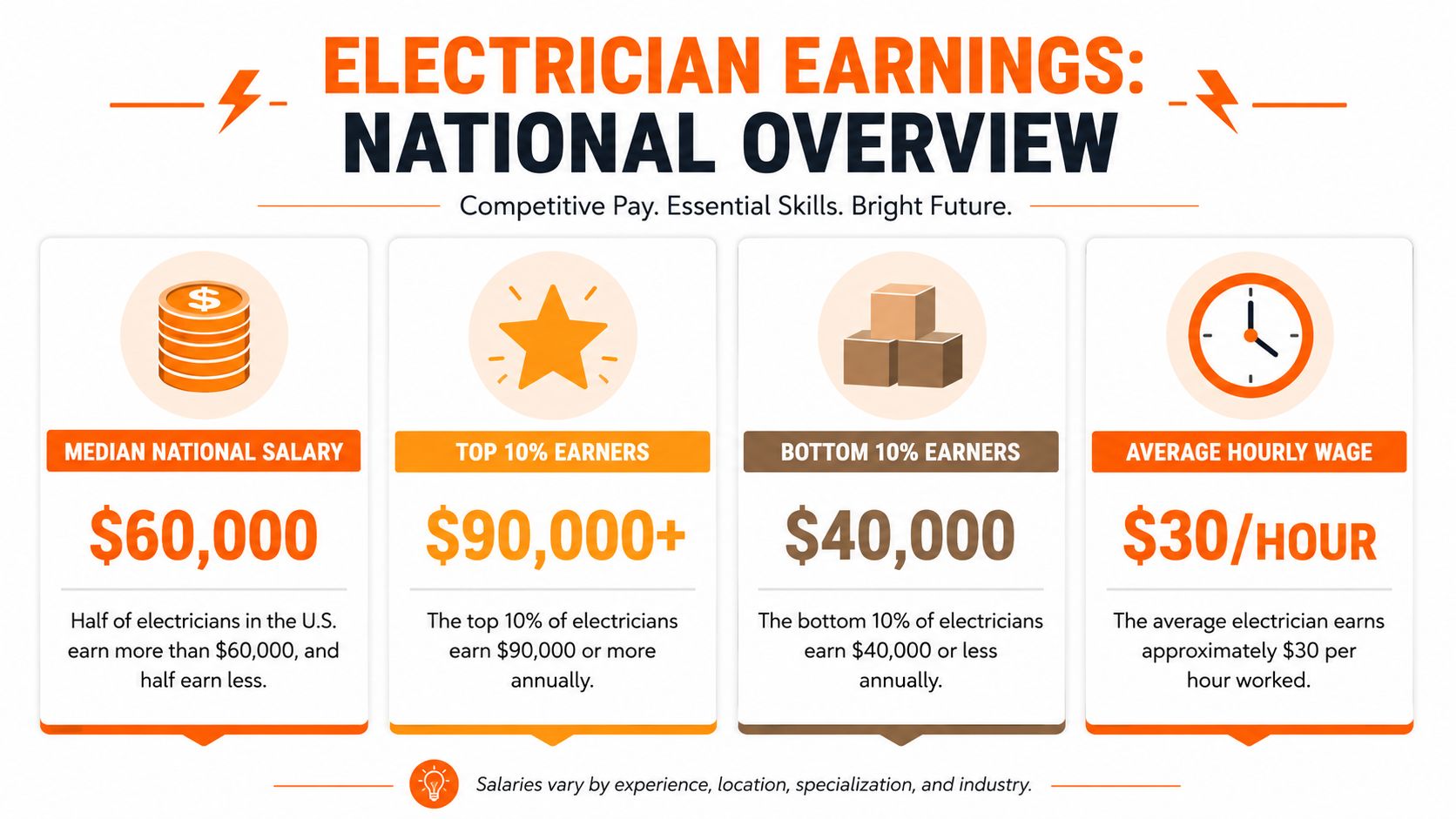
According to the U.S. Bureau of Labor Statistics electrician outlook, as of May 2024, the median annual wage for electricians in the United States was $62,350, or $29.98 an hour. The top 25% earned $81,730 or more, while the bottom 25% earned $48,820 or less.
Median tells you more than average
Median is the number to watch because it shows the midpoint of the trade. Half of electricians are above it, and half are below it. That gives you a cleaner benchmark than casual talk about “average pay,” where a smaller group of high earners can skew the picture.
Here's how to read those national bands:
- Below $48,820: you're in the lower quarter nationally.
- Around $62,350: you're near the middle of the market.
- Above $81,730: you're in the higher-paid quarter nationally.
That does not mean every electrician above the median has built a better career. Some are in stronger union markets. Some are on industrial jobs with tougher conditions. Some are working enough overtime to raise gross pay while burning through nights and weekends. The number matters, but the way you earn it matters too.
State differences are real
Location changes the baseline before you make a single career move. BLS wage data puts Illinois at $81,650, New York at $81,340, Hawaii at $79,280, and the District of Columbia at $79,030 among the higher-paying markets.
That's why national salary numbers should be used as a measuring stick, not a promise. A residential electrician in a lower-paying market can land below the national median and still be normal for that area. An electrician who chooses a stronger market, a harder specialty, or a business model with better margins has more room to build income instead of just collect a wage.
The national number shows the middle of the trade. Your long-term earnings come from the choices that move you out of the middle.
How Your Experience Level Shapes Your Paycheck
A first-year apprentice and a licensed electrician can both say they “work in the trade,” but they are selling very different value. One is getting paid to learn under supervision. The other is getting paid to finish work safely, solve problems without hand-holding, and carry responsibility that saves a contractor time and risk.
That difference is why experience changes income so much. Time matters, but capability matters more. If you want to build income instead of just collect a wage, track the level of responsibility you can take off someone else's desk.
According to the Workiz electrician salary guide, entry-level apprentices start around $40,000 to $45,000 annually, journeymen reach about $85,000, master electricians with 10+ years of experience often exceed $90,000 to $120,000+, and business owners who run efficient operations can push income to $150,000 to $200,000+.
| Experience Level | Typical Annual Salary Range |
|---|---|
| Apprentice | $40,000–$45,000 |
| Journeyman | Approximately $85,000 |
| Master Electrician | $90,000–$120,000+ |
| Business Owner | $150,000–$200,000+ |
Apprentice pay buys access
Early pay matters. Training value matters more.
A strong apprenticeship gives you hours, code exposure, troubleshooting reps, and access to electricians who will teach. A weak one can leave you stuck doing repetitive low-skill work for too long. I've seen apprentices chase an extra dollar or two an hour, then lose years because they were not learning the kind of work that leads to licensing, service independence, or better-margin jobs.
Ask practical questions early:
- What systems am I learning to install and service?
- Am I getting enough variety to become useful faster?
- Who is checking my work and teaching me why it matters?
- Will this experience help me qualify for the next licence level?
- Am I learning work with strong customer value, such as service upgrades or full home rewiring projects?
Those questions shape earning power later.
Journeyman pay comes from independence
Journeyman income rises because supervision costs less and output goes up. At this stage, the market starts paying for judgment. A contractor can send you to a job expecting you to keep it moving, communicate with the client or site supervisor, spot issues before they turn into rework, and finish with fewer callbacks.
That is a big shift from getting paid for hours on site.
A journeyman who reads plans well, diagnoses faults cleanly, and keeps a tidy job file is worth more than one who needs constant direction. The licence raises your floor. Reliable judgment raises your rate.
Master level raises the ceiling
Master-level electricians get paid for technical authority and accountability. They can sign off, supervise, price complex work, and carry more compliance responsibility. That opens the door to larger projects, stronger margins, and leadership roles.
The trade-off is simple. The higher you go, the less your income depends only on how many tools you can swing in a day. It depends more on whether you can lead jobs, train others, price work properly, and prevent expensive mistakes.
The electricians who make the strongest jump at this level usually do three things well:
- They take supervision seriously and can run jobs without chaos.
- They move into harder work that fewer electricians can handle.
- They learn the commercial side, including quoting, scheduling, labour control, and cash flow.
Business ownership can push income much higher, but it also exposes weak estimating, poor debtor control, and wasted labour fast. That is the core shift from getting a wage to building an income. Your experience level raises your earning potential only when you turn skill into responsibility, and responsibility into decisions that produce better revenue.
Where You Work The Impact of Location and Specialty
The fastest way to misunderstand electrician income is to compare jobs that shouldn't be compared. A residential service electrician in one market isn't competing with an industrial electrician in a high-risk plant environment. They're in the same broad trade, but the pay logic is different.
Location sets your base. Specialty sets your upside.
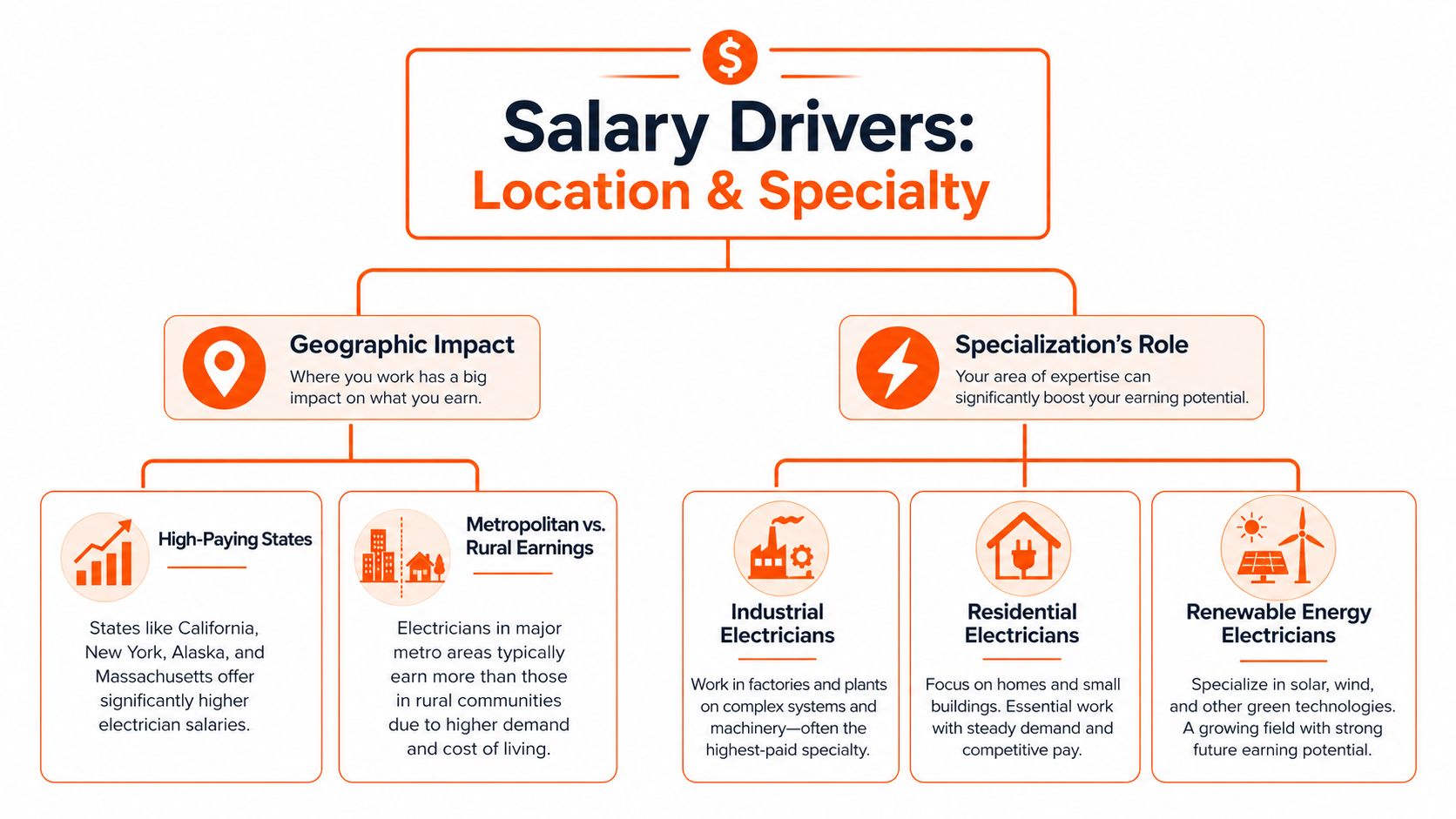
Location changes the baseline
Some areas pay more because labour markets are tighter, projects are bigger, union presence is stronger, or the cost of living is higher. In practical terms, this means two electricians with similar skill can earn very different incomes depending on where they work.
You don't need to relocate blindly, but you do need to think commercially about geography. If your market is crowded with low-price residential work, your wage growth may stay limited unless you move into a better segment. If you're quoting your own jobs, local pricing power matters just as much as labour demand.
For electricians doing residential work, even understanding related job values helps. Looking at project economics like the average cost of rewiring a home gives context for what clients are paying for larger electrical jobs and how labour fits into the total value of the work.
Specialty changes the ceiling
According to the Best Electrician Jobs salary breakdown, industrial electricians in high-risk sectors such as factories, power plants, and oil rigs can earn between $110,000 and $160,000+ annually. The same source notes that entry-level electricians earn around $38,000, while master electricians typically earn between $80,000 and $120,000.
That tells you something important. Higher earnings usually aren't random. They tend to follow higher complexity, higher risk, harsher environments, and stronger barriers to entry.
A simple comparison makes the point:
| Work Type | Earnings Pattern |
|---|---|
| Entry-level general electrical work | Around $38,000 |
| Master-level electrical work | $80,000–$120,000 |
| Industrial high-risk sectors | $110,000–$160,000+ |
The trade-off is obvious. High-paying sectors often demand more from you. You may need extra certifications, tougher schedules, travel, strict site rules, or a willingness to work in environments many electricians avoid.
Higher-paying electrical work usually asks for one of three things. More risk, more technical skill, or more inconvenience.
That's why “follow the money” only works if you're honest about fit. Some electricians thrive in industrial settings. Others make better money staying local, building a reliable service business, and controlling their margins instead of chasing remote premium work.
Employed vs Self-Employed Which Path Earns More
Two electricians can have the same license and very different incomes five years later. One earns a solid wage, picks up some overtime, and goes home with predictable money each week. The other owns the jobs, carries the risk, and has the chance to keep far more. That gap usually comes down to structure, pricing, and how well the work is run.

The employee path offers stability
Employment pays for consistency.
You know your rate, your hours are easier to forecast, and the admin load stays low. A strong employer can also cover benefits, retirement contributions, training, vehicles, tools, and a pipeline of jobs you would struggle to win on your own.
That structure matters more than many electricians admit. Early in a career, employed work often gives the fastest path to better earnings because it builds technical speed, exposes you to better systems, and lets you learn under pressure without carrying the full commercial risk.
The employee path makes sense when:
- You are still building technical range and benefit from supervision, repetition, and higher-level crews.
- Your employer gives you access to premium work such as commercial, industrial, or service contracts with better rates.
- You want predictable cash flow because family costs, debt, or other commitments leave little room for income swings.
- You prefer doing the work over running the business and do not want nights spent quoting, chasing approvals, or following up unpaid invoices.
The self-employed path offers a higher ceiling
Self-employment changes the question from "What do electricians get paid?" to "What does this job leave after costs?"
That is the shift from getting a wage to building an income.
A self-employed electrician can earn more than an employee, but only if the business produces margin. Revenue alone means very little. A full diary can still lead to weak personal income if pricing is soft, call-backs are common, materials are poorly controlled, or customers pay late.
The electricians who outperform wages usually get four things right:
- They quote for profit, not just to win the job. Labour, materials, travel, collection time, small consumables, and mistakes all need to be covered.
- They choose better work. A week filled with awkward, low-trust, low-margin jobs can make less money than three clean jobs for good clients.
- They run systems that protect cash flow. Scheduling, deposits, invoicing, and follow-up need to happen on time. If you are weighing that move, this guide on starting an electrician business covers the setup side well.
- They build a reputation that supports stronger pricing. Cheap work attracts price shoppers. Reliable work attracts repeat customers, property managers, builders, and commercial clients who care about response time and low hassle.
There is also more pressure. The business owner wears the cost of quiet weeks, insurance, software, vehicles, marketing, bad debt, and the hours no customer ever sees.
Self-employment earns more when the business is managed well enough to turn jobs into margin.
For many electricians, the best path is staged. Stay employed long enough to sharpen your technical standard, learn how profitable jobs are run, and build contacts. Then move into self-employment with a plan, a target market, and pricing discipline. The electricians who make that shift well stop thinking like wage earners and start thinking like operators.
Practical Steps to Increase Your Electrician Salary
A lot of electricians hit a ceiling because they keep treating income like a wage problem. It is usually a strategy problem. The money moves when you choose work with better margins, build proof that you can handle harder jobs, and set yourself up for roles or clients that pay for reliability and skill.
Demand helps, but demand on its own does not guarantee better money. The Buildforce electrician pay guide notes strong hiring demand, stronger pay in certain sectors, and better earning potential for electricians who hold the right certifications for higher-value work.
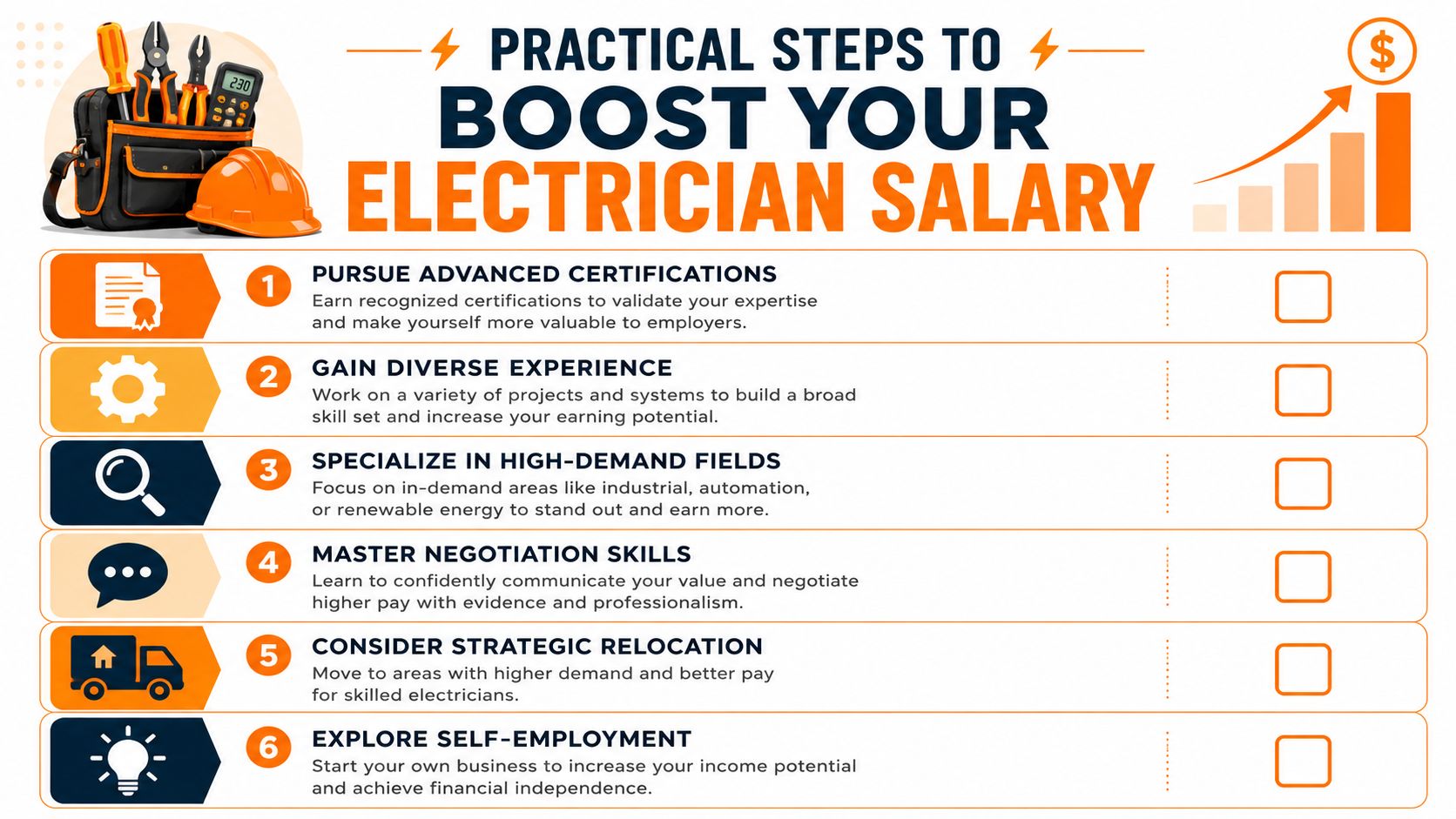
Six moves that lift earnings
Get certifications that change what work you can win. Extra tickets only matter if they let you step into better-paid environments, stronger compliance work, or specialist jobs with fewer qualified competitors.
Pick a specialty with pricing power. General electrical work keeps the diary full. Specialist work raises your ceiling. Industrial maintenance, controls, testing, data-related environments, and fault-heavy service work often pay better because the risk is higher and the talent pool is smaller.
Build commercial awareness, not just technical range. The higher earners know how long jobs should take, where margin disappears, and which clients create repeat work. That matters whether you stay employed or plan to go out on your own.
Make your value easy to prove. Faster fault finding, fewer call-backs, cleaner paperwork, and better client communication all strengthen your case for a raise or better contract rates. Supervisors and clients pay more when the risk of hiring you feels lower.
A practical video can help sharpen that thinking:
Move location only if the numbers improve. A higher hourly rate means little if rent, travel, and downtime eat the gain. Compare real take-home pay, not headline rates.
Run the admin like it affects profit, because it does. Missed quotes, slow invoicing, weak job notes, and poor scheduling all cut earnings. If you are building a business, these best apps for electricians can help you quote faster, stay organised, and keep cash moving.
Think like an income builder, not just a wage earner
The better question is not only, "What does this job pay?" The better question is, "What does this job lead to?"
One job might teach you testing and commissioning. Another might get you in front of a builder who sends repeat work. Another might be the step that gets you into industrial, commercial maintenance, or a specialist service lane where rates are stronger. Those choices stack over time.
That marks the shift from getting a wage to building an income. Employees raise earnings by becoming harder to replace. Self-employed electricians raise earnings by choosing profitable work, pricing it properly, and running the business tightly enough to keep the margin.
If you've been wondering how much do electricians make a year, the honest answer is simple. Average pay is only the starting point. The top end usually goes to electricians who make deliberate moves on certifications, specialty, client type, and business structure.
If you want more local jobs without spending your evenings trying to write posts and stay visible online, GrowTradie is built for tradies who need a practical system, not more hassle. It creates and schedules content for your trade business so your profiles stay active, look professional, and help turn attention into real enquiries while you stay focused on the work.