
You're probably dealing with this right now. A client asked for a price. You sent a quick number by text, scribbled a few notes on an invoice, or fired off a rough PDF from the ute between jobs. Then the job started shifting. The client thought disposal was included. You assumed they were supplying fittings. Someone expected patching, painting, or after-hours access. Now you're arguing over work that was never properly written down.
That's where a proper proposal template for services earns its keep.
For tradies, a proposal isn't corporate fluff. It's a practical job tool. It helps you explain the work clearly, price it properly, and set rules before boots hit site. Done well, it saves time, protects margin, and makes you look like the safer choice to hire.
Table of Contents
- Why a Scrappy Quote No Longer Cuts It
- The Core Sections of Your Service Proposal Template
- Nailing the Scope of Work for Different Trades
- Structuring Your Pricing and Payment Terms
- Writing Clear Terms That Protect Your Business
- Sending Your Proposal and Winning the Job
Why a Scrappy Quote No Longer Cuts It
Most tradies have learned this lesson the hard way. A small job starts with a quick verbal agreement. Then the client asks for one extra thing. Then another. By the end, you've done more than you priced, and the client still thinks you missed something.
That old style of quoting can work on tiny, simple jobs. It falls apart fast once there are materials, site conditions, multiple visits, or any trade coordination. The problem isn't only lost profit. It's the confusion that follows when nobody can point to one clear document and say, “This is what we agreed.”

A professional proposal fixes that. It gives the client a clean summary of the problem, the work, the timeframe, the price, and the conditions. It also gives you a record to fall back on when the job starts drifting.
According to Visme's service proposal guidance, service proposals typically follow a standardized length of 2 to 5 pages, which is enough space to include scope, costs, and timelines without overwhelming the client. That's the sweet spot for trade work too. Shorter than that and key details go missing. Longer than that and many clients stop reading.
A rough quote creates expensive assumptions
A homeowner hears “install hot water unit” and thinks that includes removal, disposal, reconnecting everything, and making the area look untouched when you leave. A plumber may have priced the installation itself, basic connections, and testing. Both people think they're being clear. They're not.
Practical rule: If a client can assume it's included, write whether it is or it isn't.
That's why a proper proposal isn't paperwork for paperwork's sake. It builds trust before the first invoice goes out. The client sees that you're organised. You see that the job has boundaries.
Better jobs usually go to the clearer operator
Clients compare more than price. They compare confidence. A scrappy quote makes you look rushed. A tidy proposal makes you look prepared.
That matters most on jobs involving plumbing replacements, switchboard work, deck builds, fit-outs, maintenance agreements, and any job where the client is nervous about surprises. A reusable template lets you respond fast without sounding generic. You're not starting from scratch each time. You're using a system.
The Core Sections of Your Service Proposal Template
A good proposal template for services should be easy to reuse and easy for a client to scan. If it takes too long to build, you won't use it. If it's hard to read, the client won't trust it.
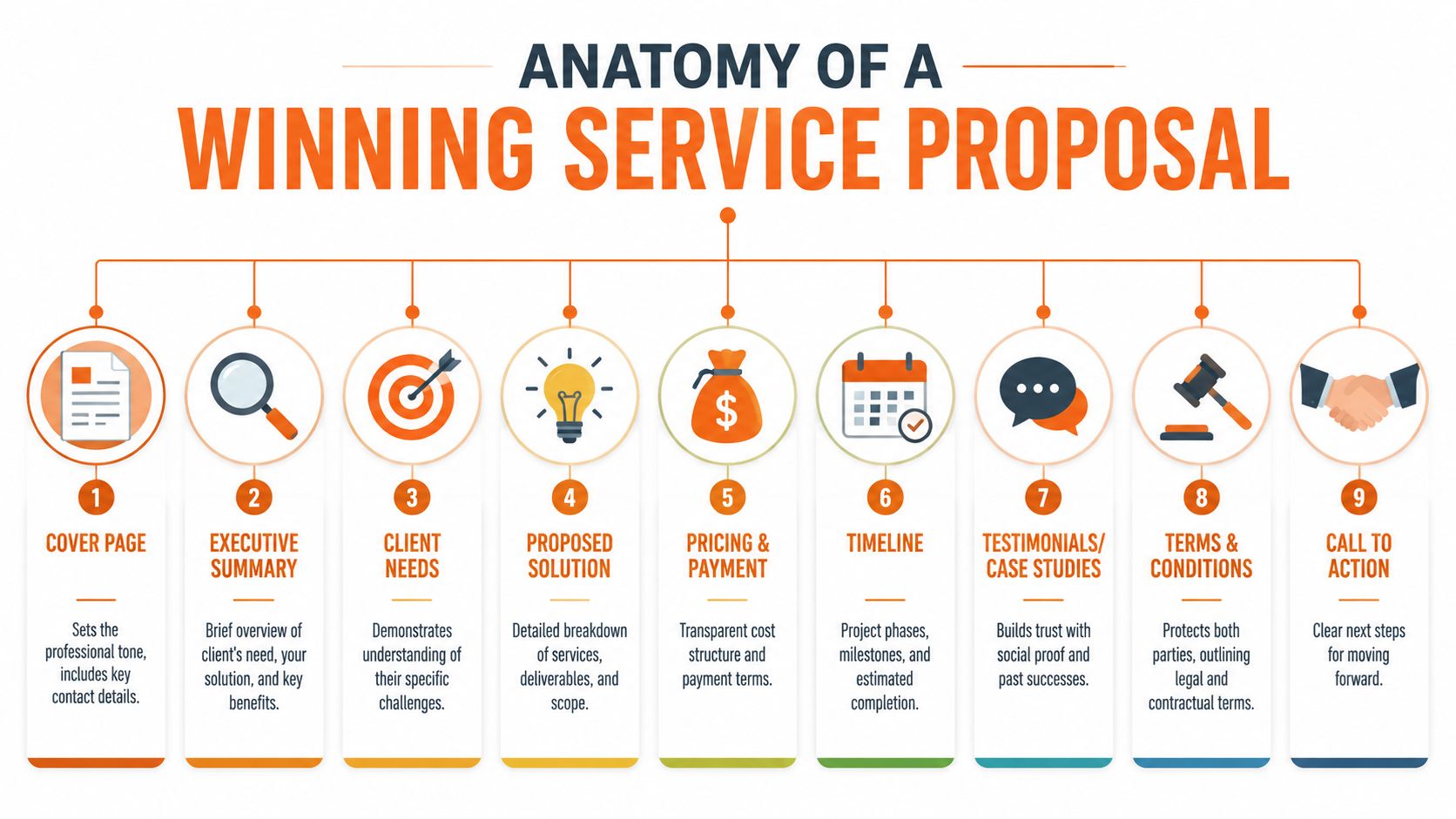
Start with a short front section
Your opening pages should do three jobs fast.
- Cover page. Put your business name, client name, proposal title, date, and contact details in one place.
- Executive summary. Keep this tight. The executive summary in a modern proposal should be 150 to 250 words and give decision-makers a high-level overview, as outlined in Zapier's business proposal template guide.
- Client needs. Restate the problem in plain language so the client knows you understood the brief.
If you already use estimate sheets, this is the step that turns a price into a professional offer. For tradies who want a simple format to adapt from another trade workflow, a painting estimate template in Word is useful for studying how line items and presentation can be structured cleanly.
Build the middle around the work
This part does the heavy lifting.
The most important section is the Scope of Work. It should come first in the working part of the document. The SOW is the framework for the final agreement and explicitly defines what will and will not be done, which helps prevent scope creep, as explained in the earlier-cited Zapier guidance.
After the scope, add the parts that make the job feel real and manageable:
- Proposed solution. Explain how you'll do the work.
- Timeline. Show stages, access dates, lead times, and estimated completion.
- Pricing and payment. Break down the investment in a way the client can understand.
A proposal should answer the questions clients ask after they stop talking to you.
Finish with the parts that get approval
Strong proposals don't trail off. They close clearly.
Include:
- Testimonials or brief proof of capability. Use real examples from your own work if you have permission. If you don't, keep it general and factual.
- Terms and conditions. Here, you set payment terms, exclusions, revision policy, and expiry.
- Acceptance section. Give the client a clear next step such as approval by signature or written acceptance.
A basic structure that works for most plumbing, electrical, carpentry, and HVAC jobs looks like this:
| Section | Why it matters |
|---|---|
| Cover page | Makes the document feel formal and easy to identify |
| Executive summary | Gives the client the big picture fast |
| Client needs | Shows you listened |
| Scope of work | Stops confusion and unpaid extras |
| Timeline | Sets expectations around delivery |
| Pricing and payment | Removes ambiguity around cost |
| Terms and conditions | Protects both parties |
| Acceptance | Moves the job forward |
Nailing the Scope of Work for Different Trades
Most proposal disputes start with scope. Not price. Not personality. Scope.
If your scope is vague, the client fills in the blanks. If your scope is sharp, the job stays under control. The easiest way to write better scope is to think in three layers. What you will do. What you won't do. What must happen on site for you to do it properly.
Plumbing example
A plumber quoting a hot water system replacement shouldn't write “Supply and install new unit” and leave it there. That line is too broad.
A better scope looks like this:
- Included work. Isolate and disconnect existing unit, remove existing unit, supply and install nominated replacement unit, reconnect water services, test operation, and dispose of removed unit.
- Site assumptions. Existing pipework is serviceable and compliant for reconnection. Safe access is available during normal hours.
- Exclusions. Electrical upgrades, wall patching, carpentry alterations, and relocation of the unit.
That last line matters. If wall sheeting has to be opened or repaired, that's not a surprise later. It was excluded from the start.
Electrical example
For an electrician pricing a switchboard or panel upgrade, the scope needs to spell out exactly what equipment and circuits are covered.
Write it more like this:
Remove existing switchboard components as required. Supply and install new board and listed protective devices. Label nominated circuits. Test installation and provide standard commissioning on completion.
Then add boundaries:
- Included items. Board replacement, installation of listed breakers, circuit identification where accessible, and testing.
- Not included. Rectification of hidden faults, replacement of non-listed circuits, homeowner-supplied fixtures, and repairs to walls or finishes after access.
- Client responsibilities. Unobstructed access to the board and a clear decision-maker on site if existing issues are discovered.
That wording protects you from the common trap where old faults show up mid-job and the client expects them fixed under the original quote.
Carpentry example
Decks are a classic scope-creep job. Clients often focus on the finished look, but the tradie has to deal with set-out, framing, fixings, stairs, handrails, waste removal, and site conditions.
A solid carpentry scope might say:
- Work included. Construct timber deck to agreed dimensions using nominated materials. Install subframe, decking boards, and handrail where shown in the proposal. Remove construction waste generated by deck build.
- Allowances and assumptions. Existing ground levels are suitable for standard deck construction. Site access is sufficient for material delivery.
- Excluded work. Landscaping, retaining walls, painting, staining, council approvals, and restoration of lawn or garden areas affected by access.
Scope wording that stops confusion
Short, blunt wording usually works best. Avoid fluffy phrases like “full service” or “complete installation” unless you immediately define them.
Use these habits in every trade proposal:
- Name the exact task. “Install 3 double power outlets to bedroom wall” is stronger than “electrical works to bedroom.”
- List materials where they matter. If you've allowed for treated pine, say treated pine. If you've priced brushed chrome fittings, say that.
- State exclusions in plain English. Don't hide them. Put them in the same section or directly below it.
- Tie scope to site reality. Access, existing condition, shutdown windows, and client-supplied items all affect what's possible.
Clear scope doesn't scare good clients off. It reassures them that you know where jobs usually go wrong.
If you want your proposal template for services to work across jobs, build the scope section as a repeatable framework. Trade-specific wording can change. The logic shouldn't.
Structuring Your Pricing and Payment Terms
A messy pricing section creates doubt. Even when your number is fair, clients hesitate if they can't tell what they're paying for.
The fix is simple. Show the price in parts. A professional pricing section should separate labor, materials, and any contracted work, and it should also include a clear expiry date for the offer, according to Business in a Box's service proposal template guidance.
What clients need to see
Most clients don't need a full internal costing sheet. They do need enough structure to understand the job.
Break pricing into sensible groups such as:
- Labor. Installation hours, site visits, commissioning, or fit-off work.
- Materials. Fixtures, timber, pipe, cable, fasteners, trims, adhesives, consumables.
- Contracted work. Specialist trades, equipment hire, waste disposal, or testing by another provider.
That layout helps when a client asks why the price changed. You can point to the section that moved.
For jobs where the customer may need staged payments or outside funding, it also helps to understand the broader conversation around financing options for plumbing customers, because payment structure can affect whether the client says yes.
Fixed price or time and materials
Not every job should be priced the same way.
A fixed price works best when the scope is clear, access is known, and there aren't many hidden variables. Bathroom fit-offs, like-for-like replacements, and straightforward deck builds often suit this model.
A time and materials model is safer when the job has unknowns. Fault-finding, remedial work, and older properties often fall into this category. If you choose this approach, say how labour is charged, how materials are billed, and when you'll notify the client of changes.
If the job has hidden risk, don't hide that risk inside a fixed number and hope for the best.
Sample Price Breakdown for a Bathroom Tiling Job
| Item / Service | Description | Cost |
|---|---|---|
| Labor | Floor and wall tile installation to agreed bathroom areas | Quote as per site measure |
| Materials | Tiles, adhesive, grout, trims, spacers, waterproofing materials | Quote as per selected product and quantities |
| Contracted Work | Waste removal or specialist waterproofing inspection if required | Quote as applicable |
This table format is simple for a reason. It's easy to scan. It also keeps you from lumping everything into one figure that invites arguments later.
Payment terms should be just as clear. State the deposit if required, progress payments if the job runs in stages, and final payment timing. You can use practical wording such as deposit on acceptance, progress claim at agreed milestone, and balance due on completion.
Finish the section with one line clients often miss unless you make it obvious: This proposal is valid until [date].
Writing Clear Terms That Protect Your Business
A lot of tradies treat terms and conditions like an afterthought. That's backwards. Terms are what keep a good job from turning into a messy one.
A complete service proposal should define the legal and operational framework, including specific payment terms, liability disclaimers, confidentiality clauses, and clear conditions for contract termination to help prevent financial disputes, as outlined by ProjectManager's guide to service proposal basics.
The clauses that matter most
You don't need pages of legal language. You need a short set of plain-English terms that answer the problems that show up on real sites.
Start with these:
- Payment terms. State when invoices are due and what triggers each invoice.
- Site access. Make it clear the client must provide safe and reasonable access.
- Variations. Extra work needs written approval before it starts.
- Delays outside your control. Weather, supplier issues, hidden damage, and access delays can affect timing.
- Liability and limitations. You're responsible for the work you agreed to do, not every pre-existing issue uncovered around it.
- Termination. Explain how either party can end the arrangement and what happens to work already completed.
Plain-English examples you can adapt
Here's the style that works well for tradies:
Any work requested outside the approved scope will be treated as a variation and priced separately before the work proceeds.
That sentence is doing real work. It tells the client extras are possible, but not free.
Another useful clause:
The client is responsible for providing clear site access, authority to proceed, and timely selections of fixtures or finishes where required.
Now delays caused by late decisions aren't automatically your burden.
You should also spell out assumptions and exclusions in the terms section, not only in scope. Many proposal templates fail to adequately address this. The terms and conditions should explicitly list assumptions, exclusions, revision policies, and the expiry date of the offer, based on the guidance already cited earlier from Business in a Box.
Keep it firm, not hostile
Terms shouldn't read like you expect a fight. They should read like you run an organised business.
Use direct language:
- For changes. “Changes must be approved in writing.”
- For delays. “Completion dates may shift if site access, materials, or approvals are delayed.”
- For deposits. “Work is scheduled once the deposit is received.”
- For cancellations. “If the job is cancelled after materials are ordered, those costs remain payable.”
Clients usually accept clear terms when they're written early and discussed calmly. They push back more often when rules appear after a dispute starts.
Sending Your Proposal and Winning the Job
A solid proposal still needs a solid handoff. Plenty of tradies lose momentum right here. They write a decent document, send it with a vague one-line email, and then wait too long to follow up.

Clients now expect a smoother experience than a rough attachment with no context. According to Monday.com's consulting proposal template article, 68% of service buyers expect personalized, digital-first proposal experiences. For tradies, that doesn't mean you need fancy software for every job. It does mean your proposal should arrive promptly, look professional, and feel customized.
Send it in a format that holds up
Always send a locked PDF. It keeps the layout consistent, looks more finished, and avoids accidental edits.
Your email should be short and direct:
- Subject line. Proposal for [job name or address]
- Opening line. Thank the client for the opportunity.
- Middle line. State what's attached and what it covers.
- Closing line. Invite questions and give one clear next step.
If you're trying to sharpen how you present offers and compete more effectively for service work, it can help to study broader advice on bidding for service contracts, even if your own trade work is site-based and more technical.
After you send it, give the client a reason to act. Tell them the proposal expiry date. Tell them your next available scheduling window if that's relevant. Don't ramble.
Follow up without chasing like a pest
The best follow-up is simple and calm.
Send the proposal. Then follow up after a reasonable gap with a message like:
Just checking that you received the proposal for the work at [address]. Happy to answer any questions or walk through the scope if helpful.
That works because it's easy to reply to. It doesn't pressure the client, but it does move the conversation forward.
A useful walkthrough can help here:
Keep the process tight
Winning more jobs with a proposal template for services isn't about sounding polished for the sake of it. It's about removing friction.
Do these things every time:
- Send fast. Momentum matters after the site visit or phone call.
- Match the proposal to the actual job. Generic wording kills confidence.
- Make approval easy. Include a clean acceptance step.
- Be available. Good clients often have one or two final questions before committing.
The proposal is not separate from the job. It's the first part of the job. If it's clear, organised, and easy to approve, the client assumes the rest of your work will be too.
GrowTradie helps trade businesses stay visible between quotes, callouts, and site work without having to create content by hand. If you want a simpler way to keep your business active online with well-suited posts, professional design, and automatic publishing, have a look at GrowTradie.