
A lot of people assume snow removal is a simple driveway job with a simple price. It isn't. A single heavy storm can push one visit well past what many homeowners expect, and the gap between one town and the next can be wider than the snowfall totals suggest. For 2026, the national average cost for one residential snow removal visit is $105, with most homeowners paying between $45 and $160 per service call according to Lawn Love's 2026 snow removal cost guide.
That headline number matters for two groups. Homeowners need it to judge whether a quote is fair. Tradies need it to avoid underpricing winter work that eats fuel, time, and equipment life. Snow removal looks straightforward from the street, but the invoice is shaped by access, depth, trigger points, and even how common snow services are in your area.
A buried driveway after an overnight storm is a good example. One property might be a quick push with a plow. Another might need multiple passes, hand work around parked cars, and extra time at the street where the council windrow has packed in. Those aren't small details. They're the job.
If you're used to comparing costs for other home services, it helps to think in the same practical way you would with wiring or other variable site work. The price changes with conditions, access, and scope, much like the factors discussed in this guide on the average cost of rewiring a home.
Table of Contents
- Introduction to Snow Removal Costs
- Common Pricing Models
- Typical Price Ranges and Regional Variations
- Key Cost Drivers
- Sample Price Tables and Example Quotes
- Tips for Homeowners Getting Accurate Estimates
- Guidance for Tradies on Pricing and Communicating Value
- Conclusion and Key Takeaways
Introduction to Snow Removal Costs
A single snow event can turn a simple driveway into a labor, equipment, and timing problem in a matter of hours. Earlier pricing benchmarks in this article show how wide the gap can be between a light clear and a difficult callout. The lesson is not just the average. It is why two properties on the same street can get very different quotes.
Snow removal pricing works a lot like emergency plumbing or electrical work. The customer sees the task at the surface, but the contractor prices the conditions behind it. Access, snow depth, where the snow can be stacked, whether the plow left a heavy berm at the curb, and how quickly the site must be cleared all change the job.
That is why average pricing is useful, but only as a starting point.
For homeowners, the average cost helps test whether a quote is in the right ballpark before you compare scope. For tradies, it helps set a floor, not a final number. A rate that looks fine on a mild day can lose money fast once return visits, slow travel between jobs, hand shoveling around obstacles, and equipment wear are added in.
One point causes confusion again and again. People often compare snow quotes as if they were comparing identical products. In practice, they are often comparing different service packages. One contractor may include walkway clearing, de-icing, and a second pass after the municipal plow comes through. Another may price only the driveway and only for the first visit.
Regional rarity adds another layer. In heavy-snow markets, contractors usually have established routes, dedicated equipment, and crews that price winter work every season. In places where snow is less common, the same job can cost more because fewer operators keep plows, blowers, and salt stock ready to go. Scarcity pushes the rate up, even if the snowfall itself is modest.
Homeowners run into the same issue with other irregular trade jobs. A useful comparison is the average cost of rewiring a home. The headline figure gives context, but the actual price depends on access, complexity, and hidden conditions once the work starts.
The short version is simple. Snow removal is not priced by snow alone. It is priced by difficulty, urgency, local capacity, and how much risk the contractor is carrying on the day.
Common Pricing Models
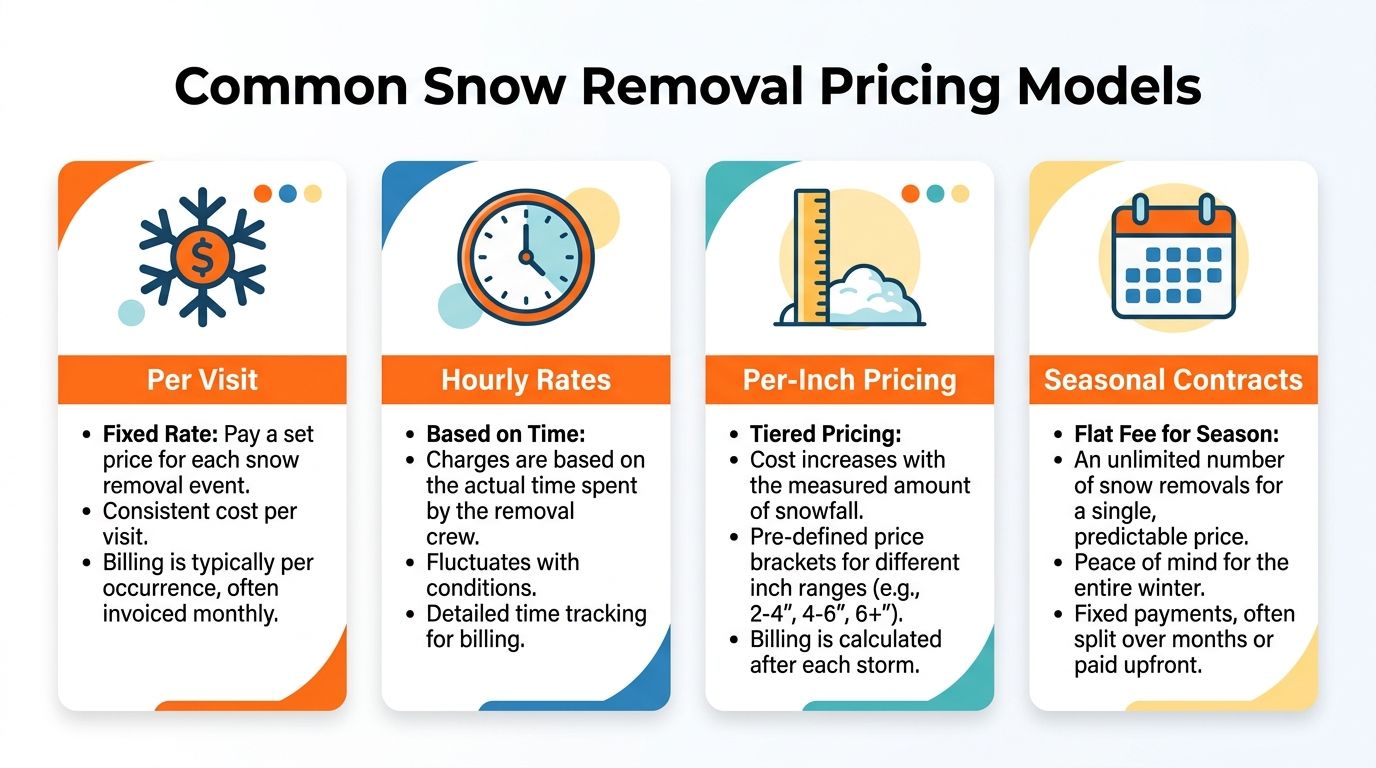
Snow contractors usually charge in one of four ways. Each model fits a different kind of customer, property, and weather pattern. If you don't know the billing structure first, it's hard to judge whether a quote is expensive or structured differently.
Per visit pricing
This is the easiest model to understand. The contractor clears the property once after a qualifying snowfall, then charges for that attendance.
It suits homeowners who don't want a seasonal commitment or who live in places where snow is irregular. The trade-off is flexibility usually costs more. Seasonal residential snow removal contracts typically cap at $200 to $600 for unlimited visits, while per-visit rates average $123 nationally, indicating a 20 to 30 percent premium for the flexibility of non-contracted service, according to Angi's annual snow removal contract pricing guide.
Hourly rates
Hourly pricing is common when the scope is less predictable. That might mean a property with difficult access, a site with many obstacles, or work that combines machine clearing and hand labor.
This model can be fair for both sides when site conditions are variable. It can also create tension if the customer expected a quick visit and the job drags out. For that reason, good contractors explain what slows the clock down before the storm arrives.
Per inch pricing
Per-inch pricing is the closest thing snow removal has to a metered rate. The bill rises with accumulation depth.
This works well when snowfall is the main cost driver. It also helps tradies protect margin during larger storms rather than getting stuck with a flat fee that no longer matches the work. Homeowners like it less because the final total isn't fully known in advance.
Practical rule: If the weather is unpredictable but snow depth is the main variable, per-inch pricing is often the cleanest model to explain and defend.
Seasonal contracts
Seasonal work is the subscription version of snow removal. The customer pays a set amount to cover winter service across the season, usually with agreed trigger points and property limits.
This model suits households that want certainty and contractors who want steadier winter revenue. The biggest misunderstanding is that “unlimited visits” never means “unlimited everything.” It still needs clear terms about depth triggers, walkways, de-icing, and where piled snow will go.
Typical Price Ranges and Regional Variations
The average cost of snow removal shifts a lot by region, but not always in the way people expect. Many assume the snowiest places are automatically the most expensive. Sometimes they are. Sometimes they aren't.
Early in your research, it helps to see the pricing overview visually.
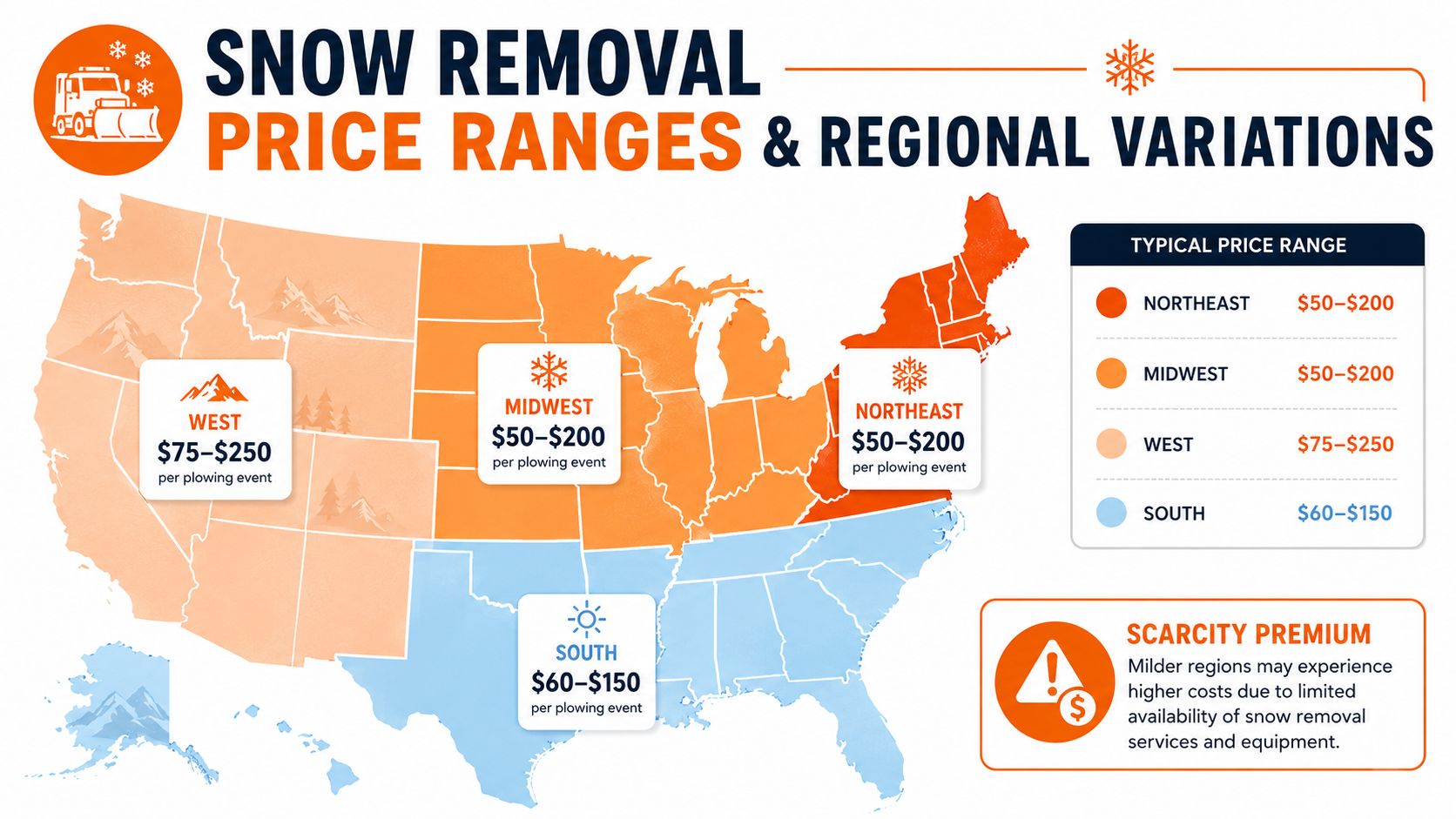
In the Northeast and Midwest, snow removal costs typically range from $50 to $200 for a single plowing event, while mild-snow areas now charge a 40 to 50 percent premium over heavy-snow regions due to equipment rarity and low contractor density, based on regional snow removal pricing analysis for 2025 and 2026.
Why rare snow can cost more
This is the hidden pricing driver many people miss. In places with frequent winter storms, contractors already own plows, spreaders, skid steers, and support gear. Routes are established. Operators know the local problem driveways. The market is built for snow.
In mild-snow regions, fewer businesses carry that setup year-round. When snow does arrive, equipment is scarce, schedules compress, and the available contractors can charge more because the service is less common. That's not opportunism. It's a scarcity premium.
Snow removal is specialty emergency work. If only a handful of operators in town can do it on short notice, the market price won't look like the rate in cities where crews do it all winter.
Residential and commercial don't price the same way
A homeowner often thinks in terms of a driveway. A contractor looking at a retail strip or office car park thinks in access lanes, turning radius, stacking zones, liability exposure, and timing windows.
Commercial work usually carries higher expectations around service timing and site usability. Even when the equipment is larger and more efficient, the operational pressure is higher too. Clearing a domestic drive before breakfast is one thing. Making a business lot safe and open on a deadline is another.
Here's a quick way to frame regional variation:
- Heavy-snow markets: More competition, more established routes, more normalized pricing.
- Light-snow markets: Fewer operators, less equipment availability, more price volatility.
- Urban areas: Access issues and congestion can complicate simple jobs.
- Rural areas: Travel time can shape the quote as much as the plowing itself.
A short explainer can also help if you want to see how contractors think through storm events and pricing pressure in practice.
What homeowners and tradies should take from this
Homeowners shouldn't compare a quote from a rare-snow town to a friend's price in Minnesota and assume one of them is wrong. Tradies shouldn't pull numbers from national averages and ignore local equipment supply.
A fair quote is local before it's national. The map matters, but contractor density matters too.
Key Cost Drivers
Most price differences come down to a handful of site and storm factors. Considering these, the average cost of snow removal stops being a headline and starts becoming a real quote.
Snow depth changes the math fast
Depth is one of the biggest drivers because snow removal doesn't rise in a neat straight line. Residential snow removal exhibits a non-linear cost escalation: the base rate for the first 6 inches averages $60 to $100, with each additional inch costing $3 to $10 due to increased fuel consumption and equipment wear, according to LawnStarter's snow removal pricing breakdown.
That matters because six inches and ten inches are not just “a little more snow.” The contractor may need extra passes, slower pushing, and more time clearing the street-end buildup. Fuel use climbs. Equipment works harder. Small machines reach their limits faster.
Property layout often beats property size
A wide, open driveway is usually easier than a smaller space with awkward angles. The quote can rise when a site includes tight turns, steep grades, parked vehicles, decorative edging, or nowhere practical to stack snow.
Three common examples cause confusion:
- Narrow access: Trucks and blades can't move efficiently, so more hand work is needed.
- Steep slopes: Operators slow down and work more carefully to avoid slide-offs and surface damage.
- Obstacle-heavy sites: Mailboxes, low walls, pavers, and garden borders all reduce speed.
Equipment and service scope matter
A shovel crew, a snowblower operator, and a plow truck don't approach the same job the same way. Faster equipment can lower labor time on open ground, but tricky sites often pull the job back toward hand work.
Scope also drives price. Some customers think “snow removal” means only the main driveway path. Others expect full-width clearing, walkway access, the apron at the road, and treatment for slick spots. If that isn't defined up front, the quote and the expectation drift apart.
The hidden cost driver isn't always the storm. Often it's the gap between what the customer pictures and what the contractor priced.
Access and timing
Two identical driveways can produce different prices if one customer wants routine service and the other calls once the snow has compacted, frozen, and been driven over. Timing changes difficulty. So does access if cars, bins, trailers, or gates block the route.
For tradies, this is why pre-site photos and written inclusions matter. For homeowners, it's why the cheapest quote can become the most expensive one if it leaves out half the work you assumed was included.
Sample Price Tables and Example Quotes
A quote table works like a tape measure. It does not tell you the whole story, but it gives you a reliable starting point if you know what it is measuring.
Sample Snow Removal Pricing Table
| Service Type | Typical Billing Range |
|---|---|
| Per visit residential service | Often priced as a flat call-out for a routine snowfall |
| Hourly snow removal | Used when access, depth, or site difficulty makes time the fairest method |
| Per-inch pricing for first 6 inches | Common where contractors want storm depth tied clearly to price |
| Additional inches beyond first 6 | Often charged at a lower per-inch rate after the base snowfall tier |
| Seasonal residential contract | Bundles a winter's service into one agreed price, usually with clear limits and trigger terms |
The point of the table is comparison, not prediction. A homeowner should not expect all five rows to apply to one driveway. A contractor should not expect one billing model to protect margin on every site.
The easier way to read it is to ask one question first. What is the contractor selling: a visit, a block of time, a snowfall depth, or a season of availability? Once that is clear, the rest of the quote starts to make sense.
How the same property can price differently
A single suburban driveway might be quoted three valid ways:
| Billing Method | How It Works | Best Fit |
|---|---|---|
| Per visit | One fixed price each time service is triggered | Routine storms with predictable access |
| Per inch | Price rises with snowfall depth | Areas where storm size changes a lot from event to event |
| Seasonal | One contract covers repeated service through winter | Homeowners who want budget certainty and priority scheduling |
That is where confusion often starts. A low per-visit number can look cheaper than a seasonal contract, right up until a winter brings frequent storms. On the other hand, a seasonal contract can look expensive in a mild year but still be fair if it reserves equipment, labor, and response priority.
For tradies, this is the same quoting discipline used in other service work. Clear inclusions, clear triggers, and clear overage rules prevent disputes later. The layout principles in a painting estimate template in Word also apply well to snow quotes because both depend on spelling out scope before the work starts.
Example quote for a heavy storm
A 12-inch snowfall is a good stress test because it shows how a simple-looking rate can expand once the storm moves beyond the base allowance. As noted earlier in the article, many contractors price the first snowfall band differently from the snow that comes after it.
Here is a practical example:
| Quote Item | Sample Pricing Logic |
|---|---|
| First 6 inches | Charged at the contractor's base per-inch rate |
| Next 6 inches | Charged under the additional-depth rate or heavy-snow clause |
| Extra labor risk | Added time if snow is wet, packed, drifted, or pushed by council plows |
| Total pricing outcome | Often much higher than a routine visit quote |
That last row is where homeowners get surprised and where tradies lose margin if the quote is vague. A 12-inch storm is not just “double the snow.” It can be slower to move, harder to stack, and more likely to need repeat passes to keep access open.
Regional rarity premiums also matter here. In snowbelt areas, contractors often have the equipment and systems to price big storms efficiently. In places where heavy snowfall is less common, the same event can cost more because labor is harder to source, equipment is less specialized, and disruptions are wider across the local market.
Two example quote scenarios
| Scenario | What Is Included | Likely Pricing Pressure |
|---|---|---|
| Small urban driveway, light snowfall | Driveway clear only, easy street access, no walkway | Usually driven by minimum call-out price more than time on site |
| Large sloped driveway, heavy snowfall | Full-width driveway, apron, front path, return visit if plow windrow blocks access | Price rises from depth, slower operating speed, stacking limits, and broader scope |
This is the hidden driver many people miss. The invoice is shaped by the awkward parts of the job, not only by the square footage.
For homeowners, sample quotes help you spot omissions before you accept a price. For tradies, they help you show why two properties that look similar on paper can produce very different costs in practice.
A clean quote usually answers these questions before work starts:
- What area is included: Driveway only, or driveway plus walkway, apron, and entry
- What triggers service: Set snowfall depth, automatic attendance, or customer call-out
- How extra depth is billed: Per inch, hourly, or as a heavy-storm adjustment
- What is excluded: Ice treatment, repeat visits, hand shoveling, or blocked-access delays
- Whether regional conditions affect price: Scarce equipment, rare storms, or disposal and stacking limits in tighter neighborhoods
Tips for Homeowners Getting Accurate Estimates
A snow quote is only as good as the information behind it. If you give vague details, you'll get vague pricing back. The fastest way to improve quote accuracy is to make the site easier to understand before the contractor ever turns up.
What to prepare before asking for a quote
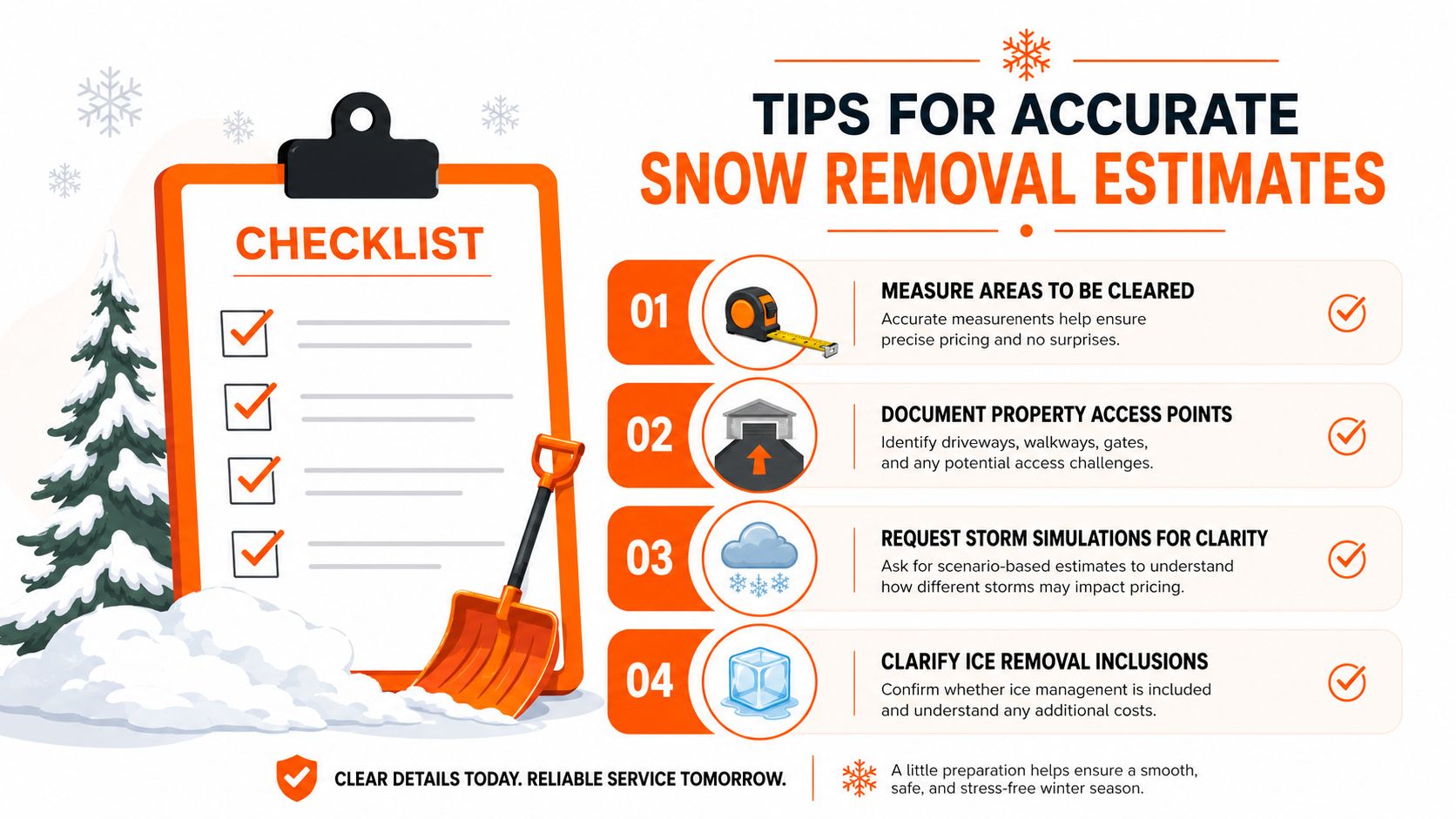
Start with the physical scope. Measure the driveway, note any walkway or steps, and mention whether the property has a steep slope, gravel surface, or tight turn near the garage. Those details change the equipment choice and the time needed on site.
Photos are surprisingly helpful. A wide front-on photo, one shot from the street, and one image showing side access or obstacles can save a lot of back-and-forth.
Questions that stop misunderstandings
Ask contractors practical questions, not just “What's your price?”
- What areas are included: Confirm whether the quote covers the driveway apron, front path, and entry area.
- When do you start: Some contractors attend automatically after a trigger depth, others only when called.
- How do you handle heavier storms: Ask what happens when snowfall exceeds the base allowance.
- Is ice treatment included: Don't assume slick areas are treated unless the quote says so.
If a quote looks vague before the season starts, it usually becomes expensive during a storm.
How to compare bids properly
Don't compare totals alone. Compare scope against scope. One contractor may include walkway clearing and return visits. Another may quote a lower headline number for a single driveway pass only.
A practical way to compare estimates is to line up each quote under the same headings:
| Comparison Point | What to Check |
|---|---|
| Service area | Driveway only or additional paths and entries |
| Trigger point | Automatic service or customer request |
| Heavy snow handling | Added charge, per-inch rate, or revised visit price |
| Site limitations | Cars, gates, bins, and stacked snow locations |
Homeowners who do this usually get better-fit pricing because contractors can quote the actual job instead of guessing around missing details.
Guidance for Tradies on Pricing and Communicating Value
Underpricing snow work is one of the easiest ways to stay busy and lose money. The route looks full, the phone keeps ringing, and the numbers still don't stack up by the end of winter. Good pricing starts with local reality, not wishful thinking.
Price for the job you actually perform
A snow route isn't just blade time. It includes travel delays, weather uncertainty, equipment prep, and the awkward properties that always take longer than they should.
If you're setting rates, build your pricing around the conditions that hurt margin most. Heavy accumulation, difficult access, and repeat passes need a structure that protects the job. Flat pricing can work on straightforward routes. Tiered pricing is usually safer once storms become less predictable.
For many trades, the same mindset used to price a painting job properly applies here too. Accurately scope the site, define what's included, and make sure your price covers the hidden work, not just the obvious task.
Communicate value in operational terms
Customers rarely object to price alone. They object to uncertainty. If you explain how your service works in plain language, you remove a lot of friction before it starts.
Strong proposals usually make these points clear:
- Response method: Tell the customer whether you service on trigger depth, scheduled rounds, or call-out.
- Property inclusions: List exactly what gets cleared and what doesn't.
- Storm escalation: Explain how larger events are priced so nobody feels surprised later.
- Reliability factors: Mention route planning, equipment readiness, and how you handle blocked access.
Customers don't just buy snow removal. They buy confidence that the property will be usable when they need it.
Protect margin without sounding defensive
You don't need to over-explain every line item. You do need to explain the logic. Customers understand that deeper snow, tighter access, and higher-risk conditions take more labor and tougher equipment. What frustrates them is finding that out only after the invoice lands.
A clean pricing conversation sounds direct. “This price covers the first snowfall band. If accumulation goes beyond that, the next band applies.” That's easier to accept than a vague low quote followed by a messy adjustment.
Tradies who win repeat winter work usually do two things well. They set expectations before the storm, and they make the invoice match the words they used when they sold the job.
Conclusion and Key Takeaways
The average cost of snow removal is useful, but it's only the starting point. The actual price depends on how the service is billed, how much snow falls, how accessible the property is, and how common snow contractors are in your area.
For homeowners, the smartest move is to stop looking at the total first. Look at the scope, trigger depth, and storm handling terms. A quote that seems cheap can become frustrating if it excludes the walkway, ignores the road-end pile, or changes sharply once snowfall deepens.
For tradies, winter pricing works best when it's honest and structured. Clear tiers, written inclusions, and local market awareness do more than protect margin. They reduce disputes and help customers see the value in your service.
A few points matter more than anything else:
- Know the billing model: Per visit, hourly, per inch, and seasonal contracts each suit different situations.
- Expect local variation: Rare-snow areas can be more expensive than heavy-snow regions.
- Watch hidden drivers: Depth, access, obstacles, and service timing all shape the invoice.
- Put scope in writing: Clear estimates prevent most pricing arguments before they begin.
Snow removal pricing isn't random. Once you break it down the way a contractor does, the numbers become much easier to understand and much easier to justify.
If you run a trade business and want to stay visible between jobs without spending your nights writing posts, GrowTradie helps keep your business active with customized content, professional designs, and auto-posting built for tradies. It's a practical way to stay in front of local customers, build trust, and turn attention into real enquiries.