

You're on site, the job's moving, the customer's happy, and you've got your phone propped against a toolbox because you meant to grab a quick clip. Then the van gets packed, the next call comes in, and that footage dies in the camera roll. That's the whole problem with tradie marketing. Most of the work is already happening, but nobody turns it into proof.
Skill demonstration is the easiest fix. Not because it's flashy, but because it lets you show real work, real standards, and real outcomes without inventing content from scratch. If you're a plumber, sparky, chippy, or HVAC tech, you already do the hard part every day. The trick is to film it with intent, package it, and make each job pull its weight twice.
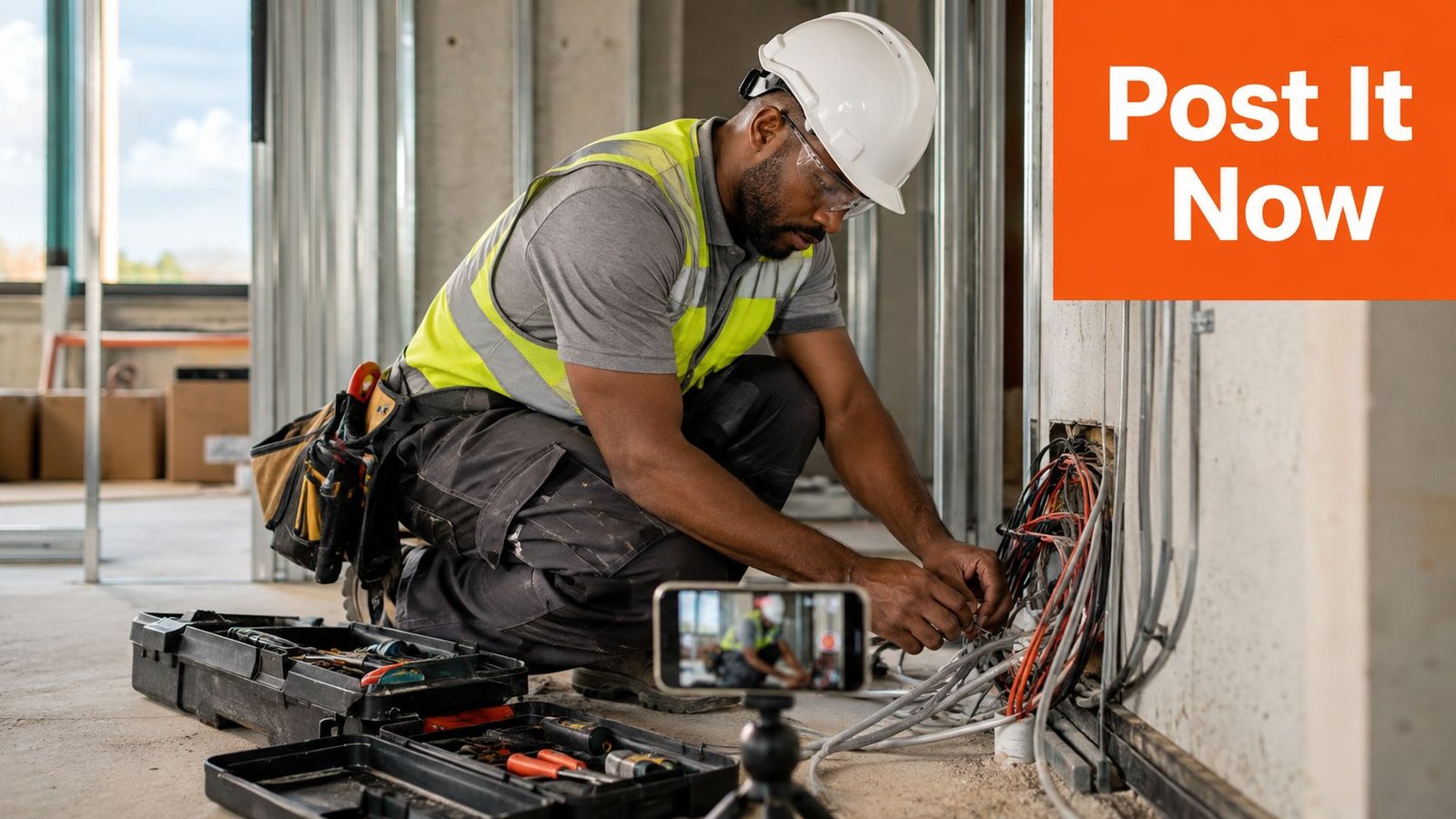
Table of Contents
- Why Skill Demonstration Is the Shortcut Most Tradies Miss
- Planning the Shot Before You Pick Up the Phone
- Filming Safely on a Live Jobsite
- Short Scripts and Caption Templates That Sound Like a Tradie
- Editing and Formatting Without a Laptop
- Posting Cadence and Calls to Action That Pull Enquiries
- Repurposing One Job Into a Week of Posts and Letting Auto-Posting Handle the Rest
Why Skill Demonstration Is the Shortcut Most Tradies Miss
Most tradies think they need a better content idea. They don't. They need a better way to show what they already know how to do.
The old history of statistics makes the point neatly. John Graunt used death records in 1662 to estimate London's population at about 384,000 people from roughly 13,000 funerals per year, which was a big deal because it showed that recorded evidence could prove something bigger than a single observation ever could. The same logic applies on the tools, if you can show the job clearly, the customer doesn't have to guess whether you know what you're doing. Historical background on the rise of statistics
Work you already do is the content
You don't need a fake “brand story.” You need clips of a clean solder, a tidy cable run, a level slab, a correct diagnosis, or a neat patch-up that a homeowner can understand at a glance. That's skill demonstration, and it's the fastest way to turn working proof into trust.
Practical rule: if the job already looks good in person, it can usually be turned into a post with almost no extra effort.
The best part is that it doesn't rely on you being clever on camera. The work does the talking. That's why a simple install, fix, or test often lands harder than polished marketing copy.
If you want a clean example of how to capture that behind-the-scenes proof without overthinking it, this is the right starting point: behind-the-scenes content. Keep the focus on the job, not on performing for the phone.
Trust comes from seeing the process
People don't hire tradies because they enjoy scrolling. They hire the person who feels competent, careful, and straight-up. When you show the process, you give them evidence instead of promises.
That lines up with the broader history of demonstrated skill. John Snow's 1854 cholera work used mapped case data to identify a contaminated water pump, and Florence Nightingale's 1859 casualty statistics helped change public debate because the evidence was visible, not just asserted. The same principle still holds, measured work beats opinion. Public health milestones in skill demonstration
The real obstacle is the system
Most tradies aren't short on proof. They're short on a repeatable way to capture it. Once you fix the system, the content gets easier, the enquiries feel more natural, and your working week stops getting chewed up by random posting decisions.
Planning the Shot Before You Pick Up the Phone
Good demonstration content starts before you hit record. If you wait until the last second, you end up filming whatever the angle gives you, not whatever proves the work.
Use a 10-minute pre-shoot routine
Start by choosing one skill from the job in front of you. Not the whole job, just one clear thing worth showing, like the clean termination, the accurate cut, the test result, or the final fit-off. Then decide what the homeowner needs to see to believe it.
A simple pre-shoot habit works better than winging it. The routine should be: scout the area, clean the workspace, set the phone angle, test the lighting, and do a quick test clip before action starts. That lines up with a broader six-step competency flow of Learn, See, Practice, Prove, Do, Maintain, where the proof only becomes useful when the setup is deliberate. Six-step skill-demonstration pipeline
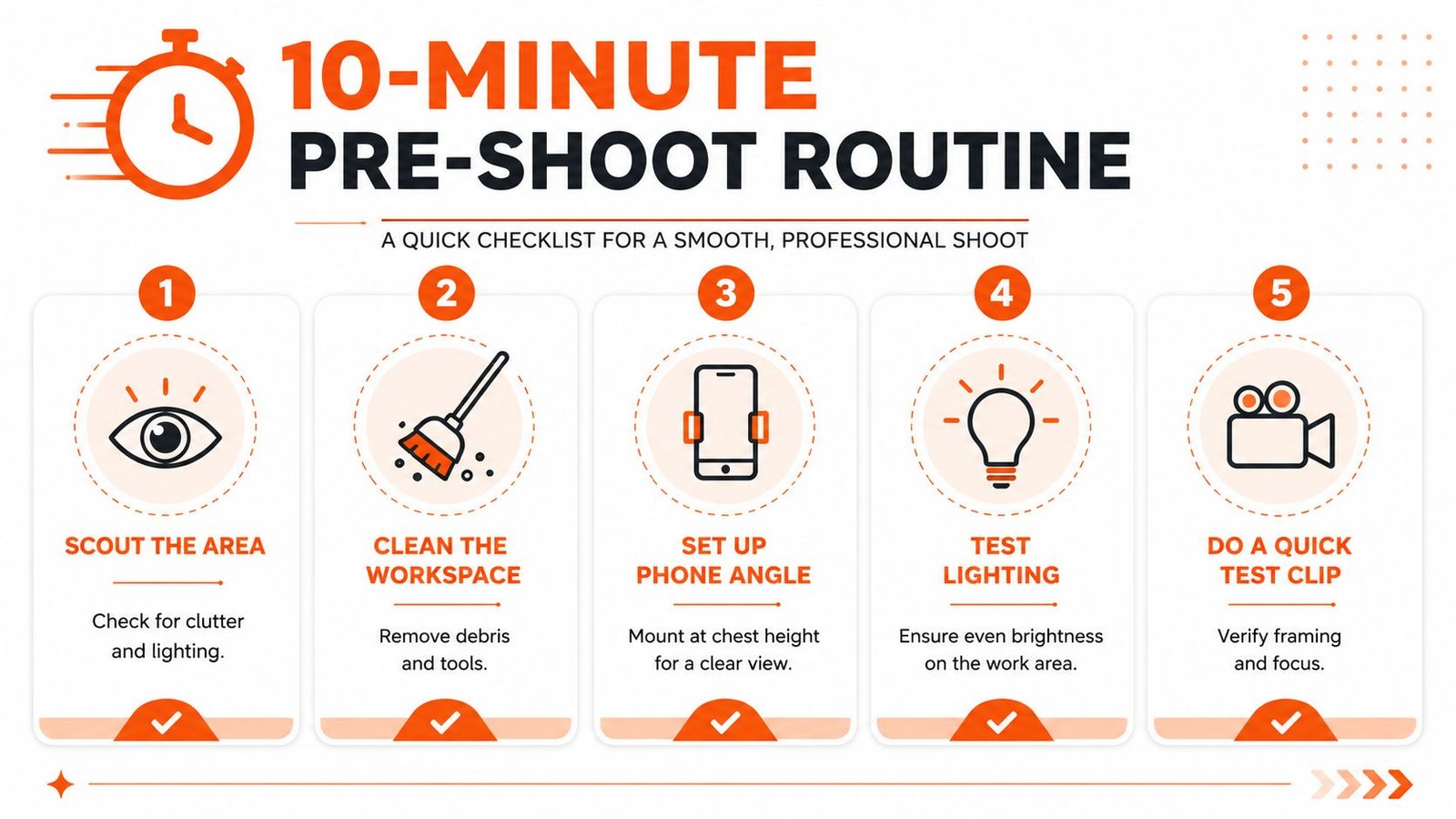
A solid internal check list is the difference between random clips and usable proof. If you want a simple photo workflow that keeps the job looking sharp, this is worth a look: tips for professional photos.
A useful standard: if you can't say what outcome the clip proves, you probably don't need to film it.
Match the shot to the result
Different shots do different jobs. A wide shot shows the setting and scale. A tight close-up shows the detail. A mid-action over-the-shoulder shot shows your hands doing the work in a way customers can follow without getting lost.
Use that deliberately. A feed post can handle a wider frame. A short vertical clip works better for a tight action moment. A story-style clip should feel like a quick glance over your shoulder, not a polished commercial.
Write the outcome before the clip starts
The clip needs one outcome written down in plain English. “Circuit tagged and tested.” “Joist reinforced, ready for tile.” “No leak after test.” If the outcome isn't clear to you, it won't be clear to the homeowner either.
That one line becomes the backbone of the post. It tells you what to film, what to say, and what to leave out. Random footage feels busy. Footage with an outcome feels professional.
Filming Safely on a Live Jobsite
Tradies don't work in studios. They work in roof spaces, switchboards, trenches, kitchens, and cramped corners where one bad move can cause trouble. That means filming has to fit around the job, not the other way around.
Safety and consent come first
PPE goes on before the phone comes out. No exceptions. If the work is live, risky, or sensitive, the camera stays away until the job is safe to film.
Get consent before you capture anything identifiable about the property or the customer. Keep the consent in writing, even if it's short and plain. That keeps the footage usable later and avoids dumb arguments after the fact.
Blunt rule: if the clip shows a hazard you wouldn't happily explain to the customer face to face, bin it or re-cut it.
Keep the filming practical
Use the environment you've got. A phone leaning against a level is better than one wobbling on a roll of tape. Natural light is usually your best friend, especially in open areas where artificial glare makes the job look messy.
Record extra B-roll around the main action, about ten seconds of movement, hands, tools, or the finished detail. That gives you options when you edit later and stops every post from feeling like a single static shot. If the satisfying part is the final pull, tighten the frame and let the clean result carry the clip.
Don't film the wrong moment
Some moments belong in the bin. Live electrical work in shot, unsafe angles, messy backgrounds, or anything that exposes the customer in a way you'd regret later. A good demonstration clip should make you look careful, not reckless.
The goal isn't to make the job look easy. The goal is to make your standard obvious. Safe footage is usable footage, and usable footage is what keeps your posting system moving without drama.
Short Scripts and Caption Templates That Sound Like a Tradie
Most tradies stall at the caption stage because they think they need to sound polished. They don't. They need to sound like the person who did the job.
Keep the structure brutally simple
Use this order. Hook first. Proof second. Ask third. That's it.
The strongest proof language is plain and specific, the kind a customer can repeat back without confusion. Phrases like “here's what I found,” “here's why,” and “here's the test I run” work because they sound like a working tradie, not an ad. A strong interview answer follows the same logic, choose the skill, show the evidence, then connect it back to the job question. How to demonstrate your skills in a job interview with concrete evidence
| Demonstration Type | Hook Line | Proof Line | Call to Action |
|---|---|---|---|
| Diagnosis reveal | Here's what I found on this one. | The fault was hiding behind the symptom, so I traced it back before touching anything else. | If you've got a similar issue, send through a photo. |
| Before and after | This is the difference a proper fix makes. | The original setup wasn't failing loudly, it was failing slowly, so the repair had to be tidy and permanent. | Book it in before it becomes a bigger job. |
| Tool tip | This is the tool I use for this part of the job. | It gives me a clean result without wasting time or damaging the finish. | Save this if you want the setup on your next job. |
| Safety reminder | Don't rush this step. | This is the check that stops problems later and keeps the work compliant. | If you're not sure on your own setup, call us. |
| Why we did it this way | We didn't take the quick shortcut here. | The better choice was the one that gives the customer a longer-lasting result. | DM us if you want it done properly. |
Use the same language customers already use
Don't write like a brand manager. Write like a person who's explaining the job to a homeowner at the front gate. Short words beat fancy ones. Clear beats clever every time.
A caption can be only a few lines if it does the job. One line for the hook, one line for the proof, one line for the ask. That's enough.
Make the action visible
Your own work has to be the focus. Don't hide behind “we” when you're the one doing the key part. The customer wants to know who did the work and what they did well.
A specific measurable outcome always strengthens the point. Even when you can't quote a number, you can still make the result concrete by naming the test, the fit, the finish, or the check that proves the job's done right. That's the same logic behind strong resume evidence, where the best proof is action verb + specific situation + measurable outcome. Verifiable skills guidance for resumes
Editing and Formatting Without a Laptop
You don't need a laptop to make a good clip. You need a clean trim, readable text, and a finish that lands on the result instead of the tradie walking off into the distance.
Edit for speed and clarity
Cut the clip down to a 15 or 30-second window. Front-load the hook in the first three seconds, because if the opening is slow, the viewer is gone. Then end on the result, not on you packing up tools.
Auto-captions are worth using because plenty of people watch with the sound off. Keep the text inside the safe area so platform buttons and icons don't hide your point. A single font, one brand colour, and square text corners make the whole thing feel deliberate instead of thrown together.
Format it like a repeatable system
The difference between polished and random is usually boring stuff done consistently. Use the same end card each time. Keep the same font family. Don't cram five messages into one post.
A quick phone edit should follow this order.
- Trim the dead time. Cut out the walk-backs, pauses, and setup chatter that don't help the proof.
- Add captions. Make the clip usable without sound.
- Crop for the platform. Vertical when the platform expects vertical, tighter framing when the action matters.
- Place the hook early. The viewer should know what they're looking at straight away.
- Finish on the result. Let the completed work do the closing, not a rambling goodbye.
Keep the edit simple enough that you'll actually do it while the job is still fresh.
That's the point. Not perfection, just repeatability. Once the format is the same every time, the clip looks like part of a process, which is exactly what builds trust.
Posting Cadence and Calls to Action That Pull Enquiries
Posting more often isn't the answer. Posting with rhythm is. If you're trying to run a business at the same time, your content has to fit inside a working week, not hijack it.
Use a weekly rhythm you can keep
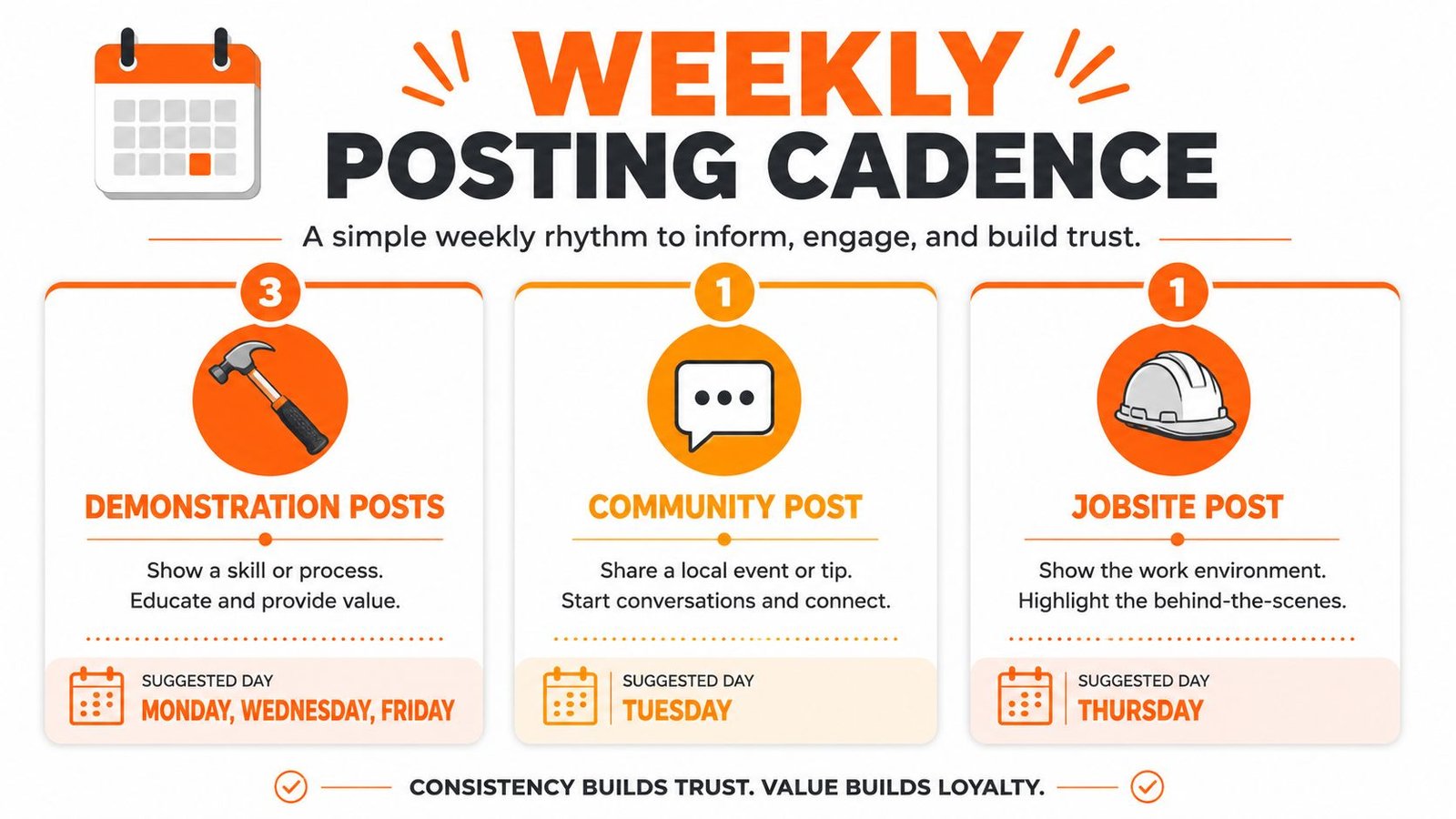
A solo tradie doesn't need to post every day. A realistic cadence is three demonstration posts, one community post, and one jobsite post each week. That gives you enough consistency to stay visible without living on your phone.
The format should match the platform. Short vertical video fits Reels and Shorts. Image carousels work well on Facebook. A single strong before-and-after image can carry the grid post on its own. The point is to pick one main platform and one secondary one, not try to be everywhere and end up nowhere.
The history of formal demonstration also backs this up. Modern assessment methods moved toward structured comparison, defined criteria, and visible evidence because vague judgment doesn't scale well across people or settings. Skills demonstration only works when the evidence is clear enough to compare. Structured skills demonstration in assessment settings
Choose calls to action that make enquiries easier
Not every CTA should chase comments. If you're a tradie, you want action that leads to a job. “Save this” has a place, especially on educational clips, but “DM us your job” and “call for a quote” are closer to the money.
Use the CTA that matches the post. A tip post can ask for a save. A before-and-after can ask for a message. A proof-heavy demo should invite the homeowner to get in touch if they've got the same issue. That keeps the post useful without turning it into a hard sell.
Match the post type to the job
A short clip proves the method. A carousel can show the sequence. A single image can show the result. A community post keeps your name around the local area without pretending to be a sales post.
That rhythm matters because it keeps your profile alive between jobs, calls, and site visits. Most tradies don't need more content ideas. They need a posting habit they can maintain.
Repurposing One Job Into a Week of Posts and Letting Auto-Posting Handle the Rest
One job should produce more than one post. If you squeeze it properly, a single Monday on the tools can carry your content for the rest of the week without you dragging yourself back into the camera app every night.
Turn one switchboard upgrade into five assets
Take a switchboard upgrade as the example. The wide establishing clip becomes the feed post, because it shows the job in context. The 15-second slow-mo of the rewire becomes the short video, because the movement and detail hold attention. A before-and-after carousel shows the improvement clearly.
A safety-tip story can focus on the one thing the homeowner should notice, like why the original setup needed attention. Then a quote graphic can carry the customer outcome in a clean, easy-to-share format. The same work, five different angles, no new job needed.
Hand the raw material off to a system
That's where a proper content pipeline makes sense. You drop the raw clips into the platform, it pulls out the skill demonstration angle, writes the captions in your voice, designs the post, and schedules it across the week through auto-posting. The job on site becomes the content source, not another admin task hanging around after hours.
If batching content is a new habit for you, the logic is simple. Collect the proof while you're already there, then let the system do the reshaping later. content batching for tradies fits this model because it keeps the effort attached to the job, not to a separate marketing day.
The smartest trade content isn't made from scratch. It's extracted from work you've already done properly.
That's the whole game. The tradies who stay visible aren't the ones who post random stuff in a rush. They're the ones who turn every good job into proof, then let a repeatable system keep the week full while they stay on the tools.
If you want a cleaner way to turn everyday jobs into proof, GrowTradie is built for that exact problem. It helps tradies turn real work into posts, keep their pages active, and stop losing good footage in the camera roll. If you're sick of content taking over the week, get in there and let the jobs do the talking.