
Brand authority is the trust, proof, and local recognition that makes a customer pick your trade business before they've even spoken to you, and 81% of consumers need to trust a brand before they'll consider buying (brand credibility research). In trade work, that shows up early, in the profile they click, the reviews they read, and the name they remember when they need a plumber or sparkie.
You've seen it. Two decent tradies work the same area, charge similar money, and can both do the job properly, yet one gets the call while the other waits by the phone. The difference usually isn't skill. It's the one with stronger signals that make people feel safe enough to get in touch.
Table of Contents
- The Two Tradies Down the Road and Why One Always Gets the Call
- What Brand Authority Actually Means for a Trade Business
- Why Brand Authority Hits Harder for Local Tradies Than for Online Brands
- The Signals That Make a Trade Business Look Authoritative
- Common Myths Tradies Believe About Brand Authority
- Practical Strategies Tradies Can Use to Build Brand Authority Locally
- How GrowTradie Helps Tradies Build Authority Without the Marketing Hassle
- A Simple Plan to Build Brand Authority This Quarter
The Two Tradies Down the Road and Why One Always Gets the Call
Same suburb, same trade, different result
One plumber has the van, the tools, and the know-how. The other plumber has the same sort of setup, maybe even better gear. Yet the first one keeps getting recommended in the local Facebook group, the second one gets the scraps, and neither of them can quite explain why.
That pattern shows up everywhere in trade work because customers don't hire only on skill. They hire on confidence. If a homeowner is staring at a leaking pipe or a dead power point, they're not comparing craftsmanship in detail, they're looking for the tradie who seems least likely to waste their time, mess them around, or disappear after the deposit.
Practical rule: if a customer can't tell who's best from the job itself, they'll use the signals around the job instead.
The tradie who gets chosen usually has a few simple advantages. Their name keeps showing up. Their reviews sound specific, not fake. Their photos look like actual jobs from the area. Their business details match everywhere, so the customer doesn't feel like they're dealing with a one-off operator who might be hard to reach later.
Why the quieter operator loses out
The quieter operator can still be a better tradesperson and still lose the enquiry. That's the frustrating part. Local buyers don't have the luxury of trying before they buy, so they lean on whatever makes the decision feel safer, and that often means the business that looks established, consistent, and easy to verify.
Moz's launch of Brand Authority™, a 1-to-100 score, reflected that shift toward measurable strength rather than loose reputation language (Moz on Brand Authority). For tradies, the lesson is plain. The market doesn't just ask, “Can you do the work?” It asks, “Can I trust you to show up, explain the job properly, and finish cleanly?”
That's why one tradie becomes the obvious call while another stays invisible. The visible one has built a pattern of trust. The invisible one has relied on skill alone, and skill rarely gets a chance to speak first.
What Brand Authority Actually Means for a Trade Business
What the customer actually sees
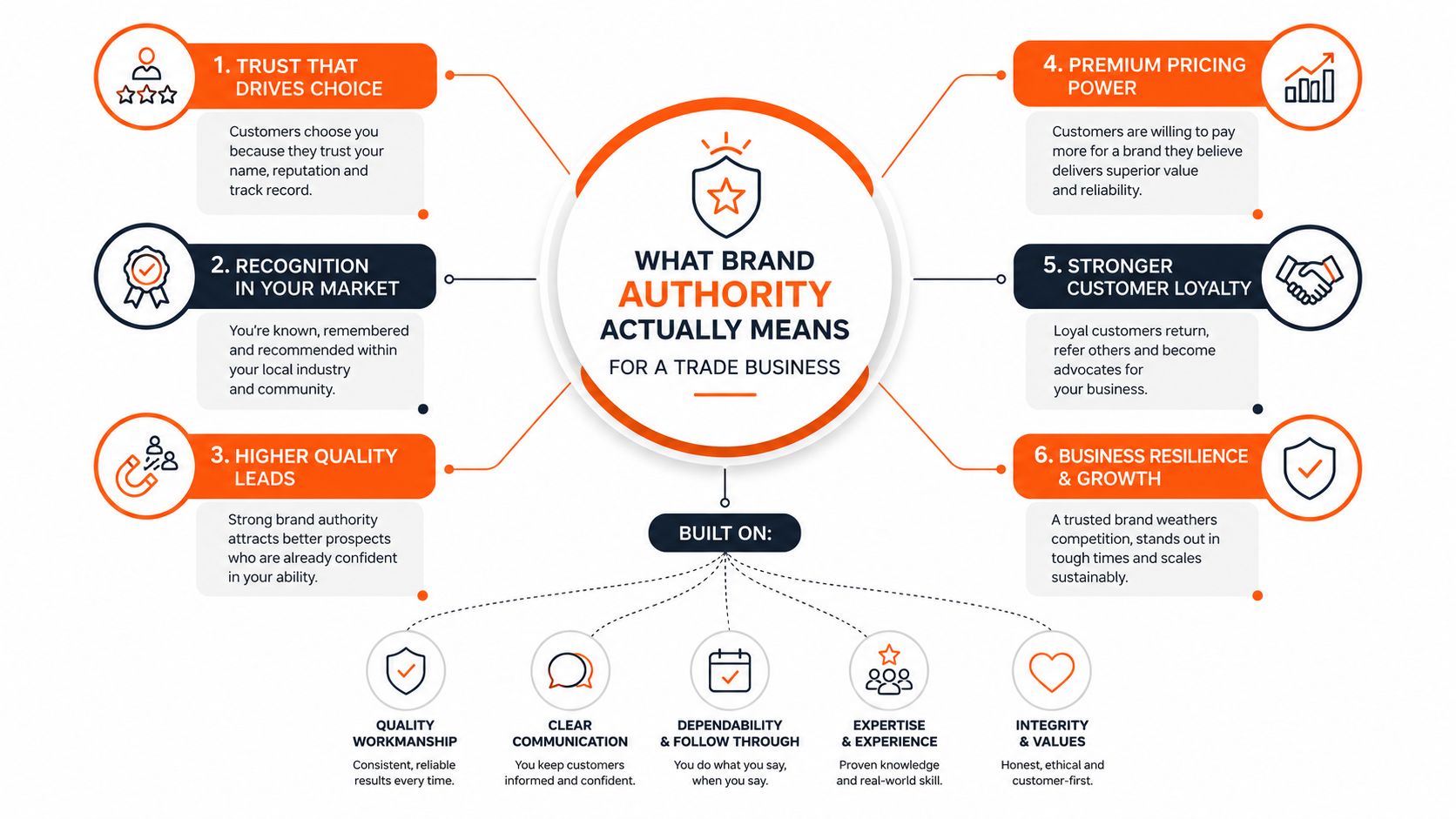
Brand authority starts with what a customer feels before they ever speak to you. They recognise the business name, the profile looks complete, the photos feel real, the reviews sound like actual jobs, and the whole thing suggests, “This person has done this before.” That's the test in a local market.
For trade businesses, authority isn't a fluffy branding idea. It's a stack of signals that make a homeowner or site manager comfortable enough to call. Independent guidance for AI ranking describes brand authority as being estimated from brand mentions on the web, unlinked citations, social media presence and engagement, media coverage, and direct brand searches (AI ranking guidance on brand authority). That's useful because it shows authority is broader than backlinks or one polished page.
The three parts that matter most
For a plumber, electrician, carpenter, or HVAC tech, brand authority comes down to three things. Trust, because people are letting you into their home or job site. Demonstrated expertise, because they need proof you've solved similar problems before. Local recognition, because the business feels more legitimate when other people in the area already know it.
A subcontractor on a builder's crew works the same way. The new bloke might be skilled, but if the builder hasn't seen how he works, how he communicates, or whether he turns up on time, he doesn't get the same level of confidence as the subcontractor who's been on twenty jobs and never caused drama.
A tradie with authority doesn't just look busy. They look proven.
Reputation and authority aren't the same thing
Most tradies use reputation and authority as if they're the same word. They're close, but not identical. Reputation is the result people talk about after the job. Authority is the system that creates the result in the first place.
A business can have a decent reputation in private and still lack authority in public if the proof is thin, the details are inconsistent, or the market can't easily verify who they are. That's why the better question isn't “Do people like us?” It's “What makes people believe us before they call?”
Why Brand Authority Hits Harder for Local Tradies Than for Online Brands
The buyer can't test the service first
Local service buying is a trust-first game. A customer can't test a burst pipe repair, a switchboard upgrade, or a ceiling fan install the way they can test a pair of boots or return a shirt that doesn't fit. They need to choose before they know how the work will feel.
That makes authority cues carry more weight in trade markets than in a simple online shop. An ecommerce buyer can check specs, compare prices, read shipping terms, and return the item if it's off. A homeowner choosing a tradie is making a high-trust, low-information decision, usually while something's already broken.
The moment they search for a local service, they start sorting businesses by confidence. They look at reviews, photos, how complete the profile is, whether the brand name keeps appearing, and whether the business seems active enough to answer the call. If those signals are weak, the lead disappears.
Why a solo operator can beat a bigger competitor
That's the part many tradies miss. A solo operator can beat a larger competitor if the solo operator looks more credible in the local market. A bigger business with more trucks doesn't automatically win if its profiles are stale, its reviews are generic, and its proof is thin.
Recent commentary on branded versus unbranded search makes the same point in a different way. Discovery is moving toward citations, mentions, and branded search, not just raw clicks, and local-business guidance says branded search is a concrete signal that people nearby are actively looking for your business (branded versus unbranded search commentary). That matters because authority isn't only about being found. It's about being the name people remember when they're ready to choose.
For tradies, that means credibility gets judged before workmanship is ever tested. The call goes to the business that feels easier to trust, not necessarily the one with the longest tool list.
The Signals That Make a Trade Business Look Authoritative
What people and systems look for
A trade business looks authoritative when the same story shows up in a few different places. The Google Business Profile is complete. The business name, suburb, phone number, and website match across listings. Reviews are recent and specific. Photos show real jobs, not stock images. The brand appears in local conversations and supplier mentions. Those are the basics.
A practical way to prove authority is through multi-signal evidence, including on-site proof such as authorship, editorial policy, references, case studies, and methodologies, plus off-site proof such as press mentions, reviews, affiliations, and conference talks. The same source also points to entity-consistency signals across platforms like LinkedIn, G2, Crunchbase, Google Business Profile, and Wikidata/Wikipedia (multi-signal evidence guidance). For tradies, the platform names matter less than the principle, consistency across places beats isolated polish.
What a strong local profile actually looks like
A good profile doesn't need fancy copy. It needs proof. A tidy switchboard install says more than a stock handshake photo because it shows actual workmanship. A review that names the suburb and the job type is better than “Great bloke” because it gives the next customer something concrete to trust.
- Profile details match everywhere: the same business name, address or service area, phone, and website across listings.
- Reviews sound human: customers describe the job, the response time, or how the tradie handled a problem.
- Photos show finished work: real van shots, job sites, installations, and results.
- Qualifications and insurance are visible: customers shouldn't have to hunt for them.
- Branded search grows over time: more people are looking for the business by name, not just by service type.
The idea is simple. When each signal agrees with the others, the business feels real. When one part looks off, customers get wary.
If you want a practical checklist for the reputation side of things, this guide on building online reputation is worth keeping handy.
Common Myths Tradies Believe About Brand Authority
Being skilled is enough
It isn't. Skilled tradies still lose calls if the customer never gets far enough to discover the skill. The homeowner can't judge your plumbing or electrical work from the street, so they judge the signals around your business instead.
Being busy doesn't prove authority either. A full diary is great for cashflow, but customers don't see your calendar. They see your profile, your reviews, and whether your business looks like one they can rely on.
A logo or a slick website will fix it
A polished logo helps only if the rest of the picture matches. Customers are pattern-matching across many small clues, not giving out trust because one page looks glossy. If the branding looks sharp but the reviews are thin, the photos are old, and the details differ from platform to platform, the shine wears off fast.
A lot of tradies also think authority takes years no matter what they do. That's not how local markets work. People notice visible consistency quicker than most owners expect, especially when the business starts showing up with proof of work, fresh reviews, and the same name everywhere.
Practical rule: authority grows when the market keeps seeing the same business, the same standards, and the same proof.
Big budgets are required
That's another myth that keeps good operators quiet. A solo tradie doesn't need a giant agency machine to look credible. They need disciplined habits, consistent proof, and a way to make the business easy to trust.
Moz's Brand Authority model is built around a 1-to-100 score that measures broader brand strength, while distinguishing it from Domain Authority, which is about ranking ability on search engines (Moz's Brand Authority definition). That distinction matters because it reminds you that authority is broader than one technical metric. It's the market's confidence in the business entity itself.
Practical Strategies Tradies Can Use to Build Brand Authority Locally
Build proof into the job flow
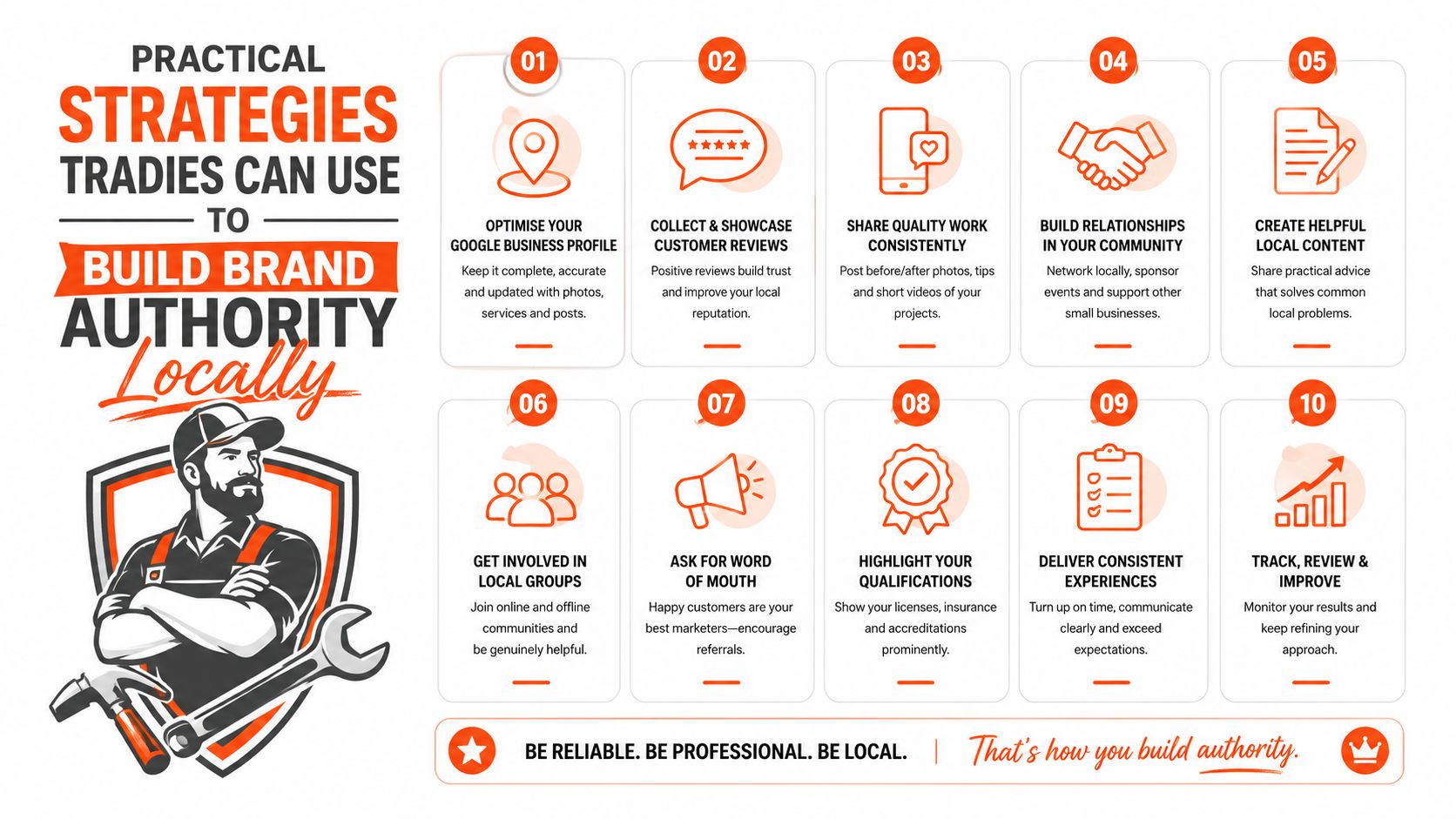
The easiest authority win is to ask for a detailed review right after a good job. Not a generic “five stars if you're happy,” but a couple of lines about what was fixed, where the job was, and how the customer felt about the result. Specific reviews give future customers something to latch onto.
Then post real work. A before-and-after on a rough bathroom reno, a neat cable run, or a cleaned-up switchboard tells a story without needing a sales pitch. The point isn't to show off, it's to make the workmanship visible.
Keep the business easy to verify
Consistency matters more than most tradies think. The name on the invoice, the website, the Google profile, and the directories should all line up. If the customer has to wonder whether they've found the right business, trust slips.
A short, useful content rhythm helps too. Answer the questions you hear on site, use local suburb references naturally, and keep the wording plain. If a supplier mentions you, or a local partner tags you, that third-party validation does more than another self-praise post ever will.
Use a simple weekly rhythm
A workable authority week might look like this.
- Monday: check listings and make sure the details still match.
- Tuesday: post one real job photo with a plain explanation of the work.
- Wednesday: ask recent happy customers for reviews while the job is still fresh.
- Thursday: answer one common customer question in a short post.
- Friday: look for one local mention, supplier tag, or community group comment you can build on.
A trade business doesn't need more noise. It needs repeatable proof. The businesses that look most credible are usually the ones that keep showing up with the same standards, not the loudest ones in the room.
A separate guide on small business content strategy can help if you're trying to turn that rhythm into something repeatable.
How GrowTradie Helps Tradies Build Authority Without the Marketing Hassle
The shortcut for staying visible
The hard part for most tradies isn't believing content matters. It's finding time to make it happen between quoting, invoicing, and being on site. That's where a system that keeps the business active without constant manual work becomes useful.
How the features line up with authority signals
AI-generated posts customized to your trade, services, and suburb support the recognition and consistency signals that make a business feel established. Professionally designed visuals help the profile look trustworthy instead of patched together. Auto-posting keeps the business active between jobs, which matters because stale profiles look forgotten.
The value here is simple. You don't need to become a marketer. You need a system that keeps putting real, relevant proof in front of local buyers so they remember your name when the job comes up.
Practical rule: if you can't post consistently by hand, use a setup that does the repetitive part for you.
For a plain walkthrough of the process, see how GrowTradie works. The point isn't clever marketing theatre. It's making sure your business keeps showing up with the sort of consistency that builds confidence.
A Simple Plan to Build Brand Authority This Quarter
Tighten the basics first
Start with the Google Business Profile. Make sure the details are complete, the service area is right, and the photos show actual work. Then go through your other listings and make the business name, phone, and website line up exactly.
After that, build the review habit. Ask every happy customer for a specific review while the job is fresh in their mind. Specific feedback carries more weight than vague praise because it helps the next customer picture what working with you is like.
Keep proof flowing every week
Post one piece of real work each week, even if it's simple. A finished install, a neat repair, or a clean upgrade tells the market that you're active and competent. Consistency matters more than production value.
Then keep an eye on the local signals that matter. If people are finding you by name more often, if your profiles look consistent, and if your jobs are showing up in local conversations, your authority is growing. That's the job.
Brand authority isn't about being the loudest tradie in town. It's about being the one customers can verify, remember, and trust without second-guessing.
If you want a practical way to keep that level of visibility going without having to plan every post yourself, GrowTradie gives tradies a simple system for steady, professional content that builds trust in the local market. It's built to help you stay consistent, look credible, and keep the phone ringing while you stay focused on the tools.