

You can do great work and still have a quiet phone. That's the trap for a lot of plumbers, sparkies, HVAC techs, and other tradies, the job gets finished, the customer's happy, then the proof of that work disappears with the ute pulling out of the driveway. The next customer doesn't see the pipe repaired, the board replaced, or the system brought back online, they see a search result, a profile, a handful of reviews, and a quick judgment about whether to call you.
Table of Contents
- Why Your Online Reputation Decides Whether the Phone Rings
- Run the Reputation Audit Before You Change Anything
- Lock Down the Two Profiles That Actually Win Local Work
- Turn Every Finished Job Into a Five-Star Review
- Post Proof From the Job So You Stay Visible Between Bookings
- Handle Negative Feedback Without Lighting a Fire
- Your 90-Day Reputation Plan and What to Measure
Why Your Online Reputation Decides Whether the Phone Rings
A trade business can be excellent on site and invisible online. That's the core problem, because a finished job leaves almost no trace unless you deliberately turn it into proof. Local buyers rarely have time to investigate thoroughly, they skim profiles, compare star ratings, glance at recent comments, and decide who feels safest to call.
The trust gap is bigger than most owners think. 86% of consumers read reviews for local businesses, and 95% of people ages 18 to 34 do so, according to Wharton Executive Education's summary of small business reputation behaviour. The same source says people read an average of 10 reviews before they feel they can trust a business, and 57% will only buy from a business with four or more stars. For a tradie, that means reputation isn't a side task, it's part of the sales process itself, because buyers are using it to narrow the field before they ever ask about price or availability.
What customers are really scanning for
They're not reading every line. They're looking for signs that you show up on time, handle problems properly, and won't leave them stuck halfway through a job. A strong online reputation gives them enough confidence to make contact, and it also supports repeat work, referrals, and the kind of pricing confidence that comes from being the safer choice.
Practical rule: if the customer can't see evidence of reliability, they'll assume the risk is on them.
That's why reputation works best as a system. One good review helps, but a steady stream of recent feedback, visible job proof, and a clean profile setup tells a much stronger story. Leave it to chance and you're at the mercy of whatever shows up first when someone searches your name on a bad day.
Run the Reputation Audit Before You Change Anything
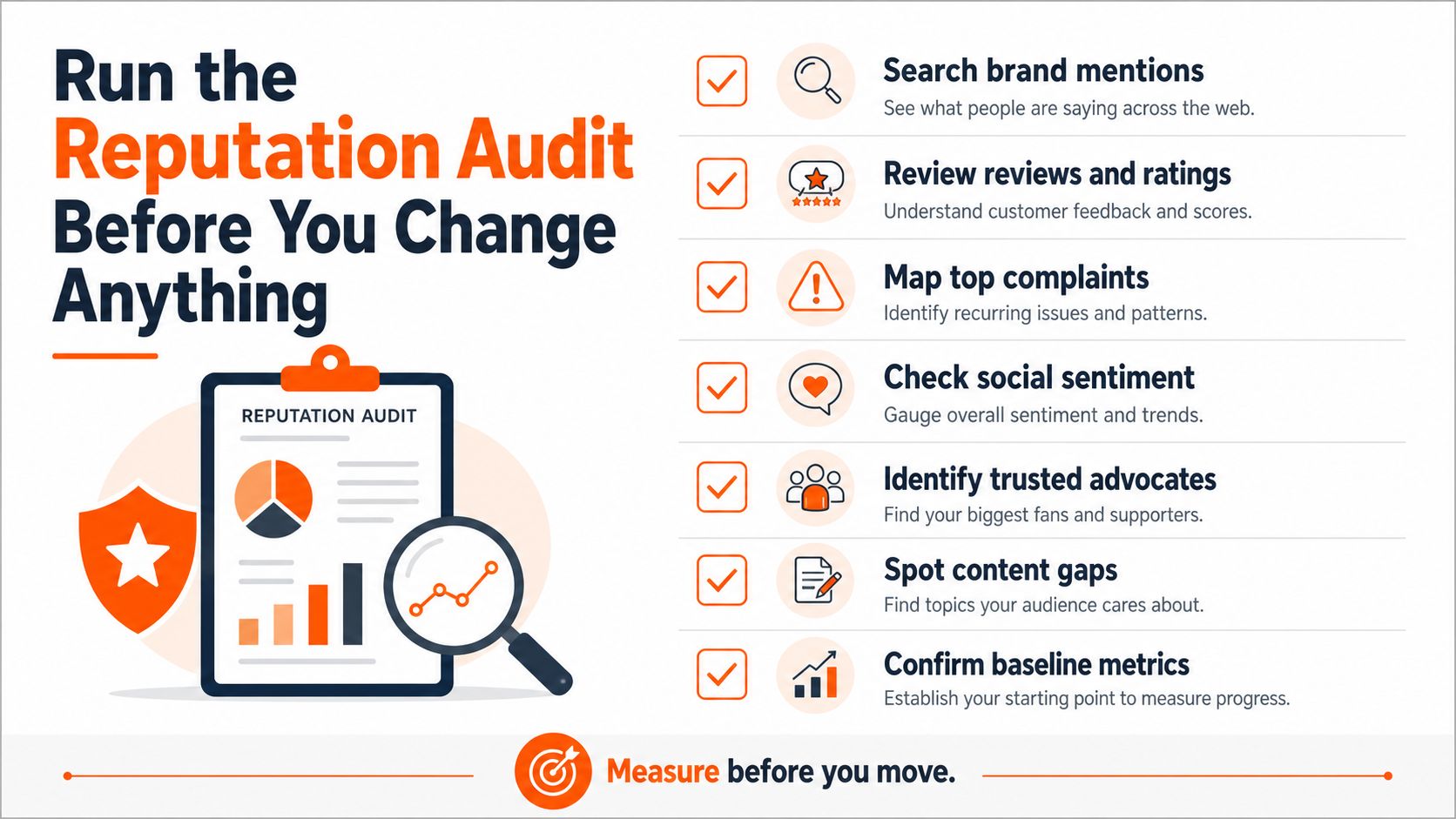
Before you touch a profile, ask for a review, or start posting, you need a clean baseline. Open an incognito or private browser window so the results aren't influenced by your search history, then look up your business name and the obvious variations customers might use. Include searches like reviews, pricing, scam, and the owner's name if that's how people talk about the business.
What to record while you search
Document the first three pages of results for branded, complaint, and review-style searches, then note where you show up at all. One practical reputation workflow recommends recording the review volume, average star rating, most recent review date, and the share of unanswered reviews as a baseline, because those are the numbers and signals you can move over time. The point is simple, if you don't know what customers see today, you can't tell whether your changes are helping.
A second pass should include the review platforms customers are most likely to trust, and the most recent comments they'll read before picking up the phone. Neil Patel's reputation management guide recommends checking the overall rating and the most recent 10 reviews on review platforms in a private browser, because those often shape first impressions more than the homepage does. In practice, that means looking for patterns, not just isolated comments.
A simple baseline sheet works best
Use one page, not a sprawling spreadsheet. Keep it blunt and practical, with fields like:
- Search term: the exact phrase you typed
- Result type: website, profile, review site, forum, social post
- What a customer sees first: the page or platform that appears most prominently
- Trust signals present: recent reviews, photos, response activity, service details
- Main risk: weak rating, no recent activity, unanswered complaints, outdated details
That baseline becomes your before-and-after snapshot. If a profile update, review system, or posting habit doesn't shift what people see, it's not working hard enough.
Lock Down the Two Profiles That Actually Win Local Work
Tradies don't need a dozen profiles pulling in different directions. They need the two that most often shape local enquiries, a Google Business Profile and a Facebook page, then they need both set up properly. In local work, those profiles carry the load because they're where customers check legitimacy, scan photos, and look for recent activity before they ring.
Claim and standardise every high-value profile with the same business name, category, contact details, photos, and tracking links, then keep the details aligned everywhere they appear. That consistency matters because a customer won't separate “small admin differences” from “sloppy operator” if the phone number, service list, or trading name changes from one place to the next. The practical reputation workflow from Gray Group International makes that point clearly, and it also says to record the baseline signals you can compare later.
Make the profiles look like a real business, not a placeholder
Use real photos of the team, the vehicles, the van signage, the work in progress, and finished jobs. A stale logo tile or a blank banner tells people you haven't paid attention. Add the service categories you offer, the hours you answer the phone, and a direct way to contact you without forcing extra clicks.
That's also where tracking links help. If you're getting enquiries from one profile more than the other, you want to know it. Otherwise you'll keep guessing about what's producing leads and what's just taking up admin time.
A profile that looks maintained gets treated like a business that's still active.
After the basics are aligned, use this as your checklist, then keep it tight:
- Name and category: match the business exactly across the main profiles
- Photos: use recent, job-related images instead of stock or generic graphics
- Contact details: make the phone number and service area easy to spot
- Messaging and booking: only turn them on if you can answer them
- Tracking links: keep the source of each enquiry visible
If you want a deeper local setup, the practical foundations are worth reading alongside this contractor-focused local visibility guide. The key is not volume, it's control, because two well-kept profiles beat a scattered presence every time.
Turn Every Finished Job Into a Five-Star Review
A lot of tradies wait until the job is long finished, the invoice is buried in the inbox, and the customer has mentally moved on before they ask for feedback. That's late. The best time to ask is when the customer's relief is obvious, the leak's stopped, the fault's fixed, or the system's working again and the house feels normal.
One easy pattern is enough. Ask in person when the customer is smiling, send a short text after payment, then follow up with an email that includes the direct review link. That creates 2 or 3 review-request touchpoints without turning the process into a pestering campaign. Reputation guidance from Reputation Defender also pushes this idea, because requests work best when they're part of the operating rhythm rather than an afterthought.
Keep the ask short and human
A text doesn't need polish. It needs clarity.
SMS example: Thanks for today, glad we could sort that out. If you've got a minute, would you mind leaving a quick review? It helps local customers know what to expect.
An email can be just as simple:
- Subject: Quick favour after today's job
- Body: Thanks for having us out. If you were happy with the work, would you mind leaving a review here? It helps other local customers choose with confidence.
For Google, send customers to your review flow from the profile. For Facebook, point them to the page's review or recommendation area if you actively use it. The point is to reduce friction, because every extra step loses a few good customers who meant to help but ran out of time.
This plumbing marketing guide is useful if you want to fit review requests into the rest of your customer follow-up without making it feel forced.
Respond to every review like a real person
Positive reviews deserve a quick reply that sounds like it came from the owner or office, not a template. Say thanks, mention the job if it's appropriate, and keep it natural. Negative reviews need a calm response within the 72-hour window the practical guidance above recommends, because slow replies make people assume you don't care.
Read the complaint carefully before you answer. A rushed reply usually creates a second problem.
A customer who had a good experience expects acknowledgement. A customer who had a bad one wants to know someone's taking it seriously. Both are watching how you handle the thread, not just whether you got the problem right the first time.
Post Proof From the Job So You Stay Visible Between Bookings
When profiles go quiet for weeks, they start to look abandoned. That's a bad look for any local trade business, especially one that does most of its work off-screen. You don't need to become a content machine, you need to turn ordinary jobs into visible proof that the business is active, capable, and still out there doing the work.
Use the job itself as the content source
The best material is already in your day. Before-and-after photos, a one-paragraph job summary, a quick safety or compliance note, and a short customer win story all work because they show real work instead of marketing fluff. A snapped meter board, a replaced unit, a tidy finished install, or a brief site note about what was sorted gives prospects something concrete to trust.
Keep the language plain. “Hot water fault repaired and tested” says more than a polished paragraph full of generic praise. If the job involved a repeat customer, mention that. If the site had a tight access issue or a compliance detail, mention that too, because those are the realities locals know matter.
Make posting fit around the day, not against it
Batch photos at the end of the morning or afternoon, then schedule them when the phone's quieter. Short, regular posts beat long gaps followed by a burst of activity, because consistency tells people the business is still alive and working. If you need a platform to help keep the rhythm going, this social posting guide for tradies is the kind of thing that fits a time-poor workflow better than starting from scratch each day.
A simple format keeps the load light:
- Job photo: one strong image that shows the result
- One-line summary: what was fixed, installed, or serviced
- Trust cue: a safety, compliance, or workmanship detail
- Local signal: suburb or service area, where appropriate
That's enough. You're not trying to entertain people, you're trying to stay visible and credible between bookings. A few tidy posts every week do more than a perfectly written post that only appears once a month.
Handle Negative Feedback Without Lighting a Fire
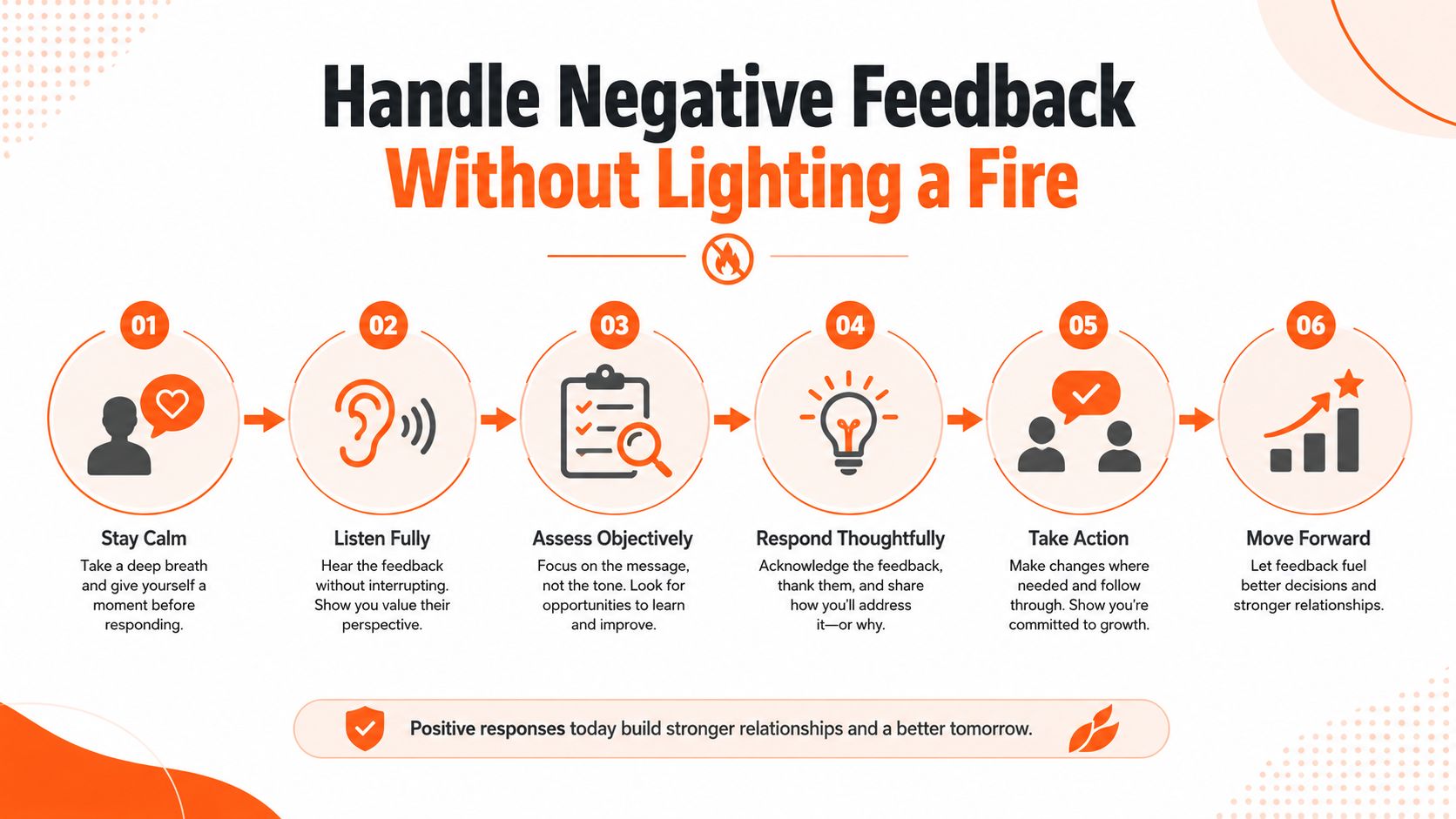
One bad review doesn't sink a trade business. The wrong response can. The instinct to ignore complaints or snap back is common, especially when the feedback feels unfair, but it usually makes the public thread look worse than the original problem.
For negative feedback, one reputation guide recommends replying within 24 to 48 hours if possible, staying calm, and reading the complaint carefully before answering. Cision's guidance also stresses monitoring recurring complaints and fixing the underlying issue, because repeated comments are usually pointing at a real service problem, not just noise. That's the part a lot of owners miss, the review is often the symptom, not the disease.
Use a simple public response pattern
Start by acknowledging the issue, take the technical detail offline, commit to a fix, then follow up publicly once it's sorted. Keep the reply short enough for a stranger to read without rolling their eyes.
Example for a frustrated customer: Sorry this wasn't the experience you expected. Send us the job details and we'll look into it properly, then we'll come back to you with the next step.
For an unreasonable review, don't get dragged into a fight. Keep your reply measured and brief.
Example for a difficult one: We can't agree with everything here, but we're happy to review the job notes and speak directly if you want to discuss it.
Never insult the customer, never accuse them of lying in public, and never write a reply you'd hate to see screenshot and shared later. The audience is bigger than the reviewer, and they're judging how steady you are under pressure.
Fix the pattern, not just the comment
If the same issue keeps showing up, it's probably in your quoting, scheduling, communication, or workmanship process. That's where the work is. Once the root cause is fixed, the reviews usually start looking less like a trend and more like isolated events.
Your 90-Day Reputation Plan and What to Measure
The cleanest way to do this is to stop treating reputation like a one-off project. Over 90 days, you can build a system that starts with an audit, locks down the main profiles, installs the review habit, and keeps proof moving onto the page between jobs.
| Week | Focus | Key Action | Signal to Track |
|---|---|---|---|
| 1 to 2 | Audit | Search your business in a private browser and record the baseline | Review volume, rating, unanswered reviews |
| 3 to 4 | Profiles | Standardise Google and Facebook details, photos, and links | Profile completeness, enquiry source |
| 5 to 6 | Reviews | Add the text, email, and in-person review asks | Review count, response rate |
| 7 to 8 | Proof | Post job photos and short summaries regularly | Profile views, post activity |
| 9 to 10 | Feedback | Reply to any negative reviews within the target window | Response speed, sentiment |
| 11 to 12 | Review | Compare the new baseline with the original snapshot | Star rating movement, enquiry quality |
The monthly signals worth watching are simple, star rating movement, review count, response rate, profile views, and where enquiries are coming from. If those are moving in the right direction, the system's working. If not, the weak point will usually be obvious enough to fix without starting over.
If you want a reputation system that keeps working while you're on the tools, GrowTradie is built for exactly that kind of trade business. It helps tradies stay visible between jobs with content that looks professional and keeps profiles active without adding another admin headache. Visit GrowTradie and see how it can help your business build trust, stay front of mind, and win more local enquiries.