
If you're a tradie looking for steadier monthly cash flow, this business model makes sense fast. You already know how to quote work, turn up on time, manage client expectations, and solve problems without drama. Those habits transfer well when you start a cleaning business built around repeat contracts instead of one-off jobs.
The appeal is simple. You can launch with modest overhead, keep operations lean, and build a book of recurring work that smooths out the ups and downs that come with project-based trades. Done properly, this isn't a filler side hustle. It's a service business with room to scale.
Table of Contents
- Is a Janitorial Business the Right Move for You
- Establishing Your Legal and Insured Foundation
- Funding Your Launch and Pricing Your Services
- Building Your Operational Workflow
- Acquiring Your First Service Contracts
- Your Go-Live Checklist and Path to Growth
Is a Janitorial Business the Right Move for You
A lot of tradies hit the same wall. Good months are strong, then a delay, cancellation, or quiet patch knocks cash flow sideways. A janitorial business gives you a different engine. Instead of chasing the next install or repair, you build around regular service intervals and contracted work.

The upside is real. According to cleaning industry trends tracked by Jobber, 73% of business owners expect revenue growth in 2026, and average annual earnings for owners in the US are $127,973. That doesn't mean every operator will hit that number. It does mean the model is strong enough to treat seriously.
Why tradies often do well in this model
Tradies already understand service standards. That matters more than people think.
A reliable operator wins because clients want four things. Consistency. Clear communication. No excuses. No mess left behind. If you've run jobs in plumbing, electrical, HVAC, carpentry, or maintenance, you've already built those muscles.
A janitorial business also starts lean. If you want a broader walk-through of setup, this guide on how to start a cleaning service is a useful external reference, especially for comparing how different operators structure their launch. The same logic applies if you've already explored other service paths like starting a handyman business. Low overhead only helps if the work repeats and the system holds.
Practical rule: If you hate repeatable process, admin discipline, and client communication, this model will frustrate you. If you like route density, stable scheduling, and predictable billing, it fits.
What works and what doesn't
What works is boring on purpose. Tight service scope. Reliable arrival windows. Standard checklists. Clear invoicing. Recurring agreements.
What doesn't work is trying to be everything to everyone. New operators often say yes to every odd request, every awkward time slot, and every client that wants a bargain. That creates a messy route, weak margins, and avoidable callbacks.
A simple comparison makes the trade-off clearer:
| Approach | Usually works | Usually fails |
|---|---|---|
| Client type | Commercial sites with regular schedules | One-off jobs with unclear expectations |
| Service design | Defined scope and repeat visits | Custom scope on every booking |
| Time use | Clustered routes and standard procedures | Long travel gaps and improvised workflow |
| Money | Contracted recurring billing | Constant repricing and chasing payments |
If you want a business that can become an asset, not just a self-employed job, this is one of the cleaner paths into recurring service revenue.
Establishing Your Legal and Insured Foundation
The fastest way to look amateur is to quote work before your legal setup is sorted. Commercial buyers check this stuff. Property managers check it. Facility teams check it. If your paperwork is loose, you lose trust before the job even starts.

According to Wolters Kluwer's guide to starting a cleaning business, 40-50% of new service businesses fail due to regulatory oversights. The same source notes that forming an LLC typically costs $100-$500, a general business license often runs $50-$400 annually, and general liability insurance commonly costs $500-$2,000 per year.
Set up the business before you chase contracts
For most operators, the cleanest setup is an LLC. It creates a line between your personal assets and business liabilities, which matters the first time a client claims damage, lost access, or some other expensive headache.
The basic sequence is straightforward:
Choose your business structure
For most startups, an LLC is the practical default because it gives liability protection without making the setup overly complex.Get your EIN
You need it for tax setup, banking, and supplier paperwork.Check local licensing requirements
Some areas only want a general business licence. Others layer on extra permits depending on where you operate and what contracts you pursue.Set up a business bank account
Mixing personal and business money creates accounting mess and weakens your legal separation.
Get legal setup done before printing flyers, wrapping a van, or bidding work. Clients forgive a plain brand. They don't forgive uninsured operators.
Insurance is part of the offer
Insurance isn't back-office admin. It's part of what you're selling. When a buyer asks if you're insured, they aren't making conversation. They're checking if hiring you creates risk for them.
At minimum, most operators should look at:
General liability insurance
This is the baseline cover clients expect when your team is working on their site.Workers' compensation
If you hire, this can become mandatory depending on your location.Bonding where relevant
Some commercial buyers ask for it as part of procurement, especially when staff have after-hours access.
If you're comparing policies and want a plain-English example of what liability cover looks like in practice, this explainer on Florida small business liability protection is useful.
A lot of operators underinsure because they only think about the tool kit and supplies. Clients are thinking about property damage, site access, slip claims, and key handling.
Keep your paperwork client-ready
Don't store everything in random emails and your phone notes app. Keep a simple digital folder with your registration, insurance certificate, licence details, W-9 or equivalent tax forms, and any onboarding documents larger clients ask for.
This video gives a helpful visual overview of setup considerations before you start taking on work:
A professional setup pack speeds up onboarding and helps you look established even if you're still in your first year.
Use a short checklist:
- Registration docs ready
Save current copies in cloud storage and on your phone. - Insurance certificate current
Check dates before every contract submission. - Licence details verified
Make sure the business name matches across documents. - Client-facing file prepared
One PDF bundle beats six scattered attachments.
Operators who treat compliance as a sales tool tend to get taken more seriously. That's the point.
Funding Your Launch and Pricing Your Services
A lot of cleaning businesses fail before the work is bad. They fail because the owner starts too heavy, prices too low, and spends six months being busy instead of profitable.
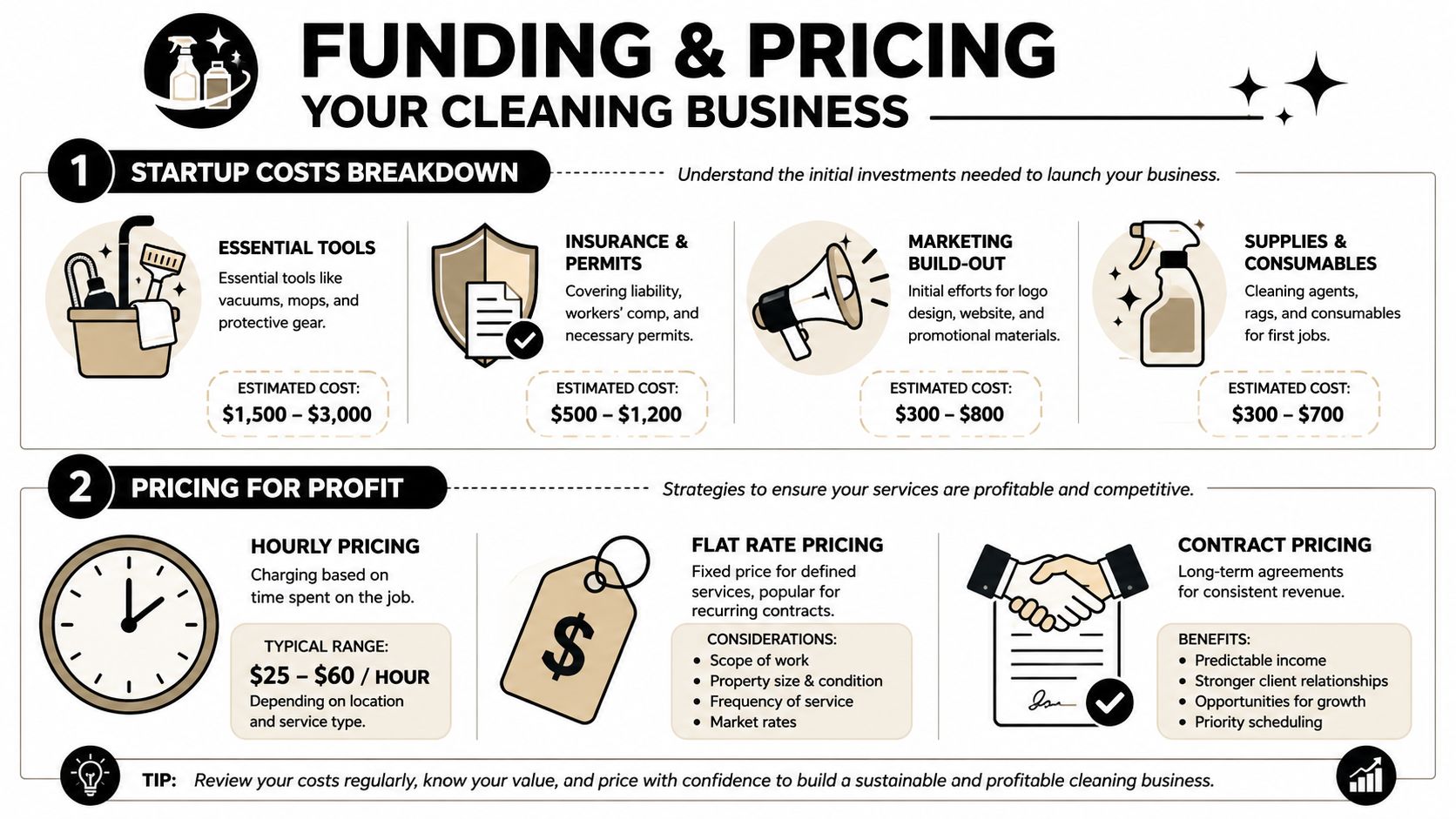
According to the SBDCNet cleaning services business report, startup costs typically range from $2,000 to $10,000, and a solo operator can often launch with under $2,000. The same source notes essential gear can include a commercial vacuum at $200-$350 plus basic supplies and licensing.
What you need to spend first
Keep the first spend tight. The goal is to get on-site, do quality work, invoice fast, and repeat the process without cash strain.
A lean launch budget usually falls into four buckets:
| Cost area | What it covers | Practical note |
|---|---|---|
| Core equipment | Vacuum, mops, buckets, cloths, PPE | Buy commercial-grade gear that can handle repeat use |
| Insurance and permits | Liability cover, licence fees, registration | Pay this early so you can quote with confidence |
| Initial supplies | Chemicals, consumables, rubbish liners, refill stock | Start with a narrow range and expand from job demand |
| Basic business setup | Cards, simple branding, quoting and invoicing tools | Keep it clean and functional |
If you already work in another trade, you may have a vehicle, storage tubs, a phone plan, and admin software. That cuts your upfront cash requirement. What doesn't help is buying gear for jobs you have not sold yet.
One mistake I see often is overbuying chemicals and specialty tools because they look professional on the shelf. Professional operators buy for the work in front of them, then restock based on usage.
Pick a pricing method that matches the job
Pricing needs to fit the service, the site, and the amount of variation in the scope.
For a practical operator, there are three solid options:
Hourly pricing
Good for first-time cleans, messy sites, uncertain scope, or clients who keep changing the brief.Per square foot
Better for commercial work with stable layouts, repeat visits, and a clear specification.Flat-rate recurring service
Works well once the scope is proven and you want predictable billing and cleaner margins.
The mistake is not choosing the wrong model. The mistake is using one model for every job because it feels easier.
If you already understand quoting from another trade, use that same discipline here. Break the job into labour, supplies, travel, overhead, and profit. This guide on how to price a painting job based on labour, materials, and margin is a useful crossover because the costing logic is the same.
Cheap prices win cheap clients. Those clients usually want extras, pay slowly, and complain the loudest.
Build your price from the ground up
A service price needs to cover more than the hours on-site. It also has to carry quoting time, travel gaps, stock runs, insurance, admin, and the occasional mistake.
Use a simple pricing formula:
Estimate labour hours
Include setup, pack-down, and access delays, not just cleaning time.Add supply cost
Use a realistic figure per job, even if consumables seem small.Add travel and overhead
Fuel, vehicle wear, software, phone, insurance, and bookkeeping all need to be recovered.Add profit margin
If there is no margin, you bought yourself a job.
Many new operators fall into a common trap. They quote based on what feels fair to the client instead of what the business needs to stay healthy. A full calendar does not fix bad pricing.
Protect margin from day one
Margin is usually lost in the quote, not on the invoice. Loose scope, poor route planning, underestimating access issues, and agreeing to add-ons for free will drain a job fast.
Track a few numbers from the start:
Quoted jobs versus sold jobs
Low conversion can mean the price is too high, but it can also mean the offer is unclear.Actual hours versus estimated hours
This shows whether your quoting is sharp or optimistic.Supply use by service type
Some jobs chew through stock faster than they should.Repeat work rate
Recurring clients give the business stability and make staffing easier later.
If you want to scale beyond owner-operator work, price for a future team now. That means enough margin to cover training time, supervision, no-shows, and marketing. It also means getting found consistently in your local area instead of relying on random referrals. Tools like GrowTradie help cleaning businesses show up where local clients are searching, which matters when you want steady quote flow rather than feast-and-famine work.
A strong launch looks boring on paper. Modest spend. Clear pricing. Tight scope. A small book of profitable jobs you can repeat. That is how a cleaning business becomes a real service company instead of a low-paid hustle.
Building Your Operational Workflow
The first contract doesn't prove the business works. Repeating the result without chaos does. That's why workflow matters more than enthusiasm.
Most new operators think quality comes from effort. It doesn't. Quality comes from sequence, checklists, and gear placed the same way every time.
Build a repeatable job sequence
Every site needs a standard order of work. Without one, you waste steps, miss tasks, and create inconsistent results if someone else joins the team.
A basic service workflow should cover:
- Arrival and access
Keys, alarms, entry windows, site notes. - Set-up
Gear placement, safety check, consumables count. - Task order
Same room flow, same finish sequence, same sign-off process. - Close-out
Waste handling, lock-up, photos if required, client update.
Write this down. Put it in a phone note, Google Doc, or job app. If the process only exists in your head, you don't have a system.
The first hire should walk into a job and know the sequence without asking you ten questions by text.
Run lean without a fixed base
A lot of tradies delay launch because they think they need a depot, garage, or office. They don't. The mobile-only model is often the smarter start.
According to the YouTube source cited in the brief, 40% of solo operators lack garage space, and many can work around that by using client-site stocking where appropriate or by using a dual-use trade van. That's practical advice. If you're already running a vehicle for another trade, storage tubs, labelled shelves, and restock discipline beat renting space too early.
A lean setup usually includes:
| Problem | Lean fix |
|---|---|
| No garage space | Use sealed bins and a fixed loadout in the van |
| Too many loose supplies | Standardise kit by job type |
| Missed restocking | Refill on the same day each week |
| Messy handoff to helpers | Pre-pack site kits and labelled checklists |
When to bring in your first helper
Don't hire because you're tired. Hire because the workflow is stable enough to hand off.
Bring in help when three things are true. You can explain the task order clearly. Your pricing supports labour. Your schedule has enough repeat work to keep someone usefully occupied.
Start small. A part-time helper on defined tasks is easier to manage than a full-time hire you're scrambling to feed with work. Give them one route, one checklist, one standard. Expand only after they can hit the mark without constant supervision.
What usually fails is hiring too early, with no written process and no quality control. Then the owner spends the day checking work instead of growing the book.
Acquiring Your First Service Contracts
Monday, 6:15 am. A small office manager has been let down again. Bins missed, toilets half done, no reply to Friday's email. They are not looking for a clever brand. They want a contractor who turns up, does the work properly, and makes the site easier to manage. That is the opening for a new cleaning business that runs like a trade business, not a side hustle.
Early contracts usually come from people who already buy maintenance services. They understand recurring work, access issues, site standards, and why reliability costs money. Start there.
Start with buyers who already use contractors
The best first targets are close to the money and close to the problem. Property managers, strata managers, clinic owners, workshop managers, builders at handover stage, and small commercial tenants all have a reason to keep sites presentable without babysitting the cleaner.
Go narrow before you go wide.
A better first offer is "weekly common-area cleaning for small strata blocks" than "we do all cleaning for everyone." A defined service is easier to quote, easier to deliver, and easier for a buyer to say yes to. It also helps you standardise staffing, stock, and timing later when you scale.
Good early-fit prospects include:
Property managers
They want fewer complaints, clear reporting, and no access drama.Small offices and clinics
They value routine, hygiene, and contractors who can work around staff and patients.Retail, warehouses, and workshops
They often need after-hours service and straightforward communication.Existing trade contacts
If they already trust your work ethic, you skip half the sales process.
Reach out directly. Email works. Phone works. Walking in can work if the site suits it. Keep the message short. State the problem you solve, the type of site you handle, your service window, and what happens next if they want a quote.
Follow-up wins more work than extra prospecting
A lot of new operators lose jobs after the enquiry comes in. Slow replies, vague quotes, no second contact, no system for remembering who asked for what. That is not a marketing problem. It is a follow-up problem.
Use a simple pipeline from day one. Name the lead. Record the site type. Note the service needed. Set a quote date. Set a follow-up date. If you do not track those steps, you will underquote some jobs, forget others, and have no idea which lead sources are worth paying attention to.
Track only the numbers that help you make better decisions:
- Lead source
- Response time
- Quotes sent
- Jobs won
- Reason lost
That is enough to start.
If local visibility is thin and you need a steady way to bring in commercial enquiries, use a system built for trades rather than generic marketing advice. This guide on lead generation for contractors shows a practical approach to getting found locally and keeping enquiries organised without adding admin bloat.
Fast replies matter because buyers compare cleaners quickly. The contractor who answers clearly, asks the right site questions, and sends a clean quote often gets the walkthrough.
Sell stability, not cheap hours
Cheap pricing can get attention. It rarely gets good contracts.
Commercial clients stay when the service is predictable. They want locked-in scope, clear communication, simple invoicing, and fewer complaints from tenants or staff. Price the job so you can deliver that standard consistently. If your margin is too thin, every missed minute on site turns into stress, shortcuts, and churn.
Make the quote easy to understand:
- What is included
- What is excluded
- How often the service happens
- When the site will be cleaned
- Who supplies consumables, if relevant
- How issues are reported
That level of clarity helps you win better clients and avoid bad-fit ones.
Renewals start on the first visit
The first contract is only half the job. High-value revenue comes from keeping the account, tightening the route, and adding nearby sites over time.
Operators who hold contracts do a few things consistently. They confirm scope in writing. They flag issues early. They invoice cleanly. They check in before the client starts wondering if they should replace them. A short service update can do more for retention than another round of cold outreach.
Ask for introductions after you have delivered steady work for a while. A satisfied site manager, strata contact, or property manager can open doors to multiple sites. That is how a small operator starts building a professional cleaning business with repeatable systems and room to grow.
Your Go-Live Checklist and Path to Growth
By launch week, the big decisions should already be made. What matters then is making sure nothing basic is missing.
Pre-launch checks that matter
Run through this list before your first live contract:
- Business setup complete Registration, bank account, tax details, and invoicing system are active.
- Insurance documents ready Current certificate saved in a client-ready folder.
- Service scope written down Your quote matches what you'll deliver.
- Kit packed and labelled No loose gear, no guessing on site.
- Client communication template prepared Booking confirmation, arrival message, completion note, invoice email.
- Payment terms set Don't negotiate this badly under pressure on the first job.
Keep the first month tight. Fewer contracts with better control beats a calendar full of badly priced work.
What early growth should look like
Good early growth is boring. A stable route. Fewer callbacks. Better time estimates. Cleaner handoffs. Renewed agreements.
Ask for feedback once you've completed work consistently, not after one rushed visit. When clients are happy, ask for a review, a testimonial, or an introduction to another site contact. Raise prices carefully and only when your delivery standard justifies it.
If you want this business to become durable, keep doing the simple things well. Protect your route. Protect your margin. Protect your standards.
GrowTradie helps tradies stay visible without having to stop and write content after a long day on the tools. If you want a simple way to keep your business active online, build trust locally, and turn attention into real enquiries, take a look at GrowTradie.