

Some weeks you're flat out, quoting at night and trying to squeeze one more job into the diary. Other weeks go quiet and you start wondering whether the phone's gone dead. Most contractors know that cycle well. It isn't usually a work quality problem. It's a pipeline problem.
Lead generation for contractors works best when it stops being a scramble and becomes a system. Not a giant marketing machine. Not a full-time admin role. Just a few repeatable parts that keep your business visible, bring in enquiries, and make sure good leads don't slip through the cracks while you're on the tools.
Table of Contents
- Building Your Lead Generation System
- Establish Your Foundation for Local Visibility
- Create a Constant Online Presence Effortlessly
- Turn Happy Customers into Your Best Sales Team
- Use Smart Paid Advertising for Quick Wins
- Create a Follow-Up System That Books the Job
Building Your Lead Generation System
Most contractors don't need more tactics. They need fewer moving parts, used properly.
The mistake is treating lead generation like a bag of random ideas. A bit of social posting when things are slow. A few paid ads when the phone stops. Asking for reviews only when you remember. That approach creates bursts of activity, then silence. It doesn't create reliable enquiry flow.
A better setup is simple. You need a base people can verify, a steady presence that shows you're active, a process for turning happy customers into more work, one paid channel for immediate demand, and a follow-up habit that stops leads going cold. That's the system.
Practical rule: If a lead source only works when you personally remember to push it, it isn't a system yet.
The tradies who get better results usually aren't doing flashy marketing. They're visible in the right places, they look trustworthy, they ask for reviews, they follow up fast, and they keep doing those things even when they're busy. That's why a practical online marketing approach for contractors has to be built around consistency, not complexity.
What a working system actually looks like
A solid lead generation system usually has these parts:
- A clear local business presence: Your business details, service areas, photos, and contact options are complete and current.
- Ongoing activity: People can see you're still operating, still doing good work, and still serving the area.
- Reputation built into the job process: Reviews and referrals aren't left to chance.
- A quick-response channel: When someone needs help now, you have a way to show up.
- A follow-up routine: Enquiries get answered even when you're on-site.
What doesn't work for long
Plenty of contractors waste time on things that feel productive but don't hold up:
- Starting and stopping: A burst of effort for two weeks, then nothing for a month.
- Buying weak leads without a process: If you don't answer fast and qualify properly, the source isn't the main problem.
- Doing everything manually: Manual effort falls apart the minute work gets busy.
- Chasing vanity: Likes and views don't matter if they don't lead to calls, quote requests, or booked jobs.
This is why lead generation for contractors should be built like an operations process. It needs to survive busy weeks, not only quiet ones.
Establish Your Foundation for Local Visibility
Before you worry about getting more enquiries, make sure people can verify that you're real, active, and local.
When homeowners look for a tradie, they usually check the web before they call. BrightLocal's study found that 99% of consumers used the internet to find local businesses in the past year. That means your online presence isn't an extra anymore. It's the modern version of your van signage, shopfront, and local reputation rolled into one.

Start with your Google Business Profile
If you only fix one thing this week, fix this.
Your Google Business Profile is often the first thing a local customer sees. They check your name, your service area, your hours, your photos, and your reviews before they decide whether to call. If the profile is half-finished, outdated, or missing basic details, you create doubt before you've even spoken to them.
Complete every section you can:
- Business details: Use the exact business name, phone number, and service area you want customers to see.
- Services: List the actual work you want more of. Don't leave people guessing.
- Hours: Keep them current, especially if you handle emergency callouts.
- Photos: Add real job photos, team photos, vehicles, and finished work.
- Business description: Write plainly. Say what you do, where you work, and who you help.
A complete profile does two jobs. It helps people find you, and it helps them trust you fast.
Treat it like a digital storefront
A lot of contractors set up the profile once and never touch it again. That's where opportunities get lost.
Your profile should answer the basic questions a good prospect has before they ring:
| What the customer wants to know | What you should show |
|---|---|
| Do these guys actually do my type of work? | Clear service list and recent work photos |
| Are they local? | Accurate service areas and business details |
| Are they active? | Fresh photos, updated hours, current info |
| Can I trust them? | Reviews, replies, and a professional profile |
If someone lands on your profile and still feels unsure, the setup isn't finished.
A weak profile doesn't just lose clicks. It loses trust before the conversation starts.
Keep your details consistent elsewhere
You don't need to be on every directory under the sun. You do need your core business details to match anywhere serious customers might check.
That includes places like Yelp, your local chamber of commerce, and trade-specific listings that matter in your area. Keep your business name, phone number, and address or service area consistent. If one listing has an old number and another has a different suburb listed, customers notice. So does Google.
A lot of tradies overcomplicate this part. It isn't about building dozens of profiles. It's about making sure the important ones are right and stay right. If you need a deeper look at the visibility side of this, this guide to local visibility for contractors is useful.
The set-and-maintain approach
This part of lead generation for contractors should not eat your week. Set it up properly once, then maintain it.
A simple routine works:
- Check business details monthly
- Upload fresh job photos regularly
- Review hours before holidays or seasonal changes
- Make sure phone and enquiry options still work
That's enough to keep your foundation solid. Without this piece, every other lead source performs worse because people can't verify what they find.
Create a Constant Online Presence Effortlessly
A quiet profile makes a business look quiet, even when you're flat out.
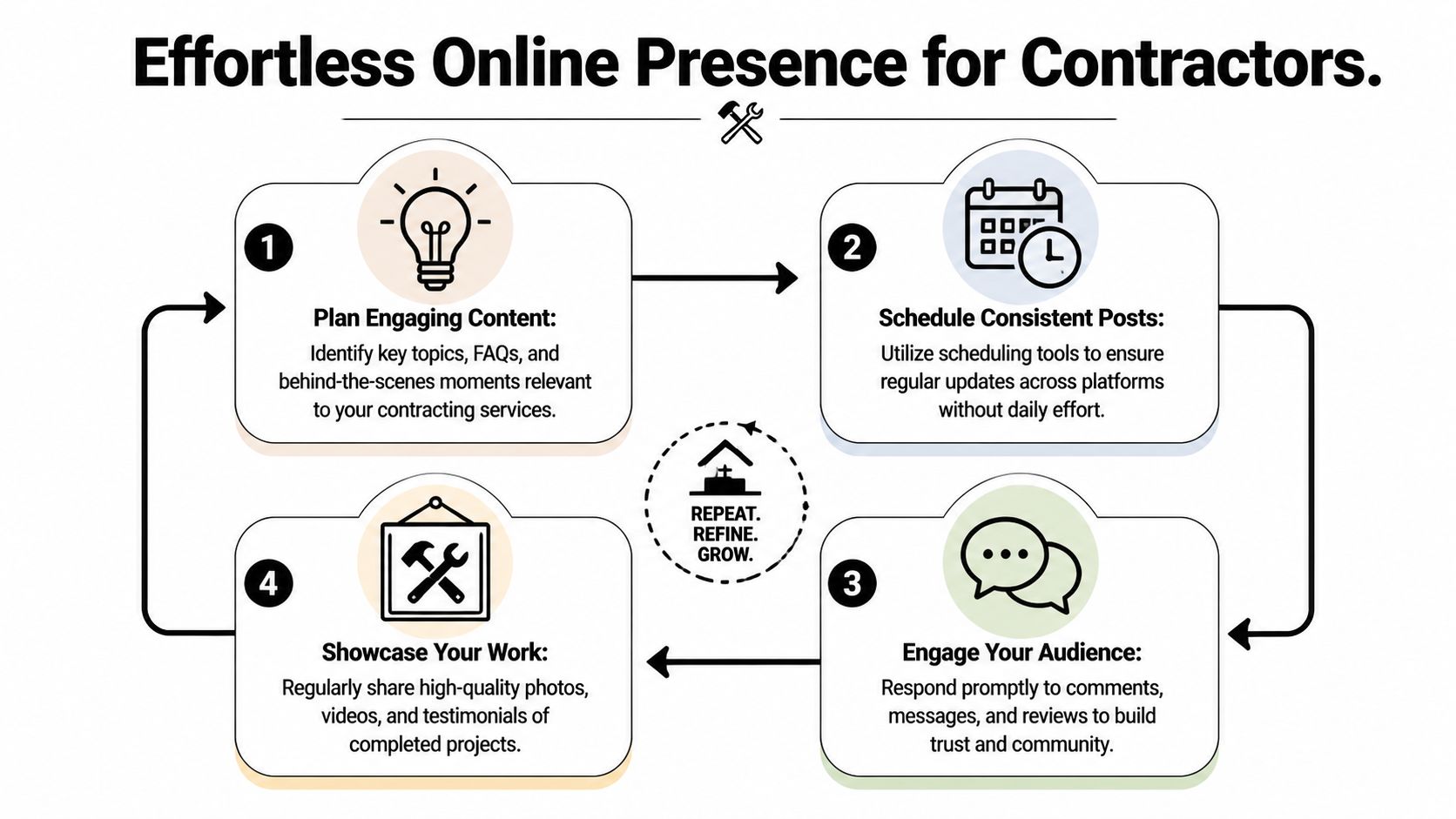
That matters because many customers don't just want a tradie who can do the work. They want one who looks current, active, and reliable. A 2025 HomeAdvisor report says 68% of homeowners discover local contractors via social media profiles, but only 22% of small contractors post weekly due to time constraints. That's a gap worth paying attention to.
Why this matters more than most tradies think
When someone checks your Facebook or Instagram and sees the last post was from months ago, they start making assumptions. Maybe you're inactive. Maybe you're unreliable. Maybe you don't do much work. None of that may be true, but people still use those signals to judge whether to contact you.
Many contractors encounter difficulty at this juncture. They understand they should post, but their daily operations present conflicting demands. You're quoting, sourcing materials, dealing with staff, driving between jobs, and handling customer calls. Content creation ends up at the bottom of the list.
The answer isn't to become a content creator. It's to make your online presence low-effort and repeatable.
What to post when you're not a marketer
Most tradies don't need clever campaigns. They need simple proof that they're active and trustworthy.
Good posts usually come from ordinary business activity:
- Completed work: Before and after shots, finished installs, repaired faults, tidy workmanship.
- Useful homeowner advice: Practical tips tied to your trade.
- Behind-the-scenes updates: Team on-site, tools, vans, materials, job prep.
- Service reminders: What areas you cover and what jobs you handle.
The point isn't to impress strangers with polished branding. The point is to remove doubt.
Customers don't expect a tradie to post like a media company. They expect signs that the business is real, current, and doing good work.
Consistency beats intensity
One of the worst approaches is posting heavily for a week, then going silent. That creates extra work and gives you nothing compounding in return.
A lighter rhythm works better. Keep your profiles active with regular, sensible updates that reflect the jobs you already do. When that runs in the background, your social pages stop being dead assets and start supporting trust.
Here's the practical difference:
| Approach | What happens |
|---|---|
| Post only when work is slow | Activity is inconsistent and easy to abandon |
| Try to create everything manually | Becomes another job and usually gets dropped |
| Build a posting routine | Presence stays active without depending on memory |
Make it automatic where you can
This is one of the few areas where automation helps contractors.
Scheduling tools, saved photo folders, simple post templates, and pre-planned content themes remove the hardest part, which is starting from scratch every time. If you can batch a few photos, keep a running note of common customer questions, and schedule posts ahead, the workload drops fast.
A practical setup might look like this:
- Save photos as you finish jobs
- Keep a short list of customer questions
- Use simple captions based on the job or tip
- Schedule content so your profiles don't go quiet
- Check messages and comments daily
Lead generation for contractors improves when your online presence supports trust before the first call. Not because posting magically creates jobs overnight, but because it helps local customers feel more confident choosing you when they compare options.
Turn Happy Customers into Your Best Sales Team
The easiest leads to win usually come from people who already trust you or trust someone who does.
Word of mouth still carries more weight in the trades than almost anything else. But too many contractors treat it like luck. They hope happy customers will leave reviews, mention them to friends, and remember their name months later. Some will. Most won't unless you make it easy.

Industry data shows that 87-88% of consumers trust online reviews as much as personal recommendations, and reviews influence 28% of purchasing decisions for local services. In plain terms, reviews now do part of the job that referrals used to do on their own.
Ask at the right moment
Timing matters more than wording.
The best time to ask for a review is right after the job is done, when the customer can see the result and the positive experience is still fresh. If you wait a week, life gets in the way. If you wait a month, the chance drops further.
Keep the ask simple. Don't write a speech. Send a short text with a direct review link.
A practical message looks like this:
Glad we could get that sorted for you today. If you've got a minute, a review on our Google profile would really help the business.
That works because it's short, polite, and easy to act on.
Build the ask into the job process
Don't rely on memory. Put review requests into your closeout routine.
For example:
- At job completion: Confirm the customer is happy with the work.
- Before leaving site: Let them know you'll text through your review link.
- Same day: Send the review request while the job is still top of mind.
- Later if needed: Follow up once, briefly and politely.
This turns review collection from an awkward extra into part of how you finish a job professionally.
Referrals need a process too
Referrals are powerful, but they also need prompting. A happy customer might mean to recommend you and then forget your business name when the chance comes up.
Give them an easy next step. That might be a saved contact card, a follow-up text they can forward, or a simple referral offer if that suits your business. The exact incentive matters less than making the process clear.
A referral system works better when customers know three things:
| What they need to know | Why it matters |
|---|---|
| What work you want more of | People refer more accurately when the service is specific |
| Who to contact | Remove any friction |
| That referrals are appreciated | A direct ask gives people permission to help |
Field advice: Customers rarely object to being asked for a review or referral after a good job. Most are happy to help if you make it easy.
Protect the experience that creates referrals
No review strategy can fix poor communication.
If you want more referral-driven lead generation for contractors, tighten the customer experience around the boring stuff that people remember: showing up when you said you would, giving clear updates, keeping the site tidy, and finishing properly. Customers talk about workmanship, but they also talk about whether you were easy to deal with.
That means your referral engine really starts earlier than the ask. It starts with how you run the job.
Keep your best customers warm
Past customers are an underused asset. They already know your standard of work. They don't need a full trust-building campaign. They just need to remember you exist.
A simple check-in message now and then, a seasonal reminder tied to your trade, or a quick update showing the type of work you do can keep your name in their head. When their neighbour asks for a recommendation, that's when it pays off.
Use Smart Paid Advertising for Quick Wins
Some lead sources take time to build. Sometimes you need calls sooner than that.
Paid advertising can help, but most contractors get into trouble when they choose the wrong type. They dive into complicated ad platforms, broad campaigns, or agency setups they don't understand. A simpler option usually makes more sense.

Why Local Services Ads suit trades
For many contractors, Google Local Services Ads are the clearest paid option to start with. They're designed around high-intent, moment-of-need searches and use a pay-per-lead model, which means contractors pay for qualified enquiries rather than clicks.
That matters because a click isn't a lead. A lead is someone who contacts you.
When a homeowner has an urgent plumbing issue, an electrical fault, or a broken system that needs attention, they usually want help now. Local Services Ads are built for that situation. They put your business in front of people already looking for a tradie, not people casually browsing.
What makes this channel practical
A lot of paid advertising wastes money because it creates too many steps between interest and contact. Local Services Ads are more direct.
They usually work best when you want:
- Immediate enquiry flow: Good for gaps in the schedule or when entering a new area.
- Simple setup: Easier to understand than full ad account management.
- Better intent: The person searching usually has a real job in mind.
- Cleaner decision-making: You can judge the quality of actual enquiries, not just traffic.
This doesn't mean every lead will be perfect. It means the format lines up better with how local service businesses win work.
Where contractors go wrong with paid ads
The problem usually isn't paid advertising itself. It's weak handling.
Common mistakes include:
- Slow responses: If you pay for the lead and call too late, you've burned the opportunity.
- Vague service settings: If your categories or service areas are loose, you'll get mismatched enquiries.
- No review support: Paid visibility works better when customers see trust signals alongside it.
- No measurement: If you don't track booked jobs, you can't tell whether the spend is worth it.
A paid lead source should support your wider system, not replace it.
Here's a useful overview if you want to understand the paid side from a trade-business angle: PPC marketing for plumbers and similar service trades.
Keep the setup lean
You don't need a giant ad strategy to get value from this channel.
Focus on the basics:
- Choose the exact services you want
- Set the right service area
- Make sure your business details and credentials are current
- Use a real phone number someone answers
- Review lead quality regularly
Later on, you can widen the setup if results justify it. Early on, narrower targeting usually saves headaches.
A quick explainer helps if you've never seen how the format works in practice:
Think of paid as a valve, not the whole plumbing system
This is the trade-off. Paid ads can produce demand faster than your other channels, but they also need management and fast response. They're useful for speed. They are not a substitute for visibility, trust, or a good reputation.
The best lead generation for contractors uses paid channels as a controlled boost. Turn them on when you need more inbound demand. Tighten them when capacity is full. That's a lot more practical than building the whole business on borrowed leads.
Create a Follow-Up System That Books the Job
A lead isn't valuable because it arrived. It's valuable if someone answers it, qualifies it, and turns it into booked work.
Contractors often leak money. They do the hard part of getting visible, collecting reviews, or paying for an enquiry, then respond too late because they're driving, on-site, or halfway through a quote. Data shows that contractors who respond within five minutes are ten times more likely to close the job than those who wait an hour. That one habit changes outcomes.
Build a five-minute response habit
You won't always be able to call instantly. That's fine. You do need a system that makes a fast first response realistic.
A practical setup includes:
- Missed call alerts turned on
- Form notifications sent to your phone
- A saved text reply for when you're on-site
- Clear ownership of incoming leads if you have office staff or a small team
If you can't talk straight away, acknowledge the enquiry quickly and set the next step. Even a short message buys you time and tells the customer they're not being ignored.
Use something like this:
Thanks for reaching out. I'm on-site at the moment but I've received your enquiry and will call you back as soon as I finish here.
That message is better than silence. Silence loses jobs.
Keep your first contact simple
The first call isn't the time to overcomplicate things. You're trying to do three things:
| First-contact job | What to listen for |
|---|---|
| Confirm the work needed | Is it the kind of job you want? |
| Check timing and location | Can you service it properly? |
| Move to the next step | Quote visit, call-back, or booking |
Contractors often waste time on long back-and-forth conversations with poor-fit leads. A short qualification process protects your schedule.
Use a basic lead log
You don't need expensive software to start tracking. A spreadsheet, notes app, or simple CRM is enough if you use it.
Track these fields:
- Lead date
- Name and phone
- Service needed
- Where the lead came from
- Outcome
- Job booked or not
After a few weeks, patterns show up. You'll see which sources bring the right type of work, which ones waste your time, and which ones produce actual revenue. That's when lead generation for contractors stops being guesswork.
Review the channels that produce jobs, not noise
The goal isn't to generate the highest number of enquiries. The goal is to book profitable work with the least wasted effort.
Some channels send lots of tyre-kickers. Some produce fewer enquiries but better-fit jobs. If you don't track outcomes, both can look the same on the surface.
A simple weekly review is enough:
- Count how many leads came in
- Mark where each came from
- Note which turned into quotes
- Note which became booked jobs
- Cut or fix the weak points
Good follow-up beats more lead volume. A smaller number of well-handled enquiries is often worth more than a bigger pile of neglected ones.
Match your system to your real capacity
If you're a one-person operation, don't build a lead process that assumes instant availability at all hours. Build one that works around the fact that you're on the tools.
That might mean:
- using auto-replies,
- having a family member or admin person screen calls,
- setting clear call-back windows,
- or limiting paid lead flow when the schedule is already full.
A lead system has to fit the business you have, not the one some marketing agency imagines. Reliable work flow comes from practical habits repeated every week.
If keeping your profiles active keeps slipping down the list, GrowTradie is built for exactly that problem. It helps trade businesses stay visible with AI-generated social posts, professional designs, and auto-posting that runs in the background while you're on the tools. Instead of trying to remember what to post, you set it up once and keep your business looking active, trustworthy, and local.