
If you're a tradie staring at rising material costs, patchy lead flow, or gaps in the schedule, this type of service business is one of the cleanest side-entry moves available. It doesn't need a workshop, expensive plant, or a long sales cycle. It needs discipline, systems, and a standard of work people trust.
That's why a lot of operators look into how to start a cleaning business. The barrier to entry is low, the work is repeatable, and you can begin solo before deciding whether it deserves a van, a crew, and a proper back office. The mistake is treating it like a casual side hustle. The operators who last build it like a trade business from day one.
Table of Contents
- Laying the Foundation For Your New Service Venture
- Making It Official With Legal and Financial Setup
- Getting the Right Tools for Professional Results
- Pricing Your Services for Profit and Growth
- Building Your Crew and Managing Daily Operations
- Finding Your First Customers and Staying Visible
Laying the Foundation For Your New Service Venture
A lot of tradies are better suited to this business than they think. If you already know how to show up on time, quote clearly, manage client expectations, and leave a site looking professional, you've already got the habits that matter. The gap usually isn't capability. It's deciding what type of work to chase and what type to ignore.

Start with the work you can deliver well
Don't begin by saying yes to everything. That's how new operators end up with awkward jobs, underpriced scopes, and a calendar full of work they hate doing.
Start by checking three things:
- What clients already pay for regularly: Property managers, builders, office tenants, Airbnb hosts, and medical or retail sites all buy upkeep differently. Some want reliability above all else. Others pay more for turnaround speed or specialist handling.
- What suits your current setup: If you've got a ute, a small storage area, and only limited time outside your main trade, recurring small jobs are easier to manage than large one-off commercial scopes.
- What matches your standard of work: Attention to detail matters more than flashy branding early on. If you're precise, organised, and good with checklists, you'll usually outperform bigger operators who are sloppy.
Practical rule: Pick one core service line, one ideal client type, and one service area first. Expansion is easier than untangling a messy launch.
A useful reference if you're comparing approaches is this guide on how to start a cleaning business. It lays out the startup path in a practical way, which helps when you're pressure-testing whether the move suits your capacity and local market.
Choose a lane early
The best early niches are the ones that create repeat work, not just busy weeks. Commercial premises can give you consistency. Post-build turnover work can pay well if you've already got builder contacts. Short-stay accommodation can suit operators who are fast, organised, and responsive.
Another lane worth serious attention is green property services. The demand for green property services is showing 28% year-over-year growth, and specialising in it can lift service premiums by an average of 18% and lead to 40% higher repeat business rates from clients who value sustainability, according to Demandium's breakdown of cleaning business ideas.
That doesn't mean buying the most expensive products and calling yourself premium. It means building a clear offer around low-tox products, reusable systems, sensible supply choices, and clients who care about that standard. If your area has wellness-focused households, boutique accommodation, or commercial tenants with sustainability policies, that niche can separate you fast.
A simple way to validate the lane is to ask local contacts what they currently struggle with. Slow turnarounds. Missed details. No-shows. Poor communication. Weak presentation. The winning offer usually isn't complicated. It's dependable work, delivered the same way every time.
Making It Official With Legal and Financial Setup
Most early problems in this business aren't caused by the work itself. They come from loose setup. Mixed bank accounts, vague terms, no insurance, forgotten tax obligations, and pricing pulled from thin air. Fix those before you start chasing volume.
Set up the business properly before the first regular client
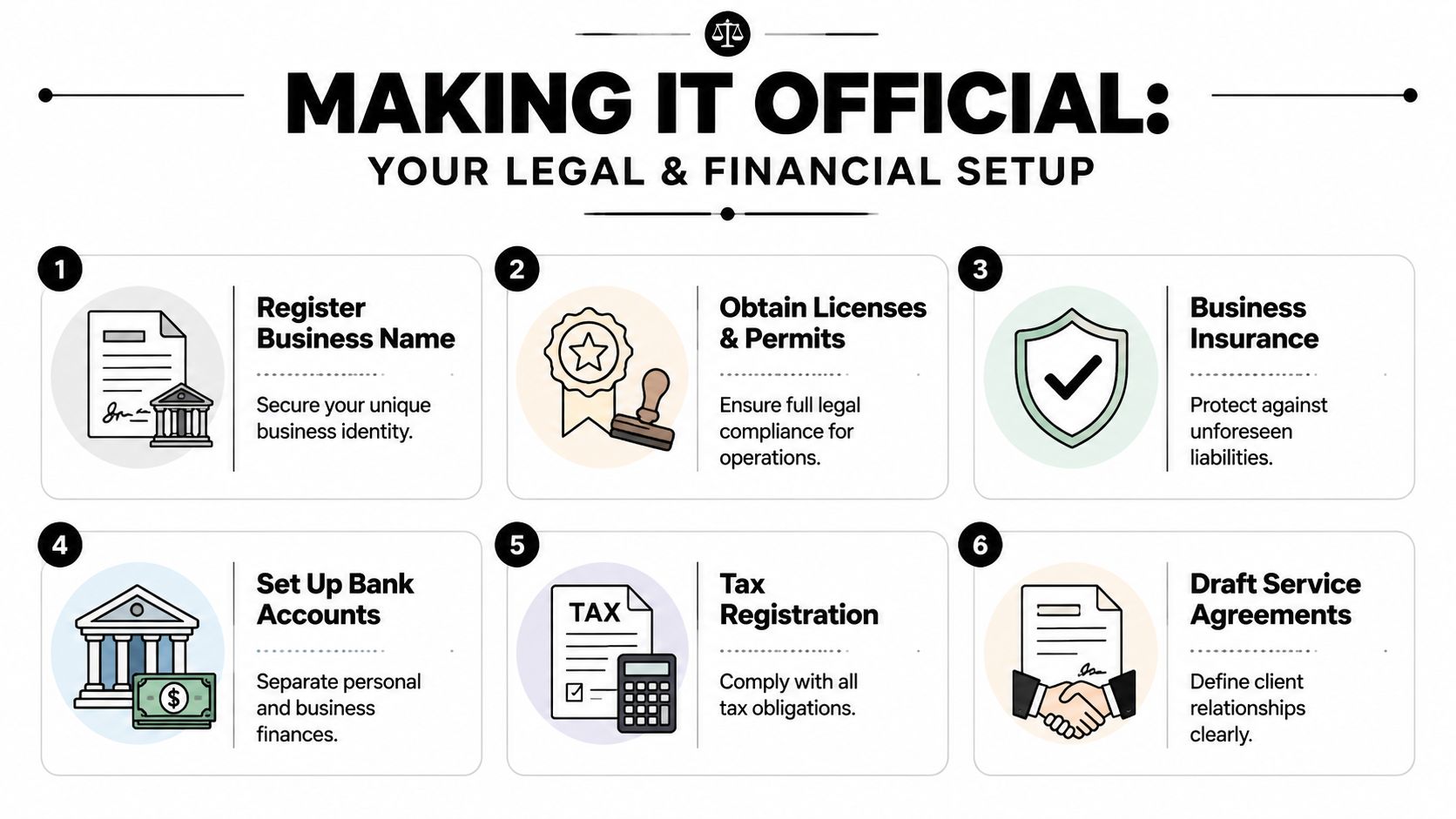
Keep the structure simple, but make it real. Register the business name. Sort out the right structure in your area. Open a dedicated business account. Put your invoicing through one system, not your personal banking app and a notes folder.
You also need insurance before you start handling client sites and property. General liability is the obvious one. Depending on your market and setup, you may also need cover for equipment, vehicles, or staff once you hire.
If you're weighing finance decisions beyond the basics, it helps to look at outside guidance on comparing startup financial advisory partners. That sort of review is useful when you're deciding whether to stay lean and self-managed or bring in support for setup, forecasting, and compliance.
Know where the first money goes
This is one reason tradies keep looking at this model. The initial investment to launch a professional upkeep service is typically $2,000 to $10,000, covering essential equipment, basic licensing, and insurance, according to Jobber's cleaning industry trends report.
That doesn't mean you should spend to the top of the range on day one. It means you can build a professional operation without the capital burden you'd face in many other trades.
Here's where the early spend usually belongs:
| Priority | What it covers | Why it matters |
|---|---|---|
| Business setup | Registration, permits, tax setup | Stops admin problems from snowballing later |
| Insurance | Liability and basic risk protection | Clients take you more seriously, and you're protected when something goes wrong |
| Core tools | Durable daily-use equipment and starter stock | Cheap gear slows the job and looks amateur |
| Brand basics | Uniforms, invoices, service agreement, simple presence online | Professional presentation helps win trust fast |
If you're already operating another service business, resist the temptation to run this one casually under the same messy admin habits. Treat it as its own unit from the start.
Keep the paperwork boring and tight
Good operators don't rely on handshakes once work becomes regular. Use a written service agreement. Spell out scope, access, timing, payment terms, cancellations, damage reporting, and what sits outside the agreed work.
Boring systems protect profit. Clear paperwork also filters out difficult clients before they become expensive.
For bank accounts and payment flow, keep these rules:
- Separate everything: Income, expenses, fuel, supplies, insurance, and contractor payments should run through the business account only.
- Invoice fast: Send invoices the same day the job is complete or on the agreed cycle for recurring work.
- Track small purchases: Consumables and replacement tools can gradually erode margin if you don't log them.
- Review monthly: One check each month is enough to catch overspending, unpaid invoices, and pricing problems before they become normal.
If you're coming from a hands-on trade background, a practical read on structuring another service operation is starting a handyman business with proper foundations. The same discipline applies here. Clean books. Clear scope. No guesswork.
Getting the Right Tools for Professional Results
The first kit you buy says a lot about how you'll run the business. Go too cheap and you'll fight your gear every day. Go too broad and you'll fill the van with things you rarely use. The smart move is a tight, durable setup that handles most common jobs without slowing you down.
Buy once for daily use
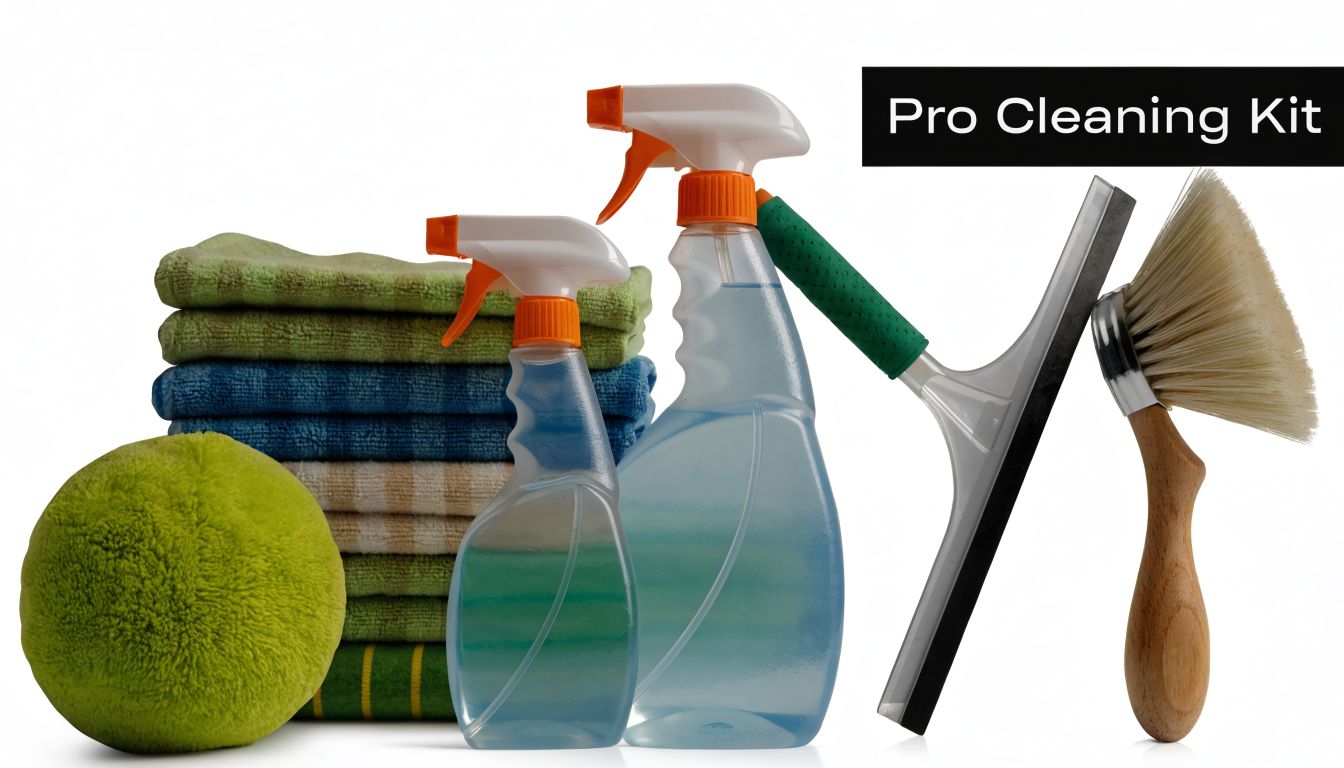
When operators ask what to buy first, the answer usually isn't exotic. It's the gear that gets handled constantly. Reliable vacuums. Quality microfiber cloth systems. Proper spray bottles that don't fail halfway through a shift. Mop setups that are fast to reset. Gloves and PPE that are comfortable enough to wear for a full run.
The trap is buying household-grade tools because they're easy to grab at a big-box store. They might survive weekend use. They usually won't survive commercial repetition.
What worked best in early setups was treating every purchase like van stock for a trade crew. If it gets used every day, it needs to be durable, easy to replace, and simple enough that anyone on the team can use it the same way.
A good visual walkthrough helps when you're deciding what a practical starter setup looks like:
Build a simple kit that travels well
Don't build the kit around every possible job. Build it around speed, order, and presentation.
A solid starter loadout usually includes:
- Microfiber in colour-coded batches: That cuts down cross-use and keeps the system easy to train later.
- Clearly labelled bottles: Staff confusion starts when every bottle looks the same.
- A dedicated caddy or crate system: You waste less time walking back to the van or hunting through loose stock.
- Spare consumables: Running out on site makes you look unprepared, even if the work quality is good.
If a tool saves only a few minutes per job but gets used on every job, it pays for itself faster than a niche gadget that sits in storage.
Keep one more rule in mind. Your kit is part of your pitch. When you arrive organised, with clean equipment and a repeatable setup, clients assume the work will be the same. Most of the time, they're right.
Pricing Your Services for Profit and Growth
Underpricing kills more service businesses than lack of demand. A full calendar can still be a bad business if every job leaks margin. That's why pricing needs a method, not a mood.
Use a bidding method instead of instinct
Top-performing service businesses don't guess prices. They use a formula. The best practice is to estimate labour hours, calculate total labour burden, add variable expenses and overhead, then apply a predetermined profit margin, as outlined by National Pro Clean's pricing methodology.
That's the backbone. The real skill is feeding accurate information into it.
Use this sequence every time:
Estimate labour hours carefully
Don't price the ideal version of the job. Price the actual version, including setup, pack-down, travel friction inside the site, and any awkward access.Calculate labour burden
If it's just you, include what you need to earn plus the business costs attached to your time. If you have staff, include payroll-related costs, not just the hourly wage.Add variable costs
Consumables, wear on equipment, fuel allocation, disposal, and any site-specific extras belong here.Add overhead
Insurance, admin time, software, uniforms, phones, and other recurring costs must be recovered across jobs.Apply profit deliberately
Profit isn't what's left over if the week goes well. It needs to be included before the quote goes out.
What to look at on a site visit
A quick walk-through can save you from a bad contract. Don't just look at size. Look at friction.
Check for:
- Access issues: Parking, keys, alarms, lifts, stair-only access, loading zones.
- Surface mix: Hard floors, glass, high-touch areas, delicate finishes, heavily used amenities.
- Site condition: Maintained property and neglected property price differently, even when the footprint looks similar.
- Timing constraints: After-hours access, short turnarounds, or shared-use spaces can stretch labour.
- Client expectations: Some clients want presentable. Others want near-perfect. Those are not the same scope.
If you want a useful parallel from another trade, this guide on how to price a painting job shows the same principle. Labour, materials, access, and margin all need to be accounted for before the work starts.
Set a floor before you quote
Too many operators quote with one question in mind: "What do I need to charge to win this?" The better question is: "What price makes this worth doing?"
Try this comparison:
| Bad pricing habit | Better pricing habit |
|---|---|
| Matching a cheap competitor | Working from your own cost base |
| Ignoring travel and admin time | Including non-billable time in your model |
| Using one flat rule for every site | Adjusting for access, condition, and complexity |
| Hoping add-ons save the job | Making the base scope profitable first |
One more thing. Don't rush to discount your way into the market. A low first price becomes the expectation. It's much harder to raise a weak rate later than it is to justify a fair one at the start.
Building Your Crew and Managing Daily Operations
The first hire changes the business. Up to that point, quality lives in your own hands. After that, quality lives in your systems. If those systems are vague, you'll spend your time fixing mistakes, apologising to clients, and redoing work you already got paid for once.

Train for consistency, not speed on day one
Businesses that implement a structured 7-10 day training plan for new hires see significantly lower employee turnover and higher service quality, while skipping that step is directly linked to inconsistent results and customer churn, according to ZenMaid's guide to starting a cleaning business.
That makes sense in practice. New staff don't fail because they're lazy. They fail because owners rush them into live jobs with half-explained standards and no written process.
A proper onboarding plan should cover:
- Company rules and client etiquette: How to enter sites, communicate, report issues, and represent the business.
- Equipment handling: What each tool is for, how to maintain it, and what not to do.
- Product use and safety: Especially important when you use multiple products or site-specific protocols.
- Task sequence: The exact order of work so standards stay repeatable.
- Quality checks: What "finished" looks like before leaving the site.
Slow, correct training is cheaper than fast, sloppy hiring.
If you plan to scale, create simple checklists and handbooks early. Not polished corporate manuals. Just usable documents. One-page scope sheets. Opening and closing procedures. Site notes. Supply restock rules. That material becomes the spine of the business later.
Run the day with simple systems
Daily operations don't need to be fancy. They need to be predictable.
Keep the day under control with three habits:
Schedule with travel in mind
Don't stack jobs based only on start times. Bad routing burns fuel, causes lateness, and creates rushed work.Assign stock responsibility
Someone needs to check cloths, chemicals, PPE, and tool condition before the next run. "I thought we had more in the van" is not a system.Inspect early and randomly
Spot checks matter more than speeches. A quick inspection catches drift before the client does.
The owner role changes as the team grows. At first you're producing. Later you're protecting standards. The operators who accept that shift early usually scale with fewer headaches.
Finding Your First Customers and Staying Visible
Most new operators don't fail because they can't do the work. They fail because visibility is inconsistent. One week they're busy from referrals. The next week the phone goes quiet. That feast-or-famine cycle is common in trades because marketing gets pushed aside the moment real work starts.
Referrals help, but consistency fills the calendar
Word of mouth is strong, but it isn't controllable. You need something that keeps your name in front of local clients even when you're on the tools all day.
That's where regular posting matters. 68% of home service businesses gain 20-30% more leads from regular social media posting, while 75% of solo operators post inconsistently due to job demands, according to Aspire's look at starting a cleaning business.
The lesson isn't that every operator should become a content creator. The lesson is that visibility compounds when it happens consistently, and most solo operators struggle to maintain that manually.
A quiet profile makes a busy business look inactive. Local clients notice that before they ever call.
What to post when you're busy on the tools
The easiest content is the content tied to real work already happening. You don't need polished campaigns. You need a repeatable stream of proof that you're active, local, and professional.
Good post types include:
- Before-and-after site shots: Only when taken professionally and with permission.
- Short process clips: Setup, tools, standards, or site-ready routines.
- Local proof posts: Jobs completed in specific suburbs or service areas.
- Client-friendly reminders: Availability windows, service days, or seasonal property upkeep notes.
If you're also using printed materials, these cleaning service flyer ideas are useful for tightening the message so your online and offline visibility match.
What doesn't work is posting randomly whenever you remember. One burst of activity followed by silence doesn't build trust. A simple system does. Batch a few photos each week. Keep branding consistent. Use the same tone across your profiles. If you can automate scheduling and publishing, even better. That removes the biggest bottleneck for owner-operators, which is time.
The operators who win steady work usually aren't louder. They're just visible more often, in a more reliable way, to the right local audience.
If you want that consistency without having to write posts after hours, GrowTradie is built for exactly that. It creates and schedules trade-focused social content for your local area, so your business stays active online while you focus on jobs, quotes, and running the day.