
A general contractor license is a state or local permit that lets you legally manage construction projects once a job crosses a certain value or regulatory threshold. In places like California, that trigger can start at $1,000, and the license is often the difference between staying stuck on small work and being able to take on bigger, more profitable jobs.
A lot of tradies hit the same wall. You know your trade, your work is solid, and clients trust you. But then a larger remodel, a tenant improvement, or a permit-heavy project comes along, and suddenly the question isn't whether you can do the work. It's whether you're legally allowed to run the whole job.
That's where people get tripped up on what is a general contractor license. They think it's just paperwork. It isn't. It's a business access pass. It affects whether you can bid, whether you can pull permits, whether you can hire and coordinate multiple trades under one contract, and whether a client sees you as a small operator or as someone ready for larger work.
For a small tradie, the question usually isn't "What is it?" It's "When is it worth getting?" If you're only doing minor repair work, the answer may be different than if you're moving into remodels, additions, fit-outs, or jobs where you're the one the client expects to take full responsibility.
Table of Contents
- More Than Just a Piece of Paper
- Understanding Your Role as a General Contractor
- The Triggers That Require a License
- Finding the Right License for Your Work
- Your Step-by-Step Application Guide
- What to Budget for Time and Money
- Common Licensing Questions Answered
More Than Just a Piece of Paper
A kitchen and bath client asks for a bigger price. Not just your trade. The whole job. They want one contract, one schedule, one person to chase subs, sort permits, and answer the phone when something slips.
That is usually the point where a small tradie has to make a business call.
A general contractor license gives you the legal standing to take on work as the prime where your state or local authority requires it. The details change by jurisdiction, but the pattern is the same. Once you hold the right license, you can bid work that was off-limits before, contract directly with the client, and take control of the margin that used to sit above you.
That control is where the upside sits. If you stay in your lane as a specialty contractor, you get paid for your scope. If you step up as the GC, you price supervision, sequencing, subcontractor coordination, problem-solving, and risk. Those are real costs, but they are also real revenue lines on the right jobs.
There is a trade-off. Licensing takes time, fees, paperwork, and ongoing compliance. You may need to prove experience, pass exams, carry a bond, keep insurance in place, and renew on schedule. For a tradie doing small repair work or narrow-scope installs, that effort can be hard to justify.
For a tradie getting asked to run remodels, additions, tenant improvements, or multi-trade fit-outs, the math changes fast.
The license stops being a bureaucratic hurdle and starts working like a growth filter. It lets you pursue better jobs, bid against a stronger field, and deal directly with clients who want one accountable contractor instead of three or four separate trades. It also keeps you out of the mess that comes from taking on prime-contractor responsibility without the paperwork to back it up.
A lot of operators wait too long because they treat licensing as something for larger firms. In practice, plenty of lean crews hit the limit much earlier. If the work you want involves managing other trades, holding the client contract, or taking responsibility for the whole result, the license is part of the business model.
If you are still deciding whether to stay with small-call work or build toward larger projects, compare that path with starting a handyman business. The difference usually comes down to scope, liability, and how much of the job you want to own.
Understanding Your Role as a General Contractor
A small tradie can stay busy for years without acting as the general contractor. Then a client asks for a full bathroom remodel, a shop fit-out, or an addition, and the job value jumps because one person is expected to run the whole thing. That is the point where your role changes from doing the work to carrying the project.
What changes when you become the prime
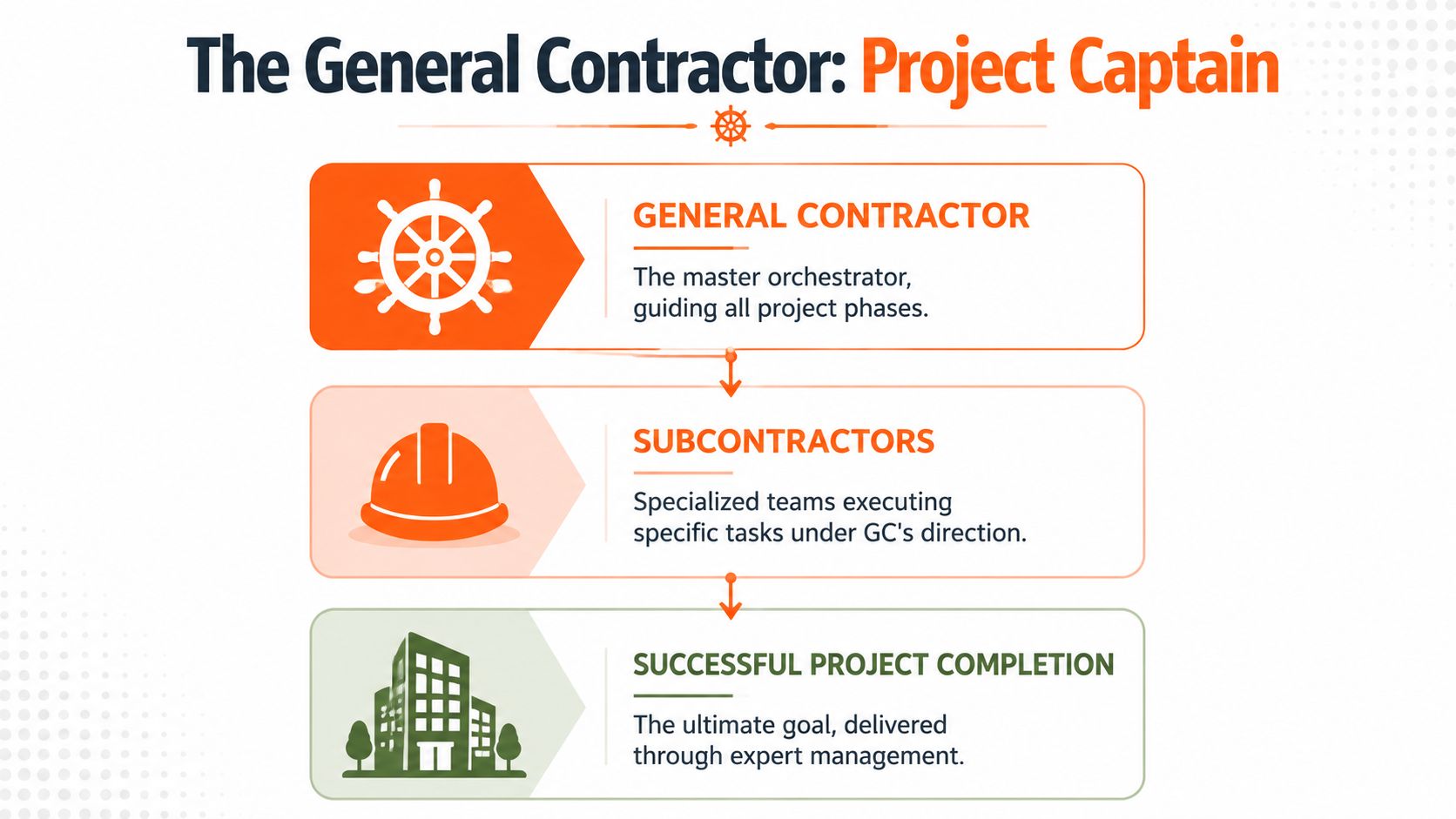
As a trade contractor, your risk usually sits inside your own scope. As the general contractor, you hold the client contract and take responsibility for the finished result, even where other trades do the physical work.
That changes the job in a few practical ways:
- You contract directly with the client and carry the main obligation to deliver what was sold
- You sequence the work so demolition, framing, rough-ins, inspections, finishes, and handover happen in the right order
- You manage subcontractors and suppliers and deal with the fallout when one of them misses dates or delivers poor work
- You handle permits, paperwork, and inspection coordination where the local authority requires it
- You own communication when the client wants updates, changes, answers, or someone to blame
That last point matters more than many good tradies expect. Clients do not separate problems neatly by trade. If the tiler is late, the inspector fails rough-in, and the joinery delivery slips a week, the client still calls the GC.
Why the role matters for your business
A general contractor license is tied to that broader responsibility. It is also tied to access.
If you want to keep taking labor-only or narrowly defined subcontract work, the license may not pay for itself yet. If you want to bid remodels, additions, tenant improvements, and other jobs where the client wants one firm to run the project, the license starts to make business sense. It gives you a cleaner path into higher-value work and puts you in the room for jobs that are closed to unlicensed operators.
This is the trade-off in plain terms. You take on more admin, more exposure, and more compliance. In return, you can price for coordination, margin the full project instead of one trade package, and build direct client relationships instead of relying on another contractor to feed you work.
How a GC differs from a specialty contractor
The difference is operational, not just legal. A specialty contractor is hired for a defined package. A general contractor is hired to deliver the whole contracted scope.
| Role | Main responsibility | Typical risk |
|---|---|---|
| Specialty contractor | Complete one trade package to spec | Defects, delays, or cost overruns inside that trade |
| General contractor | Deliver the full project or full contracted scope | Coordination failures, permit issues, schedule delays, subcontractor performance, and client disputes |
Plenty of skilled tradies underestimate that jump.
Running crews on the tools is one skill. Running contract admin, programme control, subcontractor coordination, variations, inspections, and handover is another. The operators who do well as GCs usually build systems before they chase bigger jobs, not after one goes sideways.
That is why the license should be viewed as part of a wider business move. It is not only permission to work. It marks the point where you stop selling just your trade and start selling project delivery.
The Triggers That Require a License
Most confusion around licensing starts with the wrong question. People ask, "What jobs count?" The better question is, "What triggers the rule where I work?"
The main red flags to watch
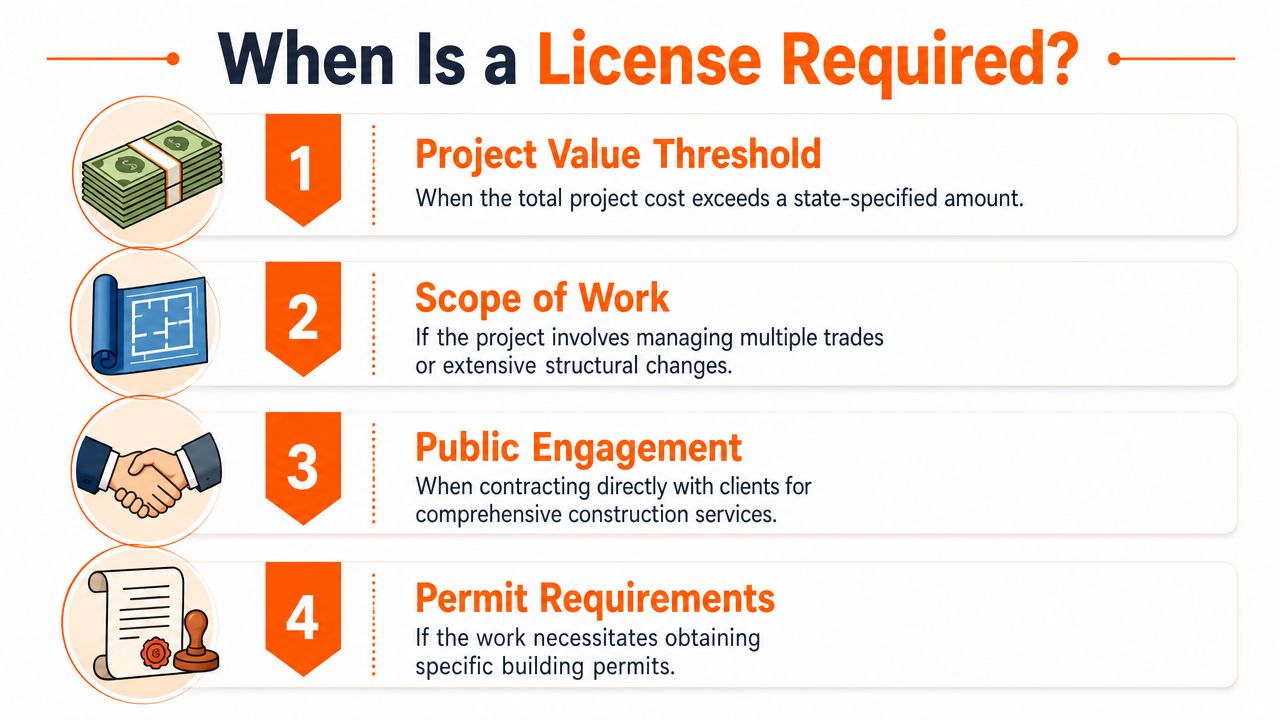
In practice, a license requirement often gets triggered by one or more of these:
- Project value. Once labor and materials pass a set threshold, you may need a license.
- Permit involvement. If the job needs a building permit, the rules often tighten.
- Prime contract status. If the client hires you to run the whole job, you may be treated differently than a sub.
- Multi-trade coordination. Once you're managing several trades, you're moving closer to GC territory.
This is why "small jobs" can be deceptive. A run of repair work might stay below the line, then one larger remodel pushes you into licensed territory. The work can look similar on site, but the legal position is completely different.
Why local rules can change the answer
Some states don't run a single statewide system. That's where contractors get burned by assumptions.
In Colorado, for example, there's no statewide general contractor license, but local systems still apply. Denver requires a supervisor certificate or qualifying credential before a contractor license can be issued, and Jefferson County requires proof of an ICC exam within the last 3 years plus a licensing fee, according to Harbor Compliance's overview of local contractor licensing.
That means crossing a city line can change whether you can legally advertise, bid, or pull permits.
A quick field test helps:
Who signed the contract
If it's your company directly with the owner, check the rules immediately.What's the total value
Count the job as the jurisdiction counts it, not how you'd prefer to frame it.Does it need permits
Permit work often changes the answer fast.Are you coordinating other trades
Once you're managing the full package, expect extra scrutiny.
If you're relying on "I've done jobs like this before," that's not a compliance strategy. Local building departments and licensing boards care about classification, thresholds, and permit status, not your memory of how the last one went.
Finding the Right License for Your Work
You quote a bathroom remodel, then the client asks if you can take on the whole addition, pull the permits, and manage the electrician and plumber. That is the point where license choice stops being paperwork and becomes a business decision. The right classification decides whether you can legally bid the job you want, not just the job you did last month.

License type follows the work you plan to sell
A contractor who wants to stay focused on one trade needs a different license path from a contractor who wants to run the whole job. If you are still doing mainly plumbing, electrical, roofing, or HVAC under your own scope, a specialty license may cover what you need. If you want to sign prime contracts, coordinate multiple trades, and own the schedule, you usually need a residential, commercial, or general building classification.
That distinction affects margin. A specialty contractor can stay lean and avoid licensing costs that do not help win better work. A general contractor license starts to pay for itself when clients expect one point of responsibility and are willing to pay for it.
For trade contractors planning to widen their scope, it helps to compare your current license path with related routes, such as this guide on how to get your plumbing license. The paperwork is different, but the business question is the same. Do you want to stay the subcontractor, or do you want control of the whole contract?
Match the license to the jobs you want in 12 to 24 months
Contractors often apply for the cheapest license that gets approved fastest. That can be a mistake.
If your target is kitchen and bath remodels, additions, and light structural residential work, a residential builder or remodeler classification may be enough. If you want tenant improvements, offices, retail, or mixed-use work, check whether your jurisdiction splits commercial work into a separate class. If your plan is to keep your crew inside one trade and just take on larger contracts, a specialty license with the right project authority may be the better fit.
Choose for the work you intend to sell next, not the work you are trying to leave behind.
License limits can cap your growth
In some areas, the license is not just about scope. It also limits contract value. That matters more than many small contractors expect, because one successful year can push you past the tier you originally applied for.
A lower tier can make sense if you are testing the market and keeping overhead tight. It can also block you from bidding profitable work once referrals start bringing in larger projects. Upgrading later is possible, but it often means more forms, more fees, and a delay right when you should be pricing the next job.
Use a simple filter before you apply:
| Business goal | Likely licensing need |
|---|---|
| Small residential remodels | Residential classification, lower project tier |
| Mid-size additions or multi-trade jobs | Residential or general building license with higher limit |
| Commercial build-outs | Commercial or general building classification |
| Broad growth across job types | Wider classification and room to move up in tier |
That table is not legal advice. It is a practical starting point for choosing a lane.
Pick a license that supports the business model
The actual question is not "What license can I get?" It is "What work do I want access to?"
If you are a one-crew operator doing profitable small jobs with little admin, staying in a narrower classification may be the right move. If you want to bid larger remodels, manage more subcontractors, and build a company that is less dependent on your own tools, broader licensing starts making commercial sense. More paperwork, insurance, and compliance only make sense when they help you win contracts that justify the cost.
Before you file anything, watch a plain-English overview like this one that breaks down common license pathways:
The expensive mistake is choosing a license that fits your past. The profitable move is choosing one that fits the jobs you want to sign.
Your Step-by-Step Application Guide
A lot of small operators stall here. They know licensing matters, but the process looks like unpaid admin with no guarantee of better work at the end.
Treat it like preconstruction. Get the sequence right, keep your paperwork clean, and the application becomes manageable. More important, you avoid the delays that keep you off larger jobs you could already be pricing.
Start with the board requirements
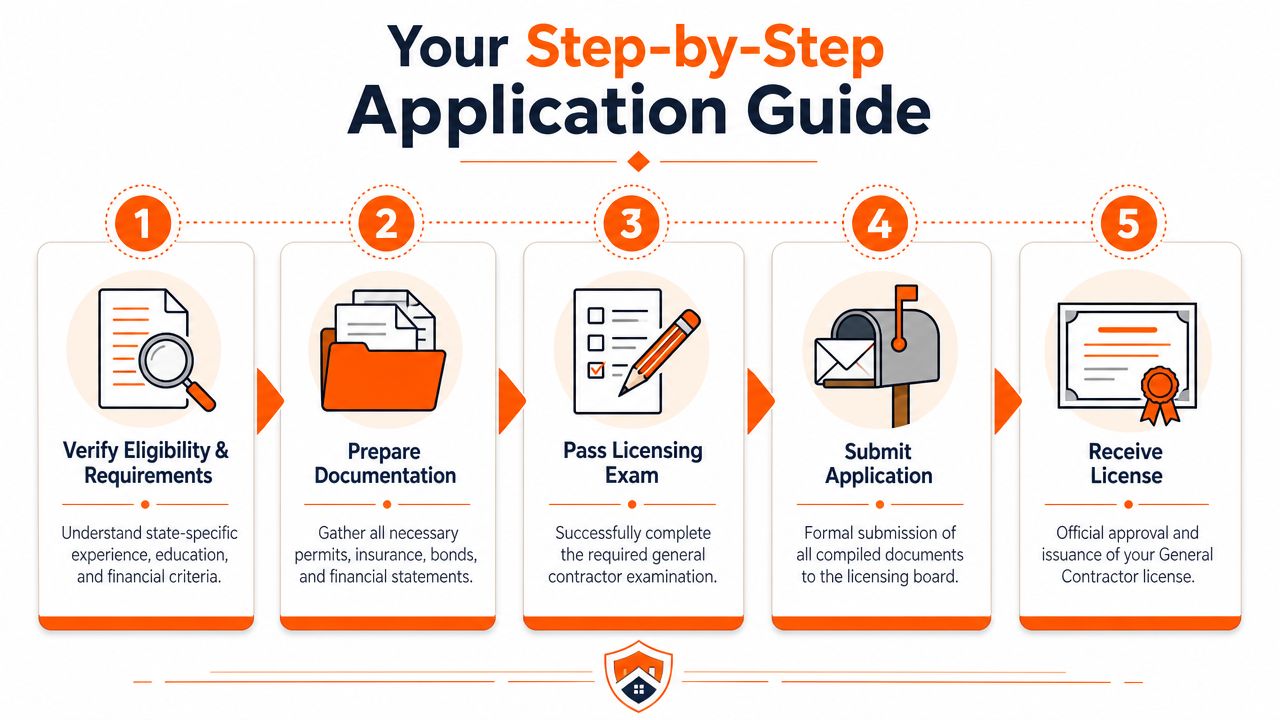
Start with the licensing authority for the place you plan to work. That might be a state board, a county office, or both.
Then write down the items that control whether you can file a complete application:
- Experience requirement
- Exam requirement
- Insurance or bond requirement
- Business entity paperwork
Do this before you pay a fee, book an exam, or set up insurance. A lot of tradies waste time because they start with prep courses or advice from another contractor in a different classification. Boards approve documents, dates, and qualifying experience. They do not care what worked for your mate three years ago.
Build your application like a bid package
Good applications are dull in the best way. Every document matches. Every date makes sense. Every claim can be backed up.
Pull your file together early:
- Work history records. Use contracts, invoices, permits, reference letters, pay records, or employer verification to prove the kind of work you've completed.
- Business documents. Keep your entity name, license name, ownership details, and mailing address identical across every form.
- Insurance paperwork. If coverage is required, confirm the certificate wording and policy details before submission.
- Financial records. Some boards want proof that the business is financially responsible or properly set up to operate.
At this stage, small mistakes cost real time. A mismatched business name, an unsigned verifier form, or missing dates can push your file to the bottom of the pile. That does not just slow approval. It can also mean missing the tender window on the exact type of job that made licensing worth pursuing in the first place.
On site advice: Hand in the application the same way you'd hand over an inspection folder. Clear labels, complete backup, no contradictions.
If you came up through a specialist trade, compare your next move against a narrower pathway like getting your plumbing license. That comparison helps clarify whether you need full GC authority now or whether a trade-specific license still fits the work you're chasing.
Pass the exam and clear the compliance pieces
Many boards require a trade exam, a business and law exam, or both. The technical part is usually familiar. The business side catches people out.
Study from the board's published outline first. Then fill the gaps with prep material that matches that outline. Random study guides waste hours and often miss the contract, lien, safety, and compliance topics that boards test because those are the areas that create claims, disputes, and failed jobs.
Handle the admin pieces at the same time:
- Book the exam as soon as your paperwork is eligible
- Set up bond and insurance items early if your jurisdiction requires them
- Check that names, addresses, and entity details match on every document
- Track deadlines for fingerprints, background checks, or follow-up forms
The practical goal is simple. Get approved once, with minimal rework.
Contractors who treat licensing like a box-ticking exercise often drag it out for months. Contractors who treat it like a business upgrade usually move faster because they know what the license is for. It gives them access to larger scopes, more direct contracts, and jobs where they are managing the site instead of only selling their own labour.
What to Budget for Time and Money
You feel the pinch here before you feel the upside. Exam fees, filing fees, bond costs, insurance changes, time off the tools, admin follow-up. For a small tradie, the question is simple. Will this license let you win work that pays back the cost within a reasonable stretch of jobs?
If the answer is no, wait. If the answer is yes, treat licensing like a business investment and price it properly.
What the money usually goes toward
The board fees are only the visible part. Earlier licensing cost guidance from the U.S. Chamber puts the starting spend in the low thousands once you include the application process, exam, license issuance, and common add-ons such as fingerprinting, bond requirements, and prep materials.
That matters because plenty of operators budget for the filing fee and get caught by everything around it.
Typical cost buckets include:
- Application and exam fees paid to the licensing board
- Initial license issuance fees once you're approved
- Exam prep books, courses, or practice tests
- Bond and insurance setup
- Fingerprinting or background checks if your state requires them
- Lost billable hours while you study, gather documents, and fix paperwork issues
Time is usually the bigger hit than cash.
A clean application can still drag if your entity name is inconsistent, your insurance certificate is wrong, or a background check expires before the board reviews the file. That delay costs more than the fee. It can mean missing a tender window or passing on a job you were ready to price.
When the hassle is worth it
Licensing starts making business sense when it changes the type of work you can legally take and the margin you can make on it.
Good signs you're there already:
- You're seeing jobs you cannot bid directly
- Clients want one contract and one responsible party
- Permit responsibility is blocking you from taking the full scope
- You keep stitching work together through other licensed contractors
- You want larger remodel, fit-out, or small commercial jobs with better margins
That last point matters. Bigger jobs are not automatically better jobs. They usually bring more paperwork, longer payment cycles, tighter supervision, and more risk if you price them badly. But they also give you room to make money from coordination, scheduling, subcontract management, and project control instead of selling labour only.
That is the strategic value of the license. It lets you bid as the contractor in charge, not just the trade on site.
If you're weighing that shift in HVAC, electrical, or another field where owners often start as technicians first, the bigger decision is company structure and job mix, not just the exam. That's the same transition covered in this guide on how to start an HVAC company.
A license is worth the cost when it gets you into jobs that are larger, cleaner, and more profitable than the ones you're piecing together now.
Common Licensing Questions Answered
The expensive mistakes usually happen in the grey area. A small cash job turns into permit work. A "quick favor" grows into managing two other trades. A subcontractor starts dealing directly with the owner and ends up carrying prime contractor risk without the paperwork to match.
Do I need a license for handyman work or small jobs
Sometimes, yes.
"Handyman" is not a legal shield. States usually look at job value, permit requirements, and the type of work being performed. In some places the threshold is low. In others, the trigger is tied to bidding, negotiating, or taking responsibility for a larger scope. The practical point is simple. Check the rule before you price the job, not after the client asks for a change that pushes it over the line.
Utah, Arizona, and Tennessee are good examples because they all set the bar differently, as shown in these state threshold examples in this contractor licensing guide. The numbers vary. The pattern does not. Small jobs can still trigger licensing rules.
Can I stay unlicensed and just work as a subcontractor
Sometimes, but only if you are genuinely acting as a subcontractor.
If the licensed prime contractor holds the main contract, controls the project, and pulls you in for your trade scope, the rule may be different than if you contract directly with the owner. Problems start when an unlicensed operator prices the whole job, coordinates multiple trades, collects the full payment, or presents himself as the party in charge. At that point, the title on the invoice matters a lot less than the role you are performing.
I have seen tradies get comfortable doing "subbie" work while handling site coordination, variations, and client communication like a GC. That setup can work until there is a payment dispute, a defect claim, or a board complaint. Then everyone starts looking at who really ran the job.
Is the license worth it if I only want slightly bigger jobs
Often, yes, if "slightly bigger" means better clients, permit work, and contracts where you control more of the margin.
That is the business case. A license gives you access to jobs where the client wants one responsible party, one contract, and someone who can legally carry the project from permit to handover. It also gives you a cleaner position in the sales process. Instead of waiting for a builder or another licensed contractor to feed you part of the work, you can bid the job yourself and use subcontractors where it makes sense.
The trade-off is real. You will spend money on the application, insurance, exams, and often bonding or financial paperwork. You will also take on more responsibility. More paperwork, more oversight, and more risk if your scheduling or pricing is weak. As noted earlier, those upfront costs can easily run into the low thousands once everything is counted.
For a tradie staying in minor maintenance and one-day jobs, that may not pencil out yet. For a tradie already losing remodels, fit-outs, or small commercial work because the client needs a licensed contractor in charge, the answer is usually clear. The license stops being a compliance chore and starts becoming a tool for winning better work.