
You're probably here because you know the work. You can frame a wall, hang doors, build trim packages, sort out a bad corner, and make a crooked room look straight. But getting paid well and staying booked still feels uneven. Some months are full. Some weeks are dead. Too many jobs look profitable until you add up the hours, fuel, callbacks, and the half day you lost chasing materials.
That's the gap between being a good carpenter and running a good carpentry business.
A lot of skilled tradespeople start out by buying more tools, saying yes to every job, and hoping word of mouth will carry the rest. That can keep you busy, but busy isn't the same as stable. A real business has structure behind it. It has a legal setup that protects you, pricing that reflects the actual cost of doing the work, a repeatable way to win jobs, and enough financial control to know whether a full calendar is helping or hurting.
If you're also trying to work out licensing questions, this guide on what a general contractor license is and when it matters is worth reading early, because a lot of carpenters get caught by scope rules before they ever get caught by bad workmanship.
Table of Contents
- From Carpenter to Business Owner
- Building Your Business Foundation
- Pricing Your Work and Estimating Jobs Accurately
- Essential Tools Equipment and Job Workflow
- Finding Local Jobs and Building Your Reputation
- Managing Your Finances and Key Numbers
- Scaling Up with Hiring and Systems
From Carpenter to Business Owner
Being self-employed sounds good until you realize you've just given yourself a boss who works weekends and forgets to send invoices.
That's the shift most carpenters have to make. Good hands don't automatically become a good carpentry business. The trade teaches you production. Business ownership demands decisions. Which work fits your margins. Which clients waste time. Which jobs fill a schedule but starve cash flow. Which tasks have to be done the same way every time so quality doesn't depend on your mood, memory, or how rushed the day feels.
A lot of new operators stay stuck because they think the next tool, ute upgrade, or bigger project will solve the problem. Usually it won't. The business gets stronger when the boring stuff gets tighter. Clear quotes. Clear scope. Deposits collected on time. Materials ordered in sequence. Photos taken before and after. Variation approvals in writing. Invoices sent the day the job is done, not when you remember.
Practical rule: If the business only works when you personally chase every lead, remember every detail, and solve every problem on site, you don't own a business yet. You own a demanding job.
The good news is that most of this is fixable with simple systems. Not corporate systems. Trade systems. Checklists, standard wording, saved estimate templates, a job handover routine, and a clear rule for what work you take and what work you walk away from.
That's how you stop thinking like a carpenter who happens to invoice people and start operating like a business owner who happens to be very good with timber.
Building Your Business Foundation
The carpentry field is big enough that sloppy operators don't stay hidden for long. IBISWorld's U.S. carpenters industry snapshot estimates the market at $63.5 billion in 2026, with about 195,000 businesses competing across framing, finish work, alterations, maintenance, repairs, and installations. In a market that broad and crowded, looking legitimate from day one gives you an edge.
Pick a structure you can live with
The first decision is how the business exists on paper. Most carpenters start as a sole proprietor because it's simple. Some stay there too long because simple at the start can become expensive later if something goes wrong.
An LLC usually takes more setup and admin, but it tends to look more professional and can offer a cleaner separation between business risk and personal risk. That doesn't replace proper insurance or good contracts, but it matters.
| Feature | Sole Proprietor | Limited Liability Company (LLC) |
|---|---|---|
| Setup | Usually simpler and faster | More paperwork and state filing |
| Liability | Business risk is generally tied closely to you personally | Better separation between business and personal liability in many situations |
| Tax handling | Commonly straightforward | Can still be simple, but depends on how it's structured |
| Professional appearance | Can look informal on larger jobs | Often presents more professionally to clients and builders |
| Best fit | Side work, very small operations, low complexity | Operators planning to grow, hire, or take on bigger responsibility |
If you're unsure, talk to a local accountant and a business attorney before you start signing larger contracts. A cheap shortcut here can become a very expensive lesson.
For readers comparing trade paths, this guide on how to start a handyman business is also useful because it highlights where small service work and contractor-style work start to split.
Handle licenses insurance and paperwork early
Many carpenters put this stuff off because it doesn't feel like real work. Clients don't see it until they ask for proof. Builders notice it immediately.
Get these sorted before you chase volume:
- Business registration: Register the business name properly and make sure the name on quotes, invoices, and banking matches.
- State and local licensing: Carpentry rules vary by state and local authority. Some places regulate carpentry directly. Others regulate contractors by project scope, permit type, or contract value.
- General liability insurance: This is basic protection when your work damages property or someone claims injury tied to the job.
- Workers' compensation: If you hire people, this stops being optional fast in many places.
- Business bank account: If client money goes into your personal account, your bookkeeping is already a mess.
- Written contracts: Even small jobs need scope, exclusions, payment terms, and variation rules in writing.
A proper foundation also changes the kind of jobs you can win. Better clients ask for certificates, license details, and a clean proposal. They don't want excuses. They want signs that you'll still be organized after the deposit clears.
Clients rarely praise paperwork. They do notice when you don't have it.
One more hard truth. Plenty of carpenters think being “good enough on the tools” will carry weak admin. It won't. The operators who last are usually the ones who treat compliance, insurance, and documentation as part of the trade, not as office fluff.
Pricing Your Work and Estimating Jobs Accurately
Most underpriced jobs don't happen because a carpenter can't do the math. They happen because the carpenter prices labor and materials, then forgets the business that sits behind both.

Why hourly pricing traps new operators
Charging by the hour feels safe because it sounds fair. The problem is that clients hear one number, while you carry a pile of hidden costs behind it. Vehicle payments, fuel, blades, bits, insurance, bookkeeping, quoting time, fix-ups, dead travel, and the hour you spent talking through the job before anyone signed.
Hourly pricing also punishes efficiency. If you've got the skill, jigs, and workflow to do a job well in less time, a pure hourly model can make you earn less for being better.
A better starting point is job pricing built from a real internal charge-out rate. That rate should include:
- Direct labor: What it costs to put yourself or a worker on site.
- Materials: Timber, fixings, adhesives, hardware, sheet goods, finishes, consumables.
- Overhead: Insurance, registration, software, vehicle costs, phone, accounting, workshop rent if you have it.
- Non-billable time: Quoting, site visits, procurement, scheduling, invoice chasing.
- Profit: The amount left after all job costs and overhead are covered.
If you don't include all five, you're not pricing. You're guessing.
Build estimates in layers not guesses
This matters even more on custom work. Projul's guidance for carpenter businesses points out that custom millwork and cabinetry estimates need to be broken into layered assemblies such as raw materials, sheet goods, labor for milling, finishing, and installation. That's the practical way to stop underbidding jobs that look simple on paper but burn hours in the shop and on site.
Here's what that looks like in real life.
A built-in cabinet isn't “one unit installed.” It's species selection, board footage, sheet stock for internals or backing, waste allowance, edge treatment, hardware, milling time, sanding time, finish time, cure time, transport, install, scribing, touch-up, and cleanup. Every one of those steps has a cost. Some have delay built in. Finishing, for example, might not need your hands every minute, but it can still hold up delivery and tie up workflow.
If you price custom work as one lump sum because that's easier to type, don't be surprised when the job takes your margin with it.
For straightforward work, your estimate can stay simpler. For custom work, detail protects you.
What a solid estimate should include
A good estimate does two jobs. It helps you make money, and it helps the client understand what they are buying.
Use this structure:
Job description
State the work plainly. “Supply and install prehung interior doors to existing openings” is better than “door work.”Scope included
List what's in the price. Demo, disposal, material supply, install, hardware fitting, trim, caulking, basic site cleanup.Scope excluded
Call out what isn't included. Painting, electrical relocation, wall repairs outside the work area, permit fees, unforeseen framing correction.Materials and allowances
If hardware, specialty timber, or finishes aren't finalized, say what allowance or assumption the price is based on.Variations rule
State that changes outside the agreed scope require written approval before extra work starts.Payment terms
Deposits, progress claims if needed, and final payment timing.Validity period
Especially important when material pricing or lead times are moving around.
This video gives a useful visual walk-through on thinking through estimate structure and job pricing before the quote goes out.
A few quoting mistakes show up again and again:
- Too little detail: You understand the job in your head. The client only sees the page.
- No exclusions: If it isn't excluded, many clients assume it's included.
- No site reality check: Old houses, uneven walls, hidden damage, and bad prior work can wreck a neat estimate.
- No admin time priced in: The work starts before the first cut and ends after final payment clears.
The best estimates aren't fancy. They're clear. They leave less room for argument, less room for missed cost, and less room for you to do free work out of politeness.
Essential Tools Equipment and Job Workflow
A lot of carpenters overspend early because tools feel productive. Sometimes they are. Sometimes they're just expensive reassurance.
The right starting setup for a carpentry business depends on the work you're selling. A finish carpenter needs different priorities than someone focused on decks, framing repairs, or small renovations. Still, the same rule holds. Buy the gear that lets you complete paid work cleanly, safely, and without constant workarounds.
Buy what earns first
Start with the tools that directly affect quality and speed on your current jobs. Usually that means a dependable saw setup, drill and impact driver, levels, layout gear, fastening tools, clamps, sanders, hand tools, PPE, and secure storage. For many operators, a track saw, miter saw, compressor, nailers, and jobsite table saw earn their place quickly.
Leave room for renting. If a tool only matters on occasional jobs, rent it until the work justifies ownership. That keeps cash free for insurance, materials, and the ugly costs no one gets excited about.
A clean vehicle setup matters more than many new operators think. Not because clients care what brand you drive, but because wasted minutes add up. If you're always digging for shims, screws, router bits, extension leads, or the right hinge jig, the job slows down and your head gets cluttered. Organized storage is a profit tool.
Useful categories for vehicle and site setup:
- Fast-access gear: Daily hand tools, tape, knife, pencils, bits, fixings, chargers.
- Protected equipment: Lasers, specialty jigs, finish tools, moisture-sensitive gear.
- Consumables: Adhesives, abrasives, blades, patch materials, caulk, packers.
- Site protection: Drop sheets, floor protection, masking, dust control.
A simple workflow beats a heroic effort
Tools alone don't run jobs. Workflow does.
Modern carpentry work leans more heavily on planning and coordination than a lot of older hands like to admit. Training programs such as Ivy Tech's Building Construction Technology program emphasize planning and completing construction projects with tools, machinery, and software. In business terms, that means scheduling, materials coordination, and job documentation are now part of doing the trade properly.
A basic workflow can stay simple:
- Initial call and fit check: Confirm the work type, location, rough budget, and timeline.
- Site visit: Measure, inspect existing conditions, note access, and flag hidden risks.
- Estimate and approval: Send the quote quickly while the conversation is fresh.
- Pre-start planning: Order materials, confirm crew, book deliveries, schedule sequence.
- Execution: Use a daily job note habit. Photos, changes, delays, client requests.
- Completion: Walk the job, note defects, close punch items, send invoice, request review.
The carpenters who look calm on busy weeks usually aren't less busy. They just decided the order of work before the work arrived.
A repeatable workflow also makes it easier to hand work off later. If you can't explain how a job moves from enquiry to final sign-off, you'll struggle to train anyone or maintain standards once work picks up.
Finding Local Jobs and Building Your Reputation
Getting work isn't about being everywhere. It's about being remembered for the right work by the right people in the right area.
Choose the kind of work you want to be known for
A common mistake in a new carpentry business is advertising everything. Framing, decks, trims, pergolas, repairs, cabinetry, renovations, fences, shop fit-outs. That sounds flexible, but to clients it can look unfocused.
There's a stronger approach. Pick a core service mix and let the rest support it.
Next Insurance's carpentry business ideas overview highlights an important angle. While common niches like framing and trim are everywhere, repair, retrofit, and specialty work can be a better opening because labor shortages tend to be tighter there and price pressure can be lower. That matches what many operators learn in the field. The glamorous job gets attention. The awkward, technical, fiddly job often gets margin.
Good examples of work that can build a reputation faster than generic “we do all carpentry” messaging:
- Repair-focused work: Rotten window frames, damaged doors, stair repairs, trim replacement, structural timber fixes within your licensing scope.
- Retrofit work: Matching existing profiles, fitting new work into old houses, correcting poor prior installs.
- Specialty finish work: Built-ins, custom shelving, detailed trim packages, high-visibility interior upgrades.
- Builder support work: Punch lists, defect rectification, overflow carpentry, finishing packages.
The best niche is rarely the one that sounds coolest. It's the one your market needs, pays for, and remembers.
Make it easy for local clients to trust you
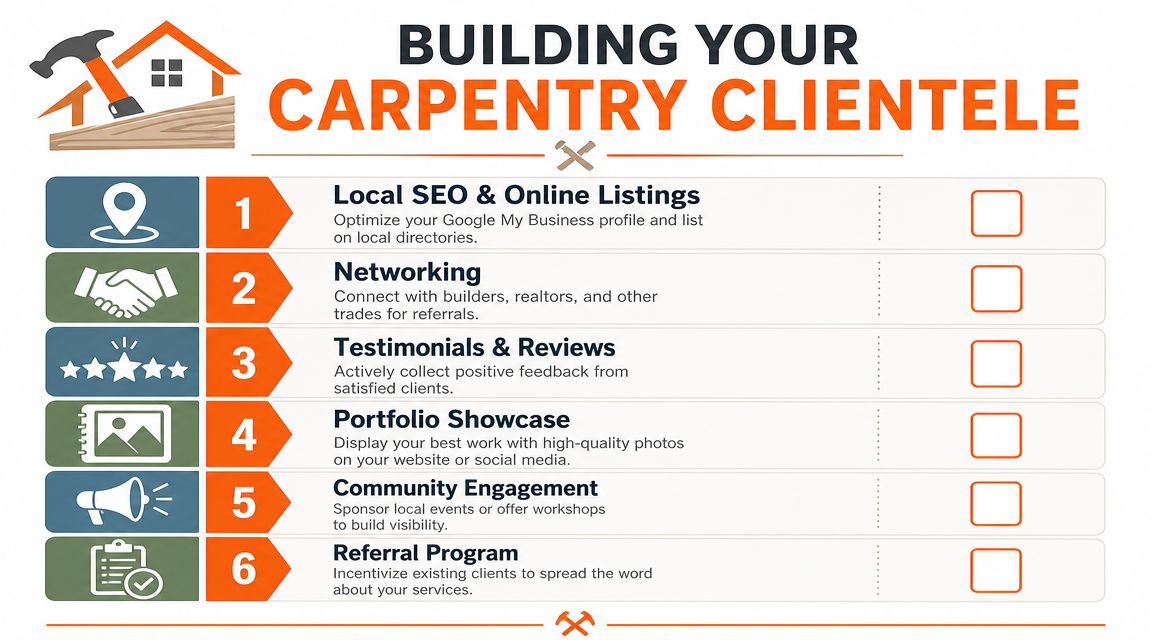
Trust gets built before the first phone call. Your business name, photos, reviews, job descriptions, and how clearly you explain your services all do part of the selling.
Start with the basics:
- Keep your business details consistent: Same name, service area, and phone number everywhere you appear.
- Show real work: Clean photos of your jobs beat stock images every time.
- List specific services: “Custom wardrobes,” “door replacements,” or “exterior timber repairs” says more than “quality carpentry.”
- Use location language naturally: Mention the suburbs, towns, or service region you work in.
If you want a practical breakdown of how tradies improve local visibility without making it a full-time job, read this guide on local SEO for contractors.
A plain, useful online presence beats a flashy one. Most clients just want to answer a few questions fast. Do you do this kind of work? Have you done it before? Can they trust you to turn up and finish it properly?
Use photos referrals and follow-up
Carpentry sells well when people can see the result.
That means your phone should be part of your tool kit. Take before photos, progress photos, and finished photos. Not dozens of random shots. A few clean, well-lit images that show the problem, the process, and the outcome. A warped gate fixed square, damaged architraves replaced neatly, a blank wall turned into built-in storage. These are proof.
Short-form content also works because it shows competence without much explanation. A quick clip of scribing a cabinet to an uneven wall or setting out a trim detail says more than a paragraph of sales copy.
Use a simple posting rhythm:
- Before and after posts: Best for repairs, retrofits, and visual upgrades.
- Work in progress posts: Useful when the process itself shows skill.
- Small advice posts: Timber movement, hardware choices, trim profile differences, what clients should decide before install day.
- Finished job posts: Show the completed space, not just the close-up joinery.
Referrals still matter, and they often come from people outside the obvious circle. Builders, painters, tilers, flooring installers, cabinetmakers, handymen, property managers, and real estate contacts all run into carpentry problems they don't want to solve themselves.
A few habits make referrals easier:
| Habit | Why it works |
|---|---|
| Reply quickly | Referrers stop sending work to people who make them look slow |
| Send tidy quotes | It reassures both the client and the referrer |
| Leave sites clean and communicate clearly | Other trades remember who makes jobs easier |
| Ask for reviews after a good finish | Fresh feedback builds trust for the next prospect |
Good reputation isn't branding. It's what people say after you leave the site.
Finally, follow up old clients. Not with hard selling. Just check in when it makes sense. Seasonal timber movement, wear and tear, unfinished wish-list items, or adjacent work they mentioned during the first job. Existing clients already know your standard. They're often the easiest work to win again.
Managing Your Finances and Key Numbers
A full calendar can hide a weak business for a long time.
The trade gives you visible proof when you're doing well. Trucks moving, materials turning up, invoices going out, jobs wrapping up. Finance is quieter. Problems show later. You can be booked solid and still be short on supplier money, tax money, or wages.
The broader labor picture is steady rather than wild. The U.S. Bureau of Labor Statistics carpenters outlook projects 4% employment growth from 2024 to 2034, with about 74,100 openings each year on average and a median annual wage of $59,310 in May 2024, or $28.51 per hour. In a mature trade with recurring demand, financial control is often the difference between a carpentry business that lasts and one that stays stressed.
Separate the business from your wallet
If there's one move that cleans up decision-making fast, it's separating personal and business money. One business bank account. One card for business spending. One bookkeeping system. Every deposit in. Every expense coded. No “I'll sort it out later” pile.
Accounting software helps because memory is bad bookkeeping. It also lets you see patterns that get lost in a bank feed. Which jobs carry materials heavily. Which clients pay slowly. Which months always tighten up. Which service types drag your margin down.
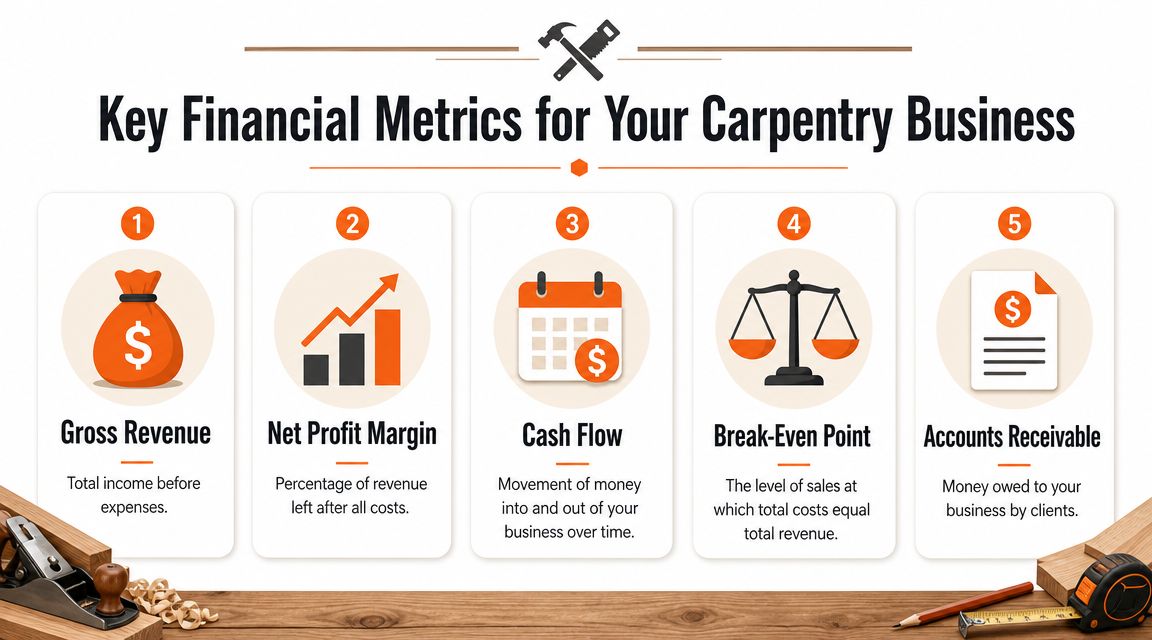
Three simple money ideas matter most:
- Profit is what should remain after all costs are paid.
- Cash flow is whether the money is in the account when you need to buy timber, pay labor, or cover insurance.
- Break-even is the point where the business covers itself before it pays you properly.
Profit and cash flow are not the same thing. A job can be profitable and still hurt you if the client pays late and suppliers want money now.
The numbers that actually matter
You do not need a finance degree. You do need a short list of numbers you review regularly.
Track these first:
- Average job value: This tells you whether your lead sources are bringing the kind of work you want.
- Gross profit per job: What remains after direct labor and materials. Weak pricing becomes evident in this metric.
- Accounts receivable: Who owes you money and how overdue it is.
- Quote acceptance pattern: Which kinds of jobs get approved and which ones stall.
- Cash on hand against upcoming commitments: Materials, wages, insurance, tax, rent, vehicle costs.
A weekly review is enough for many small operators. It does not need to be complicated. Open the numbers, compare them to the jobs in progress, and ask blunt questions.
Are you taking on too much low-value work? Are custom jobs soaking up shop hours without enough margin? Are repair jobs paying better because they're quicker to close and easier to scope? Are you invoicing fast enough? Are you carrying clients longer than you should?
Here's a practical perspective:
| Number | What it tells you |
|---|---|
| Average job value | Whether you're winning the right size work |
| Gross profit per job | Whether the job was worth doing |
| Accounts receivable | Whether sold work has actually turned into cash |
| Cash flow view | Whether the business can operate without strain |
| Break-even awareness | How much work must be sold before real profit starts |
A carpenter can survive bad bookkeeping for a while. Suppliers, tax agencies, and payroll deadlines usually have less patience.
Financial discipline also helps you make better operational choices. It tells you whether to raise prices, narrow service offerings, stop small nuisance jobs, or push harder into the work types that leave money behind.
Scaling Up with Hiring and Systems
Most one-person businesses hit the same wall. You can sell, quote, build, install, chase materials, answer calls, invoice, and manage clients for a while. Then the workload rises and quality starts depending on how tired you are.
That's usually the point where growth stops being about effort and starts being about systems.
When to hire and who to hire first
The first addition doesn't always need to be another full carpenter. It depends on where the bottleneck is.
If site production is the constraint, a capable subcontractor or employee in the field may help. If you're losing time to scheduling, supplier coordination, invoicing, and client follow-up, support on the admin side may create more capacity than another set of hands on the tools.
The subcontractor versus employee decision matters. Subcontractors can offer flexibility when work volume moves around. Employees can give you more control over standards, availability, and how the work gets done. Either way, get advice early on tax, insurance, supervision, and legal classification in your area. Guessing here can become costly.
Write the system before you need it
Most owners wait too long to document how the business runs. They think they'll do it once the team grows. That's backwards. You need the checklist before the handoff.
Write down the repeatable parts:
- Lead handling: How calls are answered, what gets asked, how site visits get booked
- Estimating: Standard inclusions, exclusions, variation wording, deposit terms
- Job prep: Ordering sequence, tool loading, site confirmation, client communication
- On-site standards: Protection, cleanup, daily updates, defect reporting
- Completion: Final walk-through, photos, invoice timing, review request
None of this needs to be fancy. A shared note, a printed checklist, a simple folder structure, a saved quote template. That's enough to start.
The point of scaling isn't to build a bigger version of your personal workload. It's to build a carpentry business that keeps its standards even when you aren't touching every cut, every call, and every invoice yourself.
If you want your carpentry business to stay visible without having to think up posts after a long day on site, GrowTradie is built for that. It creates and posts trade-specific social content for your services and local area, so your business keeps showing up professionally while you focus on quoting, building, and getting paid.