
You've seen this happen. Your tech diagnoses the problem, builds the right quote, explains why the old system is done, and the customer nods the whole way through. Then the number lands, the room gets quiet, and you hear, “We need to think about it.”
Most of the time, they don't need to think about the repair. They need to think about the cash.
That's why financing for plumbing customers isn't some add-on for bigger shops. It's a basic sales tool. If you handle high-ticket repairs, replacements, repipes, sewer work, or emergency calls, you need a financing process that works in the field, is easy to explain, and doesn't slow your team down. If you don't have that, you're handing good jobs to competitors who do.
Table of Contents
- Why You Are Losing Jobs Without Financing
- How to Choose the Right Financing Partner
- Integrating Financing into Your Business Workflow
- Training Your Team to Talk About Financing
- Answering Your Top Questions About Financing
Why You Are Losing Jobs Without Financing
A customer calls because the water heater failed, the line is leaking under the slab, or the old piping has finally reached the end. They don't call because they want to shop for debt. They call because they need the problem solved.
Then you present a serious repair or replacement quote, and they freeze. Not because your recommendation is wrong. Because the full amount has to come out of today's budget.
The real objection is usually payment timing
That hesitation gets misread all the time. Owners think the customer wants another opinion. Techs think they didn't build enough trust. Dispatch thinks the lead was weak.
A lot of the time, the customer is unable to move quickly on a large unplanned expense.
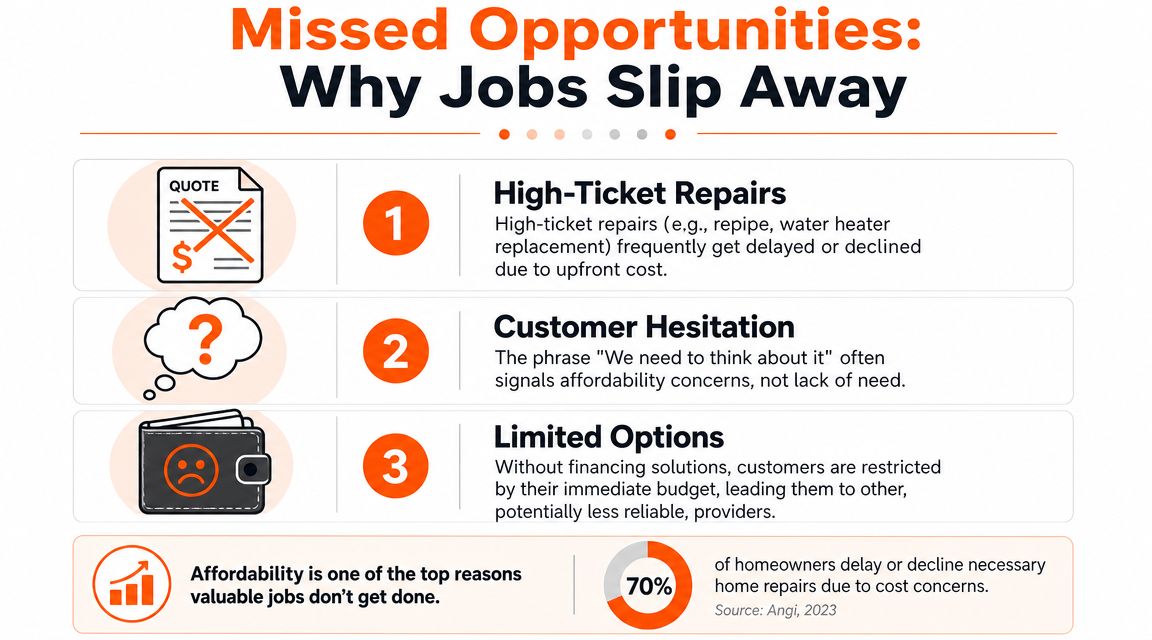
Offering financing on plumbing jobs can increase revenue by more than 17%, and alternative-lender approvals can happen the same day, with funds arriving in as little as one business day, according to ServiceTitan's plumbing industry statistics roundup. That matters because urgent plumbing work doesn't wait for payday, tax returns, or a family budget meeting.
Practical rule: When a customer says they need to think about it after agreeing the work is necessary, assume the issue is payment structure until proven otherwise.
If you're already investing in lead generation, this gets even more painful. You paid to get the phone call, scheduled the visit, sent the truck, diagnosed the issue, and built the estimate. Then you lose the job at the finish line because you gave only one way to pay. Shops that want more booked work usually focus on top-of-funnel demand first, but if your close rate leaks at the estimate stage, you'll feel it no matter how many leads you buy. That's why owners who are trying to get better plumbing leads consistently also need a payment strategy that converts them.
Financing changes the decision
The smart way to think about financing for plumbing customers is not “helping people borrow money.” It's reducing decision friction on necessary work.
When monthly payments are available, the conversation changes:
- From delay to action: The customer can approve the repair now instead of punting it.
- From cheapest patch to proper fix: They stop shopping only for the smallest upfront number.
- From awkward negotiation to clear options: Your team can present payment choices instead of discounting.
- From cash-flow strain for the customer to cash-flow stability for the business: The job moves forward instead of sitting in limbo.
You also gain a real competitive edge. A plumber who can diagnose, price, and offer a clean payment path in one visit will beat a plumber who says, “Call us back when you're ready.” Convenience closes.
How to Choose the Right Financing Partner
Most plumbing owners choose a financing partner for the wrong reason. They get impressed by the sales rep, the logo sheet, or a broad promise about approvals. None of that matters if your tech can't use it in the kitchen, on a phone, with a customer standing there waiting.
You don't need a flashy platform. You need one that gets used.
Don't buy the pitch, test the process
Industry guidance is clear on one point: plumbing-specific financing partners tend to fit the trade better because they support higher approval rates, mobile-first workflows, and contractor training. The same guidance also warns that if the application or payment explanation isn't simple, customers are more likely to abandon the process, as explained in BuyFin's guide for plumbing financing without complicated paperwork.
That should drive your decision.
Don't start with lender branding. Start with the actual customer journey in the home. Ask your rep to show you exactly how this works on a technician's tablet or phone. Time every step. Watch how many screens it takes to move from estimate to application to approved option. If it feels clunky in a demo, it will die in the field.
If the financing process needs a long explanation, your team won't present it often enough, and customers won't complete it often enough.
A good partner should make three things easy:
- Presenting financing at the same time as the estimate
- Showing a simple monthly payment example immediately
- Submitting an application without paperwork chaos
If any one of those breaks, adoption drops.
Financing Partner Comparison Checklist
| Evaluation Criterion | What to Look For | Red Flags |
|---|---|---|
| Field usability | Mobile-first application flow that works smoothly on phone or tablet | Desktop-heavy workflow, too many screens, confusing navigation |
| Customer simplicity | Clear terms, easy application steps, fast explanation of payment options | Fine-print overload, unclear payment breakdowns, too much jargon |
| Estimate integration | Financing can be presented alongside the quote, not as a separate afterthought | Team has to leave the estimate, call someone, or restart the process |
| Payment illustration | Immediate monthly payment examples your tech can show on the spot | No quick payment view, or examples hidden behind multiple steps |
| Training and support | Real onboarding for office staff and field techs, with scripts and usage guidance | “Figure it out yourself” setup, no practical rollout support |
| Fit for plumbing jobs | Familiarity with urgent repair sales and in-home presentation flow | Generic retail financing approach that ignores service-call reality |
| Approval coverage | Multiple options for different customer situations | One narrow approval path that leaves too many customers stuck |
| Speed to contractor payment | Clear explanation of when you get paid and what triggers funding | Vague funding timeline, confusing documentation requirements |
| Merchant economics | Transparent contractor costs and program structure | Hard-to-understand fees, shifting terms, buried charges |
| Reputation with your team | Easy enough that techs will actually offer it every day | So awkward that only your best salesperson ever uses it |
Questions you should ask before signing
A rep should answer these plainly. If they dance around them, keep looking.
- “Show me the full application on a phone.” Don't accept screenshots or slides.
- “How does a tech present a monthly payment before objections start?” If they can't answer that, they don't understand field sales.
- “What training do you provide for technicians, not just managers?” Managers don't close kitchen-table decisions. Techs do.
- “What happens when a customer gets confused mid-application?” You need support in the moment, not a help article.
- “How do you keep this simple enough for emergency calls?” That's the core use case in plumbing.
Pick the partner that removes friction, not the one with the slickest deck. Simplicity wins. Training wins. Field speed wins.
Integrating Financing into Your Business Workflow
Financing fails in most plumbing shops for one basic reason. It gets treated like a special tool for special situations.
That's a mistake. Financing for plumbing customers should feel as normal as paying by card. If your team only brings it up after the customer flinches, you've already made the conversation harder.
Put financing in front of the customer early
For homeowners, payment options are already standard. SoFi notes that personal home-improvement loans commonly carry 10% to 20% interest rates, with typical loan sizes of $2,000 to $35,000, and some FHA Title I loans up to $7,500 don't require home collateral, according to SoFi's overview of financing for plumbing repairs. In plain English, this isn't a strange concept to the customer. It's a familiar way to handle a big home expense.
That means you shouldn't whisper about financing like it's a rescue plan for people in trouble. Present it like a normal payment option for any customer facing a meaningful repair.

A few places where financing should appear before the estimate is even discussed:
- On your website service pages: Add clear language that payment options are available for larger repairs and replacements.
- In booking confirmation messages: Let customers know flexible payment options can be discussed during the visit.
- On dispatch notes for techs: Flag estimate-based calls where financing should be part of the standard presentation.
- Inside your field software: Include financing prompts and payment examples where the tech builds the quote.
If your office stack is outdated, fix that first. Modern apps for plumbing businesses make it easier to attach estimate notes, payment options, and presentation prompts so financing becomes part of the workflow instead of something people forget.
Build it into every estimate and every handoff
The strongest plumbing shops don't “offer financing” now and then. They bake it into the estimate process.
That means every qualifying quote should include a payment path. Not only premium installs. Not only replacement jobs. Not only when the customer looks worried.
Use a simple operating rule. If the ticket is high enough that a customer might pause, the estimate should include a monthly payment illustration and a clear next step for application.
Customers don't need a lecture on lending products. They need a clean answer to one question: “What does this look like if I don't want to pay all at once?”
The office matters too. CSRs and dispatchers shouldn't discuss loan details, but they should normalize the idea early. A simple line works: “If this turns into a larger repair, we do have payment options available, and the technician can show those during the visit.”
What your workflow should look like
Here's a practical setup that works.
Marketing and intake
Mention payment options in the places customers already look. Website, confirmations, and reminder messages.Dispatch prep
Tag calls that are likely to lead to major estimates. Repipe, sewer, water heater replacement, leak damage, fixture package upgrades.In-home diagnosis
The tech explains the problem first. Financing should never come before trust and diagnosis.Estimate presentation
Present the full solution, then show payment options as one of the ways to move forward.Application support
If the customer wants to explore it, the tech guides them through the platform without turning the kitchen table into a finance seminar.Close and handoff
Once approved and accepted, your team moves straight into scheduling, deposit handling, or same-visit execution based on your process.
This is what makes financing useful. Not having a logo on your site. Not signing with a lender. Actual daily use.
Training Your Team to Talk About Financing
A financing program doesn't fail because the lender is bad. It usually fails because the team never gets comfortable bringing it up.
Techs worry they'll sound pushy. Owners worry they'll say the wrong thing. Both concerns are fair. But the fix isn't avoiding financing. The fix is training your team to present it clearly, professionally, and without turning into sales actors.
Your techs are not lenders
Start here. Your technicians are not there to sell debt. They are there to give customers a workable path to solve a plumbing problem.
That framing changes everything.
If a tech believes financing is a pressure tactic, they'll avoid it until the customer objects. If they understand it as a service option, they'll offer it naturally. That's the right posture.
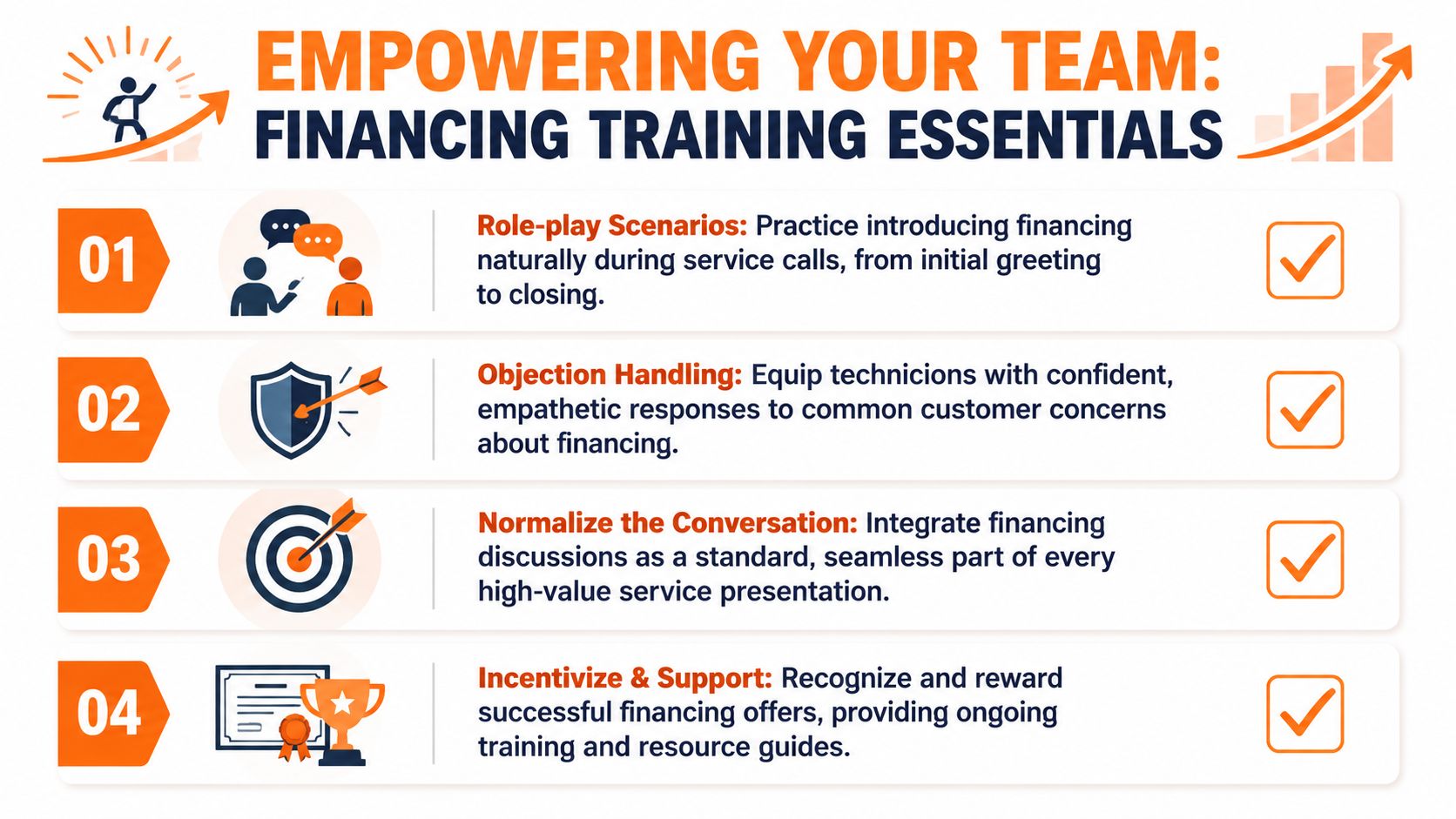
Your message to the team should be blunt:
- You are not making customers spend money they don't need to spend. You're helping them handle necessary work.
- You are not expected to explain every lending detail. You're expected to present available payment options clearly.
- You are not there to judge affordability. You're there to show choices.
- You are expected to offer financing consistently. Not selectively based on guesswork.
A lot of owners create inconsistency by letting techs decide who “looks like” a financing customer. That's a losing habit. Offer it to everyone on qualifying jobs.
Simple scripts that don't sound pushy
Don't ask, “Do you need financing?” That sounds like you're probing for weakness.
Use language that normalizes options.
Here are better scripts:
“We've got a few ways to handle payment, including options that let you spread the cost out. I can show you what that looks like.”
That works because it's calm and matter-of-fact.
Other useful lines:
- When presenting the estimate: “This is the full repair recommendation. If you'd rather not pay the whole amount upfront, we can also look at monthly payment options.”
- When the customer hesitates: “A lot of customers prefer to break up a larger repair instead of paying all at once. If you want, I can pull that up now.”
- When the customer asks if financing is hard: “The process is straightforward. I can walk you through the steps here.”
- When the customer seems embarrassed: “This is a normal option for larger home repairs. You're not the only person who uses it.”
Now add a short training video for your team review and discussion:
If your company is trying to sharpen how the team communicates value more broadly, not just financing, your front-line messaging, reputation, and follow-up all matter. That wider sales environment shapes how confident your techs feel in the home, which is why many owners improve both training and plumbing company marketing systems at the same time.
Role-play the moments that matter
Most training fails because it stays theoretical. You need role-play.
Not long classroom sessions. Short, repeated practice on the exact moments where jobs are won or lost.
Run these scenarios:
The silent pause after price
The customer stops talking and looks uneasy. Train the tech to calmly present payment options without rushing or apologizing.The “we need to think about it” response
Train a follow-up like: “Of course. Before we leave it there, would it help if I showed you the payment options available for this kind of repair?”The skeptical customer
Some homeowners hear “financing” and assume the process will be painful. Train the tech to focus on simplicity and next steps, not product detail overload.The couple with different comfort levels
One wants the repair done now. The other worries about cost. Train the tech to slow down and reframe around options, not pressure.
Coaching note: Don't evaluate a role-play by whether the tech “closed.” Evaluate whether they introduced financing clearly, confidently, and at the right moment.
What to coach after the call
If you want this to stick, review behavior, not just results.
Good post-call coaching questions include:
- Did the tech present financing before or after the objection?
- Did they use simple language or too much financial jargon?
- Did they treat financing as a standard option or a last-ditch save?
- Did they guide the customer through the next step confidently?
You should also give your team a basic estimate checklist:
- Explain the diagnosis first
- Present the recommended solution clearly
- State the total investment plainly
- Offer payment options without waiting for discomfort
- Pause and let the customer react
- Guide the next step
Train consistency, and financing becomes part of your sales system. Skip training, and it becomes another unused feature in the software.
Answering Your Top Questions About Financing
Owners usually hesitate for a handful of predictable reasons. The questions are fair. The mistake is letting them stall implementation.
What if the customer has weak credit
Some will. That doesn't mean you stop offering the option.
What matters is how the partner handles different borrower situations and whether the customer gets a clear answer quickly. Don't promise approval. Don't guess. Don't pre-qualify customers based on appearance, neighborhood, or how they react to price.
Your job is to present the option and let the financing process do its job.
If weak-credit customers are common in your market, ask financing partners hard questions about the application experience and what alternatives exist within their network. The wrong move is sending every customer off on their own to search random credit products under time pressure.
Am I taking on lender risk or legal responsibility
In a typical contractor financing setup, you are offering access to a payment option through a financing partner. You are not turning your plumbing company into a bank.
That said, stay in your lane. Don't make promises about approval. Don't invent payment terms. Don't explain financing details you aren't trained to explain. Present the approved options as provided by the platform, use the lender's materials, and make sure your team follows a consistent script.
Keep your role simple. Diagnose the problem, present the work, show available payment paths, and direct detailed finance questions into the approved process.
Why not just tell them to use a card or get a loan
Because that creates friction at the exact moment you need momentum.
A key issue in plumbing financing is whether emergency repairs are worth financing compared with alternatives like home equity or cash. LendEDU points out that most content lists products such as personal loans, HELOCs, and credit cards but fails to give a decision framework based on urgency, APR, fees, and total repayment, and it also notes that fast funding can be the most expensive option in some cases, as covered in LendEDU's review of plumbing financing options.
That's the point. “Go find money somewhere” is not a process.
For a customer dealing with an urgent repair, contractor financing is often better operationally because it keeps the decision inside the sale. The customer sees the estimate, sees the payment path, gets an answer, and can approve the work without leaving the conversation. That doesn't mean it's always the cheapest option in every scenario. It means it's often the most practical option for getting necessary work approved quickly.
Your role isn't to compare every consumer credit product in the market. Your role is to remove enough friction that the right repair gets done now, not six weeks from now after more damage and more shopping.
If you want more local customers to trust your business before your tech even walks through the door, GrowTradie helps trade businesses stay visible with consistent, professional social content that's created and posted for you. It's a practical way to keep your company active online, build credibility in your area, and turn attention into real enquiries without adding more work to your week.