
Some weeks you're flat out. The phone won't stop. Quotes pile up. You're booking work faster than you can measure it.
Then it goes quiet.
That swing is familiar to a lot of good carpenters. The frustrating part is that your workmanship usually isn't the problem. You can build, install, frame, repair, and finish to a high standard. But great trade work on its own doesn't create a reliable flow of enquiries. If most of your jobs come from old clients, builders you know, or the occasional referral, your pipeline is still fragile.
Carpentry leads get more predictable when you stop treating them like random luck and start treating them like a system. A simple one. Something you build once, tighten up, and maintain while you stay focused on site.
Table of Contents
- Why Great Carpentry Is Not Enough for Consistent Work
- Where Homeowners Actually Look for Carpenters Today
- Building Trust Before You Even Speak to Them
- Paid Options for Turning Up the Volume on Leads
- Turning Enquiries Into Booked Jobs That Pay
- Your Simple System for Consistent Carpentry Work
Why Great Carpentry Is Not Enough for Consistent Work
The feast or famine pattern has a cause
A lot of carpenters build their business backwards. They focus on the work itself, do solid jobs, and assume the next project will come from reputation alone. That can work for a while. Then one builder slows down, one repeat client disappears, or one referral source dries up, and the calendar suddenly opens up in all the wrong places.
That's not a skill problem. It's a pipeline problem.
The carpentry trade is large enough that being good isn't enough to stay visible. The Bureau of Labor Statistics estimated 959,000 carpenters were employed in 2024, with about 74,100 openings projected each year for the next decade, according to the BLS carpenter occupation outlook. In a market that size, plenty of capable operators are competing for the same local jobs.
Practical rule: Referrals are a bonus. They're not a business system.
The hard truth is that word-of-mouth is uneven by nature. It comes in waves. It depends on other people remembering you, mentioning you, and doing it at the exact time someone needs the kind of work you do.
If you specialize, the problem gets sharper. The homeowner looking for custom shelving isn't always looking for the same carpenter as the builder chasing framing support or the client restoring older timber features. When your work is varied, your message can become vague. When your message is vague, people don't know if you're the right fit.
What a lead system actually does
A proper lead system fixes that by doing three jobs at once:
- It keeps you visible when someone starts looking for a carpenter.
- It gives people confidence that you're active, legitimate, and suited to their job.
- It helps you respond properly so the enquiry turns into a booked project.
That system doesn't need to be fancy. It needs to be repeatable.
Consider running a site as a lead carpenter. A lead carpenter is usually a working lead, not just a supervisor. Palomar College's lead carpenter job description describes a role that assigns work, monitors progress against deadlines, checks standards and code requirements, and still performs the carpentry itself. The same logic applies in business. You need a method. Review what's coming in. Decide what fits. Prepare properly. Check the result. Then move to the next stage.
That's what separates random enquiries from reliable carpentry leads. You stop hoping work appears and start making it easier for the right clients to find, trust, and hire you.
Where Homeowners Actually Look for Carpenters Today
Most searches start before the phone call
Homeowners don't wait until they're fully ready to book before they start comparing trades. Many begin much earlier. They browse ideas, save inspiration, compare project styles, and shortlist local businesses before anyone gets a call.
The way customers find trades is changing. Many now use platforms like Houzz to plan projects and research carpenters before they even decide to request a quote, as explained on Houzz Pro for carpenter leads. If you only show up when someone is ready to buy immediately, you miss the planning stage where trust often gets built.
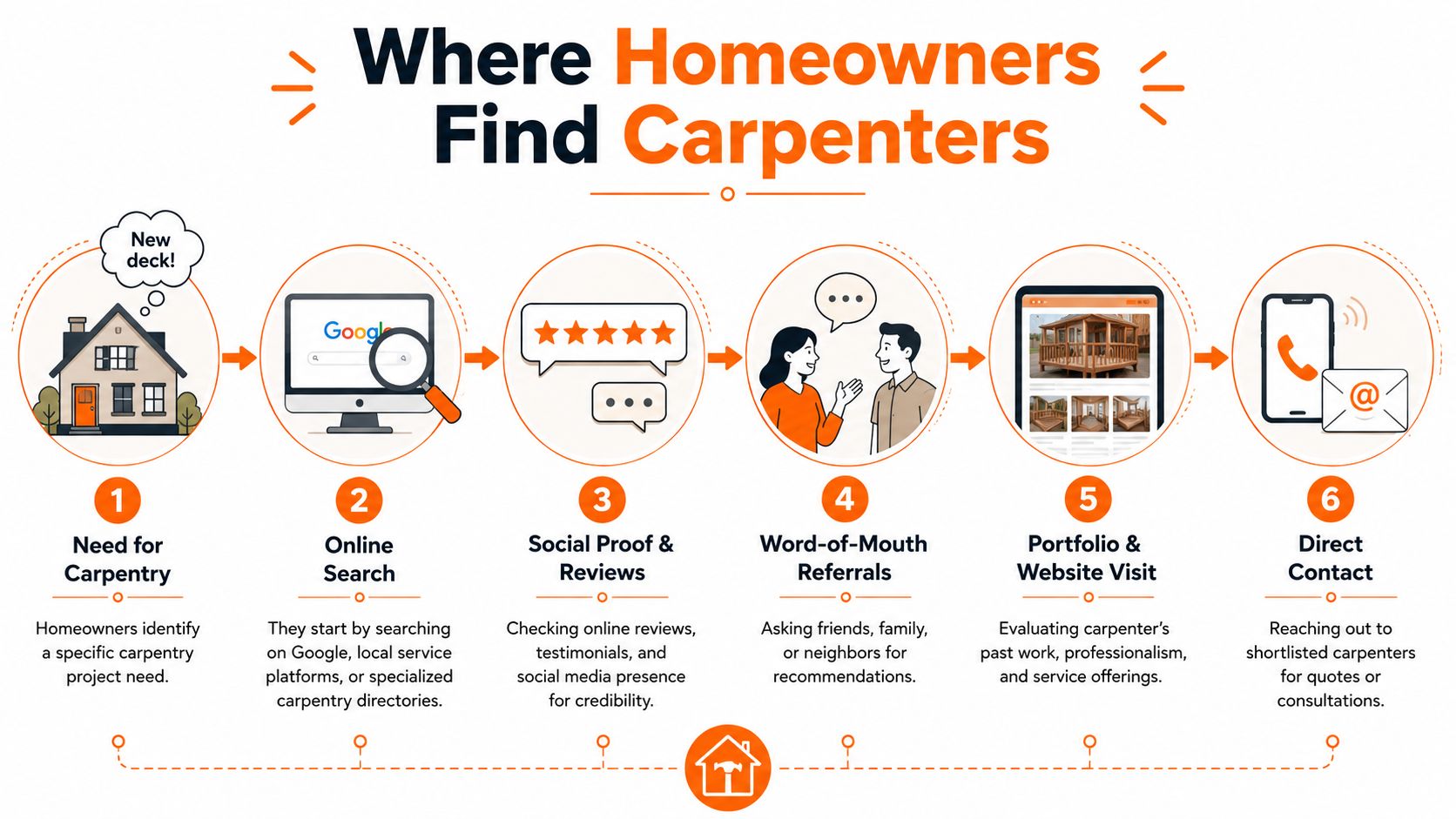
Most homeowners use a short path that looks like this:
- They realise they need a job done. A deck needs replacing. Cabinets need building. A room needs framing.
- They search locally. Often on Google and Google Maps.
- They compare quickly. Photos, reviews, service areas, and how professional the business looks.
- They shortlist two or three options.
- Then they make contact.
By the time your phone rings, they've often judged you already.
What your local presence needs
If you want stronger carpentry leads, start with the assets people check.
A solid Google Business Profile matters because it often becomes your first impression. Keep your business name, phone, service area, and hours accurate. Add photos that show finished work clearly. Not just wide shots either. Include detail shots of joins, trim, fit-out quality, stair work, decking lines, cabinetry finishes, and whatever else reflects your actual specialty.
Your website matters too, but it doesn't need to be clever. It needs to be clear. A homeowner should be able to land on it and know three things fast: what you do, where you work, and how to contact you.
Use service pages or sections that match how people think about jobs, such as:
- Finish carpentry for trim, skirting, doors, and detailed internal work
- Decking and outdoor timber work for external projects
- Framing and structural carpentry for larger build-stage work
- Cabinetry and built-ins for storage and fitted solutions
- Restoration and repair work for older homes and timber repairs
If someone can't tell whether you handle their type of job, they won't call to find out.
Reviews carry weight too. Ask for them after a good handover, not months later. A short, genuine review from a real client does more than a polished sales line.
If you need help tightening your online local presence, this guide on local visibility for contractors is a practical starting point.
Building Trust Before You Even Speak to Them

People judge your business fast
Getting found is only half the job. Once someone lands on your profile, socials, or website, they make a snap decision about whether you seem current and credible.
A neglected online presence creates doubt. Old photos. Empty profiles. Last post from ages ago. No sign of recent work. Even if you're busy and highly capable, the customer can't see that. They only see silence.
That matters more now because competition has grown. ADP Research reported that construction employment grew 13% since January 2020, more than double the 6% growth in U.S. job creation overall, as cited in the construction workforce summary on Zippia. More businesses in the market means more businesses trying to win the same attention.
Trust gets built from small signals. Not slogans. Signals.
Here are the ones that usually matter most:
- Recent project photos that show the type of work you want more of
- Clear descriptions of your services and service area
- Consistent activity so people know you're still operating
- Real reviews that mention reliability, communication, and workmanship
- Professional contact details that are easy to find
Consistency beats occasional effort
A lot of tradies treat online activity like a burst job. They post heavily for a week, then disappear for months. That pattern doesn't help much. Customers don't see your effort. They see the gaps.
Steady activity works better. A stream of project updates, finished jobs, before-and-after photos, workshop progress, and practical homeowner tips tells people you're active and engaged in your trade. It also gives them more chances to connect your name with the kind of work they need.
A quiet profile often looks like a quiet business, even when you're booked solid.
Systems save time. If writing captions, choosing images, and remembering when to post keeps getting pushed aside, use a tool that handles the routine side of it. GrowTradie is one option. It creates trade-specific posts, designs them, and auto-posts them so your profiles stay active without you needing to sit down every week and write everything manually. If you want to understand that approach better, this article on content systems for contractors lays it out.
The point isn't to look busy for the sake of it. The point is to remove doubt. When a homeowner compares three carpenters, the one who looks current usually feels safer to contact.
Paid Options for Turning Up the Volume on Leads
The main paid channels compared
Once your basic visibility and trust pieces are in place, paid lead sources can help fill gaps or push growth. They're not a substitute for your foundation. They're an amplifier.
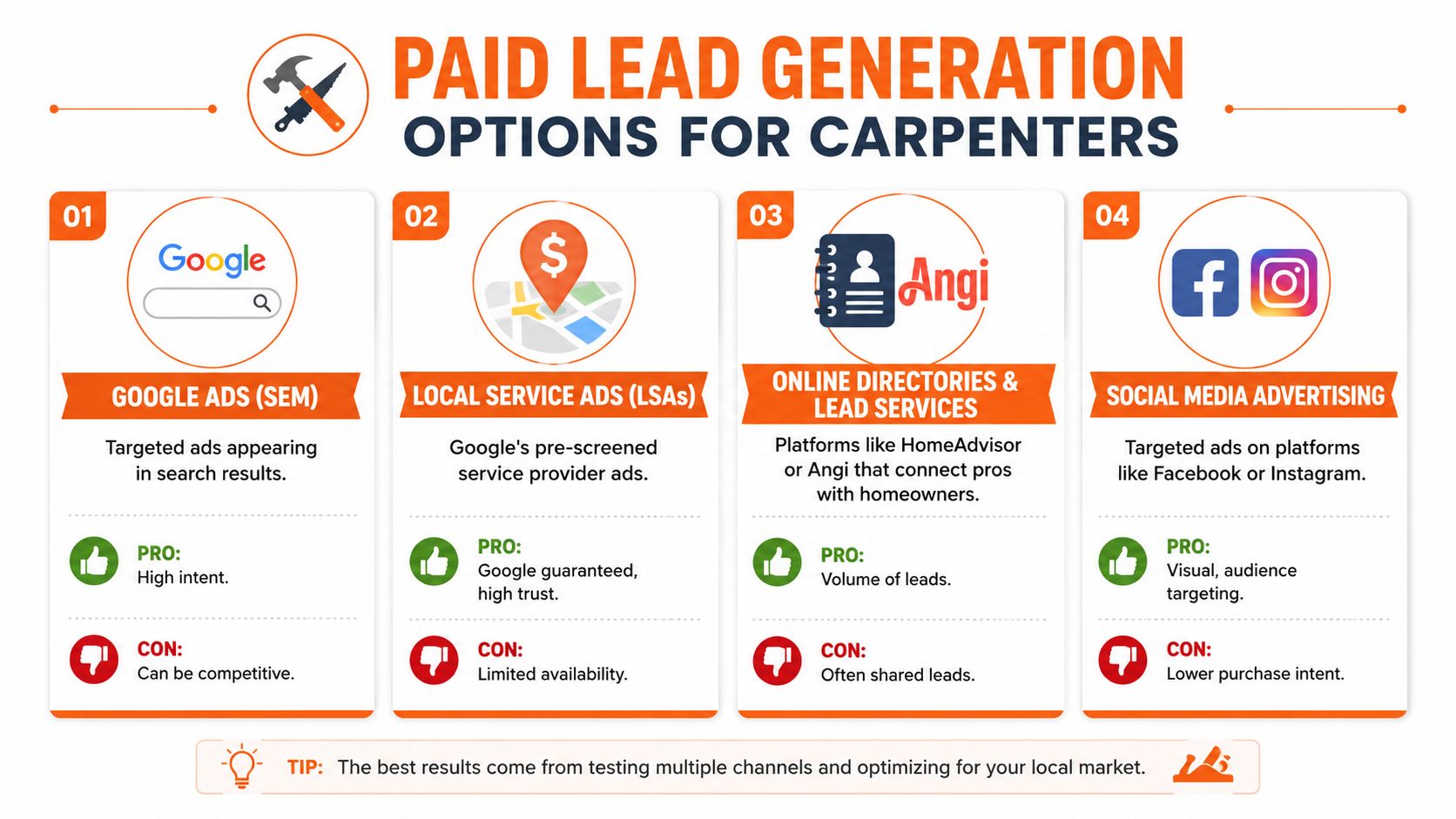
Different paid channels behave differently. Here's the practical trade-off.
| Option | How it usually works | Strength | Weak point |
|---|---|---|---|
| Google Local Services Ads | You pay for leads rather than clicks | Strong trust signal and high intent | Availability and setup can vary by area and trade |
| Google Ads | You pay when someone clicks | Good for targeted searches tied to specific jobs | Can burn money fast if the campaign is loose |
| Lead platforms | You buy or receive leads from a third-party marketplace | Quick access to volume | Leads may be shared with multiple competitors |
| Social media ads | You pay to push your work in front of local audiences | Useful for visual services like decks, built-ins, and fit-outs | People may not be ready to hire yet |
No option is perfect. That's the point.
If you want stronger intent, search-based ads are usually closer to a buying decision. If you want awareness for visual project types, social media can put your work in front of the right households. If you need immediate enquiry flow, lead marketplaces can help, but you'll often need to move faster and qualify harder because the same lead may be shopping around.
When paid leads make sense
Paid channels work best when you know your target job types.
For example, if you want more deck builds, custom storage, or finish carpentry, your message should show those exact services. Sending generic ads for “all carpentry work” usually pulls in mixed enquiries. Some fit. Some don't. Some are tiny repair jobs when you're trying to book larger projects.
Use paid options when:
- Your calendar has a gap and you need more enquiries now
- You want more of one service type rather than random jobs
- You've already fixed your basics such as profile quality and response process
- You're willing to track quality instead of judging campaigns by raw lead count
Don't buy more traffic into a weak sales process. Fix the leak first.
That's the mistake many carpenters make. They pay to get the phone ringing, then miss calls, reply late, or send vague quotes. The issue wasn't the ad. The issue was what happened next.
Turning Enquiries Into Booked Jobs That Pay
A lot of carpentry leads are lost in the first contact. Not because the customer chose a cheaper quote. Because nobody handled the enquiry properly.
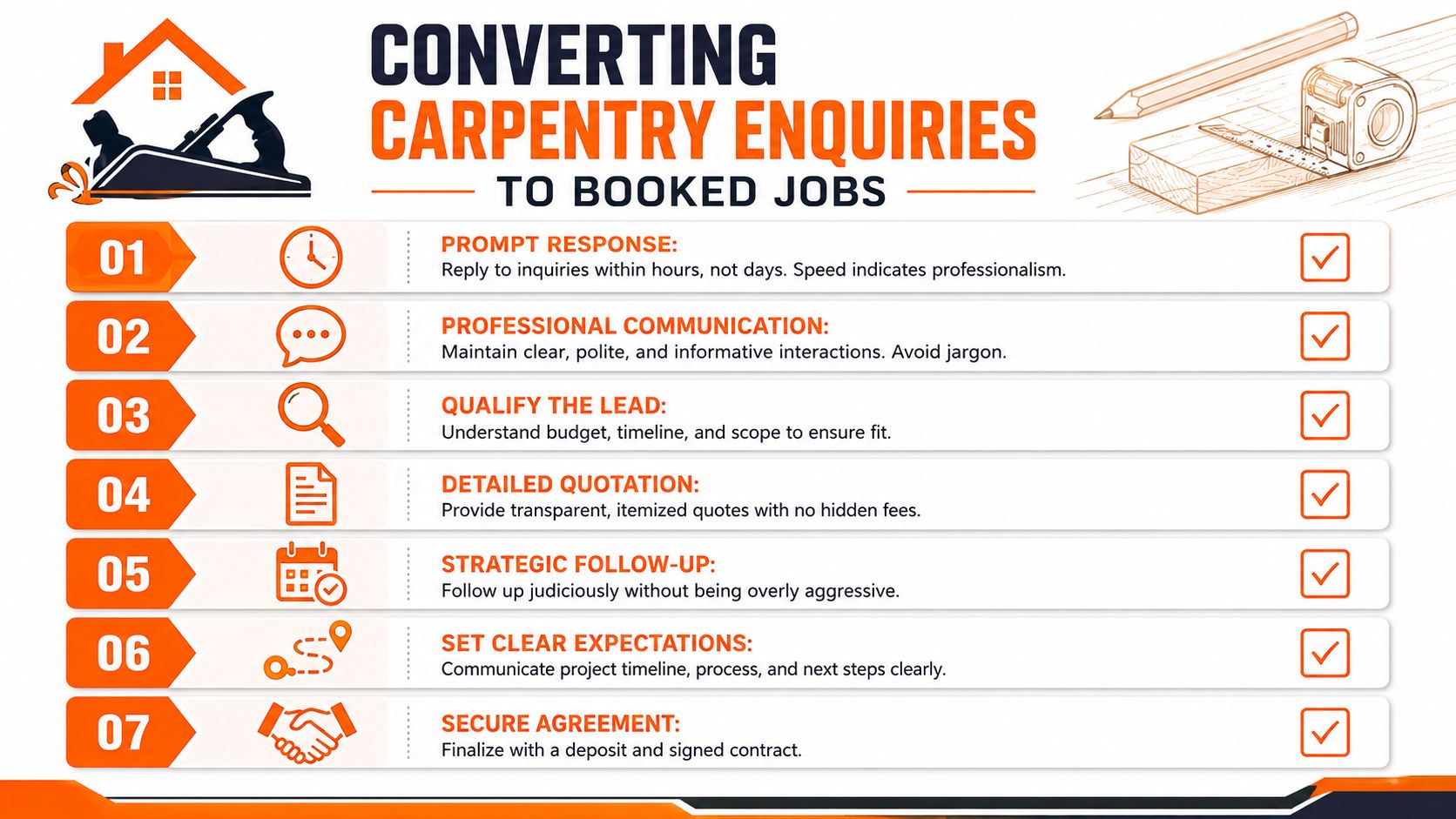
Speed matters. So does tone. If you sound rushed, unclear, or half-interested, the client keeps calling down the list.
Handle the first contact like a pro
You don't need a polished call centre script. You need a reliable structure.
A simple phone answer works well:
“Hi, [business name], [your name] speaking. How can I help?”
Then gather the basics before talking price. Keep it conversational, but don't wing it. Capture:
- Name and best contact details
- Suburb or job location
- Type of work needed
- Whether plans or photos are available
- When they want the work done
- How they found you
That last one matters because it tells you which lead sources are working.
If they ask for a price immediately, don't trap yourself. Many carpentry jobs can't be priced properly in the first minute. Say something like:
“Happy to help. I'll need to understand the scope properly first so I don't give you a number that's off.”
That answer sounds professional because it is professional.
Here's a useful rule. Small, standard jobs can sometimes be guided quickly. Custom, structural, or detail-heavy work usually needs photos, plans, measurements, or a site visit before you quote with confidence.
A quick refresher can help here:
Quote clearly and move to the next step
The quote process is where a lot of jobs stall. Not because your pricing is wrong, but because the next step is fuzzy.
Send quotes that are easy to understand. Break out what's included. State assumptions. Mention materials, labour, exclusions, and timing in plain language. If a customer has to guess what they're approving, you've left room for hesitation.
Use a follow-up process that feels organised, not pushy:
- Acknowledge the enquiry quickly. Even if you can't quote that moment.
- Set the next action. Site visit, photo review, or plan check.
- Send the quote when promised. If timing changes, tell them.
- Follow up once the quote has had time to be read.
- Ask for the decision directly. Don't leave the job sitting in limbo.
The carpenter who communicates clearly often beats the carpenter who only talks about workmanship.
That might sting, but it's true in the field. Clients read responsiveness as reliability. If you show them you're structured before the job starts, they assume the job itself will run the same way.
Your Simple System for Consistent Carpentry Work
The three-part playbook
Reliable carpentry leads come from a chain, not a trick.
First, be easy to find. Show up where local clients are already looking. Make your services clear. Show the kind of work you want more of.
Second, be easy to trust. Keep your photos current. Keep your profiles active. Make sure your business looks alive and professional even when you're busy on site and not thinking about promotion.
Third, be easy to hire. Answer properly. Qualify fast. Quote clearly. Follow up without drifting.
That's the whole system. Not glamorous, but effective.
If your work pipeline feels inconsistent, don't try to fix everything at once. Tighten one part this week. Update your profile. Ask for reviews. Sort your photo library. Write out your phone process. Build from there.
If you want a broader view of how this fits into running the trade, this guide on building a stronger carpentry business is worth a read.
The goal isn't endless marketing activity. It's fewer dry spells, better-fit jobs, and a business that doesn't depend on luck to stay booked.
If you want help keeping your business visible without having to think up posts after a long day on the tools, GrowTradie gives tradies a simple way to keep their profiles active with trade-specific content and auto-posting. It's a practical option if you want your online presence to keep working while you focus on the jobs themselves.