
You're probably seeing the same frustrating pattern a lot of self-employed contractors hit. The jobs look decent on paper, money is moving through the business, and yet your personal pay still feels lower than it should. That gap usually isn't about working harder. It's about understanding what part of the money is revenue, what part is cost, and what part is yours.
That's why the usual salary articles don't help much. They throw out one national number, but they don't explain why two contractors with similar sales can end up with very different take-home pay. A real self employed general contractor salary isn't just a wage. It's the result of pricing, job selection, overhead control, and how you pay yourself from the company.
Table of Contents
- Understanding Your True Earning Potential
- What Is the Average Self Employed General Contractor Salary
- Key Factors That Determine Your Contractor Income
- Gross Revenue vs Net Income What You Actually Keep
- How to Calculate Your Hourly Rate and Price Jobs
- The Smart Way to Pay Yourself Salary vs Distributions
- Building a Business That Pays You Well
Understanding Your True Earning Potential
A lot of contractors use the word salary when they really mean three different things at once. They mean what the business brings in, what they transfer to themselves during the month, and what they keep after job costs and overhead. Mixing those together is where the confusion starts.
If you're self-employed, no one hands you a set paycheck and benefits package. Your income comes from a chain of decisions. You choose the jobs, set the pricing, manage the schedule, hire subs, control waste, and deal with rework when something slips. The business pays you only after all of that plays out.
Practical rule: Don't judge your income by contract value. Judge it by what remains after direct job costs, operating expenses, taxes, and owner pay structure.
That's also why one contractor can stay busy all year and still feel underpaid, while another runs fewer jobs and takes home more. The difference usually comes down to business discipline, not just field skill.
A better way to think about your earning potential is to look at four layers:
- Work won: The type and volume of projects you secure
- Gross margin: What's left after labor, materials, and subs tied to the job
- Overhead control: Insurance, vehicles, software, office costs, licensing, and downtime
- Owner compensation: How you separate business profit from personal pay
When you understand those layers, the self employed general contractor salary question gets easier to answer. You stop asking, “What do contractors make?” and start asking, “What does my current business model allow me to keep, and what has to change if I want more?”
That's the shift that matters. Income stops being a mystery and becomes something you can measure, improve, and protect.
What Is the Average Self Employed General Contractor Salary
A contractor closes a $400,000 year and still ends up stressed about cash. Another closes far less revenue and takes home more. That gap is why the word salary can mislead self-employed contractors.
For owner-operators, salary is often used as shorthand for annual earnings. In practice, what you get paid may come from a mix of payroll, owner draws, and profit left after overhead, taxes, and cleanup from bad jobs. If you hold a license that lets you pull permits and run larger work, that can raise your earning range, but only if the business side keeps up. The requirements behind a general contractor license matter because they affect the type of work you can legally pursue and the size of jobs you can control.
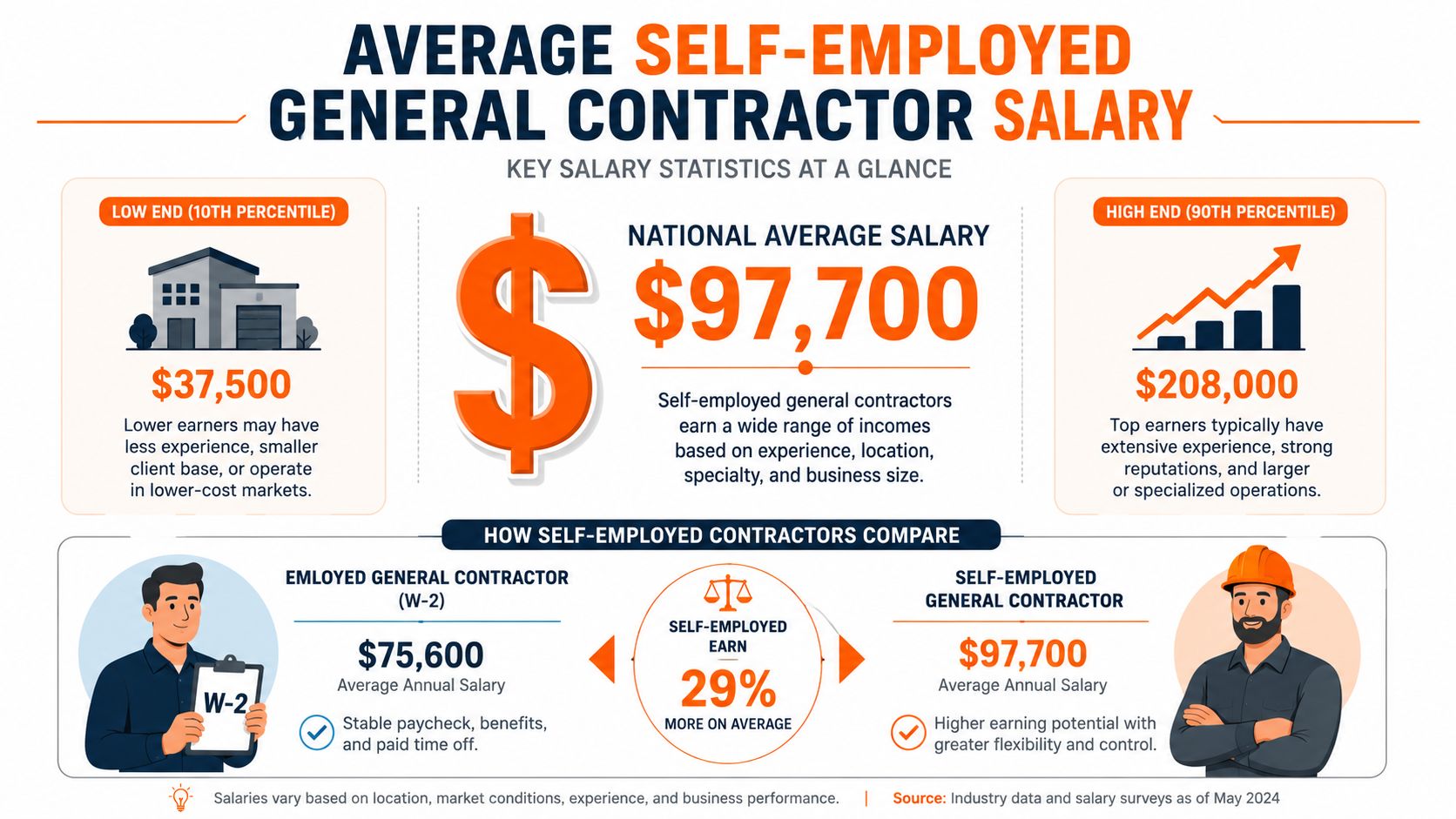
The useful answer is this. There is no single average that tells you what a self employed general contractor should personally keep. National salary data can give you a rough reference point, but it cannot tell you whether your business model is healthy.
That matters because self-employment pay is not built like a W-2 job. An employed contractor usually sees one number on a pay stub. A self-employed contractor has to separate three different numbers:
- Revenue from signed and completed work
- Salary or owner pay taken through payroll or draws
- Profit left in the business or distributed after expenses
Plenty of contractors blur those lines. They call gross receipts income, use the business account like a personal checking account, and end up with strong sales but weak take-home pay. This explains why national averages fall short. They compress very different business setups into one number.
A better benchmark is your own operation. Ask whether your pricing leaves enough gross margin, whether overhead is under control, and whether your pay method matches how the company is taxed. A remodeling contractor with a small office, steady referral work, and reliable subcontractors may keep far more than a contractor doing higher revenue with messy scheduling, change order disputes, and constant callback costs.
The upside is real. There is no fixed pay band if you build a disciplined company. The downside is just as real. If estimating is loose and overhead keeps creeping up, more jobs can create more stress without improving what you keep.
Use salary averages as a rough market reference only. Judge your business on take-home pay, retained profit, and consistency across the year. Those are the numbers that show whether the company is paying you well.
Key Factors That Determine Your Contractor Income
A self-employed GC can book a full calendar and still feel underpaid. Another can run fewer jobs, keep tighter controls, and take home more at year end. The difference usually comes from a handful of operating choices that shape what the business can produce for the owner.

Location matters, but local economics matter more than a broad state average. Two contractors in the same state can have very different income depending on permit friction, inspection delays, labor availability, commute times, customer budgets, and how competitive bidding is in their county or metro area.
Location changes your pricing room and your cost structure
Higher-priced markets give you access to larger contracts and clients who are used to professional markups. Those markets also come with expensive labor, stricter compliance, higher insurance costs, and less tolerance for delays or sloppy communication.
Rural and lower-demand areas create a different problem. Contract values are often smaller, travel time eats into production, and it is harder to spread overhead across enough profitable work.
The practical question is not whether your market is good or bad. It is whether your rates match your local cost structure and whether your job mix supports the income you want.
Reputation affects income faster than years in business
Years of experience help, but reputation is what gives you pricing power. Clients pay more comfortably when they trust the process, not just the craftsmanship. Clean scopes, realistic schedules, organized selections, documented change orders, and consistent updates reduce perceived risk. Reduced risk supports better pricing.
That is why some newer contractors out-earn veterans. They run a tighter sales and production process.
In the field, reputation usually shows up as business advantages like these:
- Higher close rates on good-fit jobs
- More referral work that costs less to acquire
- Less price resistance during sales conversations
- Fewer disputes caused by vague scopes or poor documentation
Contractors rarely stay underpaid because they lack technical skill alone. They stay underpaid because their operation leaves too much uncertainty in the estimate, the schedule, or the client experience.
Licensing and specialization change which jobs you can pursue
Licensing affects more than compliance. It affects credibility, the size of projects you can legally manage, and who will trust you with the contract in the first place. If you are sorting out the rules in your area, this guide on what a general contractor license is gives a solid starting point.
Specialization often has an even bigger impact on income. A contractor known for kitchens, additions, insurance restoration, tenant improvements, or complex structural remodels usually has a clearer sales message than a contractor advertising every service under the sun. Clear positioning attracts better-fit leads. Better-fit leads are easier to estimate, easier to sell, and usually more profitable to deliver.
There is a trade-off. Specialization can narrow the pipeline if the market is small or seasonal. Generalists get more inquiry volume, but they often compete harder on price and deal with more estimating variability.
Your systems determine whether growth turns into owner pay
Many self-employed contractors often misread their own numbers. More work only improves income if the company can estimate accurately, schedule cleanly, collect change orders, and keep callbacks under control. Without those systems, added volume creates more cash stress, more supervision problems, and more revenue that never becomes real take-home pay.
Watch the operating habits behind the income:
- Estimate accuracy. Small misses on labor, material waste, or subcontractor scope add up fast.
- Change order discipline. Unbilled extras come straight out of your profit.
- Project management quality. Missed handoffs and weak scheduling create delays that eat margin.
- Overhead control. Trucks, software, office staff, rent, and insurance have to be supported by consistent gross profit.
- Collection speed. Slow receivables force the owner to finance the job.
A contractor who understands these levers has a much clearer path to strong personal income. The business stops being measured by top-line activity and starts being measured by what it produces for the owner.
Gross Revenue vs Net Income What You Actually Keep
The biggest mistake contractors make with money is treating gross revenue like personal income. It isn't. Revenue is the top line. Your pay lives much further down the chain.
That matters because revenue can create a false sense of success. You can run a large book of work, stay busy, and still end up with weak owner pay if too much money leaks out through bad estimating, disorganized purchasing, avoidable callbacks, or overhead that's growing faster than your profit.
Why revenue creates false confidence
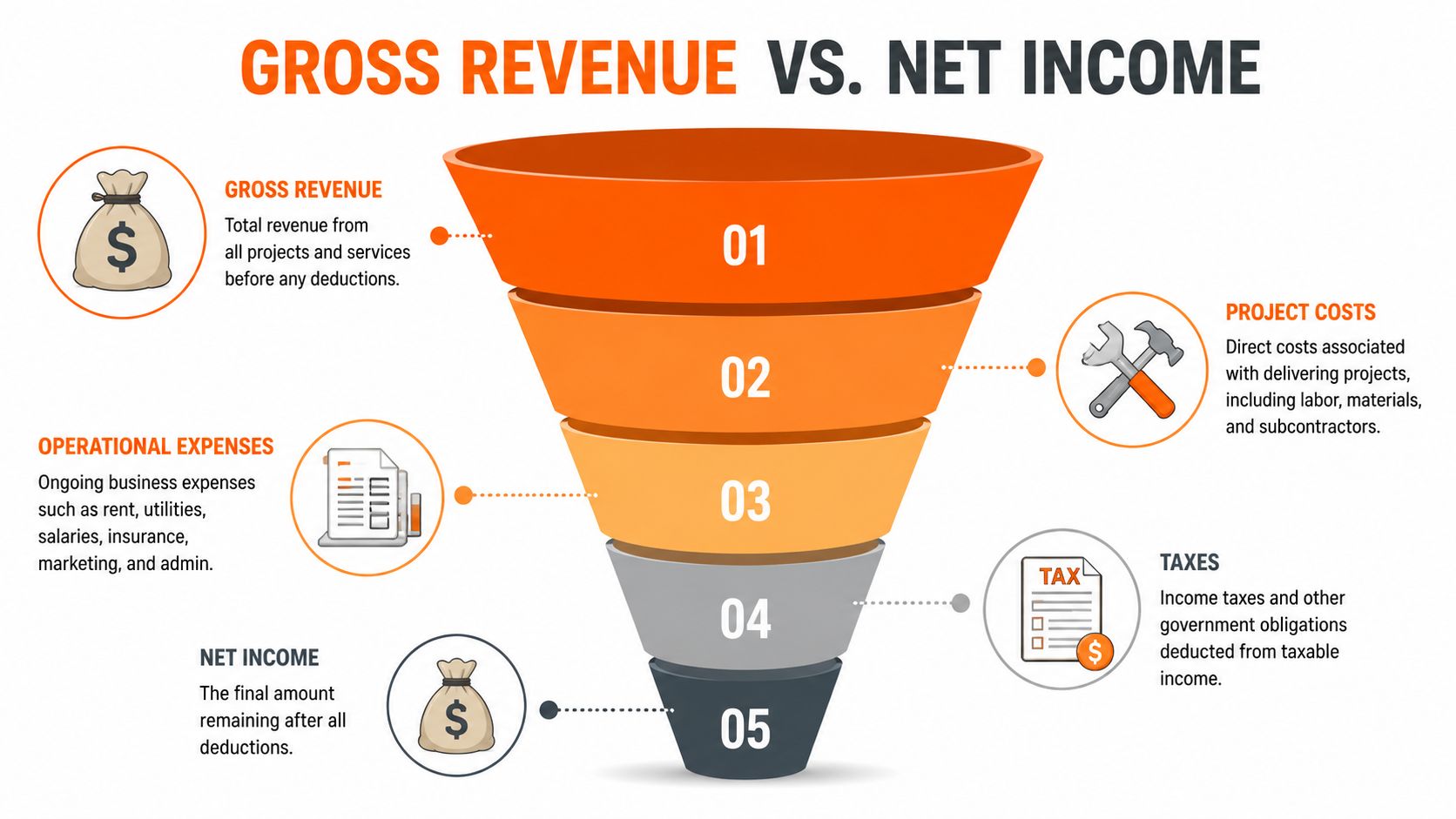
A signed contract feels like money earned. It's not. First, the project has to absorb labor, materials, subcontractors, and all the mess that comes with execution. Then the business has to cover fixed operating costs. Only after that do you get to see what the job really produced for you.
On a typical $250,000 residential remodel, 70 to 80% of the contract price passes through to subcontractors, materials, and overhead, leaving the owner's take-home to come from the remaining 20 to 30% margin, which is then split between salary and distributions after taxes, according to Built Right's breakdown of contractor income on remodel projects.
That single example explains why so many busy contractors still feel cash-starved. The contract amount is never the paycheck.
A simple money trail for one job
Think through a project in this order:
Client pays the contract amount
That's gross revenue entering the business account.Direct project costs get paid
Materials, subcontractors, equipment tied to the job, and site-specific labor come out first.Operating costs continue in the background
Insurance, vehicles, phones, software, office expenses, licensing, and admin don't stop just because one project is running well.Taxes and owner compensation come later
What remains is what can support your pay, retained earnings, and future growth.
If your bookkeeping doesn't make that trail obvious, you'll keep making emotional decisions from the bank balance. That usually leads to overpaying yourself during busy months and getting squeezed during slower ones. Tight financial reporting matters more than most contractors want to admit. Even if the example is from another trade, the discipline in bookkeeping for a plumbing business applies directly to a GC operation.
Your bank balance can lie to you. A proper job-costed profit view usually doesn't.
A contractor who understands this distinction stops celebrating revenue and starts protecting margin. That change alone improves owner pay because it forces better decisions on purchasing, scheduling, and which jobs are worth taking in the first place.
How to Calculate Your Hourly Rate and Price Jobs
Most contractors undercharge for one reason. They build their rate from memory instead of from costs. If you came out of a W-2 role, the old hourly wage in your head is almost always too low for self-employment.
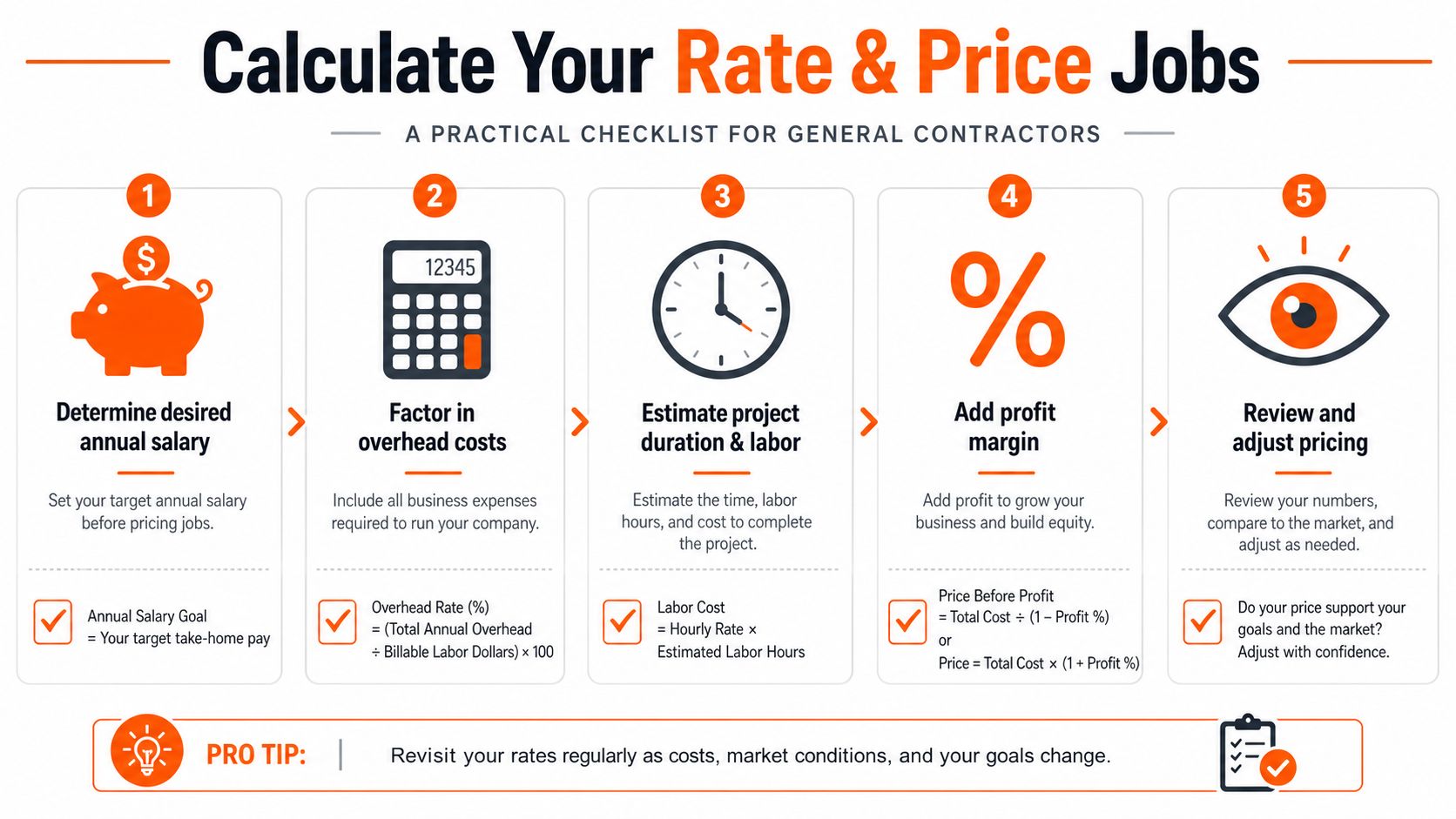
Use this pricing graphic as a quick reference before you quote work.
Use a multiplier if you came from a wage job
A practical shortcut is the rate multiplier. Experts recommend 1.4x to 1.6x for new contractors to cover self-employment taxes, health insurance, retirement, and overhead. That means a $50 per hour employee rate should become roughly $70 to $80 per hour as a contractor to hold the same net value, based on GetFigured's contractor hourly rate guidance.
Your old employer covered costs you now have to fund yourself. Once you're self-employed, your rate has to carry more than labor. It has to support the business around the labor.
A bare-bones way to use the multiplier looks like this:
- Start with your former hourly wage: Use your actual number, not what you wish it was
- Apply the multiplier: If you're newer and still lean, start near the lower end. If your overhead is heavier, move higher
- Pressure-test the result: If the market won't support that rate, the problem may be your service mix or job targeting, not the math
For more trade-specific thinking on quote building, this guide on how to price a painting job shows the same logic in action.
Build project pricing from the bottom up
Hourly billing can work for small, open-ended tasks, but most general contractors need a job-pricing method that protects margin before the work begins. A simple cost-plus approach is usually far safer than guessing.
Use this sequence:
| Pricing step | What to include |
|---|---|
| Direct costs | Materials, subcontractors, site labor, equipment, permit-related job costs |
| Overhead allocation | Vehicles, admin, insurance, software, phones, supervision, tools not assigned to one job |
| Desired owner pay | What the business must produce to support your compensation |
| Profit buffer | Room for risk, mistakes, and retained earnings |
Here's where contractors get into trouble. They estimate direct costs reasonably well, then ignore unpaid time for sales calls, estimating, revisions, site visits, and client communication. That unpaid time is still labor. If it's not built into your rate or job price, you absorb it personally.
Later, when you want a second opinion on markup logic, use resources like the embedded walkthrough below to compare your method against a more structured quoting approach.
Field check: If winning a job feels like relief instead of confidence, your price is probably too low or your scope is too loose.
The best pricing systems don't try to be clever. They make sure every quote accounts for real labor, real overhead, and a real return for the owner.
The Smart Way to Pay Yourself Salary vs Distributions
Once your business starts producing consistent profit, another question shows up. How do you take the money out in a clean, sustainable way? A lot of contractor salary advice falls apart because it treats owner pay like a single paycheck.
For many GC owners, it isn't one number. It's two. There's the payroll side, and there's the owner-profit side.
Why owner pay is not the same as payroll
For GC owners with $1M to $3M in revenue, a reasonable W-2 salary might be $90,000 to $120,000, while total cash compensation made up of salary plus profit distributions can range from $150,000 to $250,000 in a good year, according to Level CFO's contractor owner compensation analysis.
That distinction matters because many owners compare themselves to salary surveys that only capture payroll. Those surveys miss what the business owner may receive through distributions after taxes and operating costs. If you only look at the W-2 figure, you can badly underestimate what a well-run company is producing for the owner.
What works better than draining the account
The worst owner-pay system is random draws based on whatever cash happens to be sitting in the bank. That approach feels flexible, but it causes confusion fast. You can't tell whether the business is performing well, whether your pay is sustainable, or whether you've already spent money needed for tax obligations or future job costs.
A more disciplined structure usually looks like this:
- Set a consistent salary: Treat your work inside the company as a real operating cost
- Take distributions from actual profit: Only after the business has produced them
- Review with a CPA: Especially if you're using an S-Corp structure and need a reasonable salary
The cleanest contractor finances separate the job of employee from the role of owner.
This doesn't mean every contractor needs the same entity setup right away. It means you should stop treating personal spending and company profit as the same thing. When those are separated, you get clearer books, steadier cash flow, and a more honest view of your self employed general contractor salary.
Building a Business That Pays You Well
A strong self employed general contractor salary isn't something you stumble into. You build it through pricing discipline, tighter job control, and a pay structure that matches how an owner is compensated.
Contractors who earn well over time usually do a few things consistently. They stop chasing revenue for its own sake. They know which jobs fit, which clients are costly, and which parts of the business need systems instead of more hustle.
That's the fundamental shift. You're not only selling labor or supervision. You're running a company that has to produce margin, protect cash, and create reliable owner income. When that machine gets better, your pay gets better with it.
Don't aim to match an average. Build a business that makes the average irrelevant.
If you want more of the right people seeing your business consistently, GrowTradie helps trade businesses stay visible without having to write posts, design graphics, or remember to publish between site visits. It's a practical way to keep your name in front of local customers, build trust over time, and support the kind of steady enquiry flow that makes better pricing and stronger margins easier to hold.