
One week the bank account looks solid. The next week you're delaying a supplier payment, chasing two overdue invoices, and wondering how a busy month still feels tight. Most plumbers know that feeling.
The usual setup is messy. Receipts are in the ute, parts get bought from three different suppliers, labour hours live in someone's head until payroll, and the books only get attention when tax time starts breathing down your neck. That isn't a bookkeeping problem. It's a visibility problem.
Good bookkeeping for a plumbing business isn't just about keeping the tax office happy. It's about knowing which jobs make money, which ones only keep the crew busy, and where cash disappears before you notice it. If your system can't tell you that quickly, it's too weak for the way plumbing work runs.
Table of Contents
- Why Your Plumbing Bookkeeping Needs a System
- Setting Up Your Bookkeeping Foundation
- The Core Workflow for Job-by-Job Profitability
- Your Bookkeeping Rhythm for Tax and Cash Flow
- DIY Bookkeeping vs Hiring a Professional
- Common Plumbing Bookkeeping Questions
Why Your Plumbing Bookkeeping Needs a System
A lot of plumbing businesses don't have a bookkeeping system. They have a pile of transactions and a hope that it all sorts itself out later.
That works for a while when you're small, especially if you're doing most of the work yourself and the jobs are straightforward. But once you've got multiple service types, techs on the road, supplier accounts, payroll, callbacks, and jobs that stretch over more than a day, rough bookkeeping starts lying to you.
A common example is this. Emergency callouts look busy. Renovation work brings in larger invoices. Maintenance work fills gaps. On paper, the month can look fine. But if you can't separate each type of work properly, you won't see that one service line keeps chewing through labour, travel, and parts while another steadily supports the business.
Practical rule: If your books only show income and expenses by month, but not by job or service type, you're still guessing.
That's why bookkeeping for plumbing business owners needs to be built as an operating system, not an end-of-year chore. You need a setup that shows what happened on each job, what's still unpaid, what parts were used, what labour really cost, and whether the quote was right in the first place.
There's also a bigger business reason to get this under control. If you ever want a clearer view of what the business is worth, weak books make that harder. A proper plumbing business valuation guide starts with clean records, dependable job data, and reports that show how profit is produced.
The upside is simple. Once the books are organised around the job, decisions get easier. You stop pricing from memory. You stop being surprised by cash flow. And you stop mistaking activity for profit.
Setting Up Your Bookkeeping Foundation
A strong bookkeeping system starts before the first transaction gets coded. If the setup is generic, the reporting will be generic too. That's the trap a lot of plumbers fall into when they open Xero or QuickBooks Online and leave the default accounts mostly untouched.
Build the books around how plumbers actually work
Plumbing businesses don't earn and spend money the same way as a retail shop or a generic service company. You've got direct job costs, vehicles, supplier purchases, field labour, subcontractors, permits, and small purchases that happen fast while someone's on the road.
Your foundation needs four things in place from the start:
- Separate business money: Keep business banking separate from personal spending. If those mix, every reconciliation takes longer and every report becomes less trustworthy.
- Connected bank and card feeds: Link your business bank accounts and cards to your accounting software so transactions flow in automatically. Manual entry creates backlog and missed items.
- A plumbing-specific chart of accounts: Broad categories like “materials” or “expenses” aren't enough once you want useful reports.
- A job or customer tracking structure: Every transaction that belongs to a job needs somewhere to land.
Clean bookkeeping starts with structure, not discipline. If the setup is poor, even a hardworking owner will end up with messy books.
Sample Chart of Accounts for a Plumbing Business
Below is a practical starting point. You can adjust account names to fit your services, but don't make the list so broad that you lose detail.
Sample Chart of Accounts for a Plumbing Business
| Account Type | Account Name | Example Usage |
|---|---|---|
| Income | Service Calls Income | General repair and callout invoices |
| Income | Installation Income | Water heater, fixture, and system installation work |
| Income | Renovation Income | Bathroom, kitchen, and larger fit-out work |
| Cost of Goods Sold | Materials Rough-in | Pipe, fittings, valves used during rough-in work |
| Cost of Goods Sold | Materials Fixtures | Taps, fixtures, toilets, basins, visible finishes |
| Cost of Goods Sold | Labour Direct | Wages tied directly to jobs |
| Cost of Goods Sold | Labour Burden | Payroll on-costs attached to direct labour |
| Cost of Goods Sold | Subcontractor Costs | External trades or specialist support on jobs |
| Cost of Goods Sold | Permits and Compliance | Permit costs tied to specific jobs |
| Cost of Goods Sold | Equipment Rentals | Temporary hire equipment used on jobs |
| Cost of Goods Sold | Travel and Fuel Job Related | Travel tied to service calls and site visits |
| Expenses | Vehicle Expenses | Registration, maintenance, tyres, servicing |
| Expenses | Software Subscriptions | Xero, QuickBooks Online, receipt apps, field apps |
| Expenses | Insurance | Business, vehicle, and liability cover |
| Expenses | Office and Admin | Phones, internet, stationery, admin tools |
| Expenses | Training and Licensing | Renewals, tickets, and trade training |
| Assets | Tools and Equipment | Larger tool purchases kept on the balance sheet |
| Liabilities | Sales Tax Payable | Tax collected and owed to the authority |
| Liabilities | Payroll Liabilities | Withheld payroll amounts and related obligations |
A chart like this does two jobs. First, it keeps coding consistent. Second, it gives you reports that mean something when you review them.
Choose software that reduces double handling
For most plumbing businesses, Xero and QuickBooks Online are practical options because they're cloud-based, widely supported, and work well with bank feeds. The better choice usually comes down to what your bookkeeper knows well, what payroll setup you need, and what field service app you already use.
If you also use a job management platform, the key question isn't which app has the nicest dashboard. It's whether quotes, invoices, job notes, timesheets, and expense data move cleanly between systems. If the office has to re-enter the same information in two places, errors will creep in.
A smart way to compare options is to look at purpose-built apps for plumbing business operations and map out where quoting, scheduling, invoicing, and bookkeeping connect. The best stack is the one your team will use correctly in the field.
Set user permissions carefully too. Techs should be able to log hours, attach receipts, and allocate purchases without seeing sensitive financial reports. That keeps the process simple for them and safer for you.
If you get this foundation right, the day-to-day bookkeeping gets lighter. More important, the numbers start reflecting the shape of the business instead of a rough summary at month end.
The Core Workflow for Job-by-Job Profitability
Monday starts well. By Friday, you have completed jobs, supplier invoices from three merchants, two callbacks, one apprentice whose time was logged late, and a bank balance that looks healthy enough. Then you try to answer a simple question. Which jobs made money?
That answer only comes from a bookkeeping workflow built around the job, not the month-end P&L. If costs sit in broad overhead accounts until the end of the month, you are guessing. Turnover can look fine while margin slips out through unbilled labour, unassigned materials, and return visits nobody coded properly.
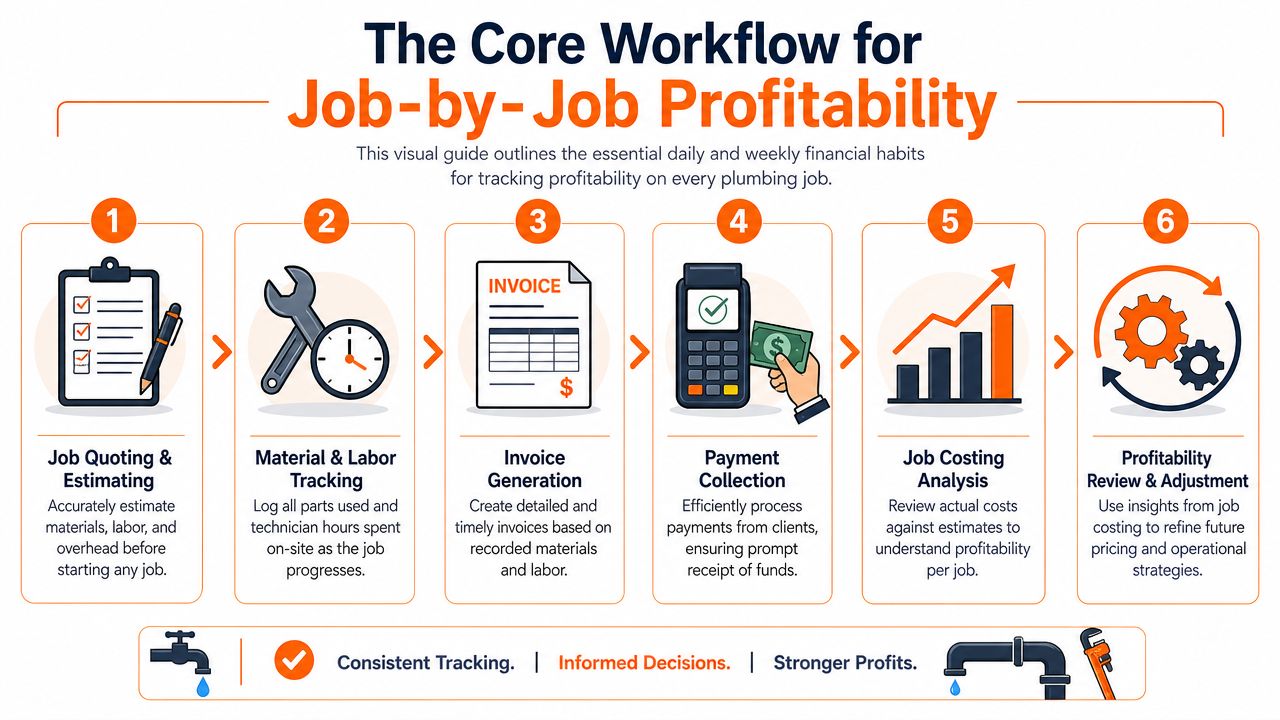
Guidance for plumbing businesses points in the same direction. Build your books around job costing, with materials, labor burden, travel, subcontractors, permits, rentals, and extras tracked at the job level so you can review profit by service line and spot work that keeps underperforming, as outlined in this plumbing bookkeeping playbook.
What each job record needs to show
A plumbing invoice only shows what you charged. It does not show what the job took out of the business.
For job-by-job profitability to mean anything, each job record needs:
- A job number used from quote to final invoice: Every timesheet, receipt, bill, and variation has to point to the same job.
- Actual labour cost: Hours alone are not enough. Include wage cost, payroll on-costs, and overtime where it applies.
- Materials tied to that specific job: Not just the supplier total. The parts used on site.
- Travel-related cost: Drive time, mileage, fuel, parking, and extra site visits.
- External job costs: Subcontractors, permits, equipment hire, disposal, inspection fees, and other direct charges.
- Variations and extras approved during the work: If it was done, it needs to be billed or at least explained.
Miss one of those and the margin gets blurred. I see this most often with small parts, second visits, and mixed supplier bills. The owner remembers the sales figure and assumes the job was fine. The books say otherwise once everything is assigned properly.
The workflow that gives you live margin visibility
What works is boring, but effective. The workflow has to start before the first wrench comes out and continue until the job is reviewed.
Build the quote in the same cost buckets you want to review later
Split labour, materials, and outside costs in a way that matches how the office will track actual spend. If the quote is one lump sum, estimate-versus-actual review becomes messy.Create the job number at quote stage
Do it early so every purchase, timesheet, and note can attach from day one. Waiting until invoicing creates gaps you rarely fix later.Capture labour and materials as the job happens
Most margin leaks begin due to a failure to do so. A technician grabs fittings, does an extra hour on site, or returns the next day, and none of it gets recorded cleanly. Field teams need a simple process they can follow from the van.Split supplier bills before they hit the accounts
One invoice can include stock, van replenishment, and parts for two active jobs. Code each line where it belongs. A generic materials account makes the monthly books look tidy, but it hides which jobs are carrying the cost.Invoice from recorded work
Pull labour, materials, and approved extras from the job record. That shortens billing time and reduces missed charges. It also gives the customer a clearer invoice, which helps if you offer financing options for plumbing customers on higher-value work.Review estimate versus actual while the details are still fresh
Such review sharpens pricing. If drain jobs keep blowing out on travel, or heater installs always need more labour than quoted, change the price, scope, or crew setup.
Where margin usually slips
It is rarely one big mistake.
A tech picks up extra fittings and nobody tags them to the job. Travel time for a callback gets missed because the customer was not charged separately. A permit lands in admin expenses. A supplier bill covers several jobs, but the office books it as one materials transaction and moves on.
That is how owners end up working hard for less profit than expected. The bank account still shows cash coming in, so the problem hides for weeks.
The fix is consistency:
- Technicians log time daily
- Receipts get uploaded on the day of purchase
- Mixed supplier invoices get split line by line
- Callbacks and warranty visits still get coded to the original job
- Job reviews happen every week, not only at month end
A good accountant can clean up reports. They cannot rebuild missing job data after the fact. If you want real-time financial clarity on every job, the bookkeeping workflow has to reflect how plumbing work happens in the field.
Your Bookkeeping Rhythm for Tax and Cash Flow
Friday afternoon. Jobs are done, the phone is still going, and you are trying to work out three things at once. What needs paying, what tax is coming up, and whether this month made money. If the books are a week or two behind, you are guessing on all three.
That is the reason rhythm matters. Good bookkeeping is not only about staying tidy for the accountant. It gives you current numbers you can trust, so you can make decisions before cash gets tight or tax catches you short.
Daily and weekly habits
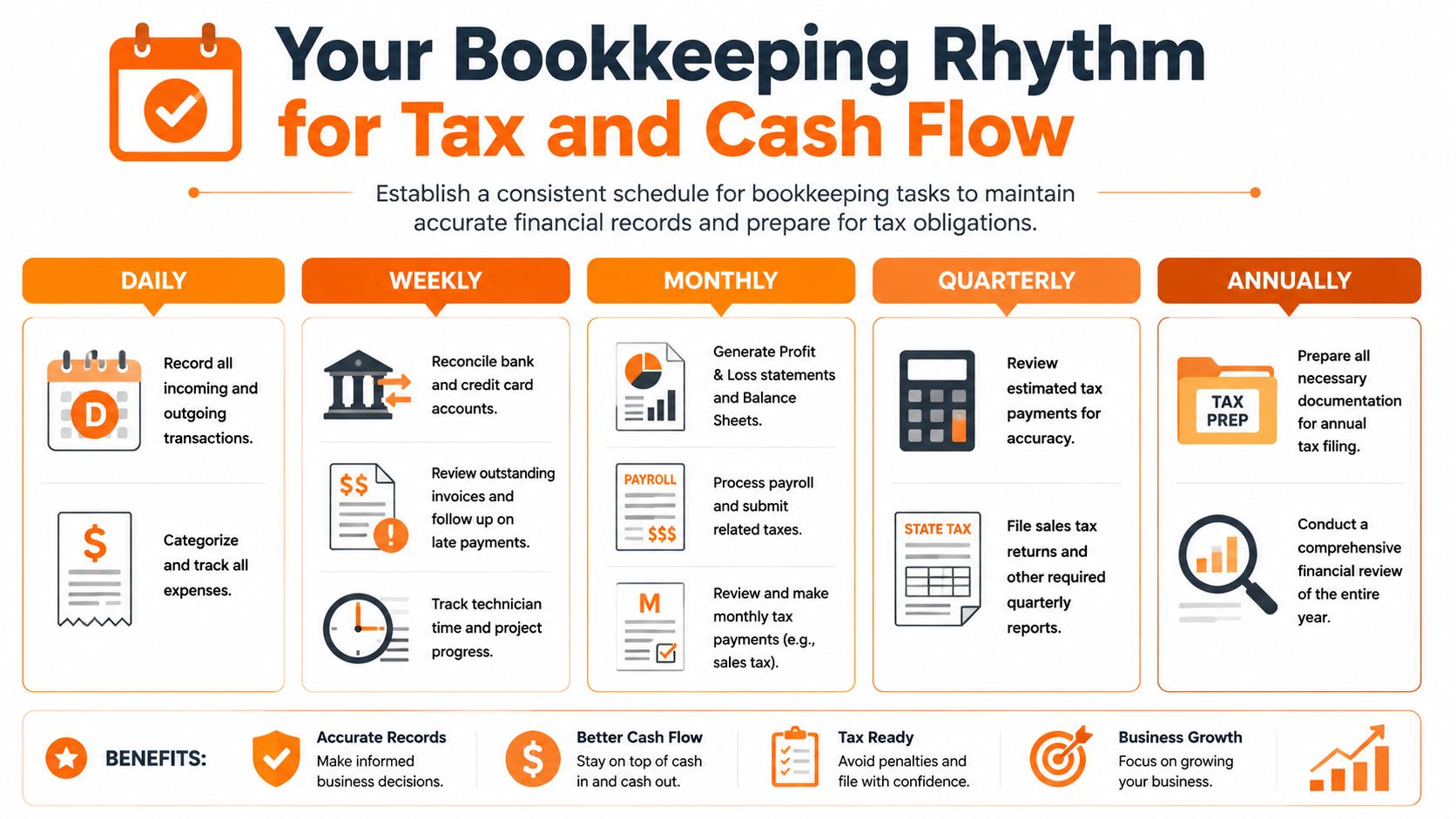
Daily bookkeeping should support the work, not slow it down. If the process is clunky, the crew will skip it and the office will spend Friday chasing scraps of information.
Keep the daily rhythm tight:
- Upload receipts on the day of purchase: Waiting until week end is how parts end up in the wrong job or missed completely.
- Close out job notes before the next callout: Labour details, extra materials, and site issues are easier to record while they are still clear.
- Send completed job details to the office fast: That shortens the gap between doing the work and sending the invoice.
- Flag deposits and staged payments clearly: On larger installs, clean records matter if you offer customer financing options for plumbing jobs or collect progress payments.
Weekly is where cash flow gets managed, not just recorded.
A practical weekly review usually covers:
- Bank feeds and card transactions reconciled
- Supplier bills checked for due dates and coding errors
- Unpaid customer invoices reviewed and chased
- Timesheets matched to the right jobs before payroll runs
- Tax set-aside transferred to a separate account
- Upcoming cash commitments compared against expected receipts
That last point matters more than many owners realise. A plumbing business can look busy and still get squeezed because wages, supplier terms, tax, and vehicle costs all hit before customer payments land.
Field habit: If a cost is not coded within a day or two, the chance of coding it right drops fast.
Monthly and quarterly control points
Monthly bookkeeping gives you the first honest read on whether operations and cash are lining up. The bank balance only shows what is left today. It does not show unpaid supplier bills, tax building in the background, or jobs that were invoiced late.
A solid month-end review includes:
- All bank and credit card accounts reconciled
- Profit and loss checked for margin drift and unusual overheads
- Balance sheet reviewed for payroll, tax, loan, and owner draw errors
- Aged receivables reviewed with action on slow-paying accounts
- Sales tax and payroll obligations checked before due dates
- Cash reserve position compared with the next few weeks of outgoings
Quarterly, step back and look for patterns. Are margins tightening on certain job types? Are materials climbing faster than your pricing? Are you paying tax from current cash flow, or scrambling because the money was already spent?
Those reviews are where a bookkeeping system starts paying for itself. You stop looking at the business as one lump of income and expenses. You can see whether the work being sold, completed, invoiced, and collected is producing enough cash at the right time.
If the current routine is patchy, do not try to fix everything in one go. Start with one daily habit the team will follow, then lock in one weekly review slot that never gets bumped. Rhythm beats catch-up work every time.
DIY Bookkeeping vs Hiring a Professional
This decision isn't about pride. It's about whether the current setup gives you clean books without stealing too much of your working week.
When DIY works
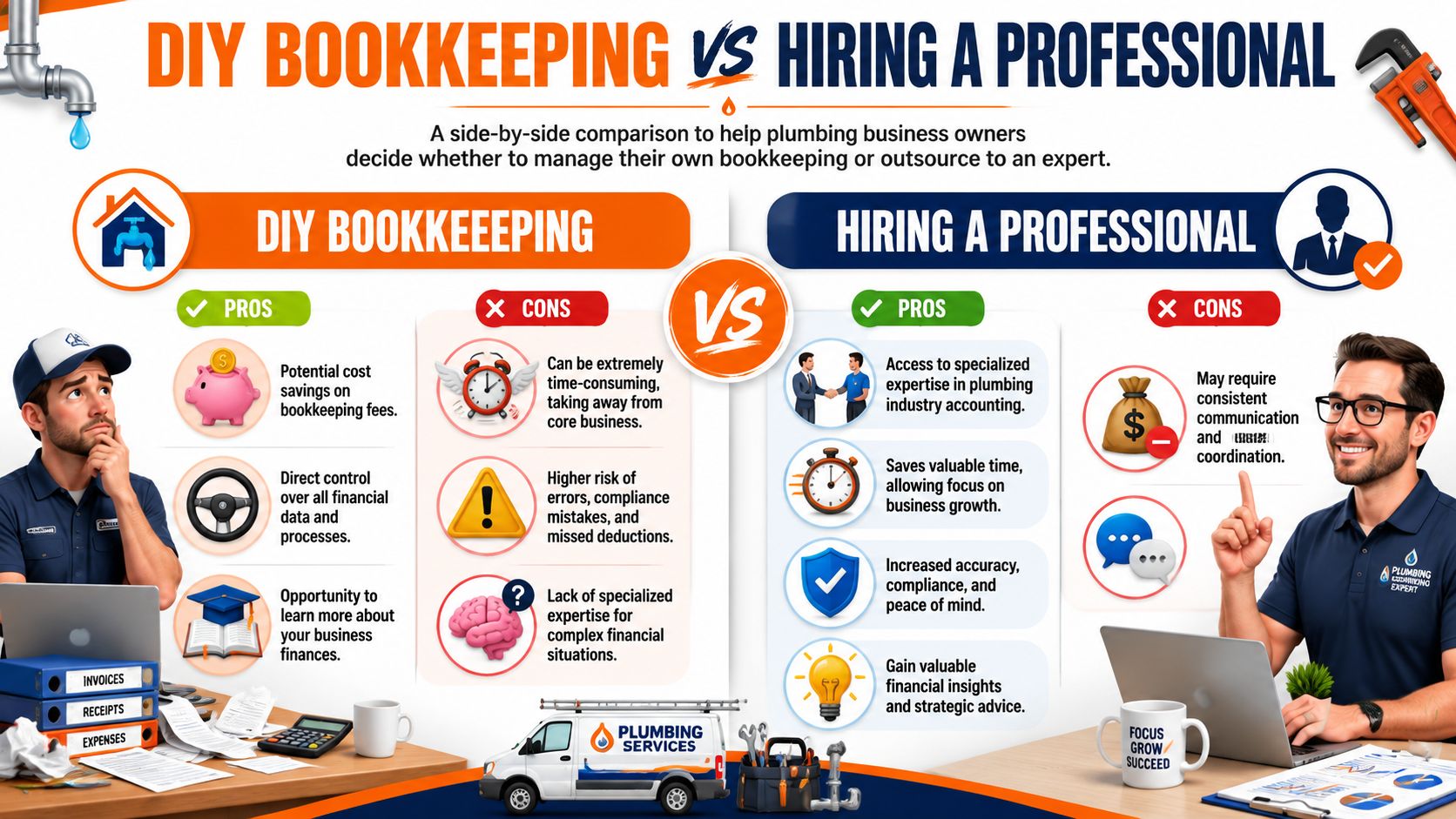
Doing your own books can work if the business is still simple and you're disciplined enough to stay on top of it. That usually means you have a manageable transaction volume, one main trading structure, reliable software, and a routine you follow.
DIY bookkeeping tends to suit owners who:
- Want direct visibility: You'll know exactly what's in the books because you entered it.
- Can protect regular admin time: If bookkeeping always gets pushed behind site work, DIY breaks down fast.
- Are comfortable learning software: Xero and QuickBooks Online are user-friendly, but they still need proper setup and review.
The downside is predictable. If you're doing quotes, site visits, staff issues, supplier calls, and invoicing, bookkeeping often gets left until late at night or the weekend. That's when coding errors, missed receipts, and weak reconciliations creep in.
When a professional earns their keep
A bookkeeper earns value by keeping the records current, clean, and review-ready. A good one also spots problems early. They'll notice when payroll doesn't align with timesheets, when a liability account looks wrong, or when too many expenses are being dumped into vague categories.
Hiring a professional usually makes sense when:
- The volume has outgrown your spare time
- You have employees or subcontractors
- Job costing needs close attention
- Tax obligations are getting harder to manage
- You keep falling behind
If you're always “catching up” on the books, the system is already costing you money somewhere else.
The trade-off is straightforward. You pay for the service, and you still need to communicate properly. A bookkeeper can't guess which job a charge belongs to if your team never records it.
The hybrid option
For many plumbing businesses, the best answer sits in the middle. The owner or office admin handles the daily capture. The bookkeeper handles reconciliations, reviews, cleanup, and reporting on a regular schedule.
That model works well because the people close to the job record the detail, and the finance professional checks that everything lands where it should. You keep visibility without carrying the full admin burden.
If you're choosing between the options, don't ask, “Can I do it myself?” Ask, “Can I do it well, consistently, and on time?” That's the better test.
Common Plumbing Bookkeeping Questions
What's the best software for a small plumbing business
There isn't one perfect answer. Xero and QuickBooks Online are both solid choices. Pick the one that fits your payroll setup, your bookkeeper's experience, and any job management software you already use. The best platform is the one your team can use consistently without double handling.
What's the difference between a bookkeeper and an accountant
A bookkeeper handles the day-to-day record keeping, reconciliations, transaction coding, and routine reporting. An accountant usually steps in for higher-level tax, structure, compliance, and year-end financial work. Most plumbing businesses benefit from both at different points.
Is it worth paying for a receipt or mileage app
Usually, yes, if receipts go missing or vehicle-related costs are poorly tracked. The point isn't the app itself. The point is getting field purchases and travel records captured quickly while the job details are still clear.
How often should I review my books
Weekly for control. Monthly for reporting. Quarterly for tax and bigger business decisions. If you only look at the numbers when something feels wrong, you're already behind.
What matters most in bookkeeping for plumbing business owners
Accurate job-level tracking. If the books can't show what each job really cost, every pricing decision gets weaker after that.
GrowTradie helps trade businesses stay visible without adding more admin to the week. If you want a simpler way to keep your business active online with customized posts, clean design, and automated publishing, take a look at GrowTradie.