

Most advice about the best time to post online is too lazy for a trade business. It pretends there's one magic hour that works for everyone, then ignores the simple fact that your customers are local, busy, and usually not scrolling at the same time as a fitness coach in another state or a SaaS founder overseas. For tradies, the right window is the one that catches people when they're off the tools, on a break, or winding down and ready to send an enquiry.
Table of Contents
- Why the Best Time to Post Online Is Not a Single Hour
- The Three Things That Decide Posting Time
- What the 2026 Benchmarks Show
- Platform-Specific Windows Tradies Should Default To
- How to Test Your Own Best Time in Four Weeks
- Using GrowTradie to Automate and Iterate
- Sample Weekly Posting Schedules for Common Trades
- Your Next Step and What to Do This Week
Why the Best Time to Post Online Is Not a Single Hour
A single universal posting time is a myth. The stronger recent guidance from Buffer makes that plain, there's no single best time to post on social media because each platform has different user behaviour and intent, and the useful answer is to segment by platform, audience, and time zone, then test it properly Buffer. That's the part most generic posts skip.
For a plumber, sparky, carpenter, or HVAC tech, the question isn't “What hour is best?” It's what hour is best for my suburb, my customer type, and the platform I'm using. A homeowner scrolling Facebook before school drop-off behaves differently from a property manager checking LinkedIn after work, and neither behaves like a teenager watching TikTok at night.
Practical rule: if the advice doesn't name the platform, the audience, and the local time zone, it's too broad to trust.
The other reason one-size-fits-all advice fails is that trade businesses don't sell to a global audience. Your market is usually local, so the clock matters. A post scheduled for 9 a.m. somewhere else can land in the middle of the night for your customers, which is a waste when you're trying to catch people during weekday daytime scrolling.
That's why the safer starting point is to think in windows, not exact minutes. The best time to post online for tradies is usually the time people are available to notice you, not the time that sounds neat in a blog headline. If you keep that mindset, the rest of the data starts to make sense instead of feeling like a pile of conflicting charts.
The Three Things That Decide Posting Time
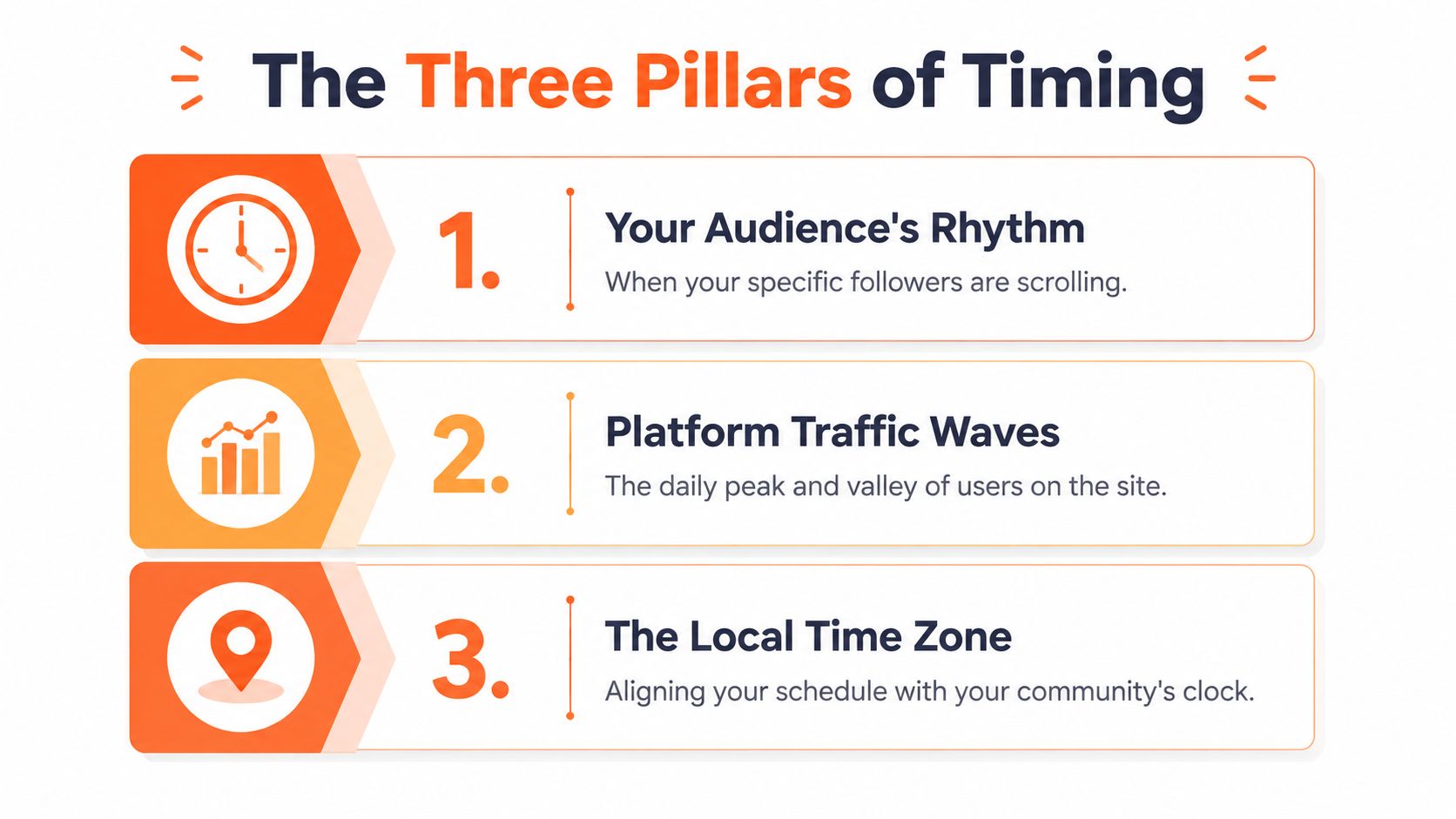
Timing comes down to three moving parts, and all three matter. The first is audience behaviour, which is when your customers are online. The second is the platform demand curve, which is the daily rhythm of how people use that app. The third is the local time zone, because a good time in one city can be useless in another if you don't line it up with the community's clock.
Audience behaviour beats guesswork
A trade business is like a shopfront. Opening at 3 a.m. leaves the street empty, and social posts work the same way if they land when your customer is asleep or flat out.
Trade customers don't spend all day staring at their phones. They scroll in gaps, during lunch, after knock-off, and while they're waiting for life to stop interrupting them. That's why weekday daytime tends to outperform late night for service businesses, especially in the middle of the week when people are in work mode and still open to booking jobs or requesting quotes.
A post has to arrive during a usable window. If it lands while your customer is on the tools, driving between jobs, or half paying attention to a screen, it gets skimmed and forgotten.
Platform waves change the answer
Each network has its own traffic pattern. Sprout Social's benchmark, built from nearly 2 billion engagements across roughly 307,000 profiles, found the strongest overall window is Tuesdays and Wednesdays between 11 a.m. and 6 p.m. local time Sprout Social. That already tells you the market is clustered around daytime use, not late-night posting.
The platform matters because each app gets used differently. A homeowner might scroll Facebook after school drop-off, check Instagram at lunch, and ignore both once the workday gets busy. That changes what counts as a good post time, even before you factor in the suburb, the state, and whether your audience is mostly domestic or commercial.
Local time is the final piece. If your audience is in Brisbane, Perth, or regional New South Wales, your schedule should match their day, not a generic spreadsheet. The right post at the wrong local hour still lands at the wrong moment.
Your calendar should follow the customer's day, not your convenience.
What the 2026 Benchmarks Show
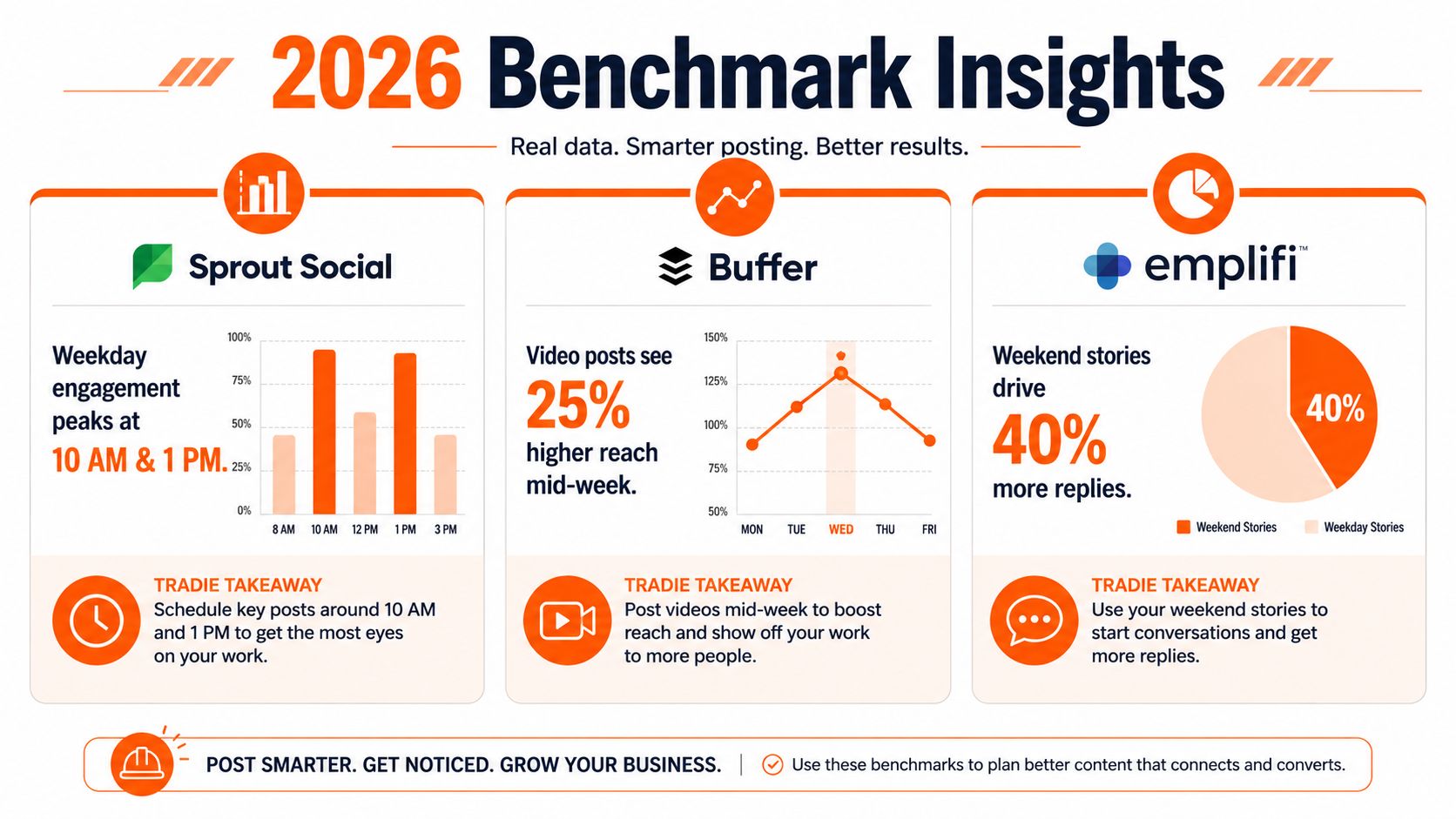
The cleanest pattern in the 2026 data is simple. Midweek daytime keeps showing up. The broader benchmark points to Tuesday and Wednesday between 11 a.m. and 6 p.m. local time as the strongest overall window, which fits the kind of content tradies post: quote prompts, finished jobs, seasonal reminders, and local offers.
Instagram leans into lunch and after work
Instagram needs its own timing, because the audience behaves differently there. Buffer's Instagram analysis found the strongest windows on Thursday 9 a.m., Wednesday 12 p.m., and Wednesday 6 p.m. Buffer. That matters for tradies because Instagram is where before-and-after work, job-site progress, and finished-project photos usually get the most traction. Those slots line up with lunch breaks, school-run gaps, and the evening scroll once people are off the tools and checking what's been happening around the house.
The pattern is practical, not random. If you post a job finish at lunchtime, it reaches people while they are still in a buying mood. If you post again in the early evening, you catch the local homeowner who finally has time to look, compare, and send a message about a quote or booking.
Buffer's guidance also gives trades a workable rhythm for planning content week to week. Their Instagram timing points to late morning, lunch, and early evening as the safest default windows, which matches how local customers use the app between work, family, and the last look at their phone before the day ends.
What this means for tradies
The takeaway is straight forward. These benchmarks do not support random posting. They show that the best response usually sits around the middle of the week and the hours when customers are off the tools, moving between jobs, or winding down at home.
That lines up with how trades sell. A decent post can miss if it lands during the wrong stretch of the day, while a solid post in the right local window gets seen while the customer still has enough headspace to act on it. If you want a practical way to turn that into a posting routine, this guide on how to post on social media shows the basic setup without making it more complicated than it needs to be.
Good timing helps the right post get seen. Bad timing buries decent content before it has a chance.
Platform-Specific Windows Tradies Should Default To
The best default depends on where you post. Facebook, Instagram, LinkedIn, X, and TikTok all pull attention at different times, so a tradie who uses the same schedule across every channel leaves reach on the table. Buffer's platform guidance is a solid baseline, and Metricool's large TikTok and X studies point to the same reality, timing shifts by channel Buffer, Metricool.
| Platform | Default Window | Best Times | Best For |
|---|---|---|---|
| Weekdays, morning to midday | 8 a.m. to 12 p.m. | Local updates, offers, reviews, community reach | |
| Weekdays, late morning to early evening | 9 a.m. and 6 p.m. | Finished jobs, before-and-after photos, project highlights | |
| Midweek to Sunday, afternoon to early evening | 3 p.m. to 6 p.m. | Commercial work, property managers, builder contacts | |
| X | Weekdays, morning | 8 a.m. to 11 a.m. | Quick updates, service alerts, news-style posts |
| TikTok | Early evening | 6 p.m. to 8 p.m. | Behind-the-scenes clips, short job tips, trade personality |
Facebook still works for local visibility because its strongest window sits inside standard weekday hours Buffer. Homeowners are more likely to see service reminders, seasonal maintenance prompts, and recent job posts while they're checking their phone between tasks, not after they've switched off for the night.
Instagram suits tradies who show the work. The midday and early-evening slots line up with the times people are more likely to pause, look at finished jobs, save a post, or send it to a partner before deciding who to call. LinkedIn is more useful for commercial relationships than for general homeowner bookings, so the afternoon window is the sensible default.
TikTok is the outlier. Metricool's 2026 study, based on more than 2 million posts from more than 92,000 accounts, found the best time is 6:00 p.m. through 8:00 p.m. Metricool. That fits a platform built for after-work scrolling, so short clips from the van, the workshop, or a job start to make sense there.
For a practical breakdown of the posting process, use this guide on how to post on social media.
How to Test Your Own Best Time in Four Weeks
Benchmarks give you a starting line. Your own audience decides the finish. WebTonic suggests building a 7×24 day-by-hour grid, then waiting until a slot has at least 3 posts per cell before treating it as real signal WebTonic. That keeps one lucky post, or one dead quiet week, from steering the whole schedule.
Build the grid, then pick two contenders
Map the week across the top and the hours down the side. Drop every post into the right cell, then watch what happens when the same slot shows up again and again. Once a pattern starts to hold, choose the two strongest windows and run a four-week A/B test between them WebTonic.
Keep the comparison tight. If one window brings in more enquiries, messages, or quote requests, that is the slot to keep using. Likes can still tell you the post landed, but they do not pay the invoices.
Measure the right outcome
For a tradie, the best metric is the one that turns into work. Direct messages, calls, quote requests, and actual enquiries matter more than vanity engagement. A post with fewer likes but more messages is doing a better job for the business.
Keep the test simple. Change one thing, hold the content style steady, and give the results time to settle before you start adjusting the rules.
WebTonic also recommends the four-week test because it gives each time slot enough runway to show a real pattern. That suits a one-person trade business that needs a process it can keep up with. If the batching side of that workflow needs tightening, this internal guide helps: what is content batching.
Using GrowTradie to Automate and Iterate
A lot of tradies already know what they want to post. The problem is getting it out on time without stopping on a ladder or between quotes to muck around with captions and images. That's where a trade-specific scheduler earns its keep, because consistency is what makes timing useful in the first place.
A practical workflow on a busy week
A typical setup looks like this. The content gets generated around the trade, the services, and the local area, then it's formatted professionally so the business looks active and credible. The posts are queued to the best windows, so they go out while you're on-site, in the ute, or dealing with the day's calls instead of trying to post manually.
That matters because timing only works if you can stick to it. One missed week or one last-minute scramble breaks the rhythm, and then the data gets noisy. Automation removes that friction, which is especially useful for a solo operator or a small crew without a marketing person.
Why automation makes testing sustainable
The win is not just scheduling, it's iteration. Once the posts are going out consistently, the next step is to see which windows and post types drive the enquiries that matter. The upcoming performance insights in GrowTradie are built to help surface that pattern, so the schedule can sharpen over time instead of staying fixed forever.
For a quick look at the broader automation stack, this internal resource is worth keeping handy: best social media automation tools.

Sample Weekly Posting Schedules for Common Trades
A good schedule is boring in the right way. It repeats the windows that are most likely to match how customers behave, and it leaves room for job photos, reviews, team shots, and short service reminders. For most trades, that means one weekday slot for booking intent, one midweek evening slot for finished work, and one weekend slot for trust-building.
Plumbers: Post Tuesday late morning for quote requests, Wednesday evening for a completed job, and Sunday morning for a review or team post. That mix fits urgent service needs and the way homeowners think about leaks, upgrades, and maintenance.
Electricians: Use Wednesday lunch for service calls, Thursday early evening for a finished install, and Saturday morning for a short trust post. It suits the mix of domestic work, compliance jobs, and small commercial enquiries.
Carpenters: Schedule Wednesday afternoon for project progress, Thursday evening for finished joinery or fit-out photos, and Sunday for a workshop or behind-the-scenes post. Visual proof matters here, so the later slots give people time to look.
HVAC technicians: Go with Tuesday midday for seasonal reminders, Wednesday evening for a system upgrade or maintenance post, and Saturday morning for a homeowner education post. That rhythm lines up with when people start thinking about comfort, not just breakdowns.
The best schedule is the one you can repeat without stress. Keep the platform and the window consistent for a few weeks, then swap in a different post type if the first one is flat. The time is the frame, the content still has to do the work.
Your Next Step and What to Do This Week
Pick one platform. Set one default window from the benchmarks above. Then schedule one full week of posts and leave the timing alone long enough to learn something useful.
The biggest mistake is changing the posting hour every few days and calling it testing. That just creates noise. Use a stable window, watch the messages and enquiries, then tighten the schedule once the pattern is clear.
GrowTradie helps tradies stay visible without living on their phones, with trade-specific content, professional design, and auto-posting built around the windows that fit a busy workday. If you want a simpler way to keep your profiles active and turn timing into enquiries, take a look at GrowTradie and see how it fits your week.