
You're in the middle of a week that looks fine on paper and still feels shaky in the shed. Monday's packed, Tuesday goes quiet, Wednesday brings a couple of calls, then Friday turns into a scramble because the next job isn't locked in yet. That swing usually isn't about effort, it's about whether people in your area can find you, trust you, and reach you fast enough when they're ready to book.
That's what is local lead generation in plain terms. It's the process of turning nearby searchers, referrals, and local enquiries into real jobs, not just website visits or casual attention. For trades, that means being visible where people already look, and making it easy for them to choose you over the next bloke with a van and a half-finished profile.
Table of Contents
- The Unreliable Week and What Causes It
- What Local Lead Generation Means
- Channels That Bring Local Enquiries
- How It Plays Out Across Trades
- What to Measure and How to Track It
- Common Mistakes That Quietly Drain Results
- A Simple Starter Checklist for Tradies
- Where Content Posting Fits in the Bigger Picture
The Unreliable Week and What Causes It
A lot of small trade businesses run on a mix of word of mouth, repeat customers, and the odd online enquiry. That can feel healthy in a busy month. Then one patch of weather, one quiet suburb, or one competitor getting more visible in the area, and the phone slows down for no obvious reason.
I've seen this pattern the hard way. A job gets finished well, the customer's happy, and a few calls come in off the back of it. Then the next week depends on whether a past client remembers your number, whether a neighbour asks for a referral, or whether somebody searching nearby sees your details before they click someone else.
The core issue isn't laziness. It's that most tradies don't have a repeatable way to stay in front of nearby buyers when those buyers are ready to act. That's why the week feels random, even when the work itself is solid.
Practical rule: if you only get attention when you're already busy, you don't have a pipeline, you've got luck.
The broader lead-gen numbers make the inefficiency easier to understand. The average organisation generates 1,877 leads per month, with a mean cost per lead of $198.44 and an average conversion rate of 2.9% (Harvest My Data). Local businesses don't need big abstract volumes, they need the right people in the right postcode at the right moment.
That's why the missing piece is usually a system, not more hustle. A tradie can work hard all week and still have gaps if there's no dependable way to attract, qualify, and convert nearby enquiries. The fix starts with understanding how local demand gets captured.
See a practical breakdown for contractors
What Local Lead Generation Means
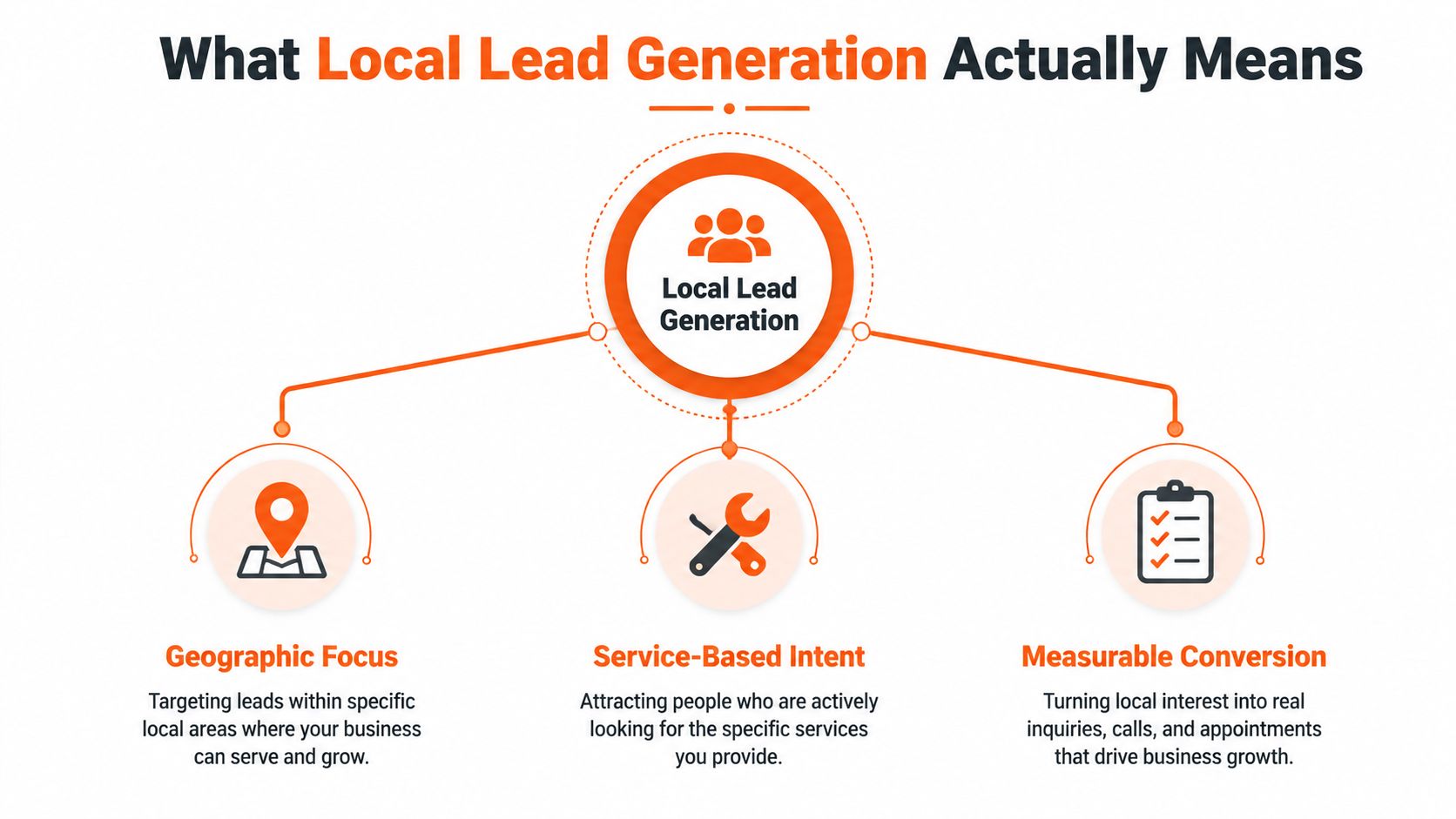
Local lead generation is a geographically focused system for turning nearby interest into booked work. The location side matters because service businesses do not sell to everyone. They sell to people inside a service radius, and that radius shapes who sees the business, who is worth chasing, and which enquiries deserve a call back.
Proximity comes first
A nearby customer is easier to win than a distant one. They are less likely to worry about travel delays, coverage limits, or whether you will turn up on time. That is why local lead gen is built around intent signals and local business data, not broad audience targeting.
Google's local-business guidance frames the idea clearly. Local lead generation is about turning people in a specific geographic area into prospects, with repeat business and word of mouth part of the value, not just first-time enquiries (Google Business resources). For tradies, that matters because a few high-intent nearby leads can be worth more than a pile of clicks from outside your patch.
The service radius changes the job. A plumber covering a tight patch should measure whether the right streets, suburbs, or postcodes are producing calls, not whether the brand is getting attention from people hours away. If the enquiry comes from outside the area you serve, it might be interest, but it is not useful local demand.
It's not the same as general marketing
Broad lead generation often chases reach. Local lead generation chases relevance. Search, maps, reviews, directory listings, and direct outreach all do different jobs, but they all need to point back to the same thing, a local person with a local problem who is ready to contact a local business.
One useful way to think about it is this.
If a lead can't be mapped to an area you serve, it's not really a local lead yet.
That is also why the first contact has to be easy. A phone number, a message button, a booking request, or a clear call-back path all matter more than vague branding. If someone is comparing three businesses near them, the one that looks active, trustworthy, and reachable usually wins. For a contractor-focused breakdown of how those pieces fit together, see this local SEO guide for contractors.
Inbound and outbound both have a place
Inbound local lead gen catches existing demand through Google Business Profiles, local pages, reviews, and directories. Outbound works the other side of the street, using lists, email, or partnership outreach against public local business records. The two should be measured differently. Inbound is about whether nearby searchers can find and contact you, while outbound is about whether your message reaches the right people in the right area and gets a response. The best setups use both to keep the calendar moving.
Channels That Bring Local Enquiries
The strongest local channels usually sit close to the buyer's moment of decision. That's why the survey data matters. In a survey of 180 local businesses, organic search accounted for 31% of leads, local listings and maps 28%, and paid search 27%, which means search channels together produced 86% of all local business leads. Social media generated only 4% of leads in the same survey (Neil Patel stats).
Search, maps, and reviews do the heavy lifting
For a tradie, search and map visibility usually catch the hottest enquiries. Someone looks up the problem, checks who's nearby, scans the reviews, and makes a quick call. That's the point where Google Business Profile, service pages, and review signals matter most, because the buyer already wants help.
Local listings and maps do a different job from a polished website. They give a fast trust check. If the hours are wrong, the phone number's outdated, or the profile looks abandoned, people bounce. If the details are clean and the reviews look current, the enquiry gets easier.
Paid search is useful, but it's not the whole game
Paid search can bring in urgent calls fast, especially when someone's actively looking for a fix. It works best when the business already knows how to answer quickly and filter bad-fit enquiries. Without that, ad spend just buys busyness, not bookings.
Directories, referrals, and repeat work still matter
Local directories still help because they add another trust point. Referrals matter because they come with built-in credibility. Repeat customers matter because a business that stays visible and reliable gets remembered when the next job comes up.
Social media sits lower in the direct-response chain for most local trade businesses, but it still has a role. It keeps names familiar, shows completed jobs, and makes the business feel active between emergencies and quote requests.
What each channel is really for
- Search and maps: Capture active demand when people are already looking.
- Paid search: Fill gaps quickly when you need leads now.
- Directories: Reinforce trust and consistency across the web.
- Reviews: Reduce hesitation at the exact moment of comparison.
- Referrals: Bring warmer enquiries with less selling.
- Social posts: Keep the business familiar so people remember it later.
The point isn't to be everywhere. It's to show up where nearby buyers are already making decisions.
How It Plays Out Across Trades
A plumber doesn't need the same enquiry mix as a carpenter, and an HVAC tech doesn't work the same calendar as an electrician. Local lead generation only makes sense when the channel mix matches the kind of call the trade wants.
Plumbing and urgent callouts
For plumbing, proximity is everything. People usually want the closest person who looks reliable, answers the phone, and can get there without fuss. That makes maps, reviews, and fast response times the core stack, because urgent callouts rarely reward long explanation.
Electrical and quote-based work
Electricians often deal with a mix of urgent faults and planned jobs like rewires, upgrades, and small installations. That means local search and directory visibility still matter, but so does proof of competence. Clear service descriptions, recent work photos, and steady review collection help separate serious enquiries from price shoppers.
Carpentry and renovation work
Carpenters usually live closer to the trust side of the spectrum. People want to see quality, consistency, and a sense that the business handles the kind of job they need. Local enquiries for carpentry often come through repeat contact, referrals, and visible proof of past work, then get backed up by a profile that looks active and legitimate.
HVAC and seasonal demand
HVAC work moves with the weather and with breakdowns. A tech who stays visible before the rush tends to do better than one who only appears when the first hot week lands. That's where regular posting, profile upkeep, and fast booking responses help keep the phone warm when demand shifts.
The same principle runs through all four trades. Tight service radii reduce wasted leads, but they also make trust signals more important. A nearby customer usually compares convenience first and proof second, then books the business that feels easiest to deal with.
Nearby leads don't need a bigger story, they need fewer reasons to hesitate.
What to Measure and How to Track It
Vague goals like “get more leads” don't help much when the calendar's thin. You need a small set of numbers that show whether a channel is creating booked jobs or just activity.
| Core Local Lead Generation KPIs | What It Measures | Why It Matters |
|---|---|---|
| Enquiries per channel | How many calls, messages, or forms come from each source | Shows which channels actually create interest |
| Lead-to-booking rate | How many enquiries turn into jobs | Separates busy noise from real revenue |
| Response time | How quickly the business replies | Faster replies usually stop leads from going cold |
| Cost per booked job | What it costs to win an actual customer | Helps compare channels on outcome, not vanity |
| Lead-to-opportunity rate | How many local leads become real chances to quote | Useful for filtering weak prospecting activity |
A practical local KPI guide cites a typical target of 10–15% for turning local leads into opportunities, alongside response-time monitoring because first-contact speed materially affects engagement (Leadzap guide). That target isn't a promise, it's a benchmark for whether the front end of the system is functioning.
Track source before you chase scale
The simplest setup is usually enough. Use a shared inbox, a tagging system, or a basic spreadsheet. Every enquiry should be marked with the original source, the campaign or profile it came from, whether it was qualified, and what happened next.
Don't confuse contact with value
A ringing phone doesn't mean the channel is working if the jobs are poor fit. A full inbox doesn't matter if half the messages are outside your service area. Measurement only helps when it tells you which sources deserve more attention and which ones are wasting time.
If you can't tell where the booking came from, you can't tell what to repeat. That's the whole game.
A simple tracking habit that pays off
- Log every enquiry: Keep calls, messages, and forms in one place.
- Tag the source: Map each lead to search, maps, referral, directory, or social.
- Mark the outcome: Quote, booked, lost, or not a fit.
- Review weekly: Drop weak channels, push the ones that book.
Common Mistakes That Quietly Drain Results
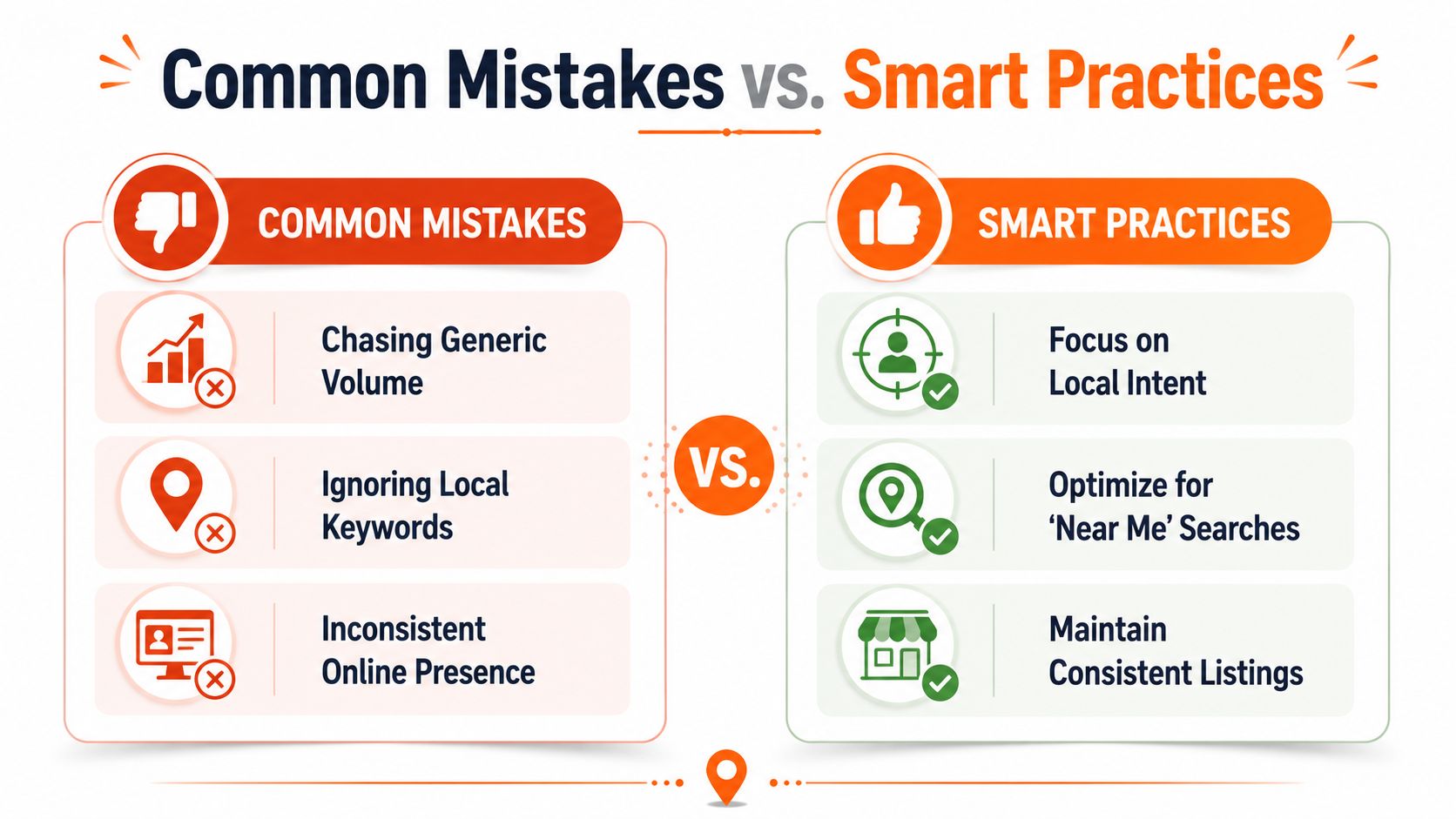
One of the easiest mistakes is chasing generic volume. A business can get busy with calls and still miss the mark if most of those people are too far away, outside the service list, or not ready to buy. Local lead generation works best when the focus stays on nearby intent, not raw exposure.
The quiet drains
Ignoring reviews until a bad one appears is another common miss. By then, the business is already reacting instead of building trust early. Inconsistent posting does the same thing in a slower way, because inactive profiles make a business look half-open even when the team's flat out working.
Copying a competitor without checking the service radius is a waste too. What works for a citywide operator often breaks for a small local crew, because the geography, travel time, and buyer expectations are completely different.
Better habits beat louder tactics
- Focus on local intent: Keep the service area tight enough to stay relevant.
- Treat enquiries differently: Urgent jobs, quote requests, and bad-fit calls need different responses.
- Maintain consistent listings: Make sure names, numbers, and hours don't drift across profiles.
- Collect reviews steadily: Don't wait for a problem before asking happy customers.
- Match the channel to the trade: What suits an emergency service won't suit a renovation business in the same way.
The biggest lesson is simple. Local lead generation fails when the business looks inactive, inconsistent, or hard to trust. The fix isn't more noise, it's better local signals.
A Simple Starter Checklist for Tradies
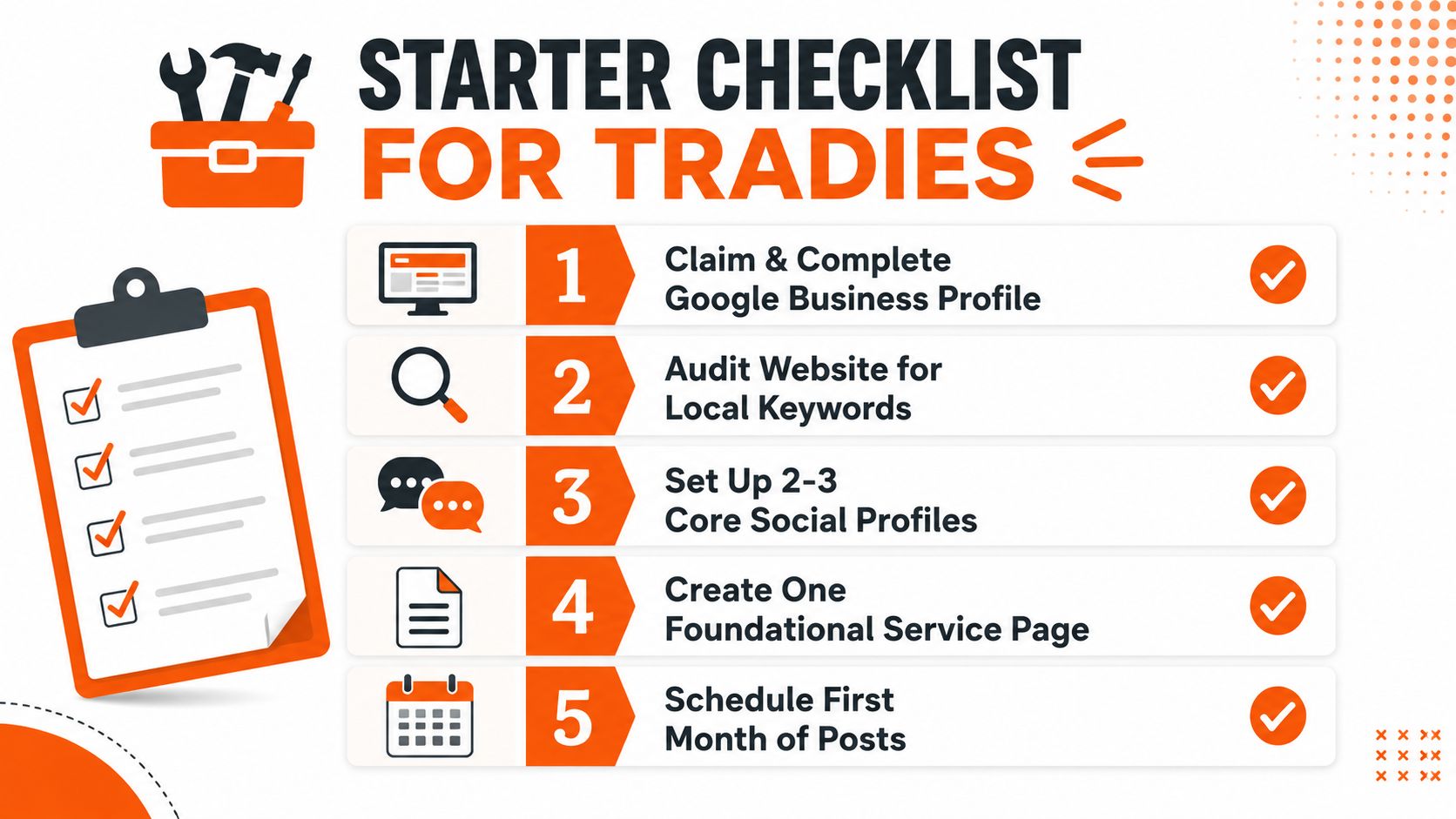
Start with the basics that affect whether someone calls.
- Claim and complete your Google Business Profile. Make sure the business name, service area, hours, phone number, and photos are all current.
- Tighten the main directories. Use the same details everywhere so nearby buyers don't run into confusion.
- Set up a simple enquiry tracker. A spreadsheet is fine if it records source, job type, and outcome.
- Ask recent happy customers for reviews. Past wins are often the fastest way to build trust with the next buyer.
- Keep posting consistently. A small but regular rhythm is enough to show the business is active.
If you only get through the first two items this weekend, that still moves the business forward. A complete profile and clean listings often do more for local trust than a pile of half-finished marketing ideas. The rest can build from there.
Where Content Posting Fits in the Bigger Picture
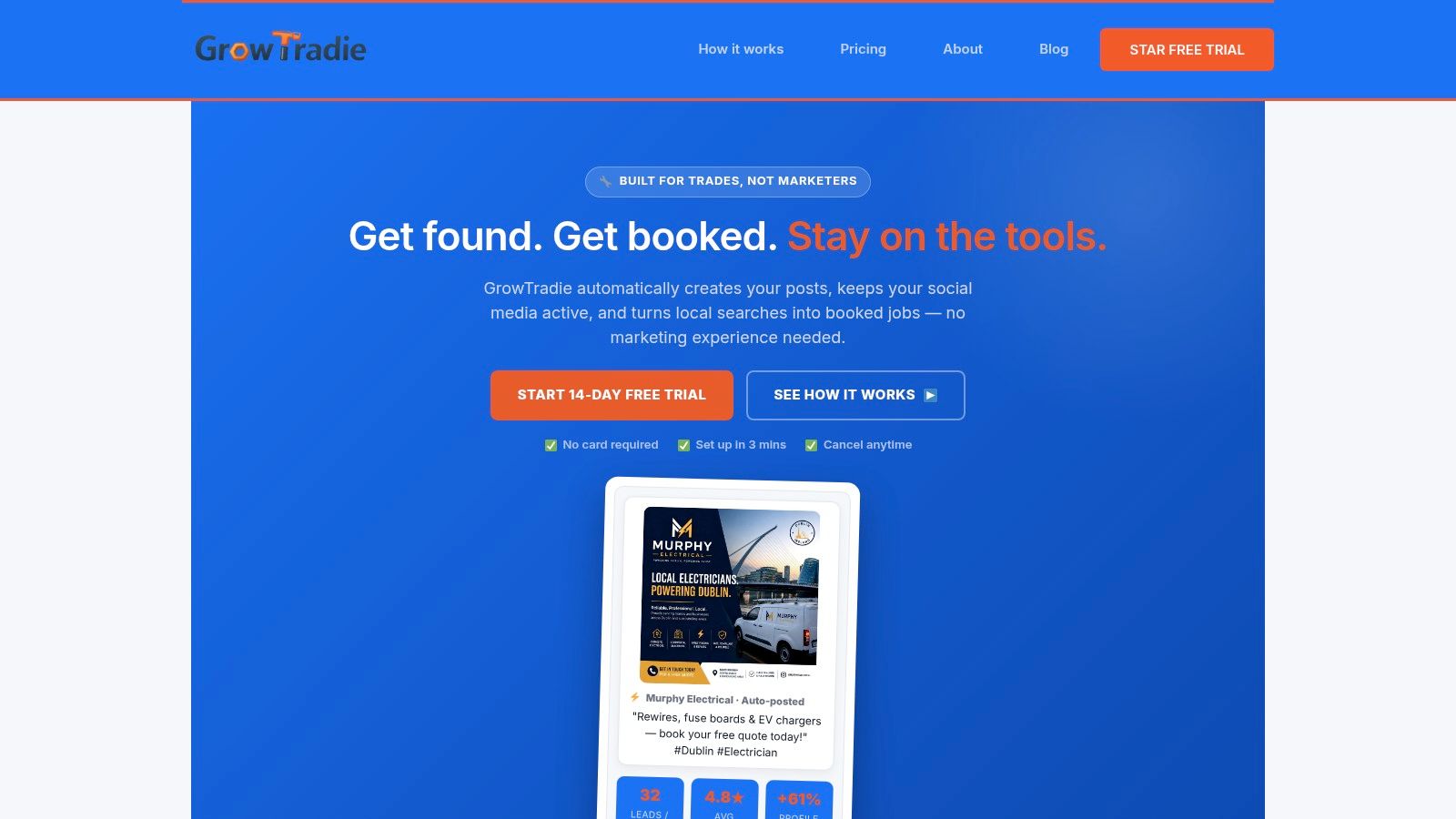
A post does not make the phone ring on its own. What it does is keep your business present in the small patch of area you want work from, so people see a live business when they check you out after a referral, a map search, or a review.
That matters because local lead generation is a proximity and trust problem. If your service radius is tight, the content you post should support that radius, not chase a wider audience that will never book you. Posts, photos, and updates are there to back up the signals buyers already use to decide whether you are worth calling.
For tradies who want that steady presence without sitting down to write posts, See the small business content strategy guide shows how content can be planned around local service work. GrowTradie can then handle trade-specific content creation and auto-posting, which keeps profiles active without turning it into another job on the list.
Keep the measure simple. If the posts are supporting a narrow local area, look for profile visits, calls, direct enquiries, and the quality of the jobs that come through, not just likes or reach. That is the test of whether the content is helping the business stay visible where it matters.