

The usual pattern goes like this. One week the phone won't stop ringing, the next week you're checking quotes, chasing old enquiries, and wondering whether to buy more leads just to keep the diary full. Most plumbers don't have a lead problem as much as they have a system problem.
Good plumber leads don't come from one trick. They come from a repeatable setup that helps local customers find you, trust you, contact you, and hear back from you fast enough to book. If you rely only on bought leads, you're renting work. If you build your own local presence, you're creating something that keeps producing even when you're on the tools.
Table of Contents
- Building Your Foundation for Steady Work
- Dominate Your Local Area When Customers Search
- Stay Top of Mind with a Consistent Online Presence
- Paid Channels Decoded The Pros and Cons
- Turn Enquiries into Booked Jobs The Follow-Up Playbook
- Tracking What Works and Winning More Jobs
Building Your Foundation for Steady Work
Inconsistent work usually starts long before a customer calls. It starts when your business looks half-finished online, your details don't match, or a homeowner can't tell whether you're active, local, or even still trading. Before spending another dollar on plumber leads, check the basics.
The opportunity is there. The plumbing trade is projected to face a shortage of about 550,000 plumbers by 2026, which means visible businesses can capture more demand as competition for skilled labour tightens, according to Jobber's plumbing industry statistics. If your business is easy to find and easy to trust, you don't need to fight for every enquiry.
Do a five minute visibility check
Search your business name on your phone. Then search it again on a laptop. You're looking for the same things a customer sees.
Check these first:
- Business name: Is it spelled the same everywhere?
- Phone number: Does every listing show the right number?
- Services: Do your listings clearly say what you do?
- Service area: Can a customer tell where you work?
- Hours: Are they current, especially for urgent callouts?
- Website link: Does it go to the right page and work properly?
If any of those are wrong, fix them before you chase more traffic. Sending people to messy information wastes enquiries you already earned.
Check what a stranger would think
Most owners look at their business through the eyes of someone who already knows them. Customers don't. They make a fast judgement based on a few clues.
Ask yourself:
| What they see | What they conclude |
|---|---|
| No recent updates | Maybe this business is inactive |
| No job photos | Hard to judge quality |
| Mixed service descriptions | Not sure they handle my problem |
| Old reviews with no replies | Nobody is paying attention |
Practical rule: If a customer has to guess whether you service their area, answer the phone, or handle their job type, many won't call.
A steady lead system starts with trust signals you control. That's why a basic online footprint check is worth doing before anything else. If you want a broader view of how regular posting supports local trades, this guide on content marketing for local businesses is a useful next read.
Dominate Your Local Area When Customers Search
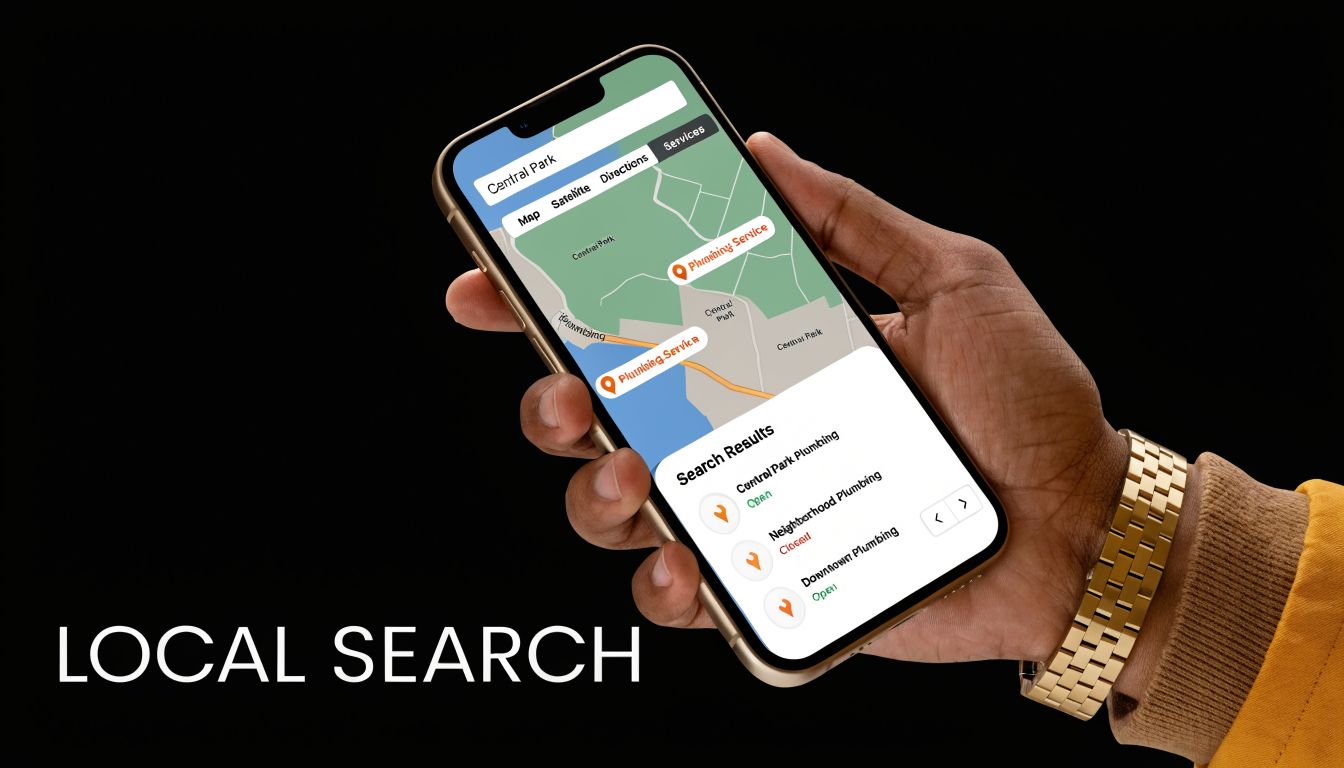
When someone has a leaking pipe, blocked drain, or dead hot water system, they don't browse for long. They search, scan, and call. That's why local search visibility matters so much for plumber leads.
According to Plumbing Webmasters' local marketing statistics, 42% of local queries result in a click on Google's Local Map 3-Pack. If you're not showing strongly there, a large share of ready-to-book customers will call someone else.
Start with your business profile
This isn't about gaming anything. It's about giving clear, complete information so a customer can choose you without friction.
Your business profile should include:
- Correct contact details: One wrong digit in a phone number can cost real jobs.
- Accurate service areas: List where you work, not where you'd like to work one day.
- Current trading hours: Include after-hours availability if you offer it.
- Relevant service list: Emergency plumbing, blocked drains, leak detection, hot water, gas fitting if applicable.
- Real business description: Write like a local operator, not a brochure.
A lot of plumbers leave this half done. That creates doubt. Doubt sends customers to the next listing.
For a more detailed breakdown of improving your local visibility, this guide on local search visibility for contractors covers the practical setup well.
Use photos and reviews to remove doubt
Photos do more work than most plumbers realise. Homeowners want proof that you're a real operator with a real van, real team, and real jobs behind you. Stock images don't help much. Your own photos do.
Upload a mix of:
- Van and branding: Helps customers recognise you when you arrive.
- Team photos: A quick group shot builds familiarity.
- Work in progress: Neat pipework, plant room jobs, hot water installs.
- Finished outcomes: Tidy, professional, easy to understand.
Reviews matter for the same reason. People want reassurance before they call. Ask for them after a job is completed, when the customer is relieved and happy with the result. Reply to them like a business owner who cares. Short, polite, and specific is enough.
Customers don't need perfection. They need enough proof to feel safe calling you first.
This walkthrough is worth watching if you want to tighten up how you appear when locals search for plumbing help.
Stay Top of Mind with a Consistent Online Presence
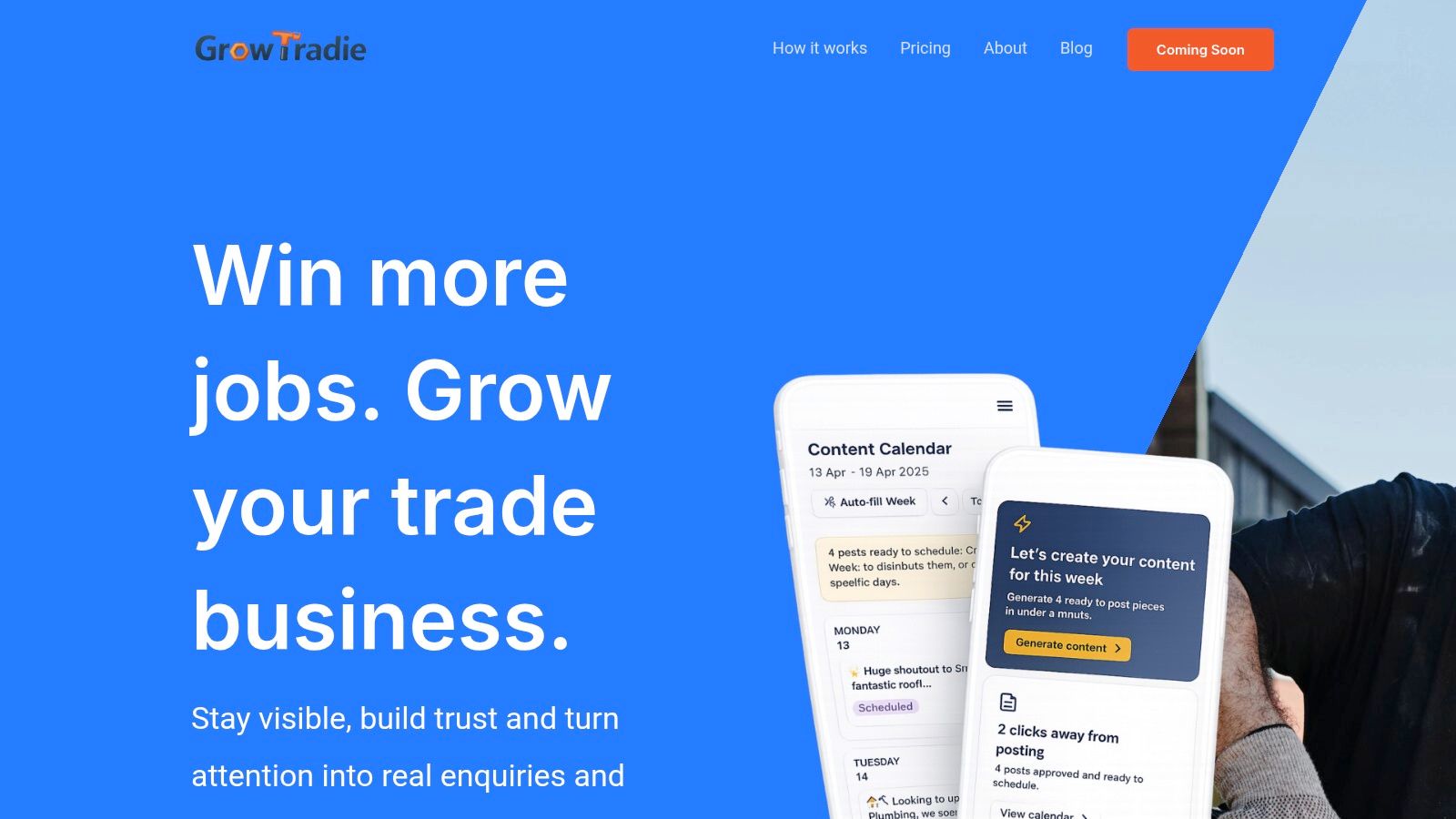
A lot of plumbing businesses look active only when someone checks reviews or their latest post happens to be recent. Then the profile goes quiet for weeks or months. To a potential customer, silence often reads as disorganisation.
The point of posting isn't to become an internet personality. It's to stay familiar and trustworthy so when someone needs a plumber, your name comes to mind before they start comparing everyone else.
Post for trust not attention
The best plumbing content is usually simple. It shows that you do solid work, know your area, and respond to the kinds of problems locals have.
Useful posts include:
- Seasonal advice: Preventing burst pipes during cold snaps, checking hot water performance before winter.
- Recent job snapshots: A replaced water heater, a repaired leak, a new fixture install.
- Customer education: What to do before the plumber arrives, when a dripping valve needs attention, signs a drain issue is getting worse.
- Behind the scenes: Stocking the van, prepping for the day, tools and materials for a larger install.
None of that needs to be fancy. It needs to be regular.
A quiet profile makes customers wonder whether you're busy, disorganised, or gone. A steady profile makes them assume you're established.
If you're trying to make posting manageable, this overview of social media marketing for plumbers shows how to keep it practical.
Separate emergency work from planned work
Many plumbers miss easy wins. As noted by Lightning Path Partners' plumbing lead strategy article, many businesses optimise for calm calls, while targeted content for emergency search domination can capture urgent, high-value work.
That matters because emergency customers and planned-job customers don't think the same way.
A simple split looks like this:
| Job type | What customers want to see |
|---|---|
| Emergency plumbing | Fast response, availability, confidence, service area |
| Planned work | Quality, tidiness, reliability, experience |
If you only post polished renovation photos, you may look great for planned work but invisible for urgent callouts. If you only talk about emergency jobs, you may miss the homeowner planning a hot water replacement next month.
Build both into your content. One post can say you're available for urgent leaks. Another can show a clean cylinder replacement or bathroom rough-in. Over time that creates a fuller picture of your business, and better plumber leads tend to follow because customers already understand what you do.
Paid Channels Decoded The Pros and Cons
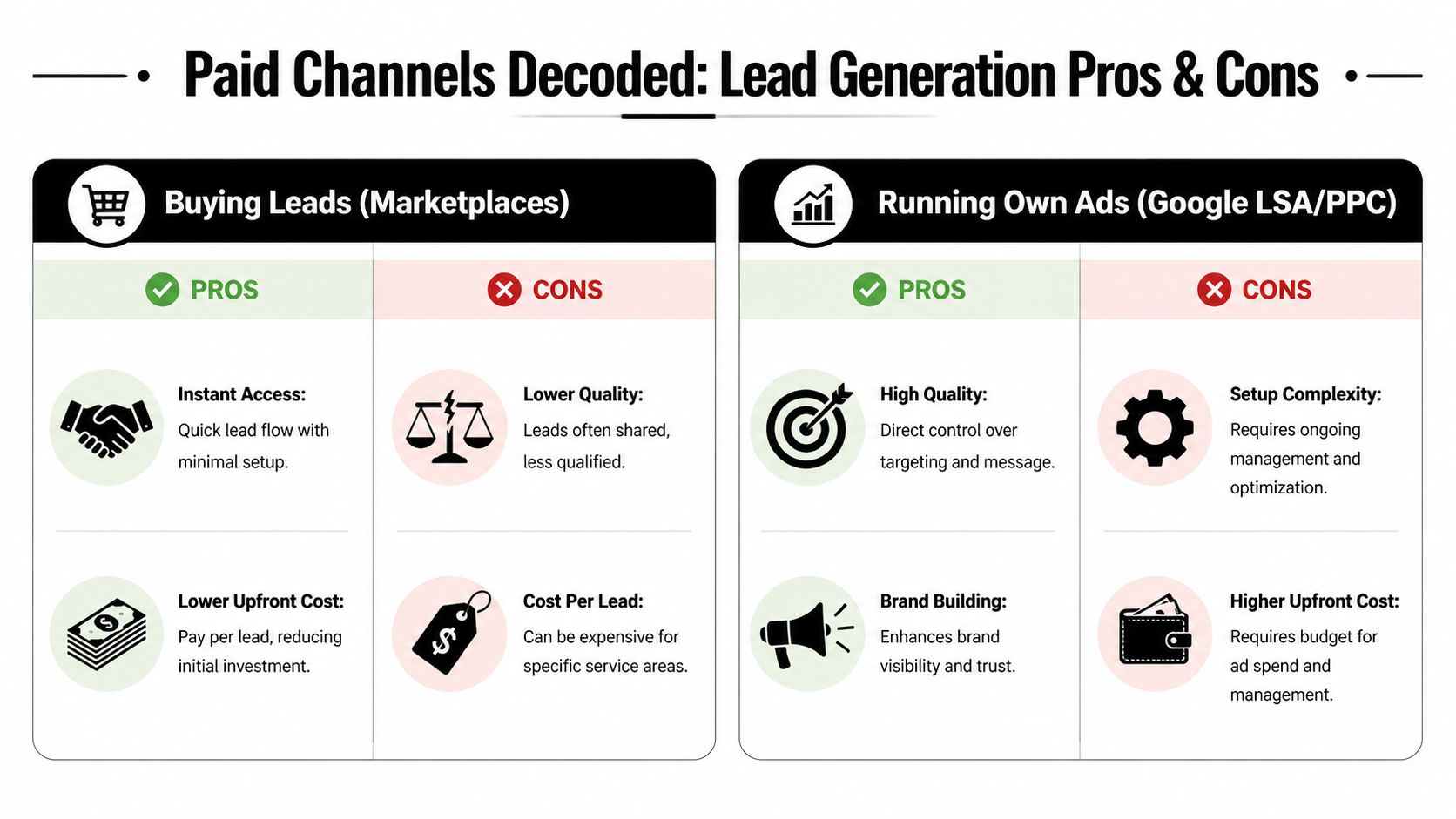
Paid lead generation can help. It can also burn time and money if you treat every lead source as equal. The biggest mistake isn't using paid channels. It's using them without understanding the trade-off between speed, control, and lead quality.
A Housecall Pro guide on plumbing lead generation points out the core issue clearly. Marketplaces can deliver quick volume, but shared leads often go to multiple plumbers, creating a race to call first and lowering the chance of conversion.
When bought leads help
Bought leads can make sense if you need work quickly or you're testing a new area or service. They reduce setup time. You don't need to build much before enquiries start arriving.
But there are obvious downsides:
- Shared attention: The same lead may be sent to several plumbers.
- Price pressure: Customers often compare purely on speed or cost.
- Weak fit: Some enquiries are vague, unqualified, or outside your ideal work.
- No asset built: When you stop paying, the flow usually stops too.
This channel is best treated as a short-term supplement, not the centre of the business.
When running your own ads makes more sense
Running your own ads usually takes more setup and more discipline, but it gives you something bought leads don't. Control. You can shape the message, choose the service focus, and send customers to your own business rather than entering a bidding war around a shared lead.
A simple side-by-side view helps:
| Option | Best for | Main risk |
|---|---|---|
| Buying marketplace leads | Quick activity | Low control and shared competition |
| Running your own ads | Better fit and brand control | More setup and ongoing management |
There's another practical difference. With your own campaign, every click or call strengthens your own business presence. With a marketplace, you're helping build someone else's platform.
If you buy leads, do it with a cap, a time frame, and a clear reason. If you can't explain why you're buying them, you'll keep buying them.
The strongest approach for most plumbers is mixed. Use paid channels carefully when needed, but keep building owned channels so you aren't forced to keep feeding the machine forever.
Turn Enquiries into Booked Jobs The Follow-Up Playbook
Most lost plumber leads aren't lost because the customer hated the price. They're lost because nobody replied fast enough, clearly enough, or professionally enough. A good follow-up process closes gaps that most trade businesses leave wide open.
According to Rank Me Top's plumbing leads guide, a rapid response can lift conversions by 300%, and automated follow-ups through text or email can convert up to 15% more stalled enquiries into jobs. That's not a small edge. That's the difference between a lead source that feels weak and one that suddenly performs.
A simple response standard
If the phone rings, answer it well. If you miss it, send a message quickly. If someone fills in a form, acknowledge it before they wonder whether it went nowhere.
A workable standard looks like this:
- Phone call answered: Confirm the problem, location, and urgency.
- Missed call: Send a text straight away.
- Quote request: Reply with the next step, not a vague promise.
- Booked job: Confirm time window and what the customer should expect.
Customers don't need a polished sales script. They need certainty.
Field rule: The first helpful plumber usually has the inside running.
Templates you can actually use
You don't need to reinvent this every day. Use simple language and keep it human.
Phone answer script
- “Thanks for calling [Business Name], this is [Name]. What seems to be happening?”
- “Are you at the property now?”
- “What suburb are you in?”
- “Is this urgent, or can it be scheduled today or tomorrow?”
- “I can give you the next available time window now.”
Missed call text
“Hi, it's [Name] from [Business Name]. Sorry I missed your call. If you reply with your suburb and the plumbing issue, I'll get back to you as soon as I can.”
Quote follow-up email
Subject: Your plumbing enquiry
“Hi [Name], thanks for reaching out about [job type]. I've received your enquiry and can help with the next step. If you can send through a photo or a short description of the issue, I'll let you know the best way to proceed and available booking times.”
Appointment confirmation text
“Hi [Name], confirming we're booked for [day] between [time window]. If anything changes on your end, just reply here.”
These aren't fancy. That's why they work. They save time, reduce hesitation, and make your business sound organised.
Tracking What Works and Winning More Jobs
A lead system gets better when you stop guessing. Most plumbing businesses don't need a complicated dashboard. They need a weekly habit. At the end of the week, look at booked jobs and ask one question. Where did this job come from?
That one question tells you more than a stack of random impressions, clicks, or vague talk about brand awareness. It shows what turns into revenue.
The weekly scorecard
Keep it simple. Use a notebook, spreadsheet, job management app, or whiteboard in the office. Track only what helps decisions.
A basic scorecard can include:
- Booked job
- Source of enquiry
- Service type
- Was it a good fit
- Did it come in as urgent or planned
- Did the customer mention a review, post, referral, or map listing
- Did it convert quickly or need follow-up
After a few weeks, patterns become obvious. Some channels send price shoppers. Some send quality work. Some look busy but produce very little.
What a healthy lead system looks like
A strong plumber lead system usually has a few things working together:
| Part of the system | Job it does |
|---|---|
| Accurate online presence | Makes you easy to trust |
| Strong local visibility | Helps new customers find you |
| Regular posting | Keeps you familiar and credible |
| Selective paid channels | Adds extra demand when needed |
| Fast follow-up | Turns interest into bookings |
| Weekly tracking | Shows what deserves more effort |
One channel won't carry the whole business forever. Bought leads can help for a while. Referrals can be excellent but uneven. A map listing can perform strongly, then dip if it's neglected. The businesses that keep winning work usually aren't relying on one source. They're running a system.
That system doesn't need to be complicated. It needs to be maintained. Tighten your basics, show up consistently, respond faster, and review results every week. Do that for long enough and plumber leads become less of a scramble and more of a process you can trust.
If you're too busy on the tools to keep your business visible online, GrowTradie helps you stay active without doing the posting yourself. It creates and auto-posts professional content specific to your trade and local area, so your profiles keep building trust while you focus on the work.