

In 2026, the installed cost to tile a standard 120-square-foot room in the United States typically runs from $2,000 to $8,400, and the national average sits around $15 to $20 per square foot for a full project. That gives you a starting point, but the actual cost of tiling a floor is decided by the parts that don't show up on a cheap quote until the job is already underway.
If you're pricing jobs right now, you already know the problem. One client wants a fast number over the phone. Another is comparing your quote against someone who's left out prep, trims, waste, and half the labor. You can win work by being the cheapest, or you can stay in business by pricing the job properly.
Good tilers learn to do both things at once. They know the market range, and they know how to defend a higher quote when the floor, layout, or tile choice justifies it. That's where most newer contractors get caught. They price by square footage alone, then lose margin on prep, pattern work, awkward cuts, or a bad subfloor.
Table of Contents
- Setting the Right Price for a Tiling Job
- Average Tiling Costs Per Room in 2026
- What a Standard Tiling Quote Should Include
- The 5 Biggest Factors That Change the Final Price
- Uncovering Hidden Costs Most Quotes Miss
- How to Confidently Price a Tiling Job
- Answering Your Customer's Questions About Tiling Costs
Setting the Right Price for a Tiling Job
A bad quote usually starts with a rushed site visit. You measure the room, ask what tile they want, throw out a square-foot figure, and move on. Then the job starts and you find out the floor is out of level, the client wants a feature pattern, the tile is oversized, and access is terrible.
That's how profitable jobs turn into long days and thin margins.
A proper quote starts with a benchmark, not a guess. The market expectation for the cost of tiling a floor is shaped by visible numbers clients can find online, but your price has to reflect the actual work in front of you. The difference between an amateur estimate and a professional one is simple. A professional quote accounts for risk before the first tile is set.
Start with the benchmark, then build the job
Use the common market rate as your opening reference, then price the actual job from the floor up. Don't reverse that process.
A practical way to consider this is:
- Know the market range: Clients often come in with a rough idea of what a room should cost.
- Inspect before committing: Tile size, substrate condition, room shape, and access can shift the price fast.
- Separate allowances from fixed work: If a condition isn't confirmed, note it clearly in the quote.
- Protect your labor: Material mistakes hurt. Underpriced labor buries you.
Practical rule: If your quote can't explain where the money goes, the client assumes you're expensive instead of thorough.
Most new contractors focus on winning the job. Better contractors focus on winning the right job at the right margin. That means spelling out what's included, what isn't, and what changes the price. It also helps to understand the wider business side of pricing your labor, especially if you're still benchmarking your own earnings against self-employed general contractor salary expectations.
Average Tiling Costs Per Room in 2026
Benchmarks matter because they stop you from pricing in a vacuum. If your quote is way outside the range clients expect, you'll need a reason they can understand. If you're well under the market without knowing why, you're probably missing something.
According to 2026 U.S. floor tiling cost benchmarks, the total installed cost to tile a standard 120-square-foot living area typically ranges from $2,000 to $8,400. The same source puts a 50-square-foot bathroom at $800 to $3,000, and floors exceeding 300 square feet at $6,000 to $18,000.
2026 Estimated Tiling Cost by Room Size (Materials & Labor)
| Room Type / Size | Typical Cost Range |
|---|---|
| Powder room / 40 sq ft | $600 to $2,000 |
| Bathroom / 50 sq ft | $800 to $3,000 |
| Standard living area / 120 sq ft | $2,000 to $8,400 |
| Large floor / 300+ sq ft | $6,000 to $18,000 |
These numbers are useful, but they don't price a job for you. They only tell you what the client is likely to think is normal before you explain the details.
What these ranges actually mean on site
A small room isn't always a cheap room. Bathrooms and powder rooms often involve more cuts, tighter working conditions, more trim detail, and slower production. A larger open area can be faster per square foot if the substrate is sound and the layout is straightforward.
That's why room size and final cost don't move in a perfectly straight line.
Here's the practical takeaway:
- Small rooms carry setup inefficiency: You still have mobilization, prep, trims, and finishing time.
- Mid-size rooms are easier to benchmark: A standard living area gives the cleanest comparison for quoting.
- Large rooms can go either way: Open square footage helps productivity, but premium tile and finish expectations can push totals up fast.
A range is not a rate. It's the outer boundary of what the market will tolerate before the details are known.
If a client says, “I saw online that this should cost around this much,” they're usually looking at a benchmark like the table above. Your job is to show why their room sits at the low end, middle, or high end of that range.
What a Standard Tiling Quote Should Include
A standard tiling quote needs to do two jobs. It has to tell the client what they are buying, and it has to protect your margin if the job changes once work starts. Weak quotes miss one of those two.
Labor usually carries a big share of the install price because tile work is slow, detail-heavy work. HomeAdvisor's tile flooring cost guide notes that labor commonly makes up a large portion of the total, often around 40% to 60% depending on tile type, layout, and prep. That matters when a client compares your number to a cheap lump-sum quote with half the scope missing.
A professional quote should spell out the scope in a way another contractor could read and understand. If it cannot survive that test, it is too vague.
What to include every time
Cover these items in writing:
- Measured floor area and room count: Quote the actual area you inspected, not the client's rough estimate.
- Tile responsibility: State whether tile is supplied by you or by the client, including who carries the risk for shortages, shade variation, and damaged boxes.
- Substrate preparation: Note cleaning, leveling, crack treatment, underlayment, waterproofing, or priming if required.
- Setting materials: List adhesive, grout, trims, movement joints, sealers, spacers, and other consumables.
- Labor scope: Include set-out, cuts, laying, curing time, grouting, silicone where needed, finishing, and cleanup.
- Waste allowance and disposal: Allow for offcuts, breakage, packaging, and removal of site rubbish.
- Exclusions and provisional items: Flag anything that cannot be confirmed until demolition or further inspection.
Prep needs its own line or at least its own scope note. New contractors often bury it inside labor, then lose money when they find a floor out of level, soft sheeting, old adhesive residue, or movement cracks.
Layout should also be written clearly. Straight lay, brick bond, diagonal, herringbone, feature borders, and small-format mosaic all price differently because they install at different speeds and create different amounts of waste. If the pattern is not named in the quote, the client will usually assume the more complex option is included.
Details that stop disputes later
Good quotes also state the assumptions behind the price. Include the inspected floor condition, the tile size quoted, edge finish details, and whether skirtings, thresholds, floor waste cuts, or toilet refits are included. Those are the items that turn a tidy job into a margin leak.
It also helps to set out your variation process in plain language. If tiles are changed after ordering, if the substrate needs more prep than visible at inspection, or if the client adds a pattern upgrade, the quote should say that extra work will be priced as a variation before proceeding.
Clear structure wins trust. A simple estimate template that breaks labor and materials into separate line items is useful for that, even outside painting, because clients accept pricing faster when each part of the job has a place.
The quote is not just a price. It is your scope, your assumptions, and your first line of defense when a client asks why the job costs what it costs.
The 5 Biggest Factors That Change the Final Price
Two jobs can measure the same on paper and still land miles apart in cost. A clean 30 m² living area with stacked ceramic and easy access is one production rate. The same area in a cut-up floorplan with large porcelain, tight doorways, and a diagonal layout is a different quote altogether. That gap is where inexperienced contractors lose margin.
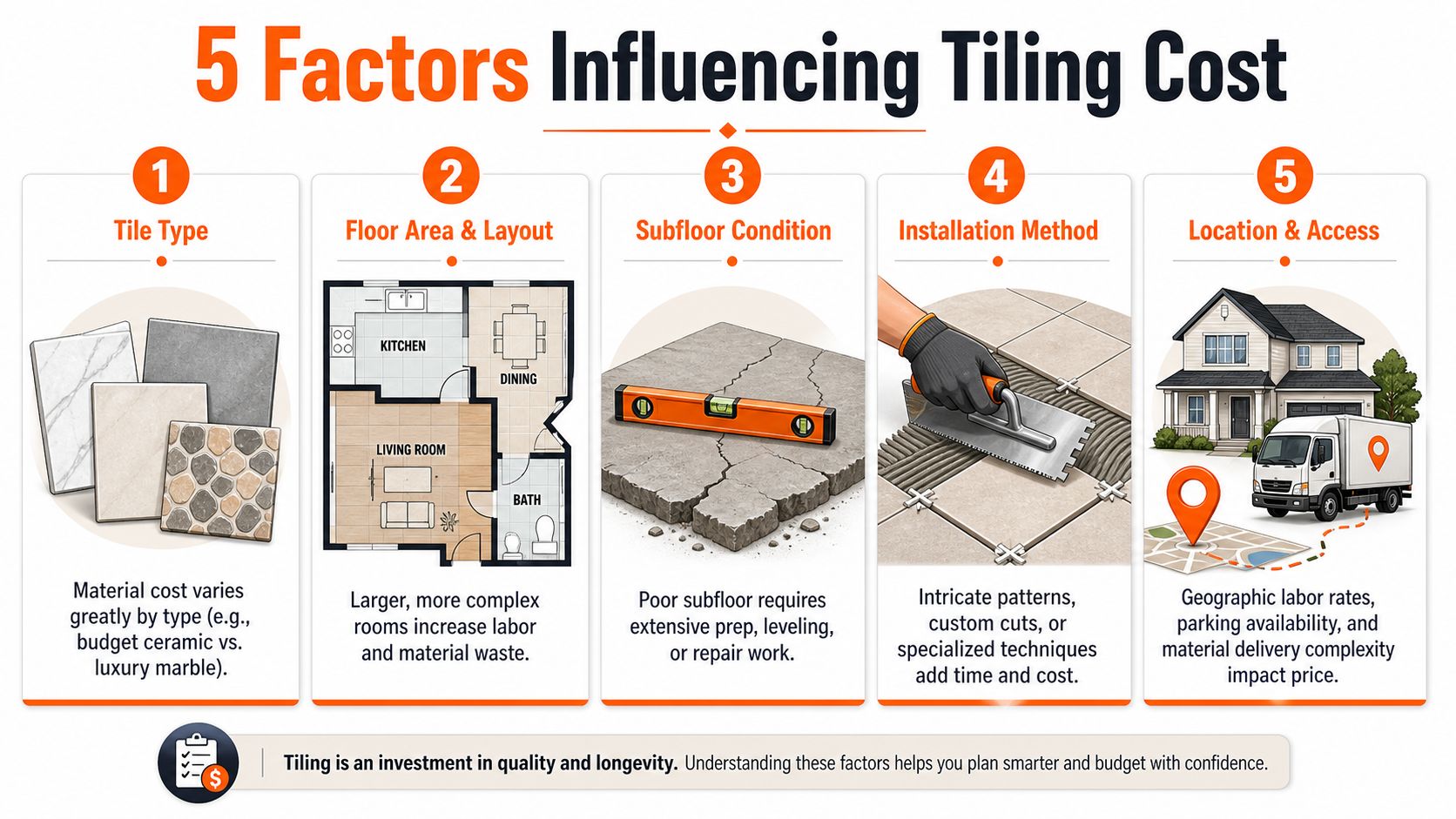
Tile type
Tile selection changes both material cost and output on site. Ceramic is usually faster to cut and install. Porcelain is denser and harder on blades. Natural stone adds sorting, sealing requirements in some cases, and tighter expectations around lippage, chipping, and visual consistency.
The National Tile Contractors Association explains in its tile and stone installation guidance that installation methods, substrate tolerances, and product handling vary by tile and stone type. That matters when pricing because the labor is not interchangeable. A quote that treats all tile as the same product usually leaves money behind.
Tile size
Large-format tile often slows the job down, not speeds it up. Bigger pieces mean flatter floors, cleaner layout control, more checking for lippage, and more time spent handling each unit without damaging edges.
The Tile Council of North America notes in its large-format tile technical guidance that larger tile demands tighter substrate flatness than standard tile. In practical terms, that means a floor that was acceptable for a smaller ceramic can become a problem floor once the client chooses 600 x 600 or larger. If the tile size changes after quoting, the labor rate should change with it.
Layout pattern
Pattern is one of the easiest places to underquote. Straight lay is usually the baseline. Brick bond can be simple or slow down fast, depending on tile size and offset limits. Diagonal layouts create more cuts around the perimeter. Herringbone and basketweave add layout time, waste, and more checking to keep joints clean.
As noted earlier, more complex patterns increase labor and waste. The point for quoting is simple. Name the pattern in writing. If the quote says only “floor tiling,” some clients will assume a feature layout is included, and you will be arguing about unpaid labor later.
Floor area and room shape
Open areas usually install faster per square metre than small rooms and chopped-up plans. A laundry, toilet, pantry, and hallway combo may have the same total area as one open living room, but the production rate is lower because there are more cuts, more starts and stops, and more time spent setting out around fixed points.
This is why square metre rates need context. Small jobs often need a higher rate, not because the work is better, but because setup, cutting, and finishing take a bigger share of the day.
Access and handling
Access affects labor more than many new contractors allow for. Stairs, lift bookings, restricted parking, long carries, occupied homes, and limited stacking space all reduce output. Heavy porcelain upstairs with no close parking can burn time before the first tile is laid.
Price access as part of production, not as an afterthought. If two men spend extra time hauling tile, adhesive, tools, and rubbish through a difficult site, that cost belongs in the quote.
Clients usually compare the tile line first. Professionals price the conditions around it. That is how you protect margin and explain, with a straight face, why your quote is higher than a low number that only priced the visible floor.
Uncovering Hidden Costs Most Quotes Miss
Subfloor problems ruin more tile job margins than almost anything else. They're also the part most low quotes conveniently ignore. A floor can look acceptable during a quick walkthrough and still need grinding, leveling, or moisture treatment before it's ready to take tile.
That's why experienced contractors don't price the visible finish only. They price the surface underneath it.
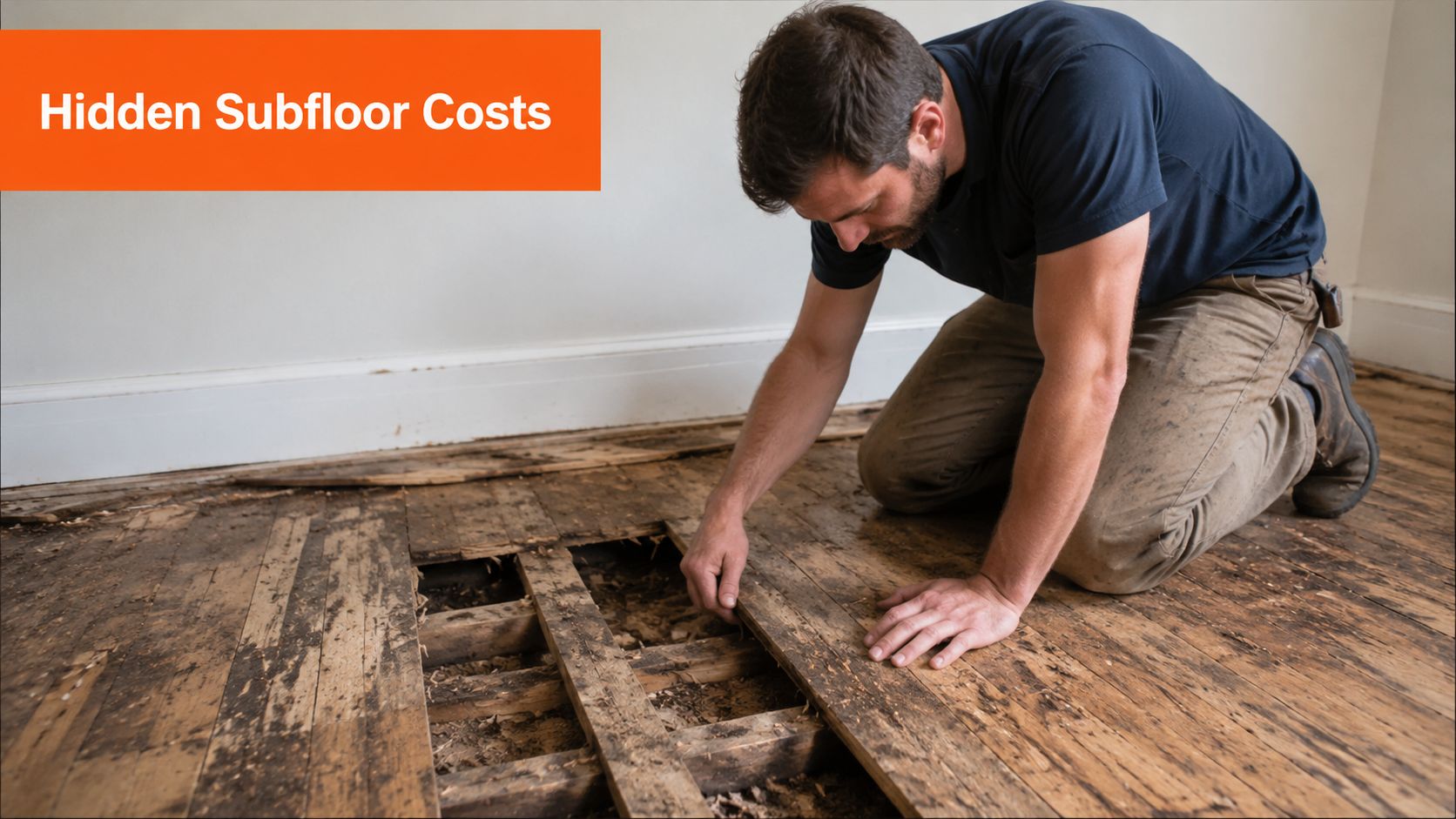
The prep work clients rarely see
According to DIYTileGuy's breakdown of overlooked tile project costs, subfloor preparation and remediation can add 20% to 40% to the total project budget. The same source lists concrete grinding at $2 to $5 per square foot and level underlayment at $3 to $7 per square foot, and says roughly 30% of tile project overruns stem from unquoted subfloor work.
Those numbers line up with what contractors see every week. The floor looks “mostly fine” until a straightedge goes down. Then the actual work becomes apparent.
What should trigger a pricing review
Look harder when you see:
- Old homes with multiple floor transitions: Previous finishes often leave dips, ridges, and patched sections.
- Visible cracks or soft movement: Even minor movement changes the installation approach.
- Rooms with recent plumbing or structural work: Repairs underneath often leave the surface uneven.
- Large-format or rectified tile selections: Tighter tolerances mean prep quality matters more.
A common mistake is giving a fixed quote before confirming level and substrate integrity. A better approach is to include a clear allowance or condition for prep where the floor can't be fully verified at inspection.
Cheap quotes often stay cheap by pretending the subfloor is perfect.
That approach might win the job. It usually loses money or trust later. If you have to stop halfway through and tell the client the floor needs extra work, the conversation gets harder. If you flagged the possibility early and documented it properly, the variation is easier to explain and much easier to approve.
How to Confidently Price a Tiling Job
You measure a kitchen at first glance, throw out a square-foot rate, and the job looks fine. Then the client picks a patterned porcelain, the doorway needs a clean transition, the floor runs out of level, and the margin disappears. That is how underpriced tile work happens.
Confident pricing comes from using the same process on every quote and building enough detail into the number that you can defend it when a client compares you to a cheaper installer.
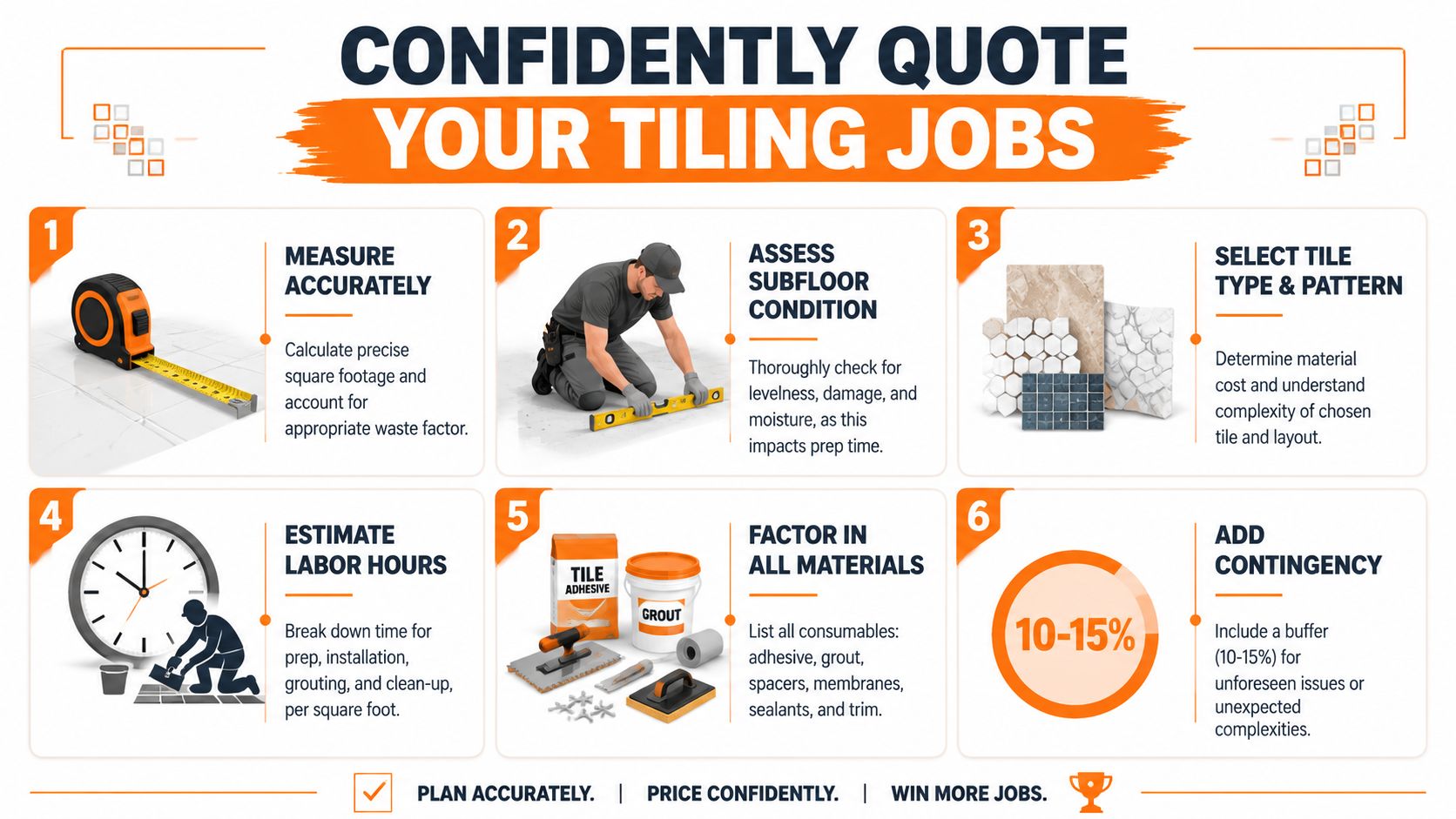
A practical quoting workflow
Measure the full scope
Measure the obvious floor area, then catch the parts that get missed in weak quotes. Pantry returns, toilet alcoves, islands, thresholds, cupboard cuts, and any skirting or trim detail all add time.Price the floor you have, not the floor you hope is there
Check level, flatness, cracks, moisture risk, previous coverings, and access. If the substrate cannot be fully verified at site visit, write that into the quote as an allowance or conditional item.Sort the job into the right labor class
Straight lay is one labor rate. Diagonal, plank offset, herringbone, large-format rectified tile, stone, and mixed-width layouts belong in different labor brackets because setting time, cutting time, and checking time all increase.Build the quote line by line
Include adhesive, grout, trims, primers, membranes, movement joints, leveling clips, wastage, delivery, pickup, and waste disposal. A professional quote shows where the money goes.Add your risk and overhead properly
Travel, quoting time, supervision, insurance, call-backs, and admin still cost money even when the client only looks at the install rate. Protecting margin starts before the first tile is laid.State assumptions in plain language
If the price depends on final tile size, pattern, substrate condition, or client-supplied materials arriving on time, write it down. That gives you a clean basis for variations later.
Use benchmarks as a check, not as the quote
Square-foot pricing is only a sense check. It is not a quoting method.
For a rough benchmark, the 2025 HomeGuide tile floor installation cost guide shows a wide installed range because material choice, prep, and labor complexity vary so much from one floor to the next. That is the point new contractors often miss. Benchmark ranges help you spot a number that is obviously too low or too high, but they do not replace a proper takeoff.
Pattern is a good example. The Tile Club guide to tile layout patterns shows how layouts like herringbone, diagonal, and Versailles create more cuts, more set-out time, and tighter visual expectations than a standard grid. On site, that means slower production, higher waste, and more checking at every stage. If you price a herringbone floor at the same labor rate as a straight lay, you are volunteering your margin.
Clients usually understand this once you explain it in work terms. More marking out. More cuts. More time on knees. More chance of visible error if the set-out is rushed.
A good quote also depends on accurate records after the job is won. If you do not track labour hours, consumables, and variations properly, you cannot tell whether your rates are working. That is why trade businesses often tighten their systems with guides on bookkeeping for a plumbing business and apply the same discipline to tiling quotes, job costing, and margin review.
Answering Your Customer's Questions About Tiling Costs
You hand over a quote at $4,800. Another tiler has come in at $3,600. The client looks at both numbers and asks the same question every contractor hears. Why is yours higher?
If you cannot explain that clearly, the job turns into a price argument. If you can, the discussion stays where it should be. Scope, risk, finish quality, and who is carrying the cost if the floor is not ready for tile.
Why is your quote higher than the other one
Answer this without knocking the other contractor. Keep it on scope.
A professional quote usually includes items that cheaper quotes leave vague. Floor prep. Waste allowance. Movement joints. Trim details. Cutting time around door jambs, islands, or toilets. Cleanup and cart-away. If those items are missing, the lower number can look better on paper and cost more once the work starts.
A simple way to put it is:
“I've priced the job based on the floor condition, the tile you've chosen, and the finish you expect. If another quote is lower, it usually means the scope is different, the prep is lighter, or some items have been left to variation later.”
That answer protects your margin and sounds reasonable to the client.
Can't you just give me a flat square-foot rate
You can give a guide rate, but a flat rate is not a proper price.
Room size matters less than access, set-out, tile size, pattern, and how much cutting is involved. The National Tile Contractors Association explains in its tile layout pattern guide that patterns such as herringbone require more planning, more cuts, and tighter layout control than a straight lay. That is the kind of detail clients need explained. Two floors with the same area can take very different labour hours.
If a client pushes for a square-foot number, give them a range and tell them what could move it up. That keeps you from locking in a bad rate before you have checked the substrate and measured the job properly.
Can we save money if we buy the tiles ourselves
Sometimes. Sometimes it creates more cost than it saves.
Client-supplied tile often causes trouble in three places. Wrong quantities. Mixed batches. Delays when damaged boxes or short stock need to be replaced. If you are not clear about responsibility, those problems land on your labour schedule.
Set the terms in writing:
- If the client supplies tile: state that quantities, shade variation, breakage, and supply delays sit with them.
- If you supply tile: include ordering, waste allowance, and replacement handling in your price.
- If the client wants the cheapest tile available: explain that uneven sizing, warped pieces, or fragile finishes can slow the install and increase labour.
Cheap tile can be expensive to lay. Good clients understand that once you explain it in work terms.
Why are you asking so many questions about the floor underneath
Because the substrate decides whether the job holds up.
Clients focus on the tile they can see. Contractors get called back for the floor they cannot. A slab that is out of level, timber with too much movement, old adhesive, cracked screed, or moisture problems all change the scope. If you skip those checks to keep the quote low, you are pricing for a best-case job on a floor that may not exist.
Use plain language:
“The tile finish is only as good as the surface under it. If the floor needs grinding, levelling, waterproofing, or crack isolation, I need to price that now instead of surprising you halfway through the job.”
That is usually the moment the client sees the difference between a quick number and a professional quote.
Why does the pattern or tile type change the price so much
Because labour changes.
Large-format tile can mean more lippage control and more time handling each piece. Small mosaics can mean more sheet alignment and more grout work. Rectified porcelain needs tighter joints and cleaner set-out. Natural stone often needs extra care, sealing, and better substrate tolerance. Patterned layouts slow production even when the room is simple.
This is one of the easiest parts of the quote to defend because the client can see it. Show them the layout. Point to the cuts. Explain where the time goes.
GrowTradie helps trade businesses stay visible without having to stop and write posts between jobs. If you want a practical way to keep your business active online, build trust locally, and stay in front of the right customers, have a look at GrowTradie.