
You're busy quoting jobs, chasing parts, answering the phone, and trying to get to the next call on time. Then someone tells you to “do more digital marketing” as if you've got half a day spare to sit behind a laptop.
Most plumbing contractors don't need a grand marketing strategy. They need a simple setup that gets found locally, builds trust fast, and turns online attention into booked work. That's the only version of digital marketing for plumbing contractors that matters.
The good news is the basics still do most of the heavy lifting. If your local profile is tight, your website is clear, your reviews are active, and your ads are set up properly, you can generate more calls without turning yourself into a full-time marketer.
Table of Contents
- Build Your Digital Foundation for Local Calls
- Use Customer Reviews to Win More Jobs
- Stay Visible Between Jobs with Simple Content
- Get Immediate Calls with Simple Paid Ads
- Know What Works by Tracking Your Leads
- Automate Your Content and Focus on Your Trade
Build Your Digital Foundation for Local Calls
If your digital setup is weak, everything else leaks money. Ads won't save a bad first impression, and word of mouth won't help much if people can't find you or can't work out how to contact you.
Think of your online presence like your shopfront. For a lot of local customers, your Google Business Profile and your website are the whole business until they call you. That's where they decide whether you look legit, available, and worth trusting with an urgent problem.
Treat your profile and website like your shopfront
Google Maps matters first. 68% of consumers use Google Maps to locate a nearby plumbing business, which makes local mobile discovery the main path for both emergency and routine calls in plumbing, according to these plumbing marketing statistics.
That means your profile needs the basics done properly:
- Business name and phone number: Keep them exact and consistent everywhere.
- Service areas: List the suburbs and regions you cover.
- Services: Add specific job types, not just “plumbing.”
- Photos: Real van shots, job photos, team photos, branded uniforms.
- Hours: Include emergency availability if you offer it.
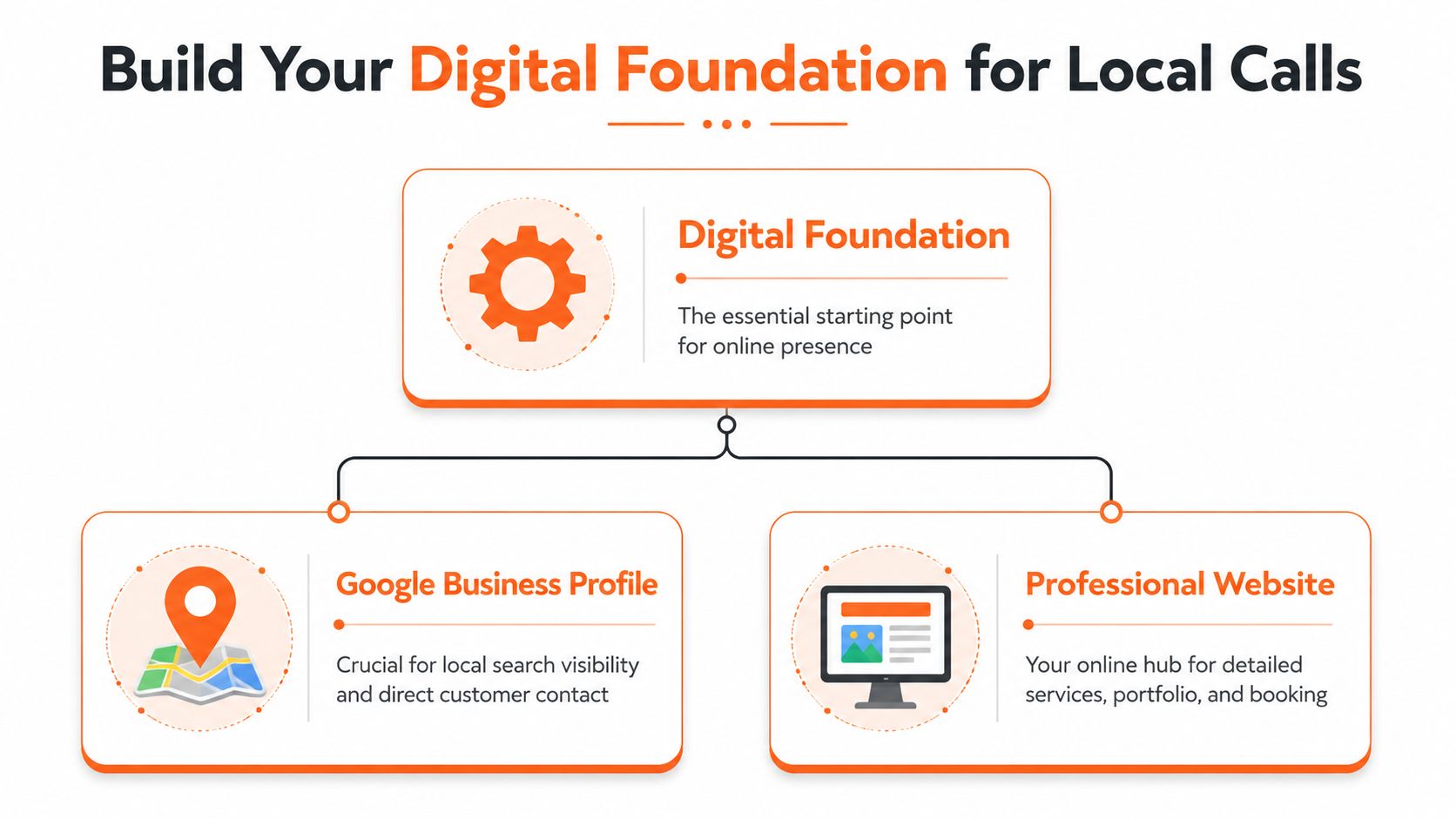
A strong local presence starts with getting found where people are already looking. If you want a practical breakdown of local visibility tactics for plumbers, this guide on plumber local marketing is a useful reference.
Practical rule: Don't spend on ads until your profile is complete, accurate, and active.
What your website must do
A plumbing website doesn't need fancy animation, a custom illustration budget, or ten pages of corporate language. It needs to answer a stressed customer's questions fast.
Use this checklist:
| Website element | Why it matters |
|---|---|
| Phone number at the top | People shouldn't need to hunt for it |
| Service list | Visitors need to know you handle their job |
| Suburb or service area details | Confirms you're local |
| Mobile-friendly layout | Most people are searching from a phone |
| Simple contact form | Gives a second option if they can't call immediately |
| Trust signals | Reviews, licences, insurance, and real photos reduce hesitation |
Keep the wording plain. “Hot water repairs,” “blocked drains,” “burst pipes,” “gas fitting,” and “emergency plumbing” work better than vague taglines.
Your website isn't there to impress other plumbers. It's there to help a customer decide to call you.
If the site loads badly on mobile, hides the phone number, or buries the services halfway down the page, it loses work. Simple wins here. Clear beats clever every time.
Use Customer Reviews to Win More Jobs
A homeowner has water on the floor, three plumbers open in separate tabs, and five minutes to choose. At that point, reviews do a lot of the selling for you.

Plumbers often treat reviews as a nice extra. They are closer to proof of work. A customer already knows what service they need. They want to know whether you turn up, fix the problem properly, leave the place tidy, and charge in a way that feels fair.
That is why reviews affect jobs in a practical way:
- They lower hesitation: People feel safer calling someone other locals have used.
- They answer the questions customers rarely ask out loud: Did you arrive on time? Were you respectful in the home? Did the fix hold up?
- They make your price easier to accept: Trust takes some of the heat out of price shopping.
If you want a simple system for getting more enquiries, this guide on the best way to get plumbing leads fits that approach well.
How to ask without making it awkward
The best time to ask is right after the job, when the stress is gone and the customer can see the result. Do not leave it for next week. By then they have moved on, and you are back to chasing.
Keep the ask short. Use words you would say on site.
“Glad we got that sorted for you. If you've got a minute, a quick review helps other local customers know we're worth calling.”
Then send a text with the direct review link. That step matters. If they have to search for your business and work it out themselves, a lot of good intentions die there.
A simple routine works better than bursts of effort. Ask after every completed job where the customer is clearly happy. You do not need dozens overnight. You need a steady flow that shows the business is active and reliable.
After you've built that habit, this video gives some practical context on handling reviews and online reputation:
What to do with bad reviews
Bad reviews happen. Some are fair. Some are missing half the story. The public reply still matters because future customers are judging how you handle pressure, not just whether one job went wrong.
Use a simple process:
- Acknowledge the issue clearly: Start with the customer's experience, not your defence.
- Keep the tone professional: One irritated reply can do more damage than the review itself.
- Offer a direct path to fix it: Give a phone number or email and invite them to continue privately.
- State facts briefly if needed: Correct obvious errors without turning the reply into an argument.
Long defensive responses usually backfire. A calm, short reply shows you run a proper business.
Reviews are one of the few marketing jobs that keep working after hours. Set up the ask once, make it part of the handover, and let your customers help you win the next call.
Stay Visible Between Jobs with Simple Content
A silent profile makes a business look half-active. That's a problem when a customer is comparing a few local plumbers and one of them looks current while the others look abandoned.
This part of digital marketing for plumbing contractors doesn't need to be complicated. You don't need polished video shoots or clever campaigns. You need signs of life.
A content routine that doesn't eat your week
The easiest way to stay visible is to keep a small repeatable routine. Not daily. Not constant. Just enough to show that your business is active and working in the area.
A workable routine looks like this:
- One job photo post: Show a finished result, a work vehicle, or a team member on site.
- One simple tip post: Explain when to call a plumber, what signs to watch for, or what to do before you arrive.
- One service reminder: Mention a core service and the areas you cover.
That's enough for most contractors. Consistency matters more than creativity.
A dead profile makes people wonder if the phone still works.
Keep the posts plain. Use real language. “Blocked stormwater drain cleared in North Lakes today” works. So does “Hot water unit replaced for a local family before lunch.” Short, specific, and local is better than generic fluff.
What to post when you have no ideas
Most plumbers run out of ideas because they think every post has to be original. It doesn't. You're documenting normal work, not producing a TV series.
Use a short list and rotate it:
| Post type | Example |
|---|---|
| Recent job | Replaced leaking tap set in a local home |
| Common problem | Signs your hot water system is on the way out |
| Seasonal reminder | Check outdoor drains before heavy rain |
| Team post | Meet the technician handling after-hours calls |
| Service area post | Now servicing nearby suburbs this week |
Take photos as you go. Keep a folder on your phone. If the photo is clear and the caption tells people what happened, that's enough.
The trap is overthinking it. If you wait until you have time to sit down and “do content properly,” it won't happen. A simple system beats good intentions every time.
Get Immediate Calls with Simple Paid Ads
A homeowner finds water spreading across the laundry floor at 7:10 pm. They are not reading blog posts. They are not comparing five plumbers. They are searching, tapping, and calling the first business that looks nearby, available, and credible.
That is the job of paid ads. They put you in front of urgent buyers while your longer-term marketing does its work in the background.
For plumbing businesses, this paid ads guide for plumbers is a practical starting point if you want the setup explained in plain English.
Use ads for jobs with strong intent. Emergency callouts, blocked drains, burst pipes, no hot water. Those leads are expensive, but they are also the ones most likely to book fast if you answer.
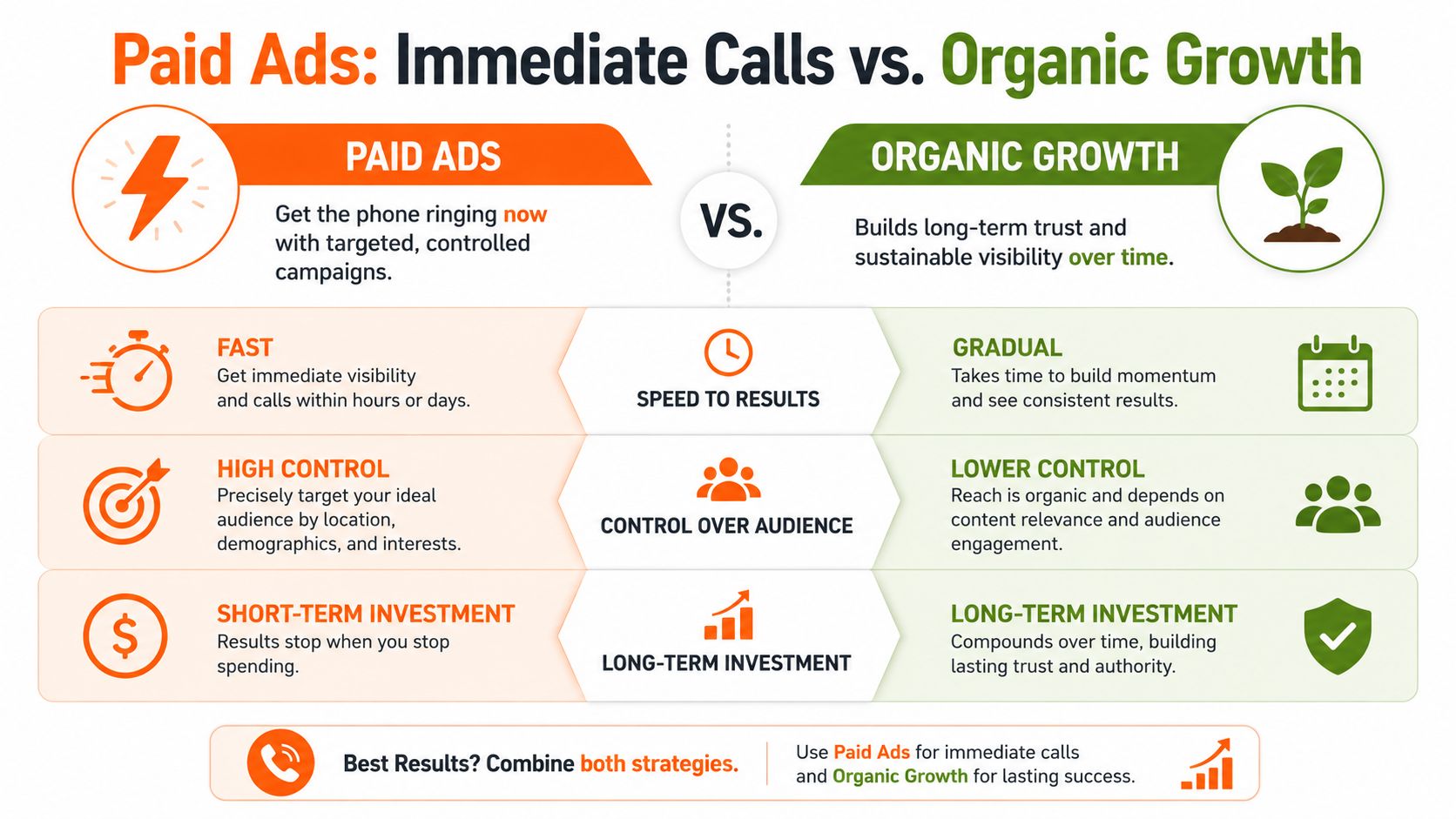
Google Local Services Ads can suit plumbers well because they sit at the top of the results and focus on lead generation, rather than paying for every website visit. Standard Google Ads still have a place too, especially if you want tighter control over service keywords and landing pages.
The trade-off is simple. Ads give speed. Your website, reviews, and local presence give staying power. If the budget is tight, put ad spend behind urgent, high-value work first instead of trying to advertise every service at once.
What a tight ad setup looks like
Loose targeting burns cash. Tight targeting brings better calls.
A good setup is usually boring. That is a good sign. It means the account is focused on service areas you cover, search terms tied to real plumbing problems, and ads that push people to call now. Geek Powered Studios makes the same point in its plumbing marketing checklist.
Keep the structure simple:
- Limit the map: Only target suburbs you can reach profitably and quickly.
- Split urgent from non-urgent: Emergency plumbing should not share ads with general maintenance.
- Make calls easy: Use call-focused ads and a phone number people can tap once.
- Match the page to the job: Send blocked drain clicks to a blocked drain page, not your homepage.
If the ad says "24/7 emergency plumber" and the page looks generic or slow, people leave. You still pay.
Capacity matters too. I have seen contractors blame ads when the underlying problem was missed calls, slow callbacks, or no one answering after hours. Paid ads work best when someone can pick up quickly, or return the call within minutes. In this channel, response time is part of the campaign.
Know What Works by Tracking Your Leads
Marketing feels expensive when you can't tell what produced the job. It feels a lot better when you know which calls came from your local profile, which came from your website, and which came from paid ads.
You don't need a complicated reporting stack for this. Most plumbing contractors need a simple habit and a clean record.
Stop guessing where jobs came from
Start with the question every new lead should hear:
“How did you hear about us?”
Ask it on every call. Ask it on every form follow-up. Ask it even if you think you already know. Customers will often tell you more than one touchpoint. They might say they saw your profile first, then checked your reviews, then called from the website.
That matters because digital marketing for plumbing contractors is rarely one-step. A person might find you in one place and convert in another.
Use basic lead categories such as:
- Google profile
- Website
- Paid ad
- Referral
- Repeat customer
- Social media
A simple lead tracking sheet beats fuzzy memory
You can track this in a spreadsheet, job management software, or even a shared note if you're small. The format matters less than using it every time.
Try this simple structure:
| Lead date | Customer name | Suburb | Lead source | Job type | Booked |
|---|---|---|---|---|---|
| Date | Who called | Where they are | What they said | Blocked drain, hot water, leak | Yes or no |
After a few weeks, patterns start to show. You'll see which source brings emergency calls, which source brings better-quality jobs, and which one sounds busy but doesn't convert.
There's another practical layer. Use separate call tracking numbers where possible, or at minimum separate contact paths for different campaigns, so you can tell whether the call came from a paid ad or your website. Keep it simple. You're not trying to build a data lab. You're trying to stop throwing money at channels that don't book work.
Good tracking doesn't need to be clever. It needs to be consistent.
This is the point where a lot of contractors improve fast. Not because they suddenly become marketers, but because they stop guessing.
Automate Your Content and Focus on Your Trade
The biggest problem with marketing for most plumbers isn't knowledge. It's time.
The plumbing industry is made up largely of small operators. More than 60,000 small and medium-sized plumbing businesses in the United States employ fewer than five people, according to these plumbing industry statistics. That's exactly why low-hassle systems matter. Small crews don't have spare staff sitting around to manage posting and follow-up.
Why consistency is the real problem
Most contractors can post for a week or two. Then the actual work gets in the way. Jobs run over. The phone goes mad. Someone calls in sick. Content disappears for a month.
That inconsistency costs trust. A customer checks your profiles and sees nothing recent. They don't know whether you're flat out, disorganised, or barely operating. Silence creates doubt.
The answer isn't “work harder on marketing.” It's to remove manual effort where you can.
Use tools to stay active without doing it manually
Software earns its keep. If a platform can create trade-specific posts, schedule them, and keep your profiles active without daily input from you, it solves the part most plumbers struggle with.
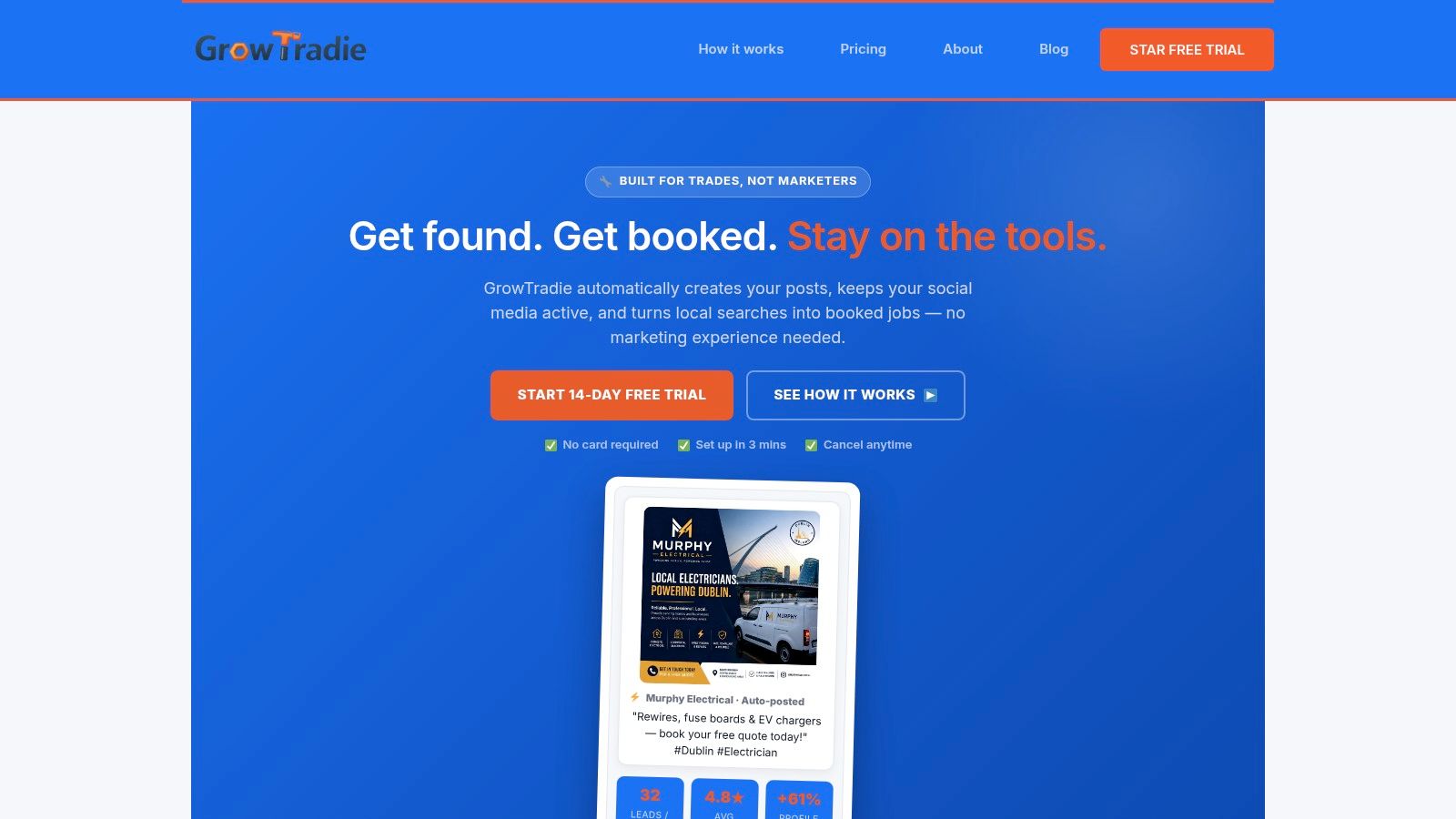
For example, GrowTradie is built for trade businesses that want content created and posted automatically based on their trade, services, and local area. That kind of setup is useful when you want steady visibility without writing captions yourself or remembering to post between jobs.
Use automation carefully:
- Automate routine visibility: Regular service posts, local updates, and branded content.
- Keep manual control for key moments: Big reviews, unusual jobs, team updates, and customer wins.
- Review what's going out: Even automated content should still sound like your business.
A contractor doesn't need a complicated content department. They need a system that keeps the business visible while they stay focused on quoting, site visits, and getting the work done properly.
If you want a practical way to stay visible online without doing all the posting yourself, GrowTradie offers a simple option for trade businesses that need steady, local content running in the background while the team stays focused on jobs.