
Your heat's out, the water heater is acting up, or you've found a leak near equipment that already gives you enough trouble. You grab your phone, type in HVAC plumber near me, and get hit with a wall of companies claiming they do everything. In that moment, most homeowners make the same mistake. They assume the first company that lists both services can handle both properly.
That's where people get burned.
A lot of jobs sit right on the line between HVAC and plumbing. Boiler piping, hydronic heating, condensate drainage, water heater venting, gas line coordination, and combo system troubleshooting all need the right license, the right experience, and clear responsibility. If one company sells the job and then hands half of it to someone else, you can end up with finger-pointing, warranty gaps, failed inspection issues, and one expensive return visit after another.
A calm process beats a rushed guess every time. You don't need to know the trade inside out. You just need to know what to ask, what to verify, and what should make you walk away.
Table of Contents
- From Panic to Plan When You Need a Pro
- Building Your Shortlist of Local HVAC Plumbers
- How to Verify Credentials and Avoid Costly Mistakes
- A Checklist of Questions for Your Top Candidates
- Understanding Quotes and Spotting Red Flags
- Final Checks and Making the Right Call
From Panic to Plan When You Need a Pro
It usually starts at the worst time. The AC quits during a hot stretch. A boiler line starts leaking. The water heater won't vent properly and now you're not sure whether to call an HVAC tech or a plumber. You search fast because the house is uncomfortable and you want somebody on the way.
That urgency is real, but panic makes people skip the basics. They hire the first company with a friendly dispatcher, or the cheapest ad, or the one that says "we do it all" without asking what that means.
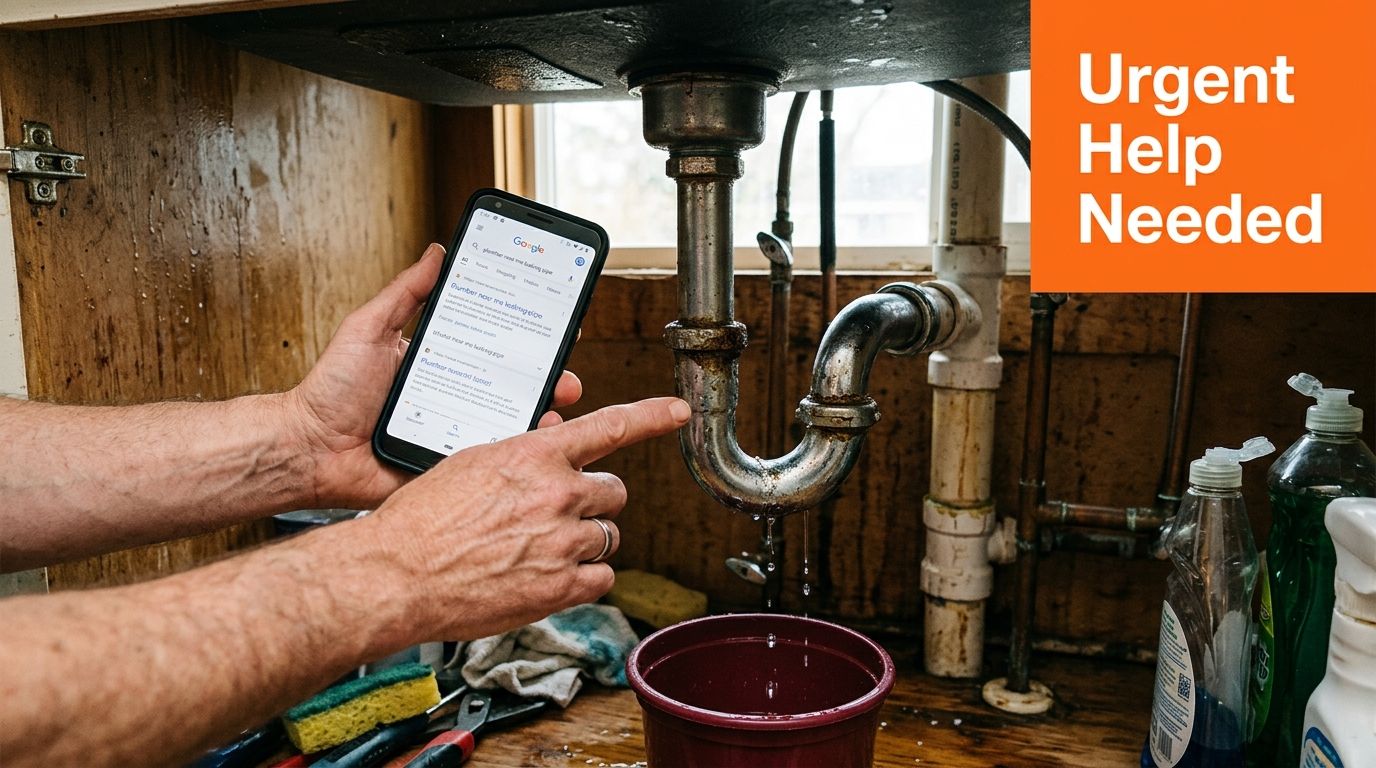
A better approach is simple. First, figure out whether your problem is mainly heating and cooling, mainly plumbing, or a mixed job. Then build a short list, verify credentials, ask direct questions, compare written quotes, and book the company that gives clear answers without dancing around responsibility.
What mixed jobs usually look like
A lot of homeowners don't realize how often systems overlap. Common examples include:
- Water heater venting issues: The unit involves water, gas, venting, and code.
- Boiler and hydronic trouble: These jobs can involve pumps, pressure, piping, controls, and heat distribution.
- Condensate drain problems: Especially around furnaces and air handlers.
- Gas line work tied to HVAC equipment: Furnaces, boilers, and some water heaters depend on proper connection and testing.
Practical rule: If the problem touches both pipes and heating equipment, don't assume one generic service ad means one properly licensed crew.
The good news is that this doesn't need to become a guessing game. A few smart checks will tell you very quickly whether you're dealing with a real dual-trade company or just a company with a wide ad budget.
Building Your Shortlist of Local HVAC Plumbers
Start small. You don't need fifteen names. You need three to five companies that look credible enough to call.
The U.S. HVAC and plumbing contractor industry includes over 107,000 companies employing more than 1.3 million workers, and the average contractor has around 12 workers, which tells you this is still a local, crew-based business in many markets, not just big national operators (Vertical IQ on HVAC and plumbing contractors). That's why your shortlist matters. A smaller local outfit can be excellent, but only if they match your job.
Where to look first
A broad search is fine for the first pass, but don't stop there. Use a few channels and look for overlap.
- Local search results: Good for finding who services your immediate area.
- Neighborhood groups and community forums: Useful for seeing who people call again after a hard job.
- Word of mouth: A referral from someone with a similar house, older boiler, slab leak history, or tricky water heater setup is worth more than a generic recommendation.
- Trade-focused business pages: If you want to see how trade businesses present specialist services, GrowTradie's HVAC plumber page is a useful example of how clearly a company should describe what it does.
How to read reviews without getting fooled
Star ratings help, but they don't tell the full story. Read the bad reviews first, then the company responses.
Look for patterns such as missed appointments, poor communication, vague billing, or the company blaming another subcontractor after the work goes wrong. One angry review isn't the issue. Repeated complaints with the same shape usually are.
A few things carry more weight than praise like "great service":
| What to look for | Why it matters |
|---|---|
| Reviews mentioning the exact type of job | It tells you they've handled your kind of problem before |
| Owner or manager replies to complaints | You see how they handle problems under pressure |
| Mentions of permits, inspections, or code fixes | That points to real project experience, not just basic service calls |
| Repeat customers | Good sign in a trade where homeowners remember bad work for years |
Good companies don't just collect positive reviews. They answer hard questions clearly and leave a paper trail that makes sense.
Keep your shortlist tight
Once you've got a few names, cut anyone who looks vague about licensing, can't explain their service area clearly, or seems to advertise every trade under the sun without specifics. The point isn't to collect options. The point is to remove weak ones before they waste your time.
How to Verify Credentials and Avoid Costly Mistakes
This is the step often rushed, and it's the step that prevents the worst outcomes.
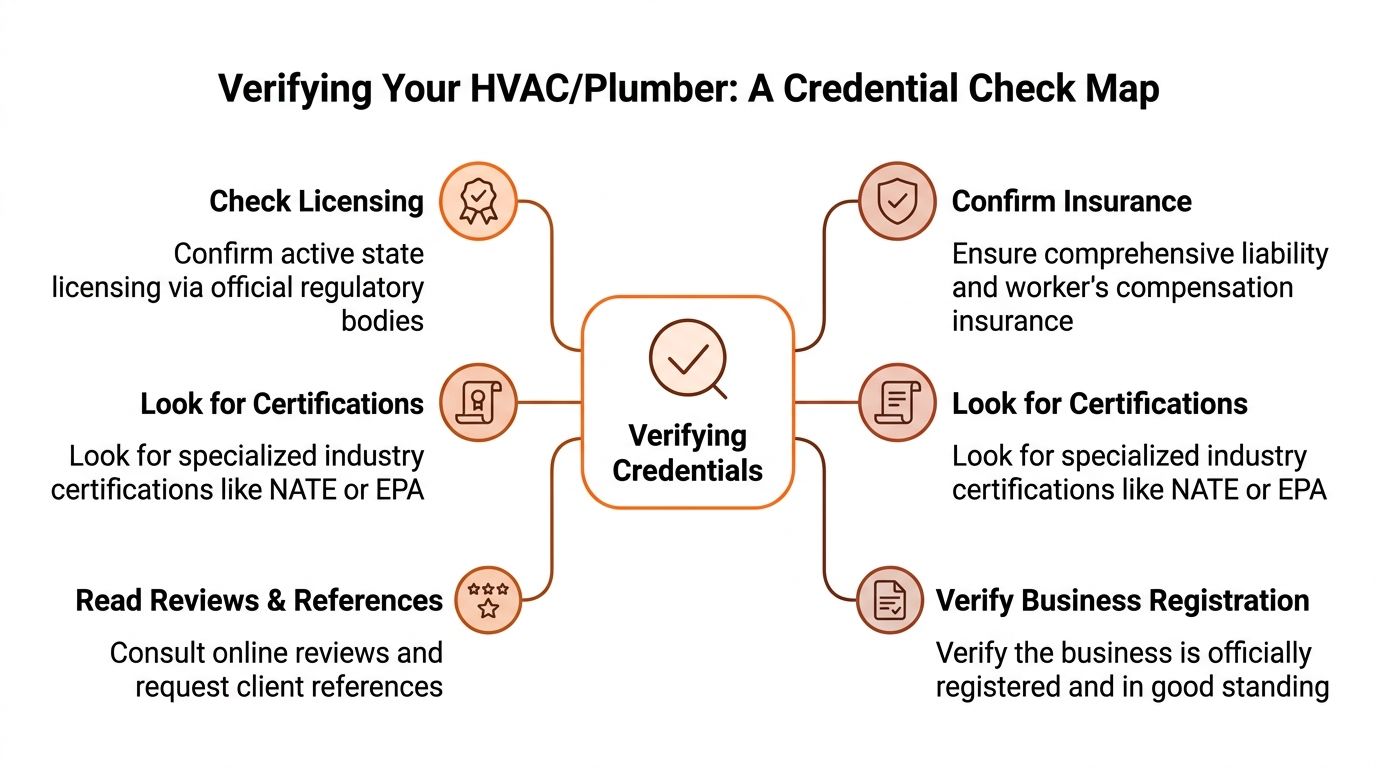
If a job touches both HVAC and plumbing, "licensed and insured" isn't enough as a general phrase. You need to know which license, for which scope, and under which business entity. That's where homeowners get trapped by dual-service marketing.
Start with this credential map before you book anyone.
Check the actual license, not just the logo
A truck decal, a badge on a website, or a verbal promise doesn't prove much. Go to your state or local licensing board and verify that the company's license is active and appropriate for the work. Then ask whether the technician assigned to your job works under that license directly or through another arrangement.
42% of local HVAC technicians lack the specific plumbing credentials required for jobs such as water heater ventilation, and dual-licensed contractors resolve complex issues at an 89% success rate compared with 64% for single-discipline providers according to the Times Union credential discussion on HVAC companies. If the job overlaps, the license overlap needs to be real too.
Ask the question most homeowners never ask
A lot of companies advertise both trades. Far fewer hold both capabilities in-house.
Ask this exactly: "Are your HVAC and plumbing technicians licensed under the same physical entity, or are you subcontracting one?"
If they hesitate, get fuzzy, or answer with sales language instead of a direct explanation, slow down. You want to know who owns the job from start to finish, whose insurance applies, and who stands behind the work if something fails.
If two companies touch one problem and neither owns the whole result, the homeowner usually ends up in the middle.
Confirm insurance and business identity
Licensing is one layer. Insurance is another. Ask for proof of liability coverage and worker's compensation coverage where required. Also confirm the business name on the quote matches the licensed entity and matches the insurance paperwork.
That sounds basic, but mismatched business names are where disputes start. If the invoice says one thing, the truck says another, and the installer says he works "with" the company, stop and sort it out before anyone turns a wrench.
A useful reference if you're trying to understand the licensing path itself is this guide on how to get your plumbing license. Even as a homeowner, it helps to see that plumbing credentials aren't casual add-ons.
A quick walkthrough can help you spot what solid verification looks like in practice.
What a proper verification call sounds like
A legitimate office should be able to answer these without circling:
- Which license covers my job
- Whether permits are required
- Whether your company self-performs both trades
- Who the technician reports to
- What happens if a code issue appears once work starts
If they say, "We'll figure that out when we get there," that's not reassuring on a mixed trade call. That's a warning.
A Checklist of Questions for Your Top Candidates
Once you've narrowed the field, the phone call should feel like a fact-finding conversation, not a sales contest. You're trying to learn how they think, how they explain problems, and whether they own the whole job.
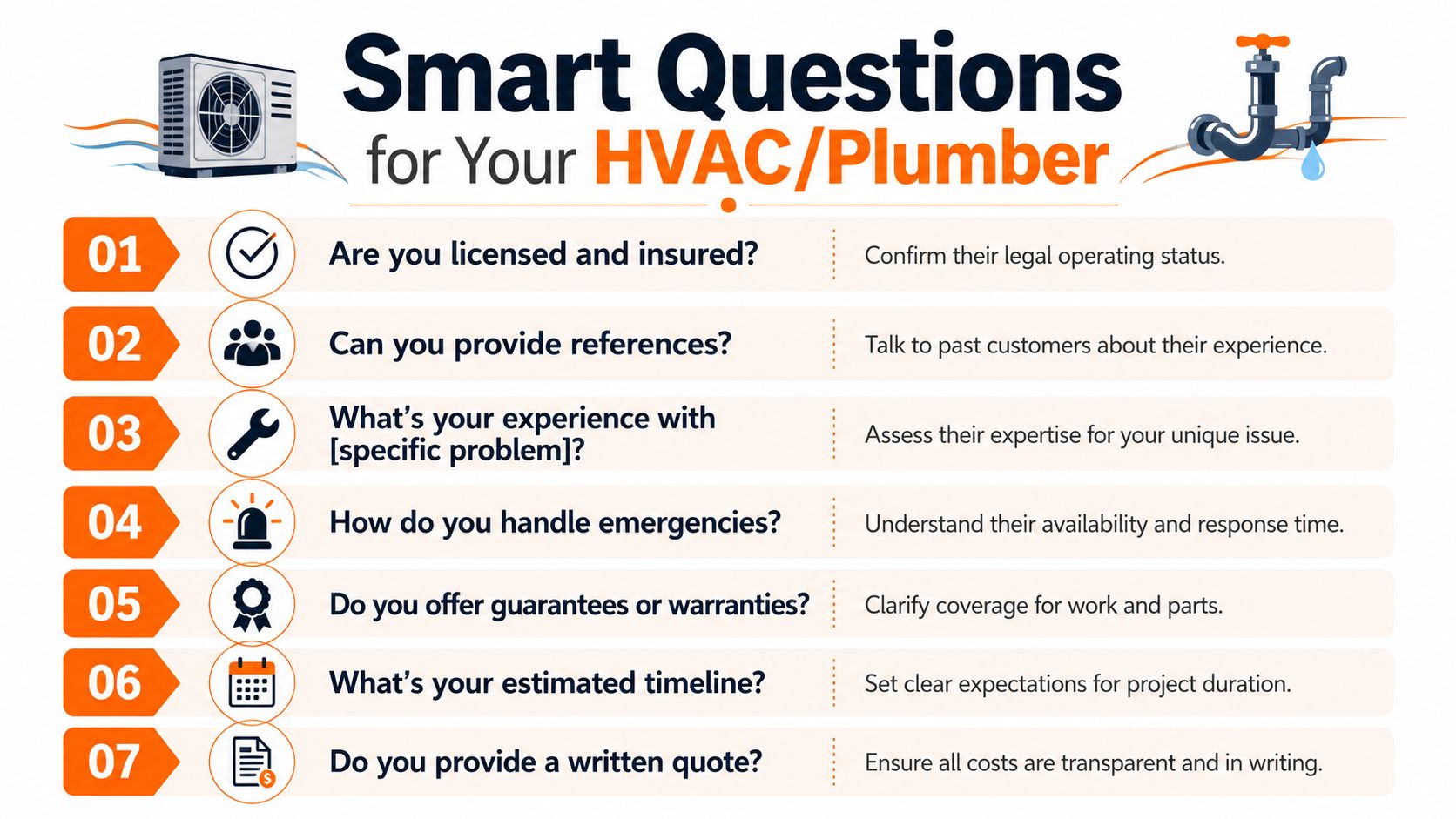
Use this as your call sheet.
The question that exposes the dual-service trap
This one goes first because it changes the meaning of every other answer.
Are your HVAC and plumbing technicians licensed under the same physical entity, or are you subcontracting one?
That's not nitpicking. State licensing board data indicates that 70% of "dual-service" companies subcontract one discipline, which can create fragmented warranties and liability issues, as noted in Local Plumber HVAC's FAQ discussion of dual-service companies. If they subcontract, ask who that company is, who supervises them, and whose warranty applies.
The questions worth asking on every call
Don't machine-gun through a script. Ask naturally and listen for direct answers.
- What's your experience with this exact problem? Boiler piping is not the same as swapping a faucet. A condensate issue at an air handler is not the same as a drain clog.
- Will you provide a written scope before work starts? You want the problem, proposed fix, exclusions, and any allowance for unknowns in writing.
- Who pulls permits if needed? A solid company won't act annoyed by that question.
- What warranty do you provide on labor, and what comes from the manufacturer? Parts and labor are not the same thing.
- If you open the job and find a second issue, how do you handle approval? The answer should involve your sign-off, not surprise charges.
- Who will be on site? Employee, lead tech, apprentice, subcontractor. Names and roles matter.
- How do you handle callback problems? You want to hear ownership, not excuses.
Ask calm, ordinary questions. Evasive answers tell you more than polished ones.
What strong answers sound like
A good contractor usually speaks plainly. They say what they know, what they need to inspect, and what might change once they open the system.
A weak contractor tends to do one of two things. They either overpromise fast, or stay so vague that nothing can be held against them later.
Here's a simple comparison:
| Response style | What it usually means |
|---|---|
| Clear scope, direct limits, written follow-up | Professional and organized |
| "We do it all" with no detail | Sales first, operations second |
| Explains permit and code responsibility | Understands accountability |
| Dodges questions about entity, staff, or warranty | Risk of subcontract confusion |
If you're choosing between a slick pitch and a precise answer, take the precise answer every time.
Understanding Quotes and Spotting Red Flags
A quote isn't just a price. It's a snapshot of how the company runs jobs.
Some contractors use flat-rate pricing for well-defined repairs. Others bill hourly plus materials when the problem is open-ended, hidden, or likely to change once they get into the work. Neither model is automatically better. What matters is whether the quote fits the job and whether the contractor explains the assumptions.
This visual sums up the trade-off.
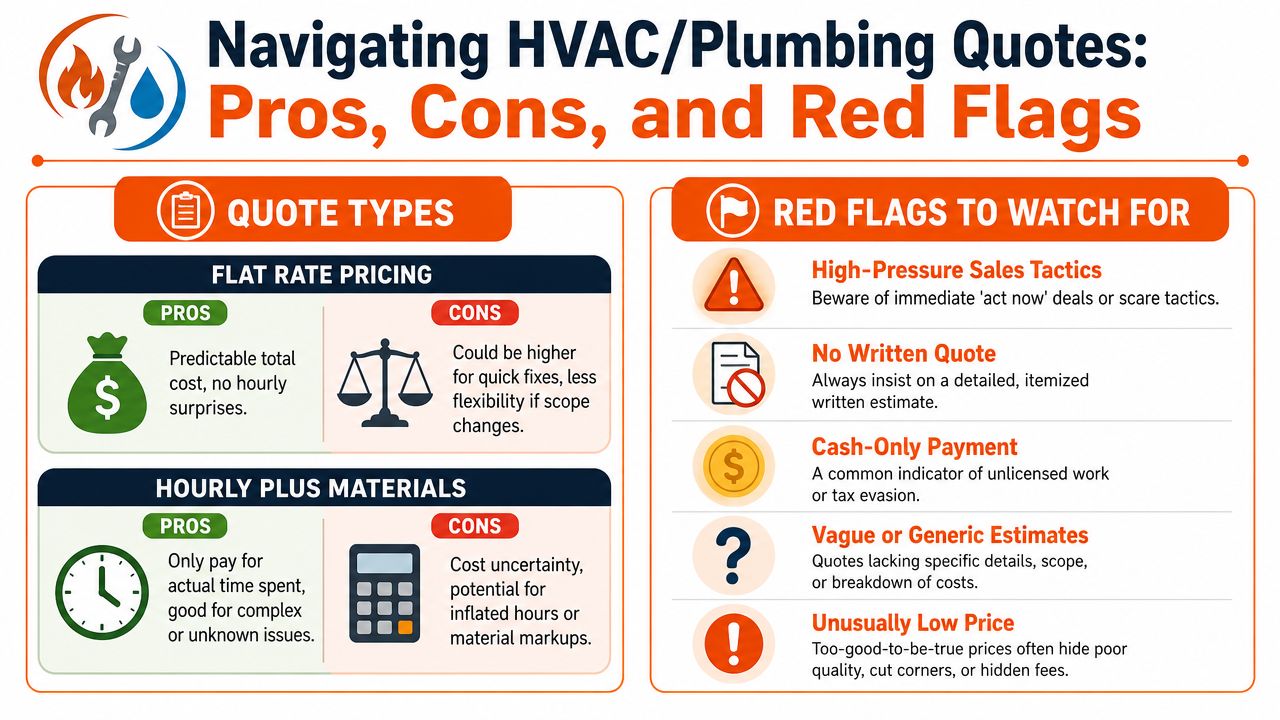
Flat rate versus hourly
For a standard replacement or a familiar repair, flat rate can make sense. You know the total before the work starts, and the contractor carries the risk if the job takes a bit longer than expected.
Hourly billing can make more sense when access is poor, the fault isn't fully diagnosed yet, or the system has been altered over the years and no one knows what they'll find behind a wall or inside a mechanical space.
| Quote type | Usually works best when | Watch out for |
|---|---|---|
| Flat rate | Scope is clear and repeatable | Vague exclusions or unclear change-order terms |
| Hourly plus materials | Troubleshooting or uncertain scope | No labor tracking, broad material markups, loose time estimates |
If you want a cleaner written format for comparing scopes side by side, even a simple template helps. Something like this estimate template example shows the level of structure you should expect, even if your project isn't painting-related.
Green flags and red flags
The easiest way to read a quote is to separate professionalism from pressure.
Green flags
- Itemized scope: You can see what they're doing and what they're not doing.
- Written assumptions: If hidden damage or code corrections might change the price, they say so upfront.
- Payment terms that make sense: Deposit, progress, and final payment are spelled out.
- Named responsibility: You know which company is doing the work.
Red flags
- Pressure to sign immediately: Especially when the explanation is thin.
- No written quote: Verbal prices drift.
- Cash-only demands: That's often a sign the paper trail matters to them for the wrong reasons.
- Very low number with no detail: Cheap can get expensive fast when the scope wasn't honest.
- Generic wording: "Repair as needed" isn't a real description of work.
A good quote makes disagreement less likely later. A bad quote leaves room for blame, extras, and memory games.
Don't compare totals only
Compare scope against scope. One company may include disposal, permit handling, testing, startup, and minor materials while another leaves all of that out. The lower quote might just be the thinner quote.
When you're looking for an HVAC plumber near me, the safest hire is usually not the fastest talker or the lowest number. It's the company that describes the job in a way another professional could read and understand.
Final Checks and Making the Right Call
Before you book, pause for one last review. Confirm the company name on the quote matches the licensed and insured entity you verified. Make sure the scope is written clearly. Check that the warranty terms are understandable. If the job crosses trades, confirm again who is doing each part and who owns the result.
For an emergency call, have a few details ready before you pick up the phone:
- Your exact symptom: No cooling, leaking relief valve, no hot water, boiler pressure issue.
- What you've observed: Sounds, smells, visible water, error code, tripped breaker, pilot issue.
- What you've already shut off: Water, thermostat, equipment switch, gas if directed and safe.
- Photos of the area: Helpful when dispatch is deciding who to send.
Trust your judgment too. If one company gave straight answers, respected your questions, and put things in writing, that's usually the right direction. If another sounded slippery, rushed, or strangely annoyed by normal homeowner questions, move on.
Finding the right pro isn't about luck. It's about refusing to hand a mixed-trade job to a company that can't clearly explain who is licensed, who is insured, and who stands behind the work. Do that, and you'll make the call with a lot more confidence.
If you run a trade business and want a simpler way to stay visible to local homeowners between jobs, GrowTradie helps tradies keep consistent, professional content going without having to write and post everything themselves. It's built for busy crews that want more local trust and more enquiries without adding another admin job to the day.