

You know the feeling. The last campaign dragged in calls from suburbs you'd never service, while the streets you work stayed quiet. The platform was happy to spend your money anyway, because it only knows how to bill for reach, not whether the job is worth doing for you.
Geographic targeting isn't a fancy settings trick. For a tradie, it's a service-area decision, plain and simple. The core question is which jobs you want, which ones you can price properly, and how far you're willing to drive before the margin gets chewed up by fuel, time, and call-backs.
Table of Contents
- Why Most Tradies Waste Money on the Wrong Customers
- What Geographic Targeting Actually Means for a Trade Business
- The Location Signals Behind Every Ad You Run
- How Each Major Platform Handles Local Targeting
- Setting Up Your Service Area the Practical Way
- Mistakes That Quietly Drain Your Budget
- Putting It Together So Leads Match Your Service Area
Why Most Tradies Waste Money on the Wrong Customers
The usual story goes like this. You run ads, the phone rings, and half the enquiries are useless because they're nowhere near your run. Meanwhile, the suburb next door, the one full of the exact jobs you want, barely sees you at all. That's not a lead problem. That's a service-area problem.
I've seen tradies blame the ad, the creative, even the price, when the issue was simpler. They were paying to be visible in places they'd never quote, never visit, and never profit from. A campaign can look busy in the dashboard and still be a dud in the van.
Practical rule: if a job doesn't fit your drive time, your pricing, and your crew's capacity, it shouldn't count as a win just because the enquiry came in.
The point of geographic targeting is not to spray your name across a whole city. It's to decide where you'll do work and make the ad platform respect that boundary. That's why the local-lead side of the business matters more than the button-pushing side, and why a sensible starting point beats a broad “let's see what happens” approach. If you want the straight talk version of local lead generation, this local lead generation guide for tradies lines up with the same idea.
A lot of campaigns fail because the platform is doing exactly what it's told. If you say “show me to people in the metro,” it will happily include people who are too far away, too expensive to serve, or not the right fit for your call-out model. The fix isn't more spend. It's tighter decision-making about where your business wants to show up.
What Geographic Targeting Actually Means for a Trade Business
Geographic targeting means drawing a sensible line around the area where you'll take work. For a tradie, that line should match real life, not wishful thinking. If you can't service a suburb without wrecking your day, that suburb doesn't belong in the target.
Start with your day, not the dashboard
Think in terms of your normal workday. Where can you start a job, travel to the next one, and still finish without turning the afternoon into a rush? That's your true service area. Ads should follow that reality, not fight it.
The platforms offer different ways to draw that line. Radius targeting is the simplest, a circle around your base or a job hub. Postcode or ZIP filters are blunt but useful when your market is neatly divided. Polygon targeting lets you shape service suburbs more accurately, while broader layers like city or state are there for wider coverage when the work justifies it.
Use the right shape for the job
Here's the tradie version.
- Radius targeting: like putting a sign in front of your workshop. Good when travel time matters more than suburb names.
- Postcode targeting: like dropping flyers into specific letterboxes. Good when your work area is tidy and repeatable.
- Polygon targeting: like drawing your exact run on a map. Good when service borders cut through messy edges.
- City or state targeting: like shouting across the whole street. Fine for bigger operators, wasteful for tight local jobs.
The major ad platforms now let you work at fine granularity, including proximity around a point, city, state, ZIP, and other local layers, so the key decision is not whether geo tools exist, but whether you're using them to match how you work (Google Ads location targeting options). Adobe Target also supports a wide spread of geographic layers, from country down to latitude and longitude.
Practical rule: if your service area is small and your work is time-sensitive, lean on the most precise setting the platform can handle without cutting off real jobs.
The main thing to remember is this. Geographic targeting is a controlled approximation system. It works best when your business can tolerate a bit of leakage and when the underlying location signal is good enough to stop obvious waste.
The Location Signals Behind Every Ad You Run
A platform never sees your service area the way you do. It pieces it together from signals, and each signal has its own flaws. That's why two campaigns set up the same way can still bring different lead quality.
The signals are useful, but none are magic
IP-based location is fine for broad regional routing. It tells the platform roughly where the device sits, but it's not something I'd trust for street-level judgment. GPS is far more precise outdoors, but it depends on permission. If the user won't share location, the signal drops away. Wi‑Fi triangulation helps in dense, indoor environments, and Bluetooth beacons can get down to store-level range when the app ecosystem supports it.
The useful part for tradies is knowing what each signal is good for. IP can help a platform avoid obvious misses. GPS can tighten local relevance. Wi‑Fi and beacons can sharpen venue or store proximity, but only when the environment supports it. That matters because a platform might look local on paper while still serving people who are only loosely connected to the area you care about.
The earlier Google Display ad study is a good reminder that location precision has limits. In that study, 41% of respondents lived outside the target ZIP code, but only 17% lived outside the target county and 2% outside the target state, and the median miss distance was 17 kilometres (Brent Hecht CSCW 2021 paper). In plain English, a lot of “wrong” delivery wasn't wildly wrong. It was just a bit off around the edges.
Interest signals can blur the picture
Platforms also infer location from what people search, where they've been in Maps, and the words they type into a query. That's useful for demand capture, but it can blur service-area discipline. Someone searching for your suburb from three towns away may still show up if the platform thinks they're interested in the location rather than present in it.
That's why quality control matters. If you're a tradie, you don't just want people who like the area. You want people who are in it, live in it, or are close enough to become a job without wrecking your margins.
Practical rule: the more the platform relies on inferred interest instead of actual presence, the more tyre-kickers you need to expect.
For that reason, your job is to think like a business owner, not a media buyer. Ask which signal matches your service reality. Then build around the one that puts the fewest bad leads in your inbox.
How Each Major Platform Handles Local Targeting
Google Ads is usually the sharpest tool for tradies because it combines intent with location. Meta is better for reach and reminders, but it's easier to waste money if your service area is tight. Bing and Microsoft Advertising can be cheaper in less crowded accounts, though the audience is smaller. Your maps profile is the bedrock underneath all of it.
Where each platform earns its keep
Google Ads lets you target people in, regularly in, or who've shown interest in a location. That last option is where plenty of tradies get burned, because it can pull in users who are only loosely connected to the area. Google also infers location of interest from search terms, past searches, Maps activity, and site context, which is helpful for demand but not always great for service-area discipline (Google Ads location targeting options).
Meta gives you reach and retargeting, but the location layer is only as good as the way you set it. If your suburbs are tight and your market is scattered, the platform can still spend into people who fit the audience but not the geography. If you need a practical walk-through for setting up the business side of Meta properly, this Facebook business page setup guide keeps the basics straight.
Bing and Microsoft Advertising can work well when you want search intent without as much competition. They're worth testing if your core terms are expensive elsewhere. Google Business Profile and Maps, meanwhile, are not optional extras. If your public-facing location story is messy, your paid targeting has to work harder to overcome it.
Platform comparison for local trade businesses
| Platform | Best Tradie Use Case | Strongest Targeting Option | Watch Out For |
|---|---|---|---|
| Google Ads | High-intent jobs with clear service areas | Presence-based local targeting and proximity filters | “Interest in” settings can pull in people outside your true run |
| Meta Ads | Brand awareness and remarketing in a defined market | Location filters on ad sets | Easy to overreach beyond the service area |
| Bing and Microsoft Advertising | Tighter-budget search campaigns | Local search targeting | Smaller audience, fewer enquiries in some markets |
| Google Business Profile and Maps | Foundation for all local visibility | Accurate service-area and profile signals | A weak profile story makes paid targeting work harder |
The blunt truth is this. Google is usually where the best local intent shows up, Meta is where reminders and reach live, and your maps presence tells people whether you're local. Treat them like a system, not separate toys.
Setting Up Your Service Area the Practical Way
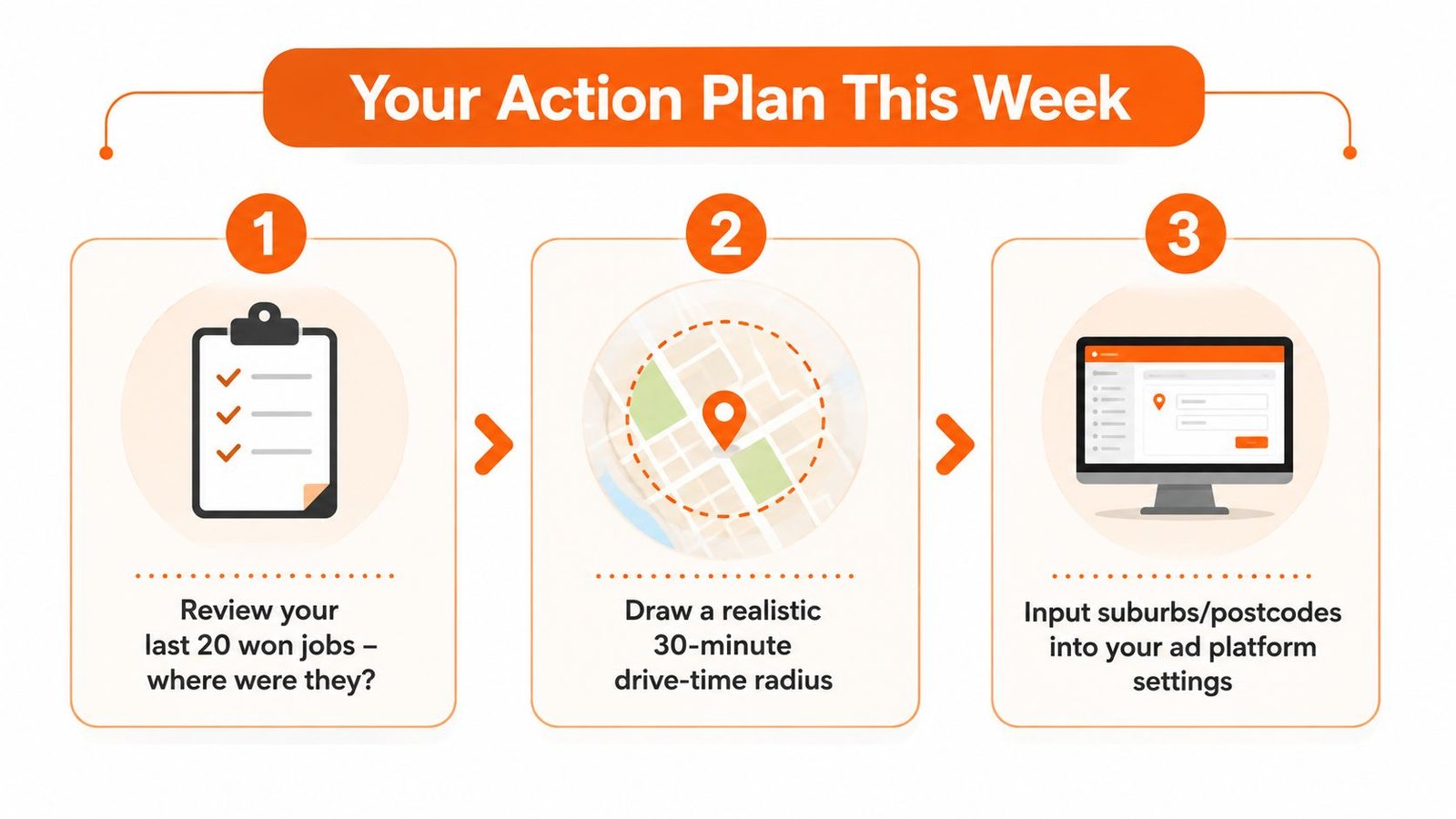
Don't start by typing in every suburb you think you might cover. Start with the jobs you've already won. Look at where the good work came from, where the crews travelled without pain, and where the jobs stayed profitable after travel and quoting.
Build the map from real jobs
Use your last month or two of work as the filter. If a suburb keeps producing easy, decent-margin jobs, include it. If a postcode keeps sending junk leads, or sending decent leads that cost too much to service, exclude it. Exclusions matter as much as inclusions because a leaky service area can eat budget fast.
On Google Ads, use location targeting with presence-based settings where possible, not broad interest-based settings. If you work from a single base, a radius around your main yard often makes more sense than a giant city-wide net. If your service borders are lumpy, add postcodes or shape them more carefully. On Meta, set the location layer at the ad set level and keep the area tight enough that the ads don't spill into neighbouring markets you won't serve.
Match the public profile to the paid setup
Your visible service area should not fight your ad account. If the profile says one thing and the ads say another, customers get mixed signals before they even ring. Keep your business listing aligned with the actual suburbs you're willing to work, so the geography looks intentional instead of random.
For site traffic, track the leads by suburb and source. You don't need a fancy attribution stack to know whether the campaign is doing its job. A simple call log, form field, or CRM note that records suburb and campaign source is enough to see which areas are worth keeping.
Practical rule: if you can't tell which suburb produced the lead, you're guessing when you should be deciding.
One more point. If your website or local pages are doing the heavy lifting, make sure the location story there matches the service area you've put into ads. This local SEO for contractors guide pairs naturally with the same setup logic.

Mistakes That Quietly Drain Your Budget
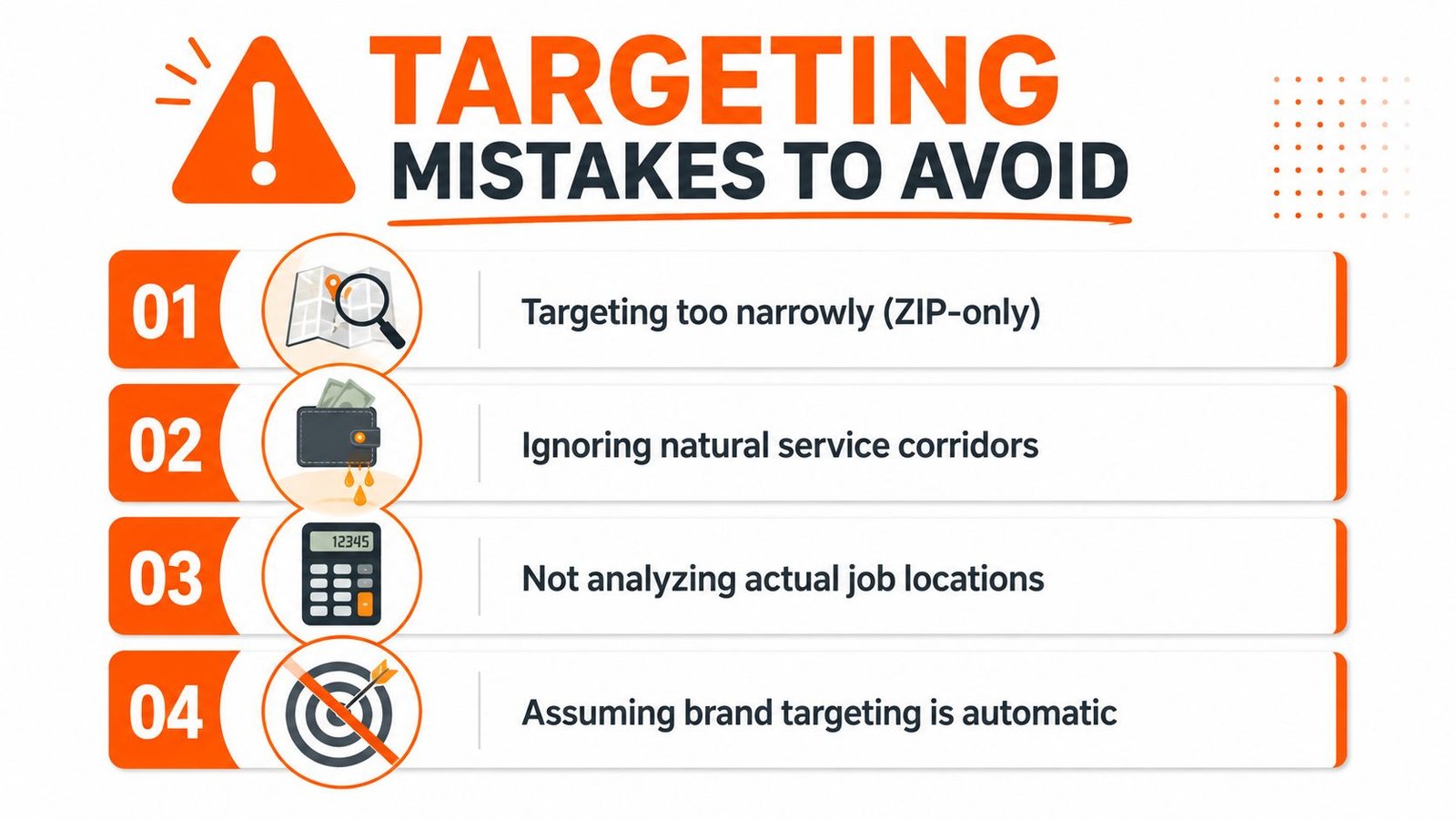
The biggest mistake is thinking tighter always means better. It doesn't. A campaign can be so narrow that it misses real demand pockets just over the boundary, or so broad that it pays for rubbish outside your run. The job is to pick the right unit, not the smallest one.
The common traps
The first trap is targeting a whole city when your actual call-out zone is much smaller. That sounds safe, but it usually pulls in people you'd never serve. The second trap is relying on “people interested in” a location. That can be useful for some businesses, but for a tradie it often drags in users who are nowhere near the job site.
The third trap is forgetting that suburb boundaries aren't the same as service patterns. Research on geographic targeting in social programs shows that coarse boundaries can miss intended recipients when demand doesn't line up neatly with administrative areas (area-level targeting and boundary mismatch research). In trade work, that means a strong suburb on paper can still hide weak pockets, while the edge suburbs next door might be full of the jobs you want.
Don't trust the circle too much
A radius setting looks clean, but roads don't run like circles. One side of town might be a quick run and the other side a nightmare because of traffic, bridges, or dead-end industrial pockets. That's why radius should be your starting point, not your final answer.
The other thing people miss is that geography changes with the job type. A small repair might justify a wider run than a large install, because the margin can carry the travel. A service-area decision should reflect the job economics, not just the map.
Practical rule: if your boundary saves spend but kills good jobs just outside the edge, you've drawn the wrong line.
The clear lesson is this. Geographic targeting rewards thoughtful boundaries. It doesn't reward maximum restriction.
Putting It Together So Leads Match Your Service Area
Start with the jobs you won, not the suburbs you wish you were known in. Then work backwards. Where were the customers, how far did you travel, and which postcodes brought in real jobs versus wasted enquiries?
If you're a solo operator in a metro area, keep the target tight and presence-based. If you run a multi-trade crew, split the service area into sensible zones so each crew gets the work it can handle. If you cover one suburb as a sub-contractor, be brutally narrow. If you're a multi-location brand, build separate location stories instead of pretending one blanket setting fits every branch.
The win is consistency. Your ads, profile, posts, and reviews should all point to the same geography so the right customers recognise you fast. When the location story matches the service area, the phone rings with better jobs.
If you want your location story to stay consistent without babysitting every post, GrowTradie gives trade businesses a simple way to keep local content active and relevant. It's built to help you stay visible in your area, which is exactly what makes geographic targeting work harder. Visit GrowTradie and set your local presence up properly before you spend another dollar chasing the wrong suburbs.