
You know the pattern. One week the phone won't stop. The next week you're staring at the schedule wondering whether referrals have dried up or a competitor is scooping up the jobs you used to get automatically. Then you search your own service in your area and see big directories, bigger companies, and maybe one local competitor showing up before you.
That's where most HVAC owners hit the same wall. Getting found online matters, especially when someone needs help fast. But getting seen isn't enough anymore. Even when a homeowner has no cooling, no heat, or a noisy system that suddenly quit, they still look for signs that your company is legitimate, responsive, and worth calling.
Many guides focus only on ranking for emergency searches like “AC repair near me,” but they miss a real gap. Homeowners still look for trust signals like verified reviews and clear information before calling, and companies that combine emergency visibility with that trust layer can win leads that directories and weaker competitors miss, as noted by Freitag Marketing's HVAC search guidance.
Table of Contents
- Getting Found Is Only Half the Battle
- Dominate Your Local Map Results
- Build a Website That Books Jobs
- Answer Questions to Attract Local Customers
- Become the Most Trusted Name in Town
- Essential Website Tune-Ups for Tradies
- Your Action Plan for Getting Found Online
Getting Found Is Only Half the Battle
A lot of owners treat HVAC company SEO like a visibility problem only. They think if they can just appear when someone searches for furnace repair or AC service in town, the calls will follow. Sometimes they do. Often they don't.
That's because searchers compare fast. They scan the listing, click through, look for reviews, check whether the business serves their area, and decide whether the company looks established. If your competitor has clearer service pages, more complete local info, and stronger proof that real people trust them, they'll often get the call even if you were both visible.
Emergency intent needs a trust layer
Urgent searches have a different feel from slower research searches. The customer wants help now, but they also don't want to make a bad decision under pressure. That's why the best-performing local presence usually combines two things:
- Immediate relevance through clear service and location signals
- Low-friction trust through reviews, photos, real business details, and straightforward website copy
- Clear next steps so the customer knows exactly how to call, book, or request help
Practical rule: Don't build your online presence only for the click. Build it for the call.
Directories win when local contractors leave gaps. If your business profile is half-filled out, your website has one generic services page, and your city pages all say the same thing with a different suburb dropped in, a directory often looks safer to the customer.
What actually works
The companies that pull ahead usually do the simple things better and more consistently.
| What works | What fails |
|---|---|
| Separate pages for each main service | One broad “services” page for everything |
| Real reviews and review replies | Ignoring feedback after jobs are done |
| Clear service area coverage | Vague wording like “we serve all nearby areas” |
| Photos of your team, vans, installs, and repairs | Stock imagery only |
| Straight answers to common customer questions | Thin copy stuffed with city names |
HVAC company SEO works best when it mirrors how homeowners choose a contractor in real life. They want someone nearby, qualified, easy to reach, and credible. If you handle only the first part, you'll get impressions. If you handle both, you'll get more booked jobs.
Dominate Your Local Map Results
For most HVAC companies, the map results are the most valuable spot on the page. That's where people tap when they need a nearby company and don't want to sort through a long list of options.
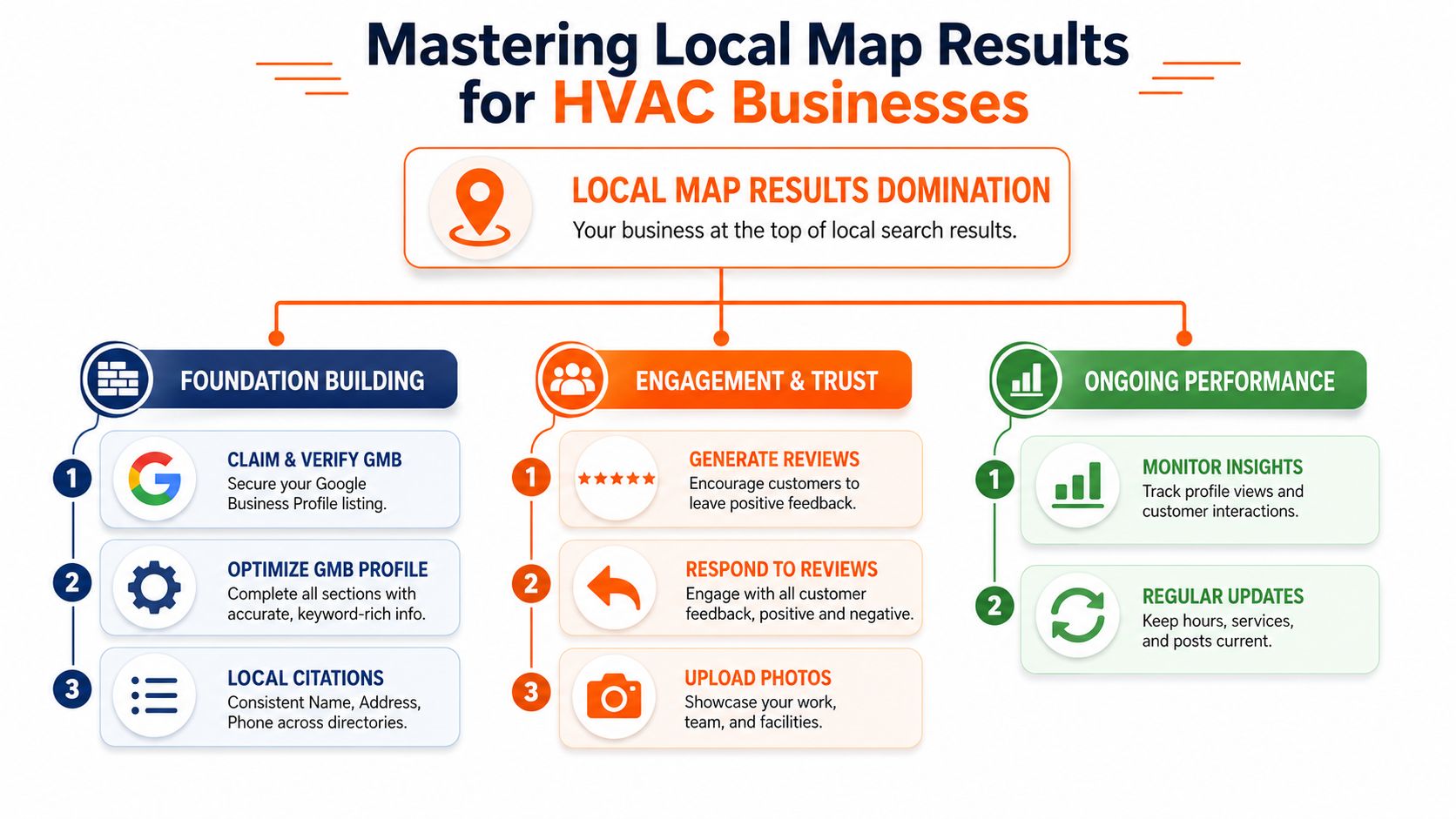
When contractors fully set up their local profiles, they see an average organic traffic increase of 188%, and that lift is tied to choosing the right profile categories, including a primary category like HVAC Contractor and secondary ones like Air Conditioning Repair Service. That matters even more because 43% of homeowners click directly on map listings, according to Digital Coast Marketing's local HVAC visibility guide.
Start with the profile basics
If your Google Business Profile isn't claimed, verified, and complete, fix that first. Don't overthink it.
Use this checklist:
Pick the best primary category
If HVAC work is the core of the business, “HVAC Contractor” is usually the right anchor.Add secondary categories carefully
Use categories that match what you really do, such as air conditioning repair or furnace repair. Don't add irrelevant services just to appear broader.Fill in every core field
Business name, phone, address, hours, service area, website, and services all need to be accurate.Write a plain-English business description
Mention your main services and local area naturally. Don't cram it with repeated keywords.
A strong profile makes you easier to choose before someone even visits your site.
Here's a walkthrough that helps show what a complete profile should look like:
Add trust signals inside the profile
The map result isn't only about relevance. It's also about confidence.
Add these next:
- Real job photos with technicians, vans, equipment, and finished work
- Answered questions in the Q&A area for common concerns like service areas, hours, and financing
- Service details that match what people need, such as AC repair, furnace replacement, heat pump installation, and maintenance
- Review responses that show the business is active and professional
A complete local profile does two jobs at once. It helps you appear, and it helps the customer feel safe calling.
Keep your business details identical everywhere
Map visibility drops when your business information is inconsistent across the web. Your name, address, and phone should match on major directories and local listings. Even small differences create confusion.
A simple standard helps:
| Item | Good example |
|---|---|
| Business name | Same wording everywhere |
| Phone | Same local number everywhere |
| Address | Same format everywhere |
| Hours | Updated when they change |
If you want better local performance from HVAC company SEO, treat your business profile like a sales asset, not a directory listing you set once and forget.
Build a Website That Books Jobs
A lot of HVAC websites look fine at first glance. They have a homepage, a contact page, and maybe a list of services. The problem is that they don't help a customer land on the exact page that matches what they need.
Think of your site like a well-organized van. If every tool is thrown into one big compartment, the job takes longer and mistakes happen. Your website works the same way. Each service needs its own place.
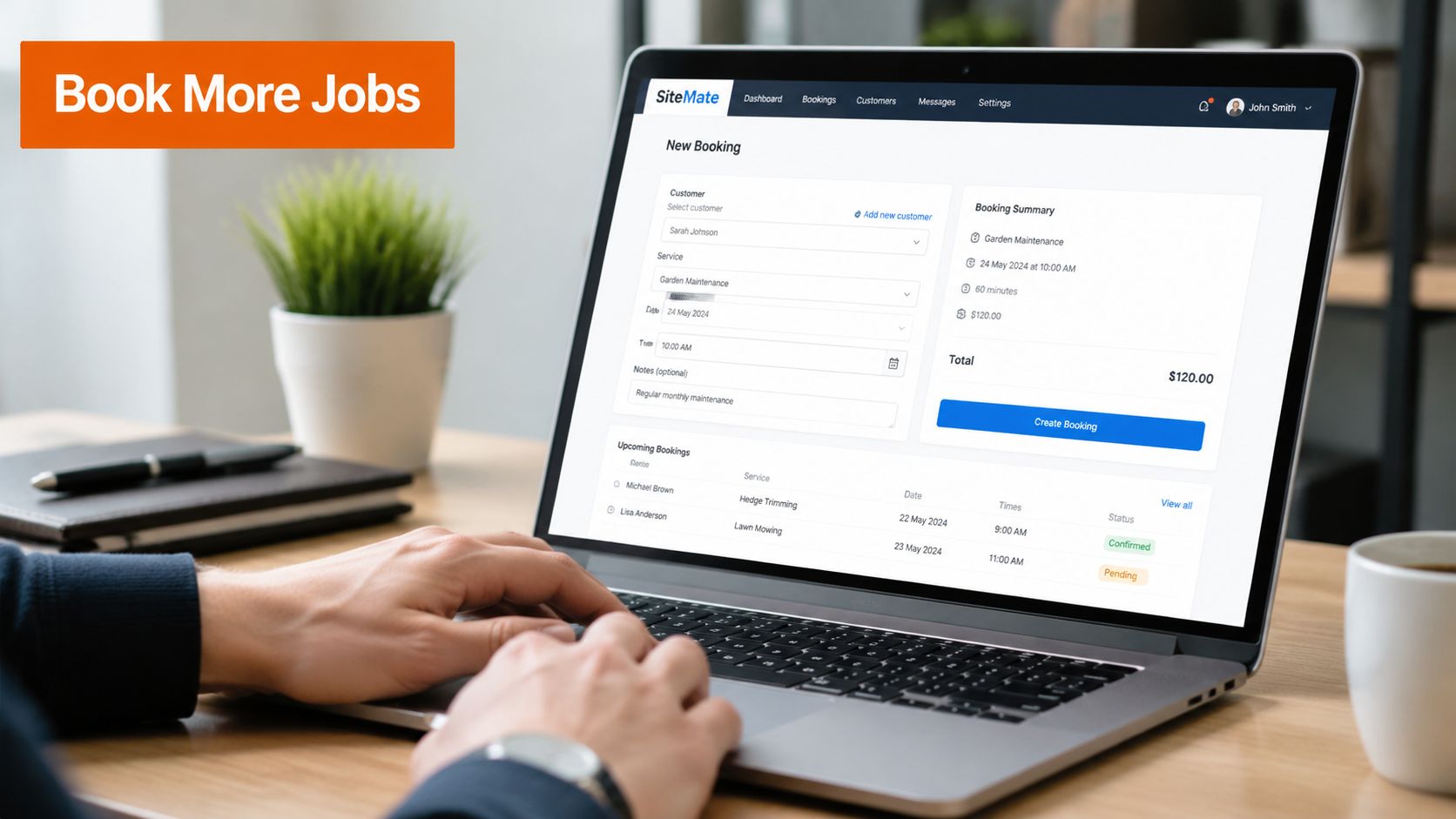
Your website should have one dedicated landing page for each specific service you offer, such as furnace repair or AC installation, and the page title should stay under 70 characters while including the main service and location, based on Construct Virtual's HVAC website structure advice.
One service per page is the right structure
Don't force one page to rank for repair, replacement, maintenance, ductless systems, and indoor air quality all at once. Build separate pages for the work people search for.
Examples include:
- AC repair
- AC installation
- Furnace repair
- Furnace replacement
- Heat pump services
- Commercial HVAC
- Maintenance plans
That structure helps search engines understand the site, but above all, it helps homeowners find the exact service they need without digging.
What every service page should include
A service page doesn't need clever copy. It needs useful information and a clear next step.
Use this layout:
| Section | What to include |
|---|---|
| Headline | Service plus location |
| Intro | What you do and who you help |
| Service details | Common problems, process, equipment, options |
| Proof | Photos, testimonials, brand experience |
| CTA | Call button, form, or booking request |
Keep the page easy to trust
Such practices cause many sites to lose jobs. They say “best HVAC company” five times and never explain anything. A better page answers practical questions.
Include details like:
- What problems you fix
- What brands or systems you work on
- Whether you handle emergency calls
- What areas you serve
- What happens after the customer contacts you
The best service pages don't sound like ads. They sound like a competent company explaining the work clearly.
Your page titles matter too. Keep them short enough to display well, and make them specific. “Furnace Repair in Springfield” is stronger than “Home Comfort Solutions and More.”
Don't hide the call to action
A surprising number of HVAC sites make people hunt for a phone number. That costs jobs.
Make the next step obvious:
- Put the phone number at the top of the page
- Use a visible quote or booking form
- Repeat the call to action lower on the page
- Make buttons easy to tap on mobile
Good HVAC company SEO brings the visitor in. Good page structure turns that visit into work.
Answer Questions to Attract Local Customers
A homeowner lands on your site at 9:30 p.m. because the AC quit and the bedrooms are still hot. They are not looking for a polished slogan. They want a straight answer, a sense that you know the problem, and a clear way to call. That is where question-based content earns its keep. It helps you show up for local searches, and it gives people enough confidence to choose your company over a directory listing or the contractor with the louder headline.
Use the questions your team already hears every week
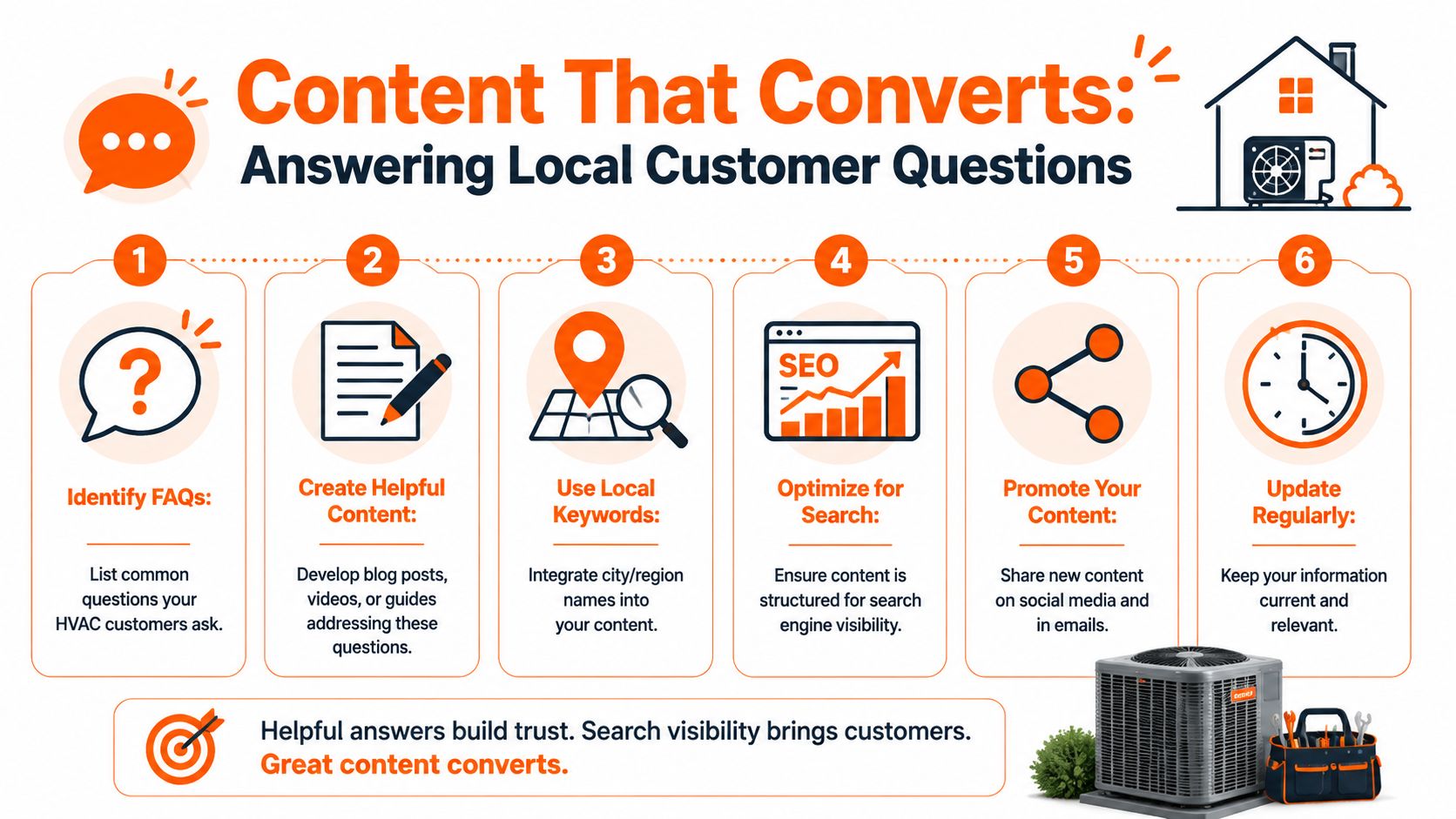
Good HVAC content usually starts with your office staff and techs. Listen to the questions that come up on calls, during quotes, and at the kitchen table after an inspection. Those are the topics that bring in qualified local traffic because they match what people search.
Useful topics often include:
- How often should I service my furnace
- Why is my AC blowing warm air
- Should I repair or replace my old system
- What size system does my home need
- How long does an HVAC installation take
- What should I check before I call for emergency service
Pages like these do two jobs at once. They attract search traffic from homeowners in decision mode, and they reduce doubt before the first phone call.
If you want a practical framework for planning and publishing these pages, this guide to content marketing for contractors is a solid next step.
Build service-area pages with real local detail
Generic city pages rarely win jobs. A page called “Furnace Repair in Springfield” needs more than a swapped suburb name. It should sound like a company that works there and understands the homes, systems, and call patterns in that area.
Google's guidance on creating helpful, reliable, people-first content lines up with what works in practice. Pages perform better when they answer a real need and show first-hand relevance, not when they recycle the same copy across ten towns.
That means your “AC Repair in Northside” page should mention something true about Northside. Maybe the area has older ducted systems, lots of split-system retrofits, or a run of top-floor apartments that overheat in summer. Specifics build trust.
What makes a location page worth reading
Strong local pages combine service information with proof that your team works in that area.
Include details like:
Nearby suburbs or neighbourhoods you cover
Help people confirm you service their address.Problems common in that area
Older homes, new estates, coastal corrosion, poor airflow upstairs, or undersized return air all change what people care about.Job examples from that location
Photos, short case notes, or a review from a local customer help the page feel credible.Clear service terms
Say whether you offer same-day visits, after-hours help, maintenance, diagnostics, or replacement quotes in that area.Straight answers about the next step
Tell people what happens after they call, how fast you usually respond, and whether there is a call-out fee.
A good local page sounds like it was written by a contractor who works in that suburb, not by someone filling a template.
Publish in the order that brings work in faster
Start with the pages tied closest to revenue. For most HVAC companies, that means core services first, then urgent customer questions, then location-specific pages for the towns that already produce work.
A simple order looks like this:
| First | Next | Then |
|---|---|---|
| Core service pages | Emergency and repair questions | Unique city pages |
| Install and replacement pages | Repair vs replace topics | Seasonal advice |
| Maintenance pages | Troubleshooting content | Area-specific case studies |
One solid page is worth more than five thin ones. Answer the question clearly, tie it to the locations you serve, and give the reader enough proof to trust you. That is how HVAC company SEO turns searches into booked jobs.
Become the Most Trusted Name in Town
A homeowner's furnace dies at 7pm. They search, see three HVAC companies in the results, and open each one in separate tabs. All three say they do emergency work. The company that gets the call is usually the one that looks safest to hire right now.
That decision gets made fast. Reviews, clear business details, real photos, and honest service information do more to win the job than visibility alone.
Reviews help close the click
A strong review profile tells a customer two things. You do solid work, and you handle problems like a professional.
Ask for reviews while the job is still fresh and the customer is happy with the result. Keep the request short. Send the direct link. Mention the job they just hired you for so it feels personal, not automated.
A review process that works:
- Ask right after completion when the customer has seen the result
- Text or email a direct review link so there is no extra step
- Reference the job like a no-cool call, thermostat replacement, or annual service
- Reply to every review in a calm, useful tone
Those replies matter. Future customers read them to judge how you communicate after the invoice is paid.
Consistent business details build confidence
Your name, address, and phone number need to match everywhere your business appears. If your website says one thing, your Google Business Profile says another, and a directory has an old tracking number, customers notice. Google notices too.
That does not always kill rankings on its own, but it creates doubt. Doubt costs calls.
Check the basics across every profile:
| Place | What to check |
|---|---|
| Website | Exact business name, phone, address |
| Google profile | Matching primary contact details |
| Directories | No old numbers, old addresses, or duplicate listings |
| Social profiles | Current hours, website link, service area info |
Google's own guidance for local ranking makes the point clearly. Relevance, distance, and prominence all affect local visibility, and prominence is influenced by information Google finds about your business across the web, including reviews and directory references, as explained in Google's local ranking help page. If you want more booked work from search, tighten these trust signals alongside your digital marketing for HVAC companies efforts.
Clear information wins against directories
Directories often rank because they aggregate a lot of business data. An HVAC company can still beat them for actual conversions by being clearer and more believable.
Show the details a serious customer wants before they call:
- Who they are hiring, including team photos or owner details
- Where you work, with specific towns or suburbs
- What you offer, including repairs, installs, maintenance, and after-hours help
- How to reach you, with a visible phone number and contact option
- Why people trust you, with recent reviews and proof of completed jobs
This is where many HVAC sites fall short. They get found, but they do not reassure.
Trust is built from small signals stacking up. Recent reviews. Matching details. Real service area information. Straight answers about what happens next. When those pieces are in place, HVAC company SEO does more than get you seen. It helps you win the call over the other businesses on the page.
Essential Website Tune-Ups for Tradies
Some websites lose jobs before the visitor reads a single line. They load slowly, look clunky on a phone, or trigger a security warning. That's enough to send someone back to the search results.
The good news is that the core fixes are usually straightforward.
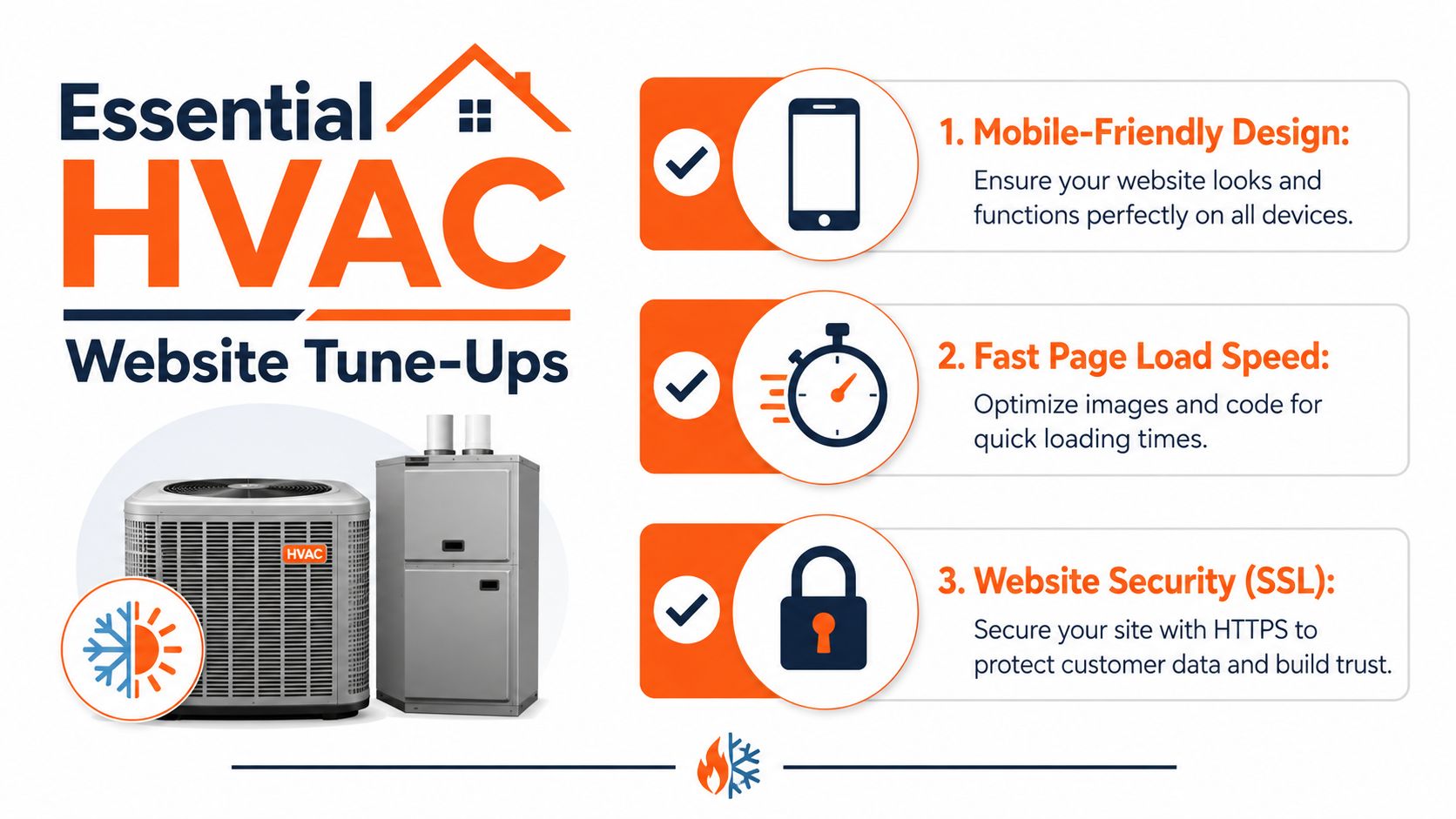
A basic technical tune-up starts with HTTPS, an updated sitemap in Google Search Console, and unique title tags under 60 characters. This foundation can improve clicks from search results by 25-35% within a month, according to FieldServicely's HVAC technical tune-up checklist.
Fix the issues customers notice first
The first layer is user experience. If your site is frustrating on mobile, you'll lose people fast.
Check these first:
Phone usability
Buttons should be easy to tap, text should be readable, and forms should be short.Load speed
Heavy images, bloated themes, and too many scripts slow everything down.Security
Your site should load on HTTPS. If it doesn't, fix that immediately.
If you want a practical overview of what stronger online visibility looks like for trade businesses, this guide on digital marketing for HVAC is worth reviewing.
What to ask your developer or web team
You don't need to do every technical task yourself. You do need to know what to ask for.
Use a checklist like this:
- Confirm the site uses HTTPS
- Submit or refresh the XML sitemap in Google Search Console
- Check that important pages aren't blocked accidentally
- Rewrite title tags so each page is unique
- Make sure the site works properly on mobile
- Compress oversized images
- Review headings for clear page structure
Keep the page structure clean
Good heading structure helps both users and search engines understand the page.
One rule matters a lot. Each page should have exactly one H1 using the main keyword phrase for that page, and the first words of the H1 should be the target phrase. Supporting headings should then organize the rest of the content, based on Alpyne Strategy's heading guidance for HVAC sites.
A technical tune-up isn't about chasing fancy features. It's about removing friction that stops people from calling.
Don't overcomplicate the fix list
Most HVAC company SEO problems at the website level come down to a small group of issues:
| Problem | Practical fix |
|---|---|
| Slow mobile pages | Compress images, reduce clutter |
| Duplicate page titles | Rewrite each title clearly |
| No HTTPS | Install SSL and force secure loading |
| Weak page structure | Use one H1 and logical subheadings |
Handle those before worrying about advanced tactics.
Your Action Plan for Getting Found Online
Most owners don't need more theory. They need a list they can act on without losing half a day.
Here's the simplest way to approach HVAC company SEO without getting buried in busywork.
Do this week
Start with the items that affect visibility and trust fastest.
- Claim and complete your Google Business Profile with the right categories, service details, business hours, and photos
- Check your business details everywhere so your name, address, and phone match
- Make your phone number obvious on the website and test it on mobile
- List your core services clearly instead of hiding them inside a generic paragraph
Do this month
The website starts pulling its weight at this point.
- Build one page for each main service such as AC repair, furnace repair, installation, and maintenance
- Create pages for the towns or suburbs you serve, making each one unique
- Add a few customer question pages based on what people ask your team all the time
- Update weak page titles and headings so each page has a clear focus
A useful benchmark for page layout is one page per service and one page per major location, not one page trying to do every job in every suburb.
Keep doing this ongoing
This is the part most competitors neglect. That's why it compounds.
- Ask for reviews after good jobs
- Reply to new reviews
- Add fresh job photos to your profile
- Publish useful answers to customer questions
- Review site speed and mobile usability
- Update business hours and service details when they change
If you want outside help from a team that understands the trade space, an HVAC SEO company can help tighten the strategy and execution.
What to ignore
Not every tactic deserves your time.
Skip these:
- Generic city pages with copied text
- Bloated homepages trying to rank for everything
- Stock-heavy websites with no proof of real work
- Set-and-forget profiles that haven't been updated in months
The businesses that win online usually aren't doing magical things. They're just more complete, more credible, and more useful than the next contractor.
GrowTradie helps trade businesses stay visible without having to think up posts, write copy, or remember to publish anything. If you want a simpler way to keep your business active online between jobs and build the kind of trust that leads to more enquiries, GrowTradie is built for that.