
If your phone's been quiet for two days, then suddenly it rings off the hook on a Friday arvo, you already know the problem isn't demand. You've got work out there, but you don't have a steady system bringing enquiries in while you're on the tools, quoting, or chasing parts. That's why HVAC contractor marketing has to be treated like a workflow, not a pile of random posts and one-off ads.
The trade goes bad when visibility is patchy. One week you're flat out, the next week you're staring at the diary wondering who's going to fill the gaps. The fix is boring in the best way, local visibility, a simple content rhythm, and basic tracking that tells you what's paying its way.
Table of Contents
- Why HVAC Work Feels Feast or Famine
- Owning Your Local Map Pack and Google Business Profile
- Building Service and Service-Area Pages That Convert
- Paid Ads and Lead Generation Without Burning the Budget
- A Steady Content Engine for Local Visibility
- Referrals, Partnerships, and Simple Tracking That Closes the Loop
- Your 30-Day HVAC Marketing Plan and Common Mistakes to Avoid
Why HVAC Work Feels Feast or Famine
Monday starts with a burst. Two urgent call-outs, one install, a quote you sent last week finally gets a yes, and for a moment it feels like the phone's sorted. By Thursday afternoon, the pace drops, the callbacks dry up, and you're wondering whether the market has gone quiet or your marketing has.
That swing usually comes from running on word of mouth plus the odd post when you remember. It works just enough to keep you hopeful, then leaves dead patches because there's nothing running in the background. A tradie can't build a reliable diary on memory and luck.
Practical rule: if enquiries only show up when you push hard, you don't have a lead problem, you've got a visibility system problem.
The numbers back that up. In this trade, 78% of homeowners search online before contacting an HVAC company, 52% choose the first company they contact, and 62% of HVAC leads come from search engines according to the industry benchmark from WebTonic. That means the first contractor people can find, trust, and contact wins a lot of the work. If your business only appears when you actively chase it, you're already behind.
There's also a timing issue. Homeowners often make decisions fast, especially for urgent repairs, and a separate industry summary says many decide within 24 hours for urgent work, with mobile searches for “HVAC near me” rising sharply over the last two years from Front Burner Marketing. That's not a branding game, it's a response game. Whoever looks local, available, and trustworthy in that short window gets the enquiry.
A good HVAC contractor marketing system does not try to impress everyone. It keeps your business visible where buyers are already looking, then makes it easy to ring, message, or book. A steady content engine, local visibility, and simple tracking do the heavy lifting. If you want a clearer path to that kind of enquiry flow, start with lead generation for contractors, then build the rest around it.
Owning Your Local Map Pack and Google Business Profile
Start with the profile, not the fancy stuff. Your Google Business Profile is the first thing many local buyers see, and it needs to look like a real business that answers the phone, turns up on time, and does clean work. A half-filled profile with old photos and vague categories costs you more jobs than most owners realise.
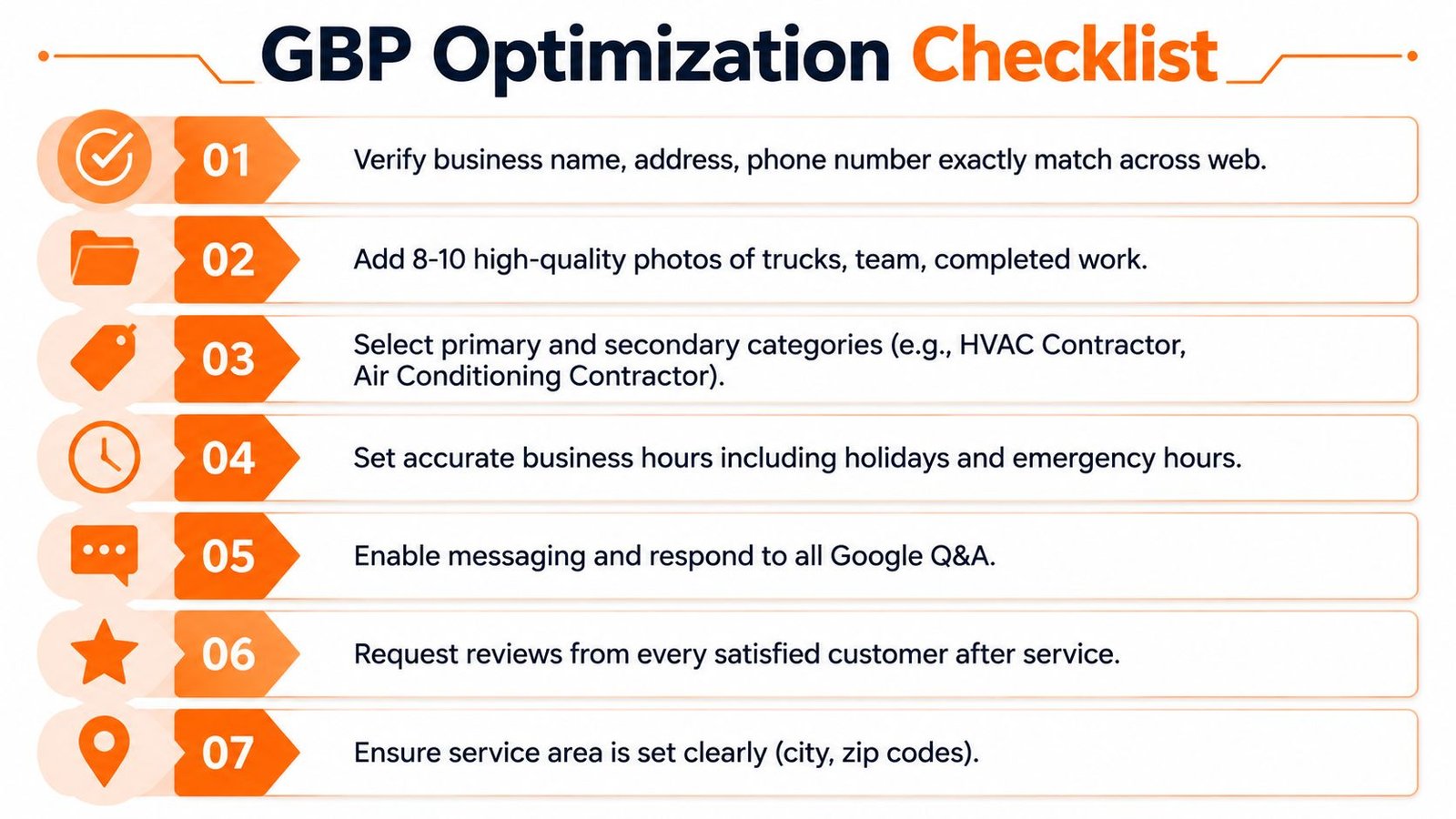
Lock the basics before you touch anything else
Your business name, address, phone number, hours, and service area have to match everywhere. If those details drift across your website, directory listings, and map profile, people lose confidence fast. Fill in the services you want, then choose categories that match the work you want more of, not just the work you already get.
Photos matter more than most operators think. One industry source says profiles with photos get 35% more clicks from Zipdo. So upload real shots, trucks, team, vans on site, completed installs, close-ups of tidy workmanship. Don't use blurry phone photos from three years ago.
Reviews are the other lever. The same source says 90% of customers read online reviews before choosing an HVAC service, and 5-star reviews can generate 2.8x more leads. You don't need to beg. Ask right after a good job, while the customer's relieved and the system's working.
Ask every happy customer the same way, right after the job is done, with a short text or email that links straight to the review page. That's less pushy than a sales speech and a lot more consistent.
Make the profile work like a front door
If someone clicks your profile, the next step has to be obvious. Messaging should be enabled if you can respond quickly, business hours should be accurate, and your service area should be clear enough that the customer knows you work their suburb. A tidy map profile doesn't just look professional, it removes friction.
The simple routine is this. Check the profile weekly, add new photos whenever you finish a decent job, and ask for reviews after every good call-out or install. If you run a one or two-truck operation, that's enough to stay competitive without burning half your week on admin.
If you want a deeper local setup checklist, the practical guide at GrowTradie's local search marketing resource fits neatly with this process.
Building Service and Service-Area Pages That Convert
A small HVAC website should do one thing well. It should answer the exact question the buyer is asking, then make contacting you painless. Thin pages full of generic fluff don't do that, and they waste the traffic you worked to get.
Service pages should sell the job, not the jargon
A service page is for a specific job type, like ducted system installs, split system replacements, emergency repair, or maintenance plans. The page should say what the service solves, what signs tell the customer they need it, and what happens when they call you. If someone's unit is blowing warm air in the middle of summer, they don't want a brochure, they want clarity.
Use straightforward headings like Emergency AC Repair in [Your Area] or Ducted Air Conditioning Installation for Local Homes. Add trust signals near the top, license details if relevant, years in trade if you want to state them, photos of your own work, and a clear button for calling or requesting a quote. Keep the wording plain. The customer is usually scanning on a phone while standing next to a broken unit.
Service-area pages should prove you actually work there
A service-area page is different. It covers a suburb, town, or district and shows that you serve that patch. Don't copy and paste one page across ten suburbs with the name swapped out. That's lazy, and buyers can smell it.
Give each area page a local angle. Mention the kinds of properties you see there, the common system types, the quickest way to get a booking, and the suburbs nearby that you also cover. If you work in a mix of residential and light commercial, say so without overexplaining. The point is to make the visitor feel like you already know the area.
A good rule is to keep the whole site tight. Five to seven strong pages with solid copy will usually beat a bloated site full of half-finished sections. The pages that matter most are the ones that can turn a visitor into a booking, not the ones that fill space.
Paid Ads and Lead Generation Without Burning the Budget
Paid traffic can fill gaps, but it can also eat margin if you run it like a hope machine. HVAC is one of the pricier local markets for clicks, so you need to know your numbers before you spend. In major markets, the average cost per click for HVAC Google Ads keywords was $29.03 in 2024 and is projected to rise to $32.77 in 2025 according to 720 Digital Marketing.
Know the economics before you launch
That same benchmark says some markets see CPCs from $18 to $62, cost per lead around $115, and recommends 7–10% of revenue for marketing, with 60–70% of that going to digital channels. It also notes a broader HVAC marketing budget guideline of 8%–10% of revenue goal, split 60/40 between digital footprint and branding from Acorn Finance. Those aren't vanity numbers. They tell you how much room you've got before the ad account starts chewing through profit.
| HVAC Paid Acquisition Economics at a Glance | ||
|---|---|---|
| Metric | Typical Range | What It Means |
| Cost per click | $29.03 in 2024, projected $32.77 in 2025, with broader ranges of $18 to $62 | Clicks can get expensive fast, so weak landing pages hurt more |
| Cost per lead | About $115 | You need decent close rates to make ads worthwhile |
| Marketing budget share | 7–10% of revenue, or 8%–10% of revenue goal | Paid work needs a real budget, not leftovers |
| Digital share of budget | 60–70% | Most spend should go where buyers are already searching |
The smarter move is to treat ads as a test, not a permanent crutch. If a campaign is bringing junk enquiries, don't just blame the keywords. Look at the landing page, the call handling, the business hours, and whether the offer makes sense for the local market.
When Local Services Ads are available in your area, they often make sense for lead capture because they sit close to the top of the buying path. Traditional search campaigns still matter, but they work best when your profile, website, and follow-up are already tight. Otherwise you're paying premium money to send traffic into a leaky bucket.
A Steady Content Engine for Local Visibility
Most contractors don't need more ideas. They need a way to keep posting without it becoming a weekly chore. A steady content engine keeps your name in front of local buyers between jobs, so when they do need help, your business feels familiar.
Post the stuff customers actually ask
Use content that answers real homeowner questions. Think Why is my energy bill climbing in summer?, Should I repair or replace this unit?, What's included in a service call?, or Why is the upstairs room always warmer than the rest of the house? That's the kind of content people search for when they're already worried about a system issue.
For social posts, keep it simple. Before-and-after shots, a short video from the van, a filter change, a quick explanation of a strange noise, or a photo of a clean install with one useful sentence underneath. No need for polished studio stuff. Real work beats fake polish every time.
If you don't want to remember to post, use a scheduling tool. GrowTradie is one option that can generate and schedule trade-focused posts automatically, so the business stays active online without you having to sit down and write every week.
Keep the rhythm steady, not frantic
A workable pattern for a solo operator is one useful post each week, then a few quick updates when a job gives you something worth showing. That might be a seasonal reminder, a local service note, or a short clip explaining a common fault. The point is to stay recognisable in your area.
Simple rule: post what a homeowner would say out loud before they called a tech.
That keeps the content practical. It also makes your business look like it knows the local climate, the local housing stock, and the problems people run into. You're not trying to go viral. You're trying to be the name that surfaces when a neighbour asks who to call.
Referrals, Partnerships, and Simple Tracking That Closes the Loop
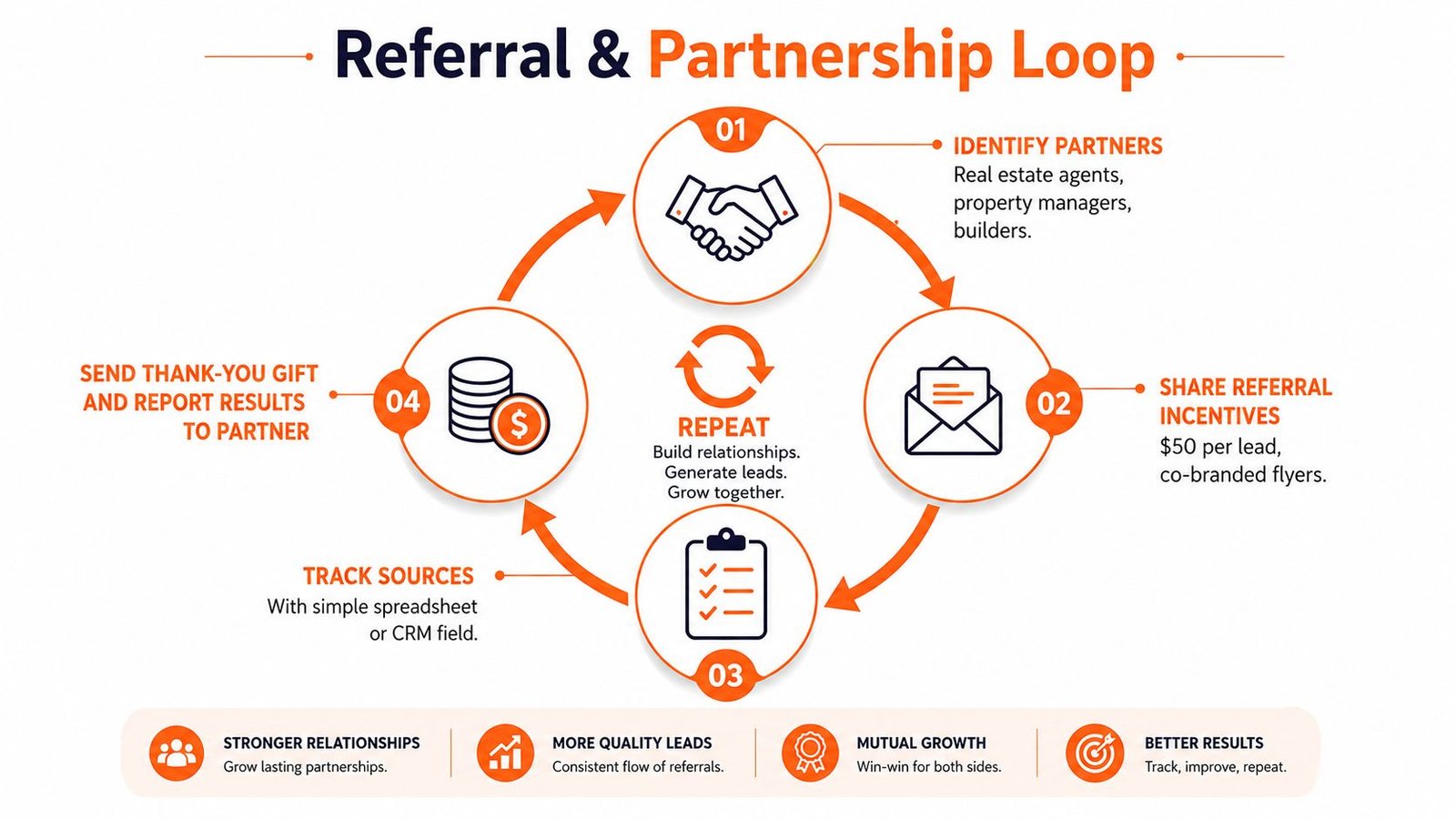
Good HVAC contractor marketing doesn't stop at search and ads. Some of the best work comes from people who already know, like, and trust you, but only if you make referral and partner follow-up part of the job. Real estate agents, property managers, builders, and past customers can become a steady source of work if you stop relying on memory.
Put the loop on rails
Start by naming the partners you want, then give them a clear reason to send work your way. That could be co-branded flyers, a simple referral thank-you, or a fast-response promise for their clients. The important bit is consistency. If you only ask once in a while, the relationship goes quiet.
For customer follow-up and repeat work, the retention side matters too. One industry source says it costs five times more to acquire a new HVAC customer than retain an existing one, and that 70% of revenue comes from repeat customers from WorldMetrics. That's why every job should feed the next job.
Track the source, not just the ring
The weakest part of most trade marketing is measurement. A lot of owners know the phone rang, but they don't know which channel produced the booked job. That's where a simple call tracking number, a basic CRM field, or even a spreadsheet comes in. Without that, you end up funding whatever feels busy.
If you want a practical reputation and follow-up framework, the resource at GrowTradie's reputation management guide fits this part of the job well.
Write down every enquiry source every Friday, then mark whether it became a quote, a booked job, or nothing. That one habit exposes the channels that are actually filling the diary.
You don't need fancy software to start. You need one sheet with columns for name, suburb, source, job type, quoted, booked, and notes. That's enough to see patterns, tighten follow-up, and stop guessing.
Your 30-Day HVAC Marketing Plan and Common Mistakes to Avoid
Don't try to fix everything at once. The contractors who get traction usually sort the basics first, then layer on more once the system is working. The point is to build momentum, not create a second job for yourself.
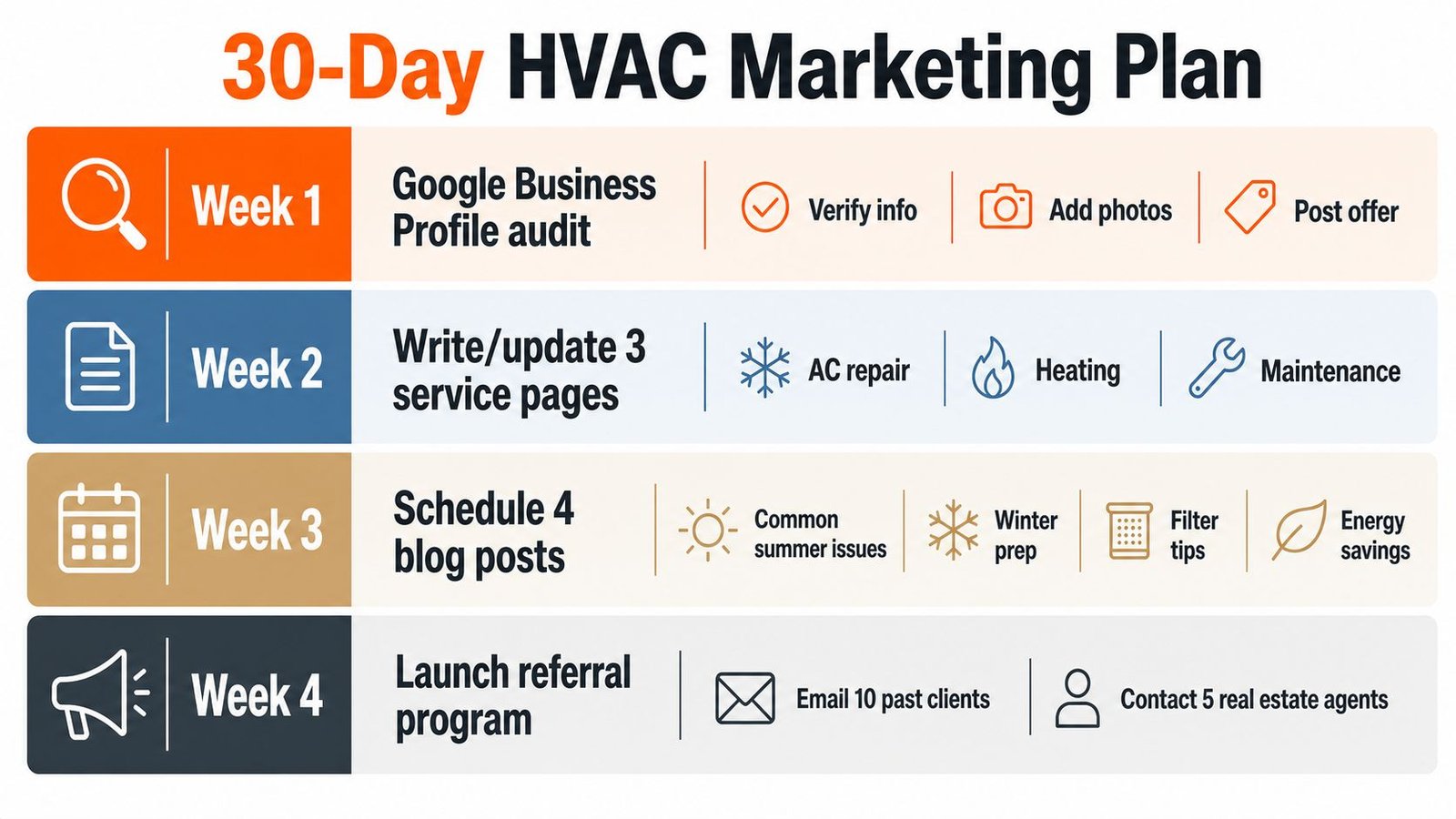
A simple month plan you can actually follow
Week 1. Audit the Google Business Profile, fix the details, upload fresh photos, and ask for reviews from the last few happy customers.
Week 2. Write or update the core service pages, the ones tied to your best work, like AC repair, heating, and maintenance.
Week 3. Test paid ads with a tight budget, one clear offer, and proper call handling so you can see whether the enquiries are worth buying.
Week 4. Set the content schedule and your tracking sheet, then line up referral outreach to past clients and local partners.
What to stop doing
Stop running ads before the profile and website are ready. Stop chasing every new platform because someone online swore it's the next big thing. Stop treating enquiries like a success if you never check whether they became paid work.
That's the edge in this trade, consistency over complexity. A clean profile, a few strong pages, regular local posts, and a simple tracking habit will beat scattered effort almost every time. The diary fills when the business keeps showing up in the same places, week after week.
If you want a simpler way to keep that visibility running without adding more to your plate, GrowTradie can help you automate trade-focused posts and keep your business active online between jobs. It's built for contractors who need steady local attention and real enquiries, not just more admin.