

If you've ever had a decent week on the tools, then watched the phone go quiet while the next-door competitor keeps getting the calls, there's a good chance reputation is the reason. In local trade work, people don't just ask who's available. They check who looks reliable, who replies, and who has enough proof to make the risk feel smaller.
That's why contractor reputation management isn't some branding side project. It's part of the machine that turns finished jobs into the next enquiry, quote request, and booked day on the calendar. The contractor who treats reviews, replies, listings, and fresh proof as weekly work usually looks busier for a reason, because buyers can see the trail.
Table of Contents
- Why Contractor Reputation Management Is the Real Growth Lever
- Run a No-Nonsense Reputation Audit
- Claim, Complete, and Standardise Every Listing
- Ask for Reviews at the Right Moments
- Respond to Every Review Like a Pro
- Keep Social Profiles Quiet No Longer
- Track the Metrics That Matter
Why Contractor Reputation Management Is the Real Growth Lever
A small plumbing crew can lose a job to a rival three suburbs away without ever meeting the homeowner. The rival's listing has more reviews, the replies look active, and the profile feels current. That's enough to tip a buyer who's comparing several trades in one evening.
The numbers behind that behaviour are blunt. BrightLocal's 2024 survey found that 88% of consumers will hire a business that responds to all reviews, while only 47% would hire one that never responds, and the average consumer expects to read 112 reviews before making a hiring decision, as reported in this contractor reputation guide. In other words, people aren't only scanning the star average, they're checking whether the business looks alive and accountable.
That's why the practical job is to run reputation every week, not “improve it” someday. A clean reply habit, a steady review flow, and up-to-date listings do more for trust than a burst of promotion followed by silence. If you want a wider take on what gives a trade business a recognisable presence, this piece on brand authority for tradies sits neatly beside reputation work.
Practical rule: if a customer can't see recent activity, clear contact details, and replies to reviews, they assume you're harder to deal with than the next contractor on the list.
For a solo operator, that usually means asking one simple question at the end of each week, did the jobs completed this week leave a better public trail than the jobs from last week? If the answer's no, the business is leaving enquiries on the table. Reputation behaves like a lead source because that's exactly how buyers use it.
Run a No-Nonsense Reputation Audit
Before changing anything, look at your business through a customer's eyes. Search your business name, then your service plus suburb, and write down every place you appear. You're looking for the pages that make someone trust you, and the pages that make them hesitate.
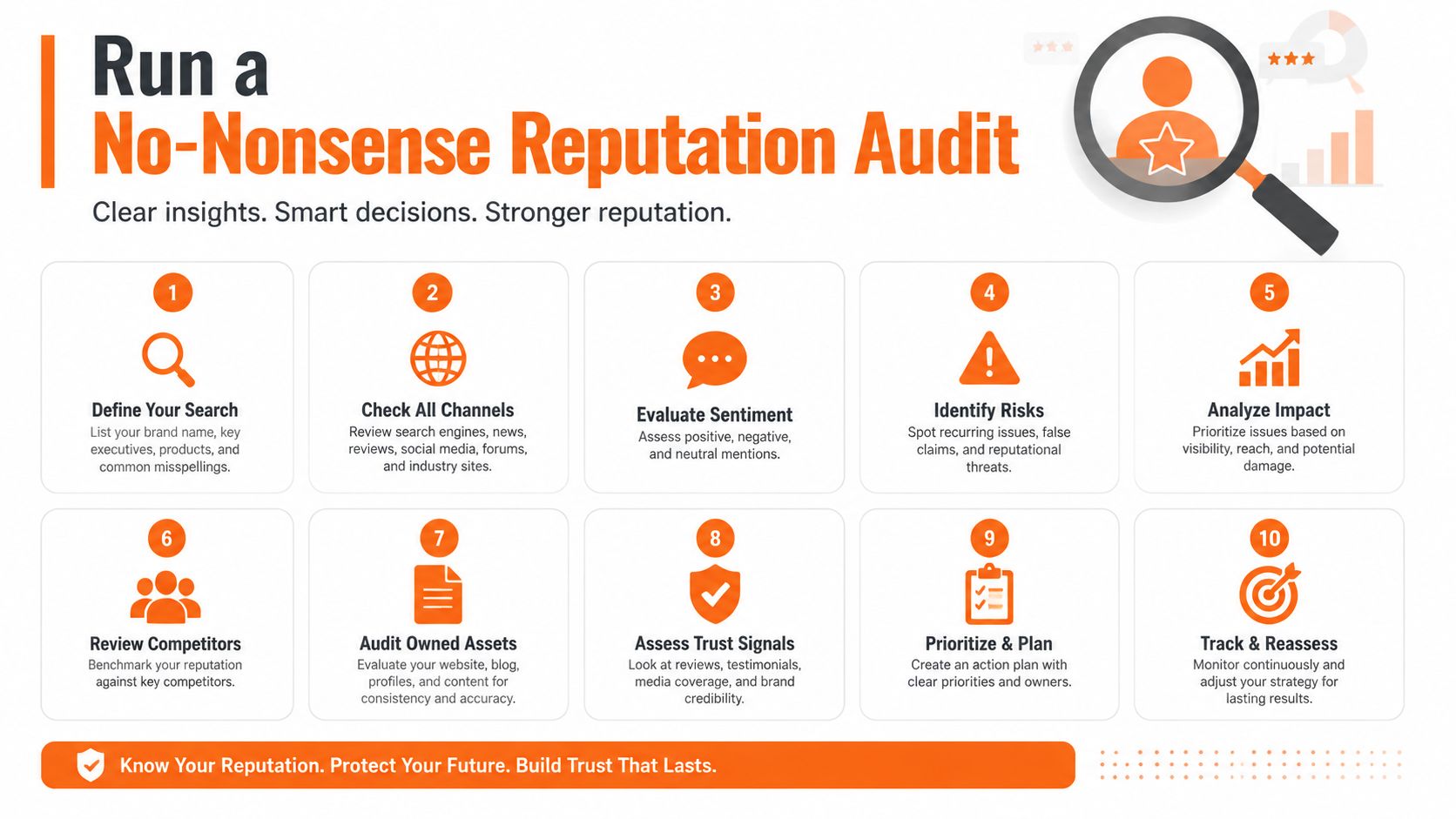
Check what customers actually see
Start with Google Business Profile, because that's usually where the first decision happens. Then look at trade directories, social profiles, and any old listings that still show an outdated phone number or an old trading name. A stale duplicate can send enquiries to the wrong place, or make a customer wonder which version of the business is real.
For each profile, answer four questions. Is it claimed, is the information accurate and consistent, what's the current rating and review count, and is there recent activity or just dead air? If one profile has a good rating but no recent posts, while another has fresh photos but no claimed ownership, that's a fixable gap, not a mystery.
Turn the audit into a one-page fix list
Keep the audit simple enough that you'll do it. One page is enough for the current state, the gaps, and the fixes you can knock out in a weekend. That might mean claiming a profile, correcting hours, replacing a bad logo, or deleting a duplicate page that's been floating around since an old phone number changed.
A tidy audit isn't about perfection. It's about removing the bits that make a customer think, “I'm not sure this mob is organised.”
The point is to stop guessing. Once you can see the footprint clearly, you can clean the pages that matter and ignore the noise that doesn't help. That's the difference between reputation management and random tidying.
Claim, Complete, and Standardise Every Listing
A customer can forgive a small delay. They will not forgive a listing that sends them to the wrong number, shows old hours, or leaves them unsure which trade name is current. Claiming a listing is only half the job. A half-done profile still looks half-done, even if the business has solid work behind it. The aim is simple, every public page should tell the same story, same name, same phone number, same service area, same hours, same level of care.
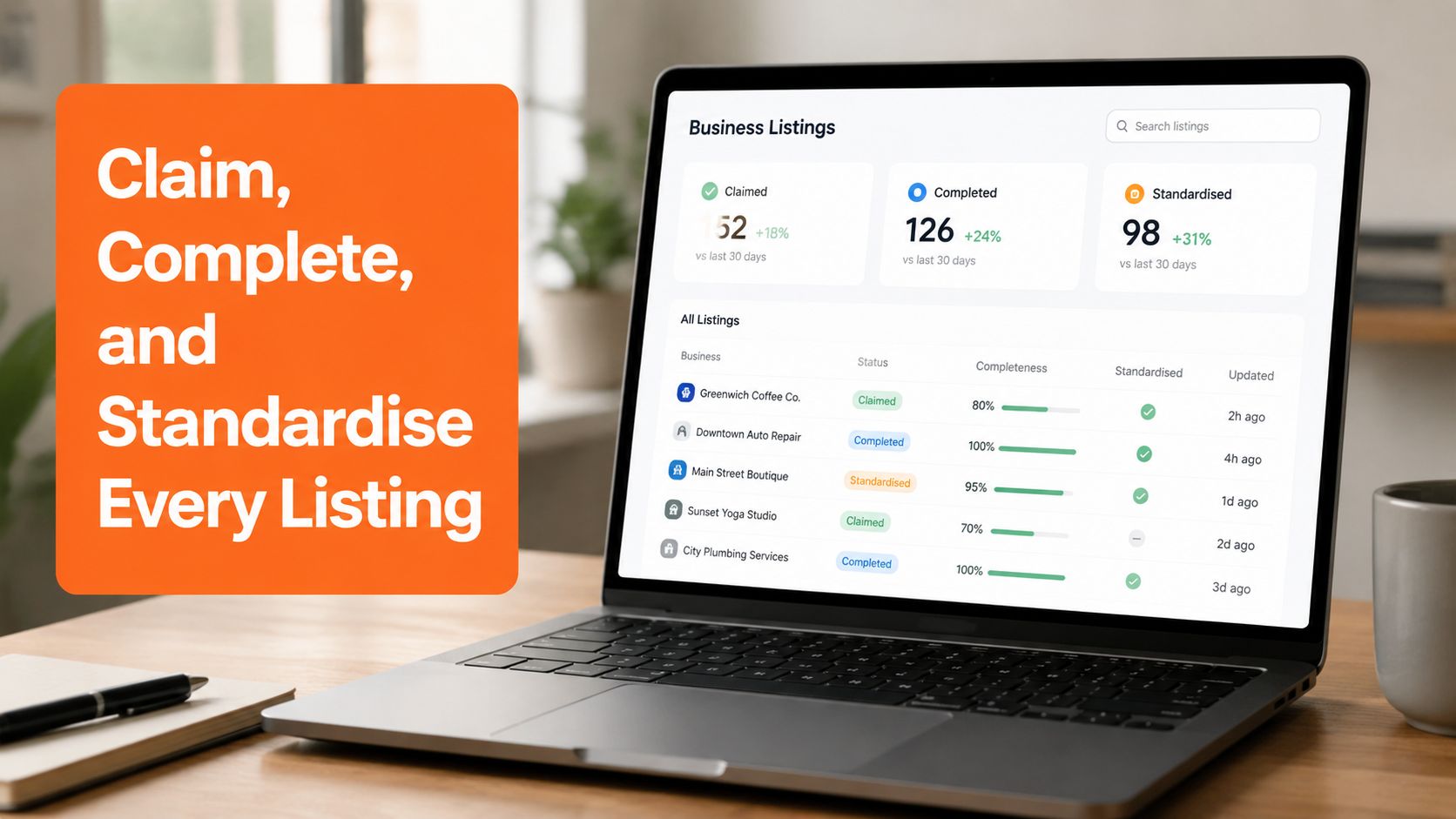
Lock the core details first
Start with Google Business Profile, then work through the other listings customers use. Projul recommends monitoring at least six review channels weekly for contractors, Google Business Profile, Yelp, Facebook, Angi, Houzz, and the Better Business Bureau, according to its contractor reputation management guide. If those pages disagree on the basics, the business loses trust before the first phone call, and that leaks enquiries.
Use the same business name everywhere, the same address format, the same phone number, and the same service areas. Keep hours accurate. Choose categories that match the work you want more of, not the jobs you took years ago because someone asked for help. Consistency matters for local search too, and local SEO for contractors depends on those signals lining up across the web.
Make the profile look active, not parked
Write a business description that says what you do, where you work, and what kind of jobs you're best known for. Keep it direct. Real photos carry more weight than polished stock images, so upload shots of completed jobs, vehicles, tools, and the team on site. A customer can tell when a profile was filled in once and then forgotten.
The goal is consistency that a homeowner can spot in seconds. If they open three listings and all three look like the same business, they feel safer enough to ring. If one listing looks abandoned, the whole operation feels less dependable, even if the work itself is good.
Useful check: if a listing can't answer the phone, show the right hours, and prove the business is active, it's not pulling its weight.
Clean up the old listings too. A forgotten directory page with the wrong number can still catch traffic and send it nowhere useful. That sort of leak never shows up in a quote sheet, but it shows up in missed jobs, especially when people are comparing you against two or three other contractors and one of your pages looks out of date.
Ask for Reviews at the Right Moments
Most contractors don't lack happy customers. They lack a repeatable way to ask while the job is still fresh in the client's head. The best time to ask is when the customer can see the result, point to the finished work, and say the problem's been solved.

Time the ask to the job, not the invoice
The Stacc recommends requesting reviews at project milestones rather than at invoicing, with the named moments being substantial completion, punch-list sign-off, final inspection or certificate of occupancy, and a short post-occupancy check, as outlined here. That timing matters because the client is judging the outcome, not the paperwork.
A simple routine works well. Trigger the first request within 24 hours of completion, send one SMS follow-up at 48 hours, then stop. An example contractor sequence says 100 jobs per month at a 30% review-rate yields 30 new reviews monthly, or 360 per year, from this contractor reputation workflow example. That's why consistency beats a once-off push.
Use words that make it easy to say yes
Keep the language short and human.
- SMS: “Thanks again for having us on the job. If you've got a minute, a quick review on Google would help the business a lot.”
- Email: “Appreciate the opportunity to work on your place. If you're happy with the result, would you mind leaving a review so others know what to expect?”
- In person: “Glad we could get that sorted for you. If you're happy with the finish, I'd really appreciate a review when you've got a moment.”
These aren't fancy, but they work because they're direct. Don't ask like you're doing the customer a favour by taking their time. Ask like this is part of finishing the job properly.
A good review system feels boring in the best way. The job gets done, the request goes out, and the business keeps building proof without chasing people weeks later when the memory has already faded.
Respond to Every Review Like a Pro
A lot of trade businesses collect reviews and then leave them sitting there. That's wasted proof. A reply tells future customers that there's a real person behind the business, someone who reads feedback and doesn't vanish when the comments aren't flattering.
Keep the tone steady
For a positive review, thank the customer, mention the job if it helps, and keep it short. Don't overdo it with copy-paste fluff. A simple reply like “Appreciate the feedback, glad we could get the hot water sorted and thanks for having us out” sounds human because it is human.
For a neutral review, acknowledge the issue and point to the fix without arguing. If the customer says communication was patchy, respond to that specific point and keep the tone calm. Future readers aren't looking for drama, they're looking for proof you can take feedback without losing your head.
For a negative review, don't try to win the comment thread. Say you're sorry the experience fell short, invite them to contact you directly, and show that the issue will be checked. If the job involved a real mistake, own it plainly and move the conversation offline fast.
Don't write replies for the reviewer. Write them for the next homeowner who's deciding whether to trust you.
Use a simple response table
| Review Type | Tone | Key Elements | Example Opening Line |
|---|---|---|---|
| Positive | Warm, brief | Thank them, mention the job, keep it personal | “Thanks for the kind words, glad we could help with the job.” |
| Neutral | Calm, factual | Acknowledge the concern, note the fix, avoid excuses | “Thanks for the feedback, I can see where we fell short on this one.” |
| Negative | Respectful, firm | Apologise, move offline, show responsibility | “Sorry to hear the experience missed the mark, we'd like to look into this properly.” |
The practical window matters too. A reply that lands within 24 to 48 hours, the benchmark noted in contractor guidance, looks attentive. A reply that shows up weeks later feels like the business only remembers customers when it's convenient.
The point isn't to sound polished. The point is to show future buyers that problems get handled, not hidden. That's often enough to keep one rough review from scaring off the next good lead.
Keep Social Profiles Quiet No Longer
A profile can have a solid review trail and still feel dead if nothing new ever appears. People notice that silence. So do platforms. Recent posts, even basic ones, tell customers the business is active and still working in the field.
Post the work you already do
Don't try to create marketing out of thin air. Post finished jobs, before-and-after shots, quick progress updates, and short notes about what was fixed or installed. A trench, a switchboard upgrade, a roofline repair, a framing stage, these are all better than a polished graphic that says nothing.
The easiest rhythm is three post types. One shows the job, one shows the result, one shows the people behind the work. That mix keeps the page from turning into a gallery of identical pictures, and it gives potential clients something concrete to judge.
Make it a weekly habit, not a campaign
For time-poor tradies, the trick is to build a posting system that doesn't depend on remembering to do it later. A simple workflow that designs and schedules posts in advance removes the worst part, staring at a blank screen after a long day. That's especially useful when the crew is flat out and nobody wants to become the office marketer after hours.
If you want a deeper look at that side of the job, there's a practical guide on social media marketing for contractors. Keep the standard here simple, though. Post enough to show the business is current, and let the job site do most of the talking.
Working rule: if a customer opens your page and can't tell whether you were active this month, the page isn't helping the business enough.
Fresh posts don't replace reviews. They support them. Together they make the business look like it's trading now, not just remembering how to trade.
Track the Metrics That Matter
Reputation work gets messy when nobody measures it. You end up knowing the phone feels quiet, but not knowing whether the problem is review volume, response habits, or stale profiles. A simple monthly scorecard fixes that and gives a solo tradie or small crew something realistic to check between site visits.
Watch the right signals
Track review count growth, average star rating, response rate, and the share of enquiries that mention a specific review, platform, or post. Those are the numbers that tell you whether public proof is turning into private enquiries. If callers keep saying, “I saw your reviews,” that is a strong sign the system is doing real work.
The revenue link is not vague. Harvard Business School research by Michael Luca found that a one-star increase in a business's average rating was associated with a 5% to 9% increase in revenue, as summarised in this contractor reputation and crisis management resource. For contractors, that matters because local buyers often compare trust signals before they compare price.
Keep the review engine moving
Use a monthly check-in with three questions. Did more reviews arrive than last month, did replies go out on time, and did enquiries mention proof from a listing or post? If the answer is no for two months running, something in the workflow needs tightening.
The best businesses I see do not treat reputation as a special project. They treat it like maintenance. Reviews get asked for at the right time, replies get posted promptly, listings stay clean, and the public trail keeps matching the quality of the work.