
You finish a long day in crawl spaces and attics, get back to the truck, and remember you haven't posted on Facebook in weeks. When you do post, it's usually a discount graphic, a blurry job photo, or a rushed reminder that you're “open for service.” Then nothing happens. No comments, no messages, no calls you can clearly tie back to the effort.
That's why a lot of HVAC contractors write social media off as fluff. Not because it can't work, but because most advice assumes you've got spare hours, a marketing person, and a camera roll full of polished content. Most shops don't. They've got installs to run, service calls to handle, and a phone that needs answering now.
It's simpler: Social media can help book jobs, but only if it fits the way a trade business operates. It has to be local, repeatable, fast to produce, and built around trust. It also has to match where homeowners already spend attention. Social media usage is projected to reach 5.85 billion global users by 2027, and visual content like before-and-after installation photos and short video tutorials outperform other formats, according to Digital Commerce 360 on social media for HVAC lead generation.
If you want a contractor-focused baseline before dialing in your own system, this overview of social media marketing for contractors is a useful starting point.
Table of Contents
- Your Guide to Social Media That Wins HVAC Jobs
- Start Here Choosing the Right Social Platforms
- Set Up Your Profile to Attract Local Customers
- A Simple Content Plan That Actually Books Jobs
- Turn Customer Reviews into Your Best Marketing Tool
- Get Seen by More Homeowners with Simple Paid Ads
- Automate Your Social Media to Save Time and Stay Visible
Your Guide to Social Media That Wins HVAC Jobs
A lot of HVAC contractor social media marketing fails for one reason. It asks a busy contractor to act like a full-time content creator.
That usually leads to one of two outcomes. Either the profile goes silent for months, or every post turns into a sales pitch that homeowners scroll right past. Neither helps when someone in your service area is deciding who to call for a failed AC, furnace issue, or replacement quote.
The shops that get results tend to do boring things well. They show real work. They make it obvious where they operate. They answer questions. They stay visible often enough that a homeowner recognizes the name when a need shows up.
Practical rule: If a post doesn't build trust, prove local presence, or prompt a message, it probably isn't worth your time.
That means the goal isn't “be everywhere.” It's to build a small system that keeps your business visible without eating your evenings. One solid before-and-after. One quick phone video from a job site. One customer review turned into a branded post. One seasonal reminder. Repeated consistently, those pieces do more than a dozen generic promo graphics.
Here's what works in practice:
- Local proof beats polished branding. Homeowners care more about seeing your crew on real jobs than perfect design.
- Helpful posts beat nonstop offers. A quick tip about strange unit noises or airflow issues often earns more attention than another discount.
- Consistency beats bursts. A steady presence keeps you familiar. Random posting makes you forgettable.
The rest of the playbook is built around that idea. Keep it practical. Keep it local. Keep it sustainable.
Start Here Choosing the Right Social Platforms
Most contractors spread themselves too thin. They start a Facebook page, an Instagram account, maybe TikTok, maybe YouTube, then abandon half of it because there's no time to keep everything active.
For a local HVAC company, that's the wrong game. Focus wins.
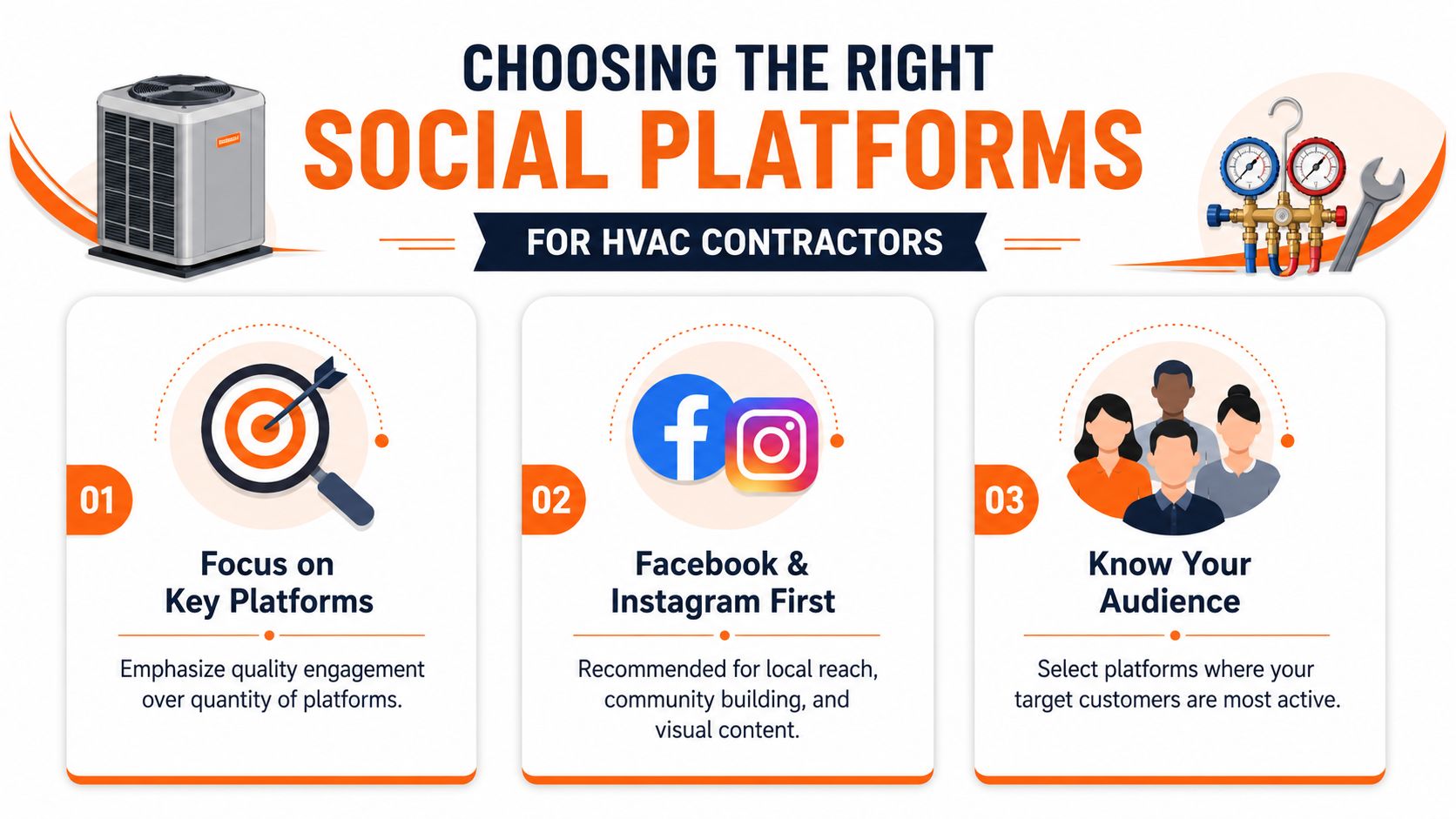
According to RSM Connect's HVAC social strategy guidance, HVAC contractors must prioritize Facebook and Google Business Profile as mandatory platforms, and posting 2–3 times per week drives local job inquiries. The same guidance says turning 4–8 customer reviews monthly into branded graphics strengthens social proof.
Why Facebook earns your time
Facebook still fits the way many homeowners look for local services. They see recommendations in community groups, notice posts from local businesses, and click through when a company feels familiar.
It also gives you practical options. You can post job photos, answer comments, share seasonal reminders, and run paid campaigns in a defined service area. That makes it useful whether you're trying to stay visible organically or reach more homeowners with ads.
Why Google Business Profile is non-negotiable
Google Business Profile catches people with immediate intent. They're not casually browsing. They're looking for help now.
That's why your time should go into keeping this profile complete and active, not chasing every platform trend. If someone finds your company and sees recent updates, reviews, service details, and a clear phone number, you've already removed friction.
Don't confuse platform count with marketing strength. Two active profiles beat five dead ones.
If you do add Instagram, treat it as a support channel for visual proof, not your main battlefield. Facebook and Google Business Profile should carry the load first.
Set Up Your Profile to Attract Local Customers
Your profile is your digital storefront. If it looks incomplete, outdated, or vague, people assume the business runs that way too.
A strong setup doesn't need to be fancy. It needs to answer the questions a homeowner has in the first few seconds: who are you, where do you work, what do you do, and how do I contact you right now?
If you want a broader view of showing up locally across digital channels, this guide to HVAC contractor local marketing gives useful context.
What to put in the profile itself
Start with your profile photo. If your company has a clean, readable logo, use it. If the logo is cluttered or hard to read at a small size, use a professional photo of the owner or lead tech in uniform. People trust people.
Then tighten your bio or description. Don't write a slogan. Write what you do and where you do it. Keep it plain: residential HVAC repair, system replacement, tune-ups, emergency service, and your service area.
Use a simple checklist:
- Business name and trade clearly stated. Make it obvious you're an HVAC company.
- Service area named. List the towns, suburbs, or region you cover.
- Phone number easy to spot. Don't bury it.
- Hours and response expectations included. Especially if you offer emergency service.
- Call to action written in plain English. “Call now for an estimate” works better than vague branding language.
What homeowners notice fast
The header image should support trust. A branded van, your crew on site, or a real install photo works. A stock image of an air conditioner doesn't.
Also check the basics that contractors often miss:
- Your website link works.
- Your message button is turned on.
- Your service list matches what you want to sell.
- Recent posts aren't months old.
- Contact details are identical across profiles.
A good profile reduces hesitation. A weak profile creates it.
That's the standard to aim for. Not “impressive.” Just clear, current, and local.
A Simple Content Plan That Actually Books Jobs
Most HVAC social feeds break down because they rely on inspiration. Inspiration is unreliable when you're booked out, behind schedule, or dealing with callbacks.
A better system uses a few repeatable content types. According to Scorpion's guide for HVAC technicians using social media, the content categories that convert are educational tips, behind-the-scenes work photos, customer testimonials, and seasonal offers. The same source says contractors who consistently post visual before-and-after content and respond to comments within 24 hours achieve 20–30% higher lead conversion.
Use a value-first mix
A lot of contractors default to promotions. Discount post. Offer post. Financing post. Then another offer post.
That gets old fast. Homeowners connect more with real people on real jobs than generic equipment images, and a value-first content ratio works better than shouting discounts every week. In practice, that means most of your posts should help, reassure, or prove competence. A smaller portion should ask for the job directly.
Consider it this way:
- Educational posts answer a common question.
- Behind-the-scenes posts show how you work.
- Testimonial posts let customers sell for you.
- Seasonal offer posts give people a reason to act now.
Build posts from the work you already do
You do not need a studio. You need a phone and a habit.
Take a quick before-and-after photo during an install. Record a short clip explaining what caused a system failure. Snap a team photo after a tough job. Save a customer message that shows relief and satisfaction. That's your content bank.
Here's a simple weekly structure.
| Day | Post Type | Example |
|---|---|---|
| Monday | Educational tip | “What a homeowner should check when airflow feels weak” |
| Wednesday | Behind-the-scenes | Photo from a system replacement with a short note about the job |
| Friday | Social proof | Customer review graphic or a before-and-after install post |
You can also rotate in these practical formats:
- Quick phone video: Explain a common issue in plain language.
- Meet the tech post: Put a face to the business.
- Seasonal reminder: Tune-up timing, filter checks, or pre-summer prep.
- Job spotlight: Show the problem, the fix, and the outcome.
If you need better local reach ideas for captions and discoverability, this list of HVAC hashtags for contractors can help tighten your posting workflow.
Helpful beats clever. Clear beats polished. Real work beats stock graphics.
That's what makes HVAC contractor social media marketing sustainable. You're not inventing content. You're documenting work you already do.
Turn Customer Reviews into Your Best Marketing Tool
Most companies treat reviews as something you collect and leave sitting on Google. That wastes a strong asset.
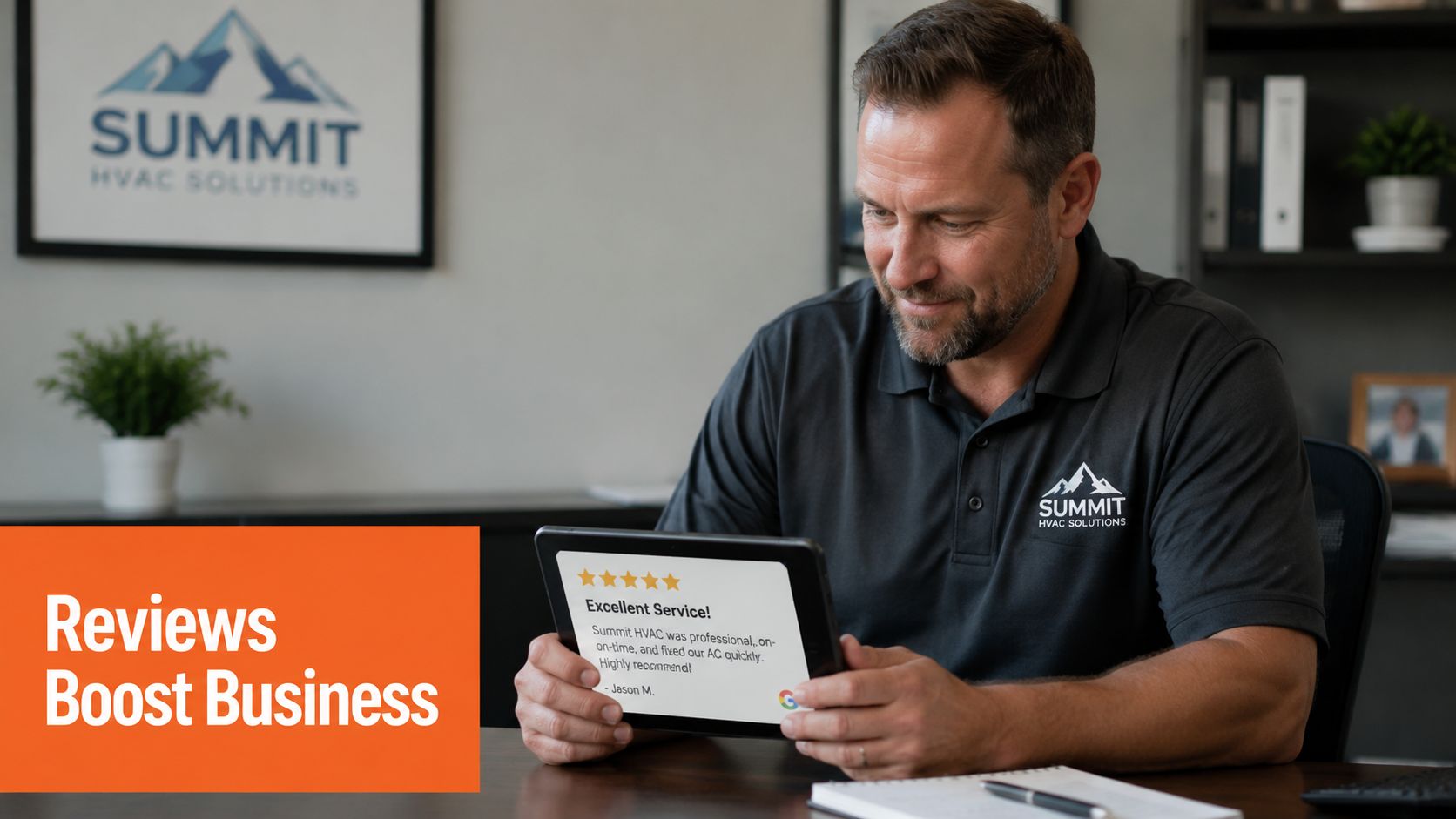
A good review can do two jobs at once. It strengthens your reputation where people search for you, and it becomes content you can post on social media to build trust with the next homeowner who's still deciding.
One review can do two jobs
Keep the process simple. Screenshot a strong Google review. Drop the text into a clean Canva template with your logo and brand colors. Add a short caption that gives context, like the suburb, service type, or what the customer needed help with.
That works because it feels specific. A homeowner trusts a neighbor's experience more than a self-promotional claim from a company page.
Turn reviews into a routine:
- Ask at the right moment. Right after the job is complete and the customer is relieved.
- Save the best ones. Create a folder on your phone for future posts.
- Use real context. Mention the type of job without overcomplicating it.
- Keep the graphic clean. One review, one logo, one clear message.
Replying matters as much as posting
Social media isn't just publishing. It's response.
According to Geek Powered Studios on HVAC social media best practices, HVAC companies that actively engage with followers by responding to comments, answering questions, and showing appreciation for feedback build stronger relationships and a better reputation. That matters because reputation is what turns a passive viewer into someone who messages or calls.
So when someone comments on a review post, reply. If a customer thanks your team publicly, acknowledge it. If someone asks a question, answer it in a useful way. Every response signals that your business is active, accountable, and paying attention.
A review post without a response strategy leaves trust on the table.
Even negative reviews have value if handled calmly. A professional response shows the next prospect how you deal with problems. That's often more persuasive than the original complaint.
Get Seen by More Homeowners with Simple Paid Ads
Organic posts help you stay familiar. Paid ads help you reach people who don't know you yet.
A lot of contractors have tried the lazy version of this. They hit “boost post,” choose a broad audience, spend some money, and get nothing useful back. That doesn't mean paid social is broken. It usually means the targeting was weak.
Stop boosting random posts
Good HVAC ads start with geography and homeowner relevance. You want your message in front of the right local audience, not everybody.
Benchmark data in this HVAC paid social analysis on YouTube says contractors using location-based paid social ads targeting homeowners by home age, such as pre-1990 builds that may suggest upgrade needs, see 2.5x higher booking rates than untargeted campaigns.
That lines up with what works on the ground. An older home in your service area is a more relevant audience for replacement or upgrade messaging than a random broad audience spread across a city.
A simple campaign that fits HVAC
Keep the offer narrow and seasonal. A spring AC tune-up campaign is a clean example.
Build it like this:
- Target the service area. Only the towns and radius you serve.
- Choose a homeowner-focused audience. Prioritize likely homeowners over general users.
- Match the message to the season. Tune-up, repair readiness, replacement consults.
- Use a real image or short video. A van, a tech, a real install, a homeowner-facing explanation.
- Send people to one action. Call, message, or book.
Blue Corona's HVAC guidance notes that paid social campaigns should include split-testing ad copy and custom audiences to improve performance, as outlined in their breakdown of HVAC social media advertising.
That matters because small tweaks change outcomes. One version may focus on reliability before summer. Another may focus on older systems and rising repair headaches. Test both. Keep the winner.
Paid ads work best when they feel local and specific, not broad and generic.
Automate Your Social Media to Save Time and Stay Visible
Monday starts with good intentions. By Wednesday, a no-cool call turns into a late repair, an install runs over, and the post you meant to publish never gets written. By Friday, the profile is quiet again.
That pattern is common in HVAC. It is not a planning problem. It is a workload problem.
The biggest challenge is consistency
Manual social media sounds manageable until you count the jobs involved. Someone has to come up with topics, write captions, choose photos, design the post, schedule it, and keep doing that every week. For a contractor or office manager already juggling calls, dispatch, estimates, and job issues, that system usually breaks.
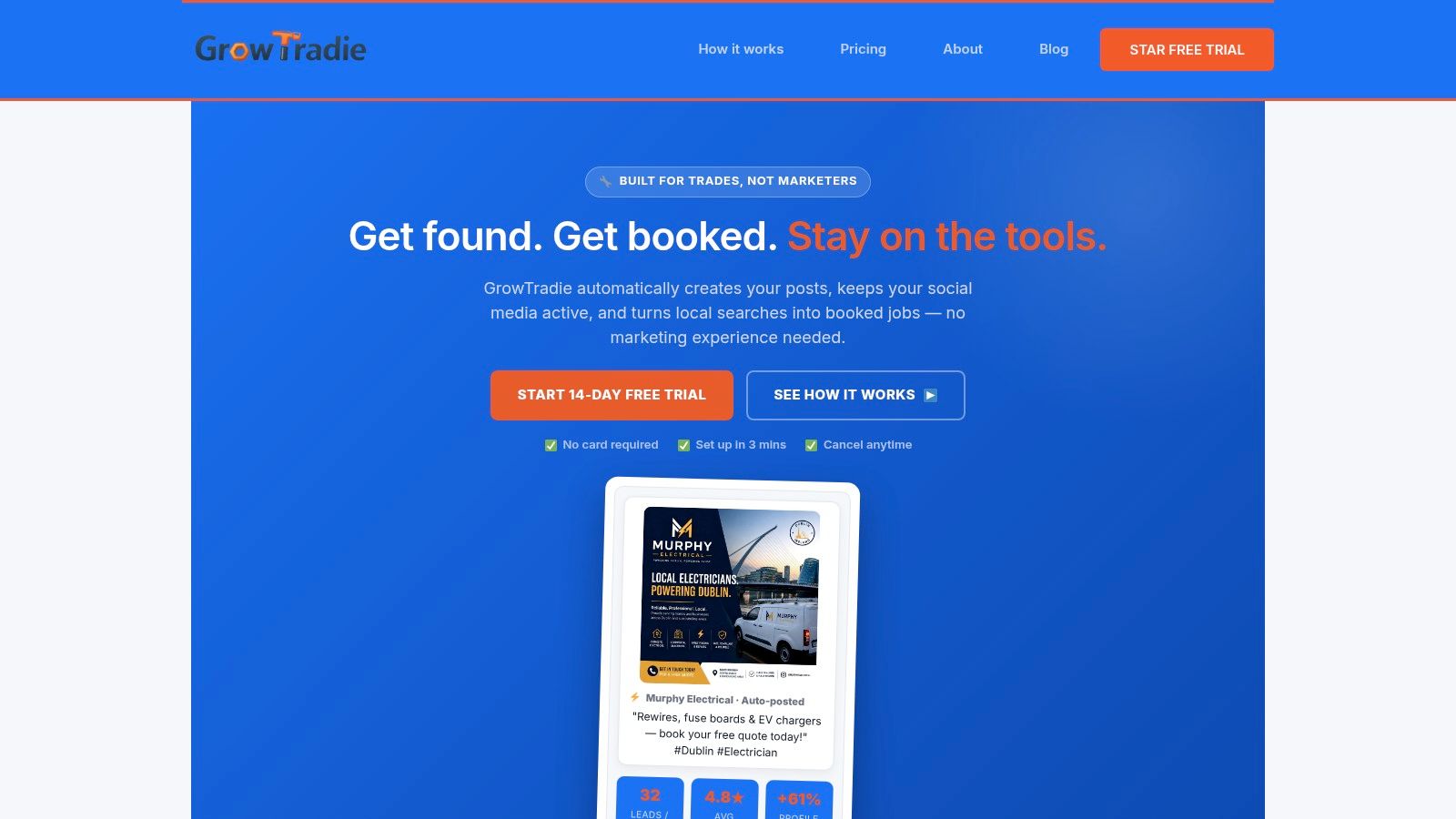
According to GrowTradie's 2025 data on inactive trade business profiles, 68% of HVAC businesses with inactive social profiles lose potential leads because they can't maintain consistent visibility between jobs. The useful takeaway is simple. Visibility drops when posting depends on spare time.
Consistency is what keeps your business in front of homeowners before they need service, not just when they are ready to call. A decent post published every week beats a burst of effort followed by silence.
What Automation Should Handle
Scheduling posts is only one piece. If the content still needs to be written from scratch every time, you have not saved much time.
A system built for a busy HVAC shop should take care of the repeatable work:
- Content creation: captions, post ideas, and service-related topics tied to the season
- Design: branded graphics that look professional without needing a designer
- Scheduling: posts lined up in advance so the feed stays active
- Local fit: wording and topics that match the towns, services, and jobs you take on
That leaves the work only your team can do well. Upload a job photo now and then. Reply to comments and messages. Ask for reviews after a good service call. Those actions build trust. The platform should handle the steady publishing around them.
One more look at how that kind of workflow works in practice:
This is the trade-off. You can keep trying to post manually between service calls, or you can put the recurring work on a system and protect your time. For most HVAC businesses, the second option is the only one that lasts.
The phone rarely rings because of one post. It rings because people keep seeing your name, your trucks, your jobs, and your reviews over time. Automation makes that repetition possible without turning social media into another job on your list.
If you want that consistency without writing captions at night or planning posts between service calls, GrowTradie is built for exactly that. It creates trade-specific social content, designs the posts, and schedules them for you so your profiles stay active while you stay focused on the work that pays.