
Some weeks your phone won't stop ringing. Other weeks you're staring at the schedule, wondering why the work dried up. That's where most HVAC contractors get stuck. You're good at the trade, but the flow of jobs depends too much on referrals, repeat customers, and luck.
That setup works until it doesn't. When someone's AC dies or the heat cuts out, they don't ask around for three days. They grab their phone and look for a local contractor who seems legitimate, close, and easy to contact. Research shows 4 out of 5 consumers use search engines to find local information, and 88% of those people are likely to contact a business within 24 hours according to Sixth City Marketing's HVAC local visibility research.
If you're still relying mostly on word-of-mouth, you're leaving urgent, high-intent jobs on the table. The fix isn't more marketing fluff. It's a repeatable local visibility system that gets you found, gets you trusted, and gets you called.
Table of Contents
- The Foundation for Attracting Local HVAC Customers
- Mastering Your Google Profile and Local Listings
- Building a Website That Wins Local Jobs
- Earning Trust with Reviews and Local Recommendations
- Activating Your Presence with Content and Paid Ads
- Tracking What Works and Turning Interest into Appointments
The Foundation for Attracting Local HVAC Customers
Most contractors don't have a lead problem. They have a visibility problem.
You're already operating in a market where people need help fast. Heating and cooling isn't an impulse purchase, but the first contact often is. The homeowner wants someone nearby, someone credible, and someone who answers the phone. If your business isn't showing up clearly when that need hits, a worse contractor can still win the job.
Stop relying on referrals alone
Referrals are valuable. They're also inconsistent.
A proper hvac contractor local seo marketing system, stripped of jargon, comes down to three basic outcomes. You need people to find you in your service area, trust what they see, and contact you without friction. Beyond these, everything else is support work.
Practical rule: If a stranger in your suburb can't confirm who you are, what you do, and how to call you within a few seconds, your online presence is leaking jobs.
Many small operators often stall in this manner. They have a website from years ago, a half-finished business listing, old photos, and different phone details floating around the web. That mess weakens trust before a prospect even calls.
For newer contractors, this issue usually shows up alongside other setup problems. If you're still building the business from the ground up, this guide on how to start an HVAC company helps frame the operational side as well.
Build a system that works in the background
You don't need a complicated funnel. You need a stable base that keeps working while you're on jobs.
That base looks like this:
- Accurate local presence: Your business details need to match everywhere customers check.
- Strong trust signals: Real photos, clear service information, and recent reviews do more than polished slogans.
- Fast contact paths: Calls, quote requests, and directions should be easy to access on every device.
A lot of tradies chase flashy tactics too early. They want ads before they fix their profile. They want social posts before they sort out their suburbs and service list. That's backwards.
Here's the better approach.
| Priority | What to fix first | Why it matters |
|---|---|---|
| First | Business profile and listings | This is where local customers often decide who to call |
| Second | Service and area pages on your website | These match what people actually search for |
| Third | Reviews and response process | These turn visibility into booked work |
The contractors who stay busy year-round usually aren't doing magical marketing. They've built a local presence that looks trustworthy and stays current. That consistency is what turns random searches into predictable booked jobs.
Mastering Your Google Profile and Local Listings
Your Google Business Profile does more heavy lifting than almost anything else online. For many local searches, it's the first thing a customer sees, and often the last thing they need before tapping Call.
Start with the profile that drives calls
Get the basics right first. Not mostly right. Exactly right.
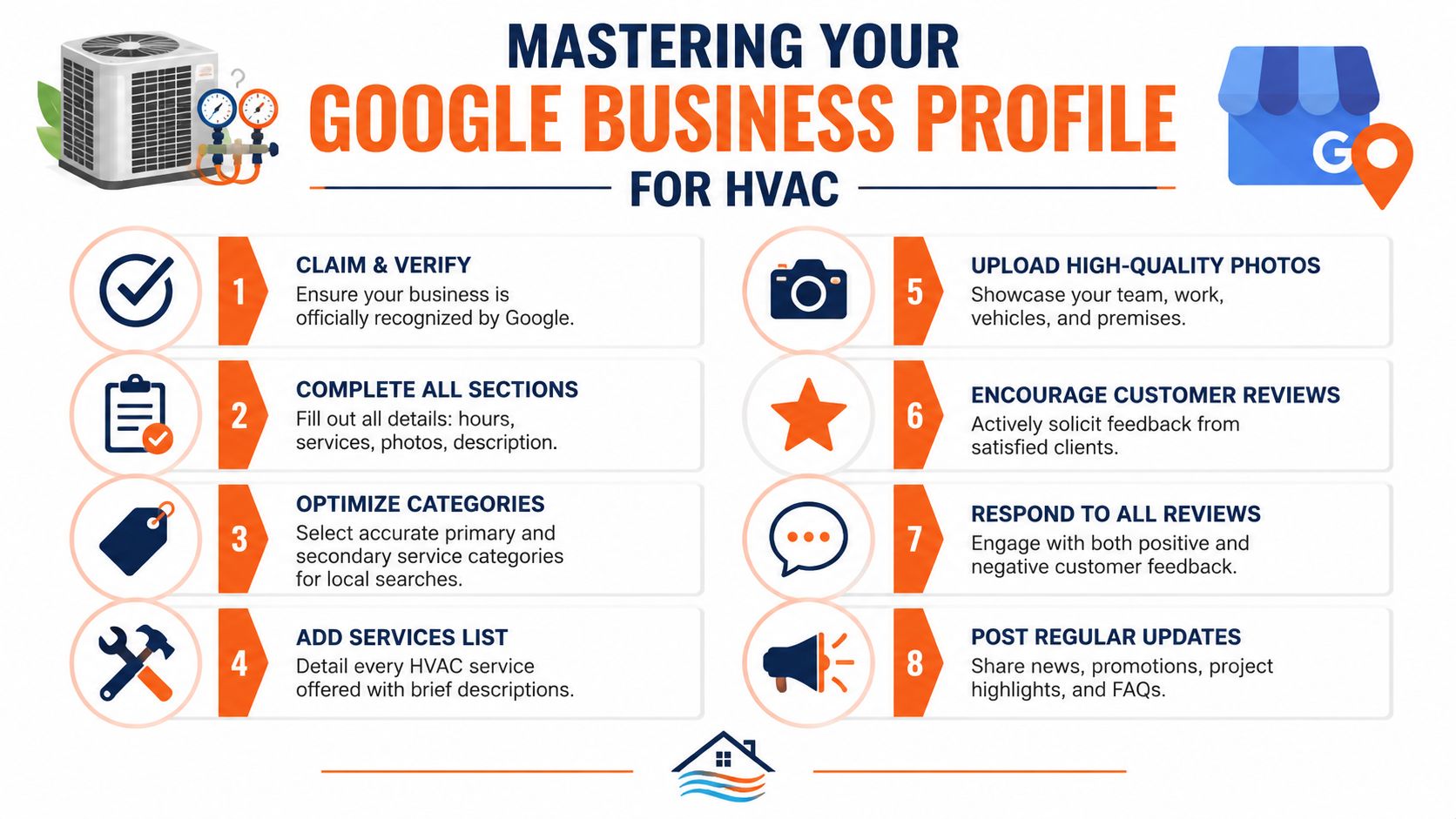
PowerChord's HVAC marketing guide notes that the fastest results in local visibility come from fully optimizing your Google Business Profile and making sure your Name, Address, and Phone information is identical everywhere online, and that most HVAC companies see meaningful improvements within three to six months when they focus on those basics.
That means your checklist should look like this:
Claim and verify the profile
If you haven't formally claimed it, you don't control it. Fix that first.
Choose the right business categories
Your main category should match your core work. Then add supporting categories that reflect the actual services you deliver.
List every major service
Don't make people guess. Add heating repair, AC repair, furnace installation, ducted systems, maintenance, emergency callouts, and anything else you offer.
Set service areas properly
Include every town and suburb you actively serve. Be precise.
A local example helps. A contractor targeting a major metro can study how Houston HVAC visibility strategies are structured around local service coverage, suburb targeting, and profile completeness.
After the setup work, use visuals that prove you're real.
- Team photos: Uniforms, vans, technicians on site.
- Job photos: Real installs, repairs, equipment swaps, plant rooms.
- Premises and vehicles: Anything that confirms you're a legitimate local operator.
Stock images are a mistake. They look fake because they are fake.
This walkthrough is worth watching before you start editing the profile:
Keep your business details identical everywhere
This is the part contractors ignore because it feels boring. It's also one of the easiest wins.
Your Name, Address, and Phone details need to match exactly across your website, Google profile, Yelp, Angi, and any other directory you use. Same spelling. Same formatting. Same phone number.
If your details are inconsistent across listings, you make it harder for platforms to trust that your business information is accurate.
Use this quick audit table:
| Listing type | What to check |
|---|---|
| Google profile | Business name, phone, hours, service areas |
| Website | Header, footer, contact page, mobile click-to-call |
| Directory listings | Same contact details and same branding |
| Review platforms | Correct business info and active owner responses |
Then keep the profile alive.
Treat it like an active storefront
An abandoned profile looks neglected. An active one looks open for business.
Do these routinely:
- Upload fresh photos: Add recent job photos regularly.
- Respond to reviews: Positive or negative, answer all of them professionally.
- Post updates: Seasonal reminders, new service announcements, and project highlights keep the profile current.
- Check hours: Especially around holidays, weekends, and emergency availability.
Most contractors don't need more complexity here. They need discipline. A complete, current profile with accurate listings is the quickest path to stronger local visibility.
Building a Website That Wins Local Jobs
A generic website is a brochure. A job-winning website acts more like a sales rep.
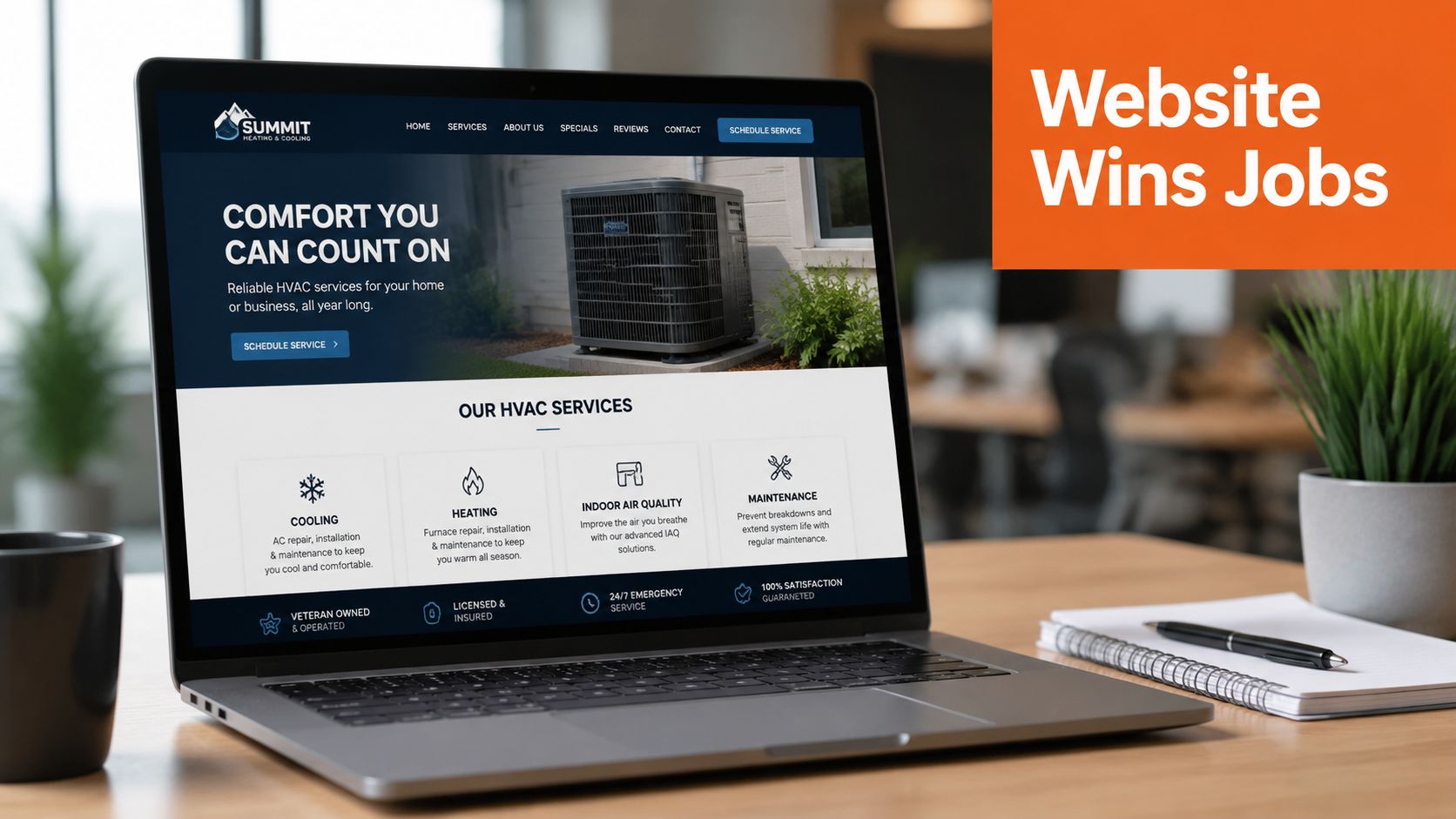
If your site has one Services page and a Contact page, you're giving away work to contractors with better local pages. People don't search in broad terms when they need help. They search for a specific service in a specific place.
Generic pages don't win local jobs
Someone looking for AC repair in one suburb doesn't want to land on a vague page that talks about heating, cooling, installations, maintenance, and commercial work across half the state. They want confirmation that you handle their problem in their area.
That's why service-plus-location pages matter.
Freitag Marketing's HVAC page strategy guidance states that creating dedicated pages for each core service and city combination with more than 500 words of unique local content and real job photos per page has helped top-performing contractors achieve traffic increases as high as 453% in a year.
That setup is straightforward:
- AC repair in Town A
- Furnace installation in Town A
- Ducted heating repairs in Town B
- Split system servicing in Town B
Each page answers a very specific local job intent. That's why it works.
What each local service page needs
Don't build thin duplicate pages and just swap suburb names. That wastes time and looks weak.
Each page should include:
- A clear service match: If the page is about furnace repair in one area, keep it focused on that service.
- Local proof: Mention the suburb, nearby areas, and the kind of properties you work on there.
- Real job photos: Use your own photos from actual work.
- An embedded map: Make the location connection obvious.
- Strong contact prompts: Calls and quote requests should be easy on mobile.
A local page should feel like it was written by a contractor who actually works in that area, not by someone filling in a template.
Here's a simple structure that works well:
| Page element | What it should do |
|---|---|
| Main heading | Match the service and location clearly |
| Intro paragraph | Confirm the problem you solve in that area |
| Service details | Explain what you do, what issues you fix, and what customers can expect |
| Local proof | Mention nearby suburbs, job examples, or area-specific context |
| Photos and map | Reinforce that you're active in that location |
| Contact section | Make calling or booking the obvious next step |
You don't need fancy copywriting. You need clarity.
A lot of HVAC websites try to sound corporate. That's the wrong move for local service work. Homeowners care about whether you handle the job, show up on time, and work in their area. Your website should answer those questions fast.
If you serve multiple towns, build the page matrix properly and keep expanding it over time. That approach outperforms one bloated page trying to cover everything at once.
Earning Trust with Reviews and Local Recommendations
People don't just compare prices. They compare risk.
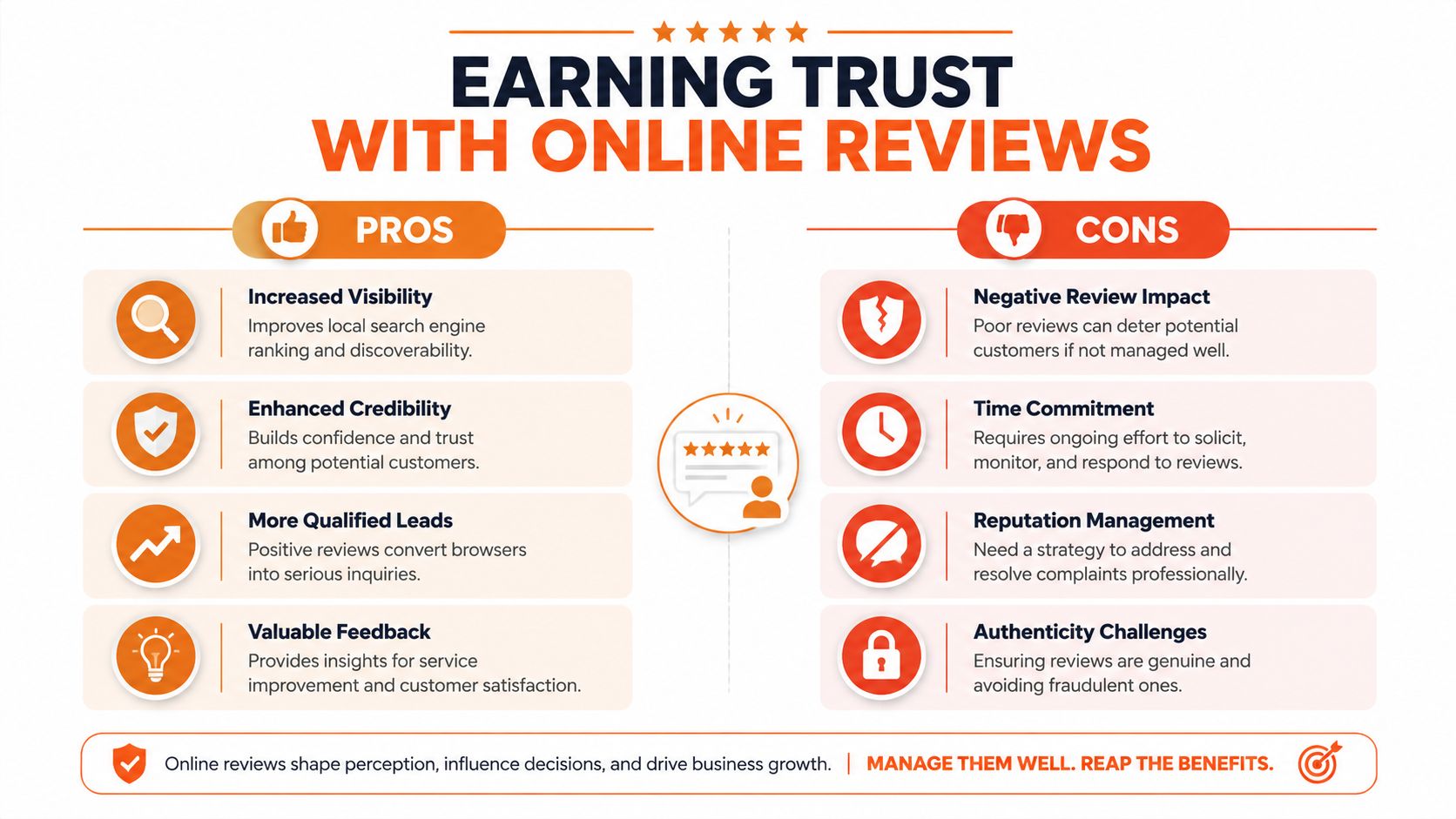
When a homeowner is choosing between two contractors they don't know, reviews often decide who gets the call. That's why your reputation system can't be random. It needs a process.
Aim for steady detailed reviews
Most contractors ask for reviews only when they remember. Then they ask five customers in one day, ignore it for two months, and wonder why results are inconsistent.
Hook Agency's review guidance for HVAC contractors highlights a key point: a steady, moderate inflow of reviews of 2 to 3 per month with detailed descriptions of 120 or more characters outperforms a sudden spike in short, generic 5-star reviews.
That's a better target than chasing volume for the sake of it.
A good review does three things:
- Names the service: AC repair, furnace replacement, emergency callout.
- Mentions the experience: Fast response, clear communication, tidy work.
- Feels specific: Real details beat generic praise.
Here's the difference.
| Weak review | Strong review |
|---|---|
| Great service, highly recommend | Our furnace stopped working and they arrived quickly, explained the fault clearly, and had the heat back on the same day |
| 5 stars | We used them for AC servicing in our suburb, and the technician was on time, professional, and easy to deal with |
Make review requests part of the job process
The best time to ask is after the customer has seen the result and the job ended well. Don't overcomplicate it.
Use a simple script your team can repeat:
“Glad we got that sorted for you. If you're happy with the work, I'd really appreciate a review. It helps other local homeowners feel confident calling us.”
Then follow up by text with a direct review link. Keep it short. Make it easy.
A solid review process looks like this:
Finish the job cleanly
If the handover feels rushed or messy, don't ask yet.
Ask in person
A quick verbal request lifts follow-through.
Send the link the same day
The longer you wait, the lower the response rate.
Reply to every review
Thank the happy customers. Stay calm and professional with unhappy ones.
Beyond reviews, get local recommendations where you can. Supplier websites, local chambers, business associations, and respected directories all help reinforce that you're an established contractor in the area.
You don't need dozens of weak listings. You need a handful of relevant local mentions and a review stream that looks natural, recent, and detailed.
Activating Your Presence with Content and Paid Ads
Once the foundation is in place, you need two engines running. One builds familiarity over time. The other fills gaps when you need leads faster.
Content builds familiarity
Most HVAC contractors overthink content. You don't need polished brand campaigns. You need practical posts that make local people recognize your business and trust that you're active.
Good content usually comes from work you're already doing:
- Seasonal reminders: Filter changes, pre-summer checks, winter heating prep.
- Job spotlights: Before and after photos, installs, fault repairs.
- Team introductions: Show who customers will meet.
- Common homeowner questions: Strange noises, airflow issues, thermostat problems.
The point isn't to go viral. The point is to stay visible between jobs so your business doesn't disappear when people aren't actively searching.
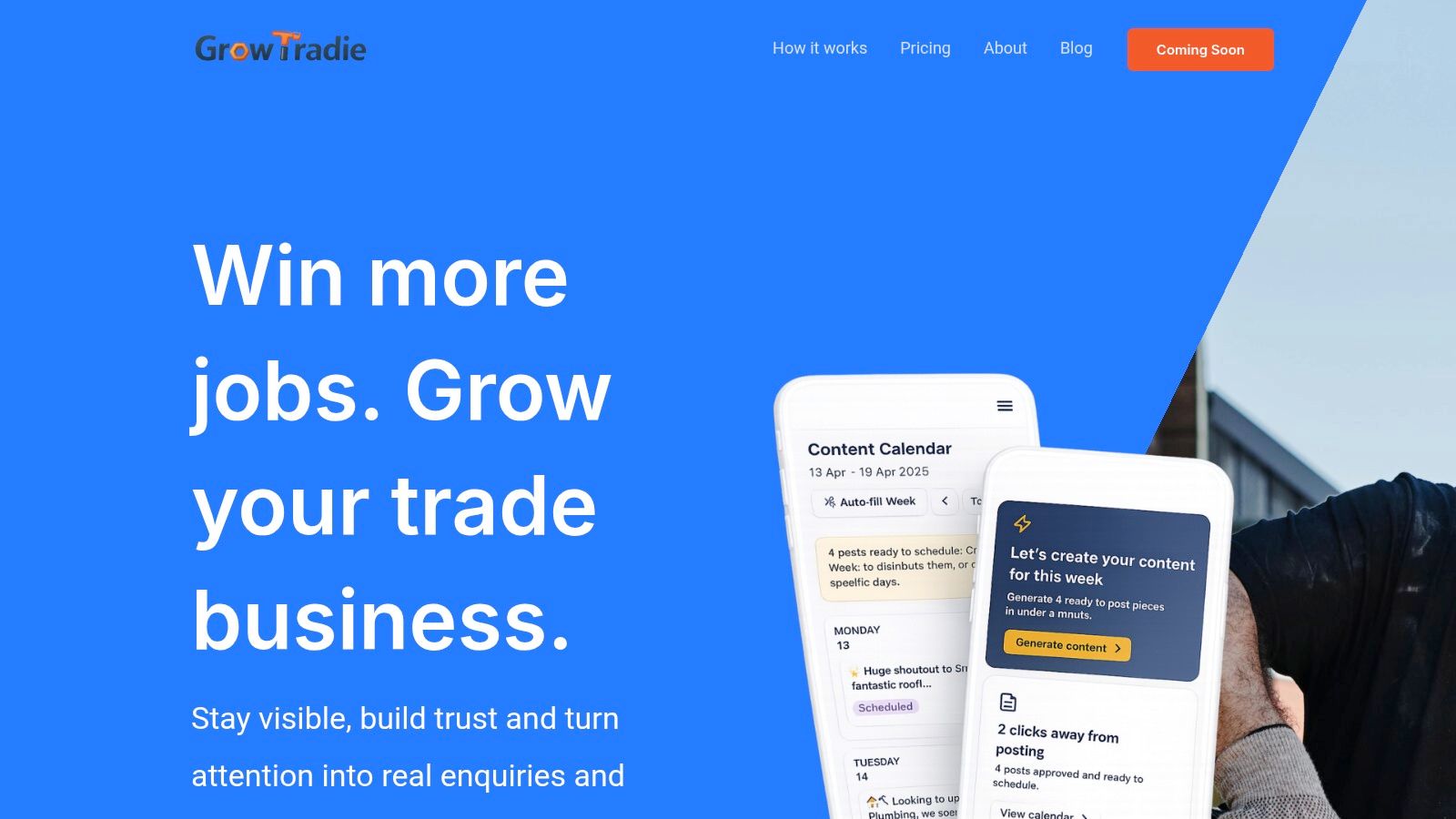
One option for handling this without writing everything yourself is GrowTradie's HVAC digital marketing platform, which creates and schedules trade-specific social content based on your services and local area. For time-poor crews, that's a practical way to keep profiles active.
Field advice: If your socials have been dead for months, prospects notice. Silence makes small operators look smaller.
Website content plays a different role. Social posts keep your name familiar. Website articles and service updates help answer real homeowner questions and support your broader visibility.
Paid ads fill schedule gaps faster
Content is slow and cumulative. Paid ads are immediate.
If you've got openings in the schedule, want more emergency work, or need to push harder during peak season, Google's paid local placements can help. The strongest use case is simple. Turn them on when you need more enquiries now, not six months from now.
This comparison keeps the decision clear:
| Channel | Best use | Strength | Limitation |
|---|---|---|---|
| Social and website content | Ongoing trust and brand familiarity | Keeps you visible and credible | Takes time to build momentum |
| Google Ads | Fast lead generation | Good for urgent demand and schedule gaps | Stops when spend stops |
| Google Business Profile activity | Local presence and proof | Supports calls from nearby searchers | Needs regular upkeep |
Budgeting matters too. BDR's HVAC marketing budget guidance says HVAC contractors in active growth mode should allocate 10 to 12 percent or more of total revenue to marketing, while established companies protecting market position can invest closer to 5 to 8 percent. It also notes that the ACCA recommends 60 to 70 percent of total marketing spend be front-loaded into the peak four to six months of the year.
That's the right mindset. Spend more aggressively when demand is strongest and customer acquisition is easier. Don't spread budget evenly just because it feels tidy.
A lot of contractors make the mistake of choosing either content or paid ads. That's the wrong frame. Use content to stay credible and present. Use paid ads when you want to accelerate demand.
Tracking What Works and Turning Interest into Appointments
Visibility means nothing if the lead dies at the phone.
A lot of contractors assume the hard part is getting found. It isn't. The harder part is converting that interest into booked work before a competitor gets there first.
Watch the signals that matter
Start with the simplest tracking points from your business profile and website. Look at calls, form enquiries, direction requests, and which service pages are getting attention. That tells you where interest is showing up.
Then compare that against what transpired in the office or on the mobile. Did someone answer the call? Did a form submission get a response? Did the customer get booked, quoted, or ignored?
Keep the scorecard simple:
- Calls received
- Missed calls
- Form leads
- Time to first response
- Booked jobs from those enquiries
If you can't tie attention to appointments, you're not measuring the part that matters.
Response speed decides who gets the job
WorldMetrics' summary of home services response data reports that 78% of buyers hire the first business that responds to their inquiry, while the home services industry still has a 14% missed call rate.
That should change how you run the front end of the business.
Slow follow-up doesn't just reduce close rate. It wastes every dollar and every hour you put into getting found.
If calls go unanswered, fix rostering. If web forms sit unread, fix ownership. If after-hours enquiries disappear, put a process in place. A smaller contractor who answers fast will often beat a bigger competitor who responds late.
You don't need a complicated conversion system. You need someone answering, someone replying, and someone booking. Fast.
GrowTradie is a practical option if you want your online presence to stay active without writing posts yourself. The platform creates and schedules content for trade businesses based on your services and local area, which helps keep your business visible while you focus on site work, quotes, and booked jobs.