
You know the call. The customer says the upstairs radiant loop is cold, the boiler is short cycling, there's water on the floor near the mechanical room, and the last contractor told them to “call a plumber,” while the plumber told them to “call HVAC.” By the time you arrive, the client is irritated, the system history is muddy, and nobody wants to own the full diagnosis.
That's where the HVAC plumber stops being a vague label and starts becoming a serious trade position. On the jobs that mix water, heat, controls, venting, combustion, condensate, and sometimes refrigerant, the contractor who can read the whole system usually wins the job, keeps the margin, and avoids the finger-pointing that kills time.
For tradies, this isn't just about adding another service line. It's a business specialization. If you can handle the overlap properly, you become the person people call when the standard handoff between trades keeps failing.
Table of Contents
- The Gray Area Between Pipes and Vents
- Defining the HVAC Plumber Role
- The Overlap Zone Common Hybrid Services
- Your Certification and Licensing Pathways
- Justifying Your Price for Specialized Work
- How to Vet a True Hybrid Professional
- Marketing Your Dual Skills to Win Local Jobs
The Gray Area Between Pipes and Vents
A straight plumbing call is simple enough. A blocked waste line, a failed mixer, a leaking isolation valve. A straight HVAC call is also familiar. No cooling, failed blower, bad igniter, faulty control board. The trouble starts when the problem lives in the middle.
Take radiant heat. The customer feels cold floors and assumes it's a boiler problem. Sometimes it is. Sometimes the boiler is fine and the issue is air in the loop, poor circulation, a stuck zone valve, a pressure problem, bad balancing, or a piping mistake from the original install. That's not a one-trade diagnosis.
The same thing happens with heat pumps and hybrid systems. One contractor looks at condensate and pipe routing. Another looks at controls and equipment operation. The customer ends up paying for two site visits before anyone commits to a fix.
Most messy call-outs don't start with a hard repair. They start with the wrong diagnosis.
That confusion is common enough that hybrid systems like radiant heat and heat pumps remain a weak spot for a lot of service businesses. In that overlap, plumbers handle water flow and piping while HVAC techs manage boilers and controls, and the confusion is intensified by a national workforce shortage of over 10,000 in these trades, as noted by Margo Plumbing's discussion of radiant heat and heat pump trade boundaries.
Why these calls are worth attention
If you're the tradie who can walk in and separate a circulation issue from a combustion issue, or a condensate routing problem from an equipment fault, you're no longer competing on basic service work alone. You're solving the jobs other contractors stall on.
That matters because these jobs usually come with three things:
- Higher trust needs: The client wants one person to take responsibility.
- Better margins: Complex diagnosis is worth more than routine replacement work.
- Stronger referrals: Builders, facilities managers, and homeowners remember who fixed the system nobody else wanted to own.
An HVAC plumber sits right in that gap. Not as a marketing phrase, but as a practical answer to a real site problem.
Defining the HVAC Plumber Role
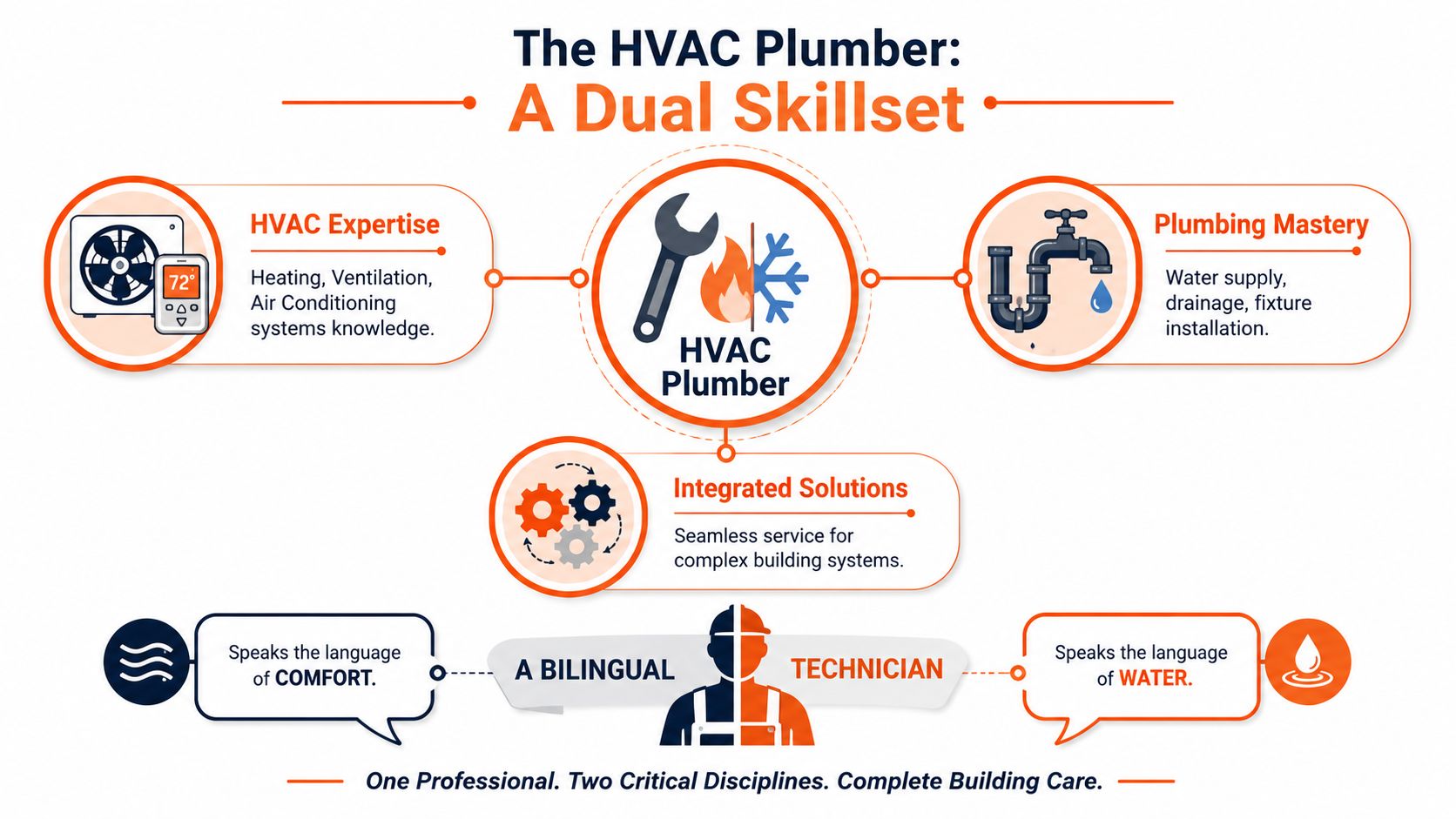
An HVAC plumber is a bilingual technician. One language is water, pressure, flow, drainage, venting, gas piping, and fixtures. The other is heat transfer, airflow, combustion, controls, refrigerants, and equipment sequencing. On a hybrid system, that combined fluency is what keeps a job moving.
What a standard plumber handles
A good plumber owns the pipework side. That includes water supply, drainage, gas line rough-in where licensed, fixtures, valves, pumps, backflow considerations, pressure regulation, and leak tracing. On heating jobs, that can extend into hydronic loops, expansion tanks, circulators, manifolds, and system fill issues.
That skill set is already part of a huge trade base. The U.S. plumbing industry is valued at an estimated $121.5 billion, with around 436,160 American plumbers employed, and in 2020 there were nearly 990,000 combined plumbing and HVAC contractor establishments across the U.S., according to ServiceTitan's plumbing industry statistics roundup.
What a standard HVAC tech handles
A focused HVAC tech usually owns air-side and equipment-side performance. That means furnaces, condensers, air handlers, duct systems, thermostats, burners, control boards, refrigerant circuits, combustion tuning, and venting performance tied directly to heating and cooling equipment.
They diagnose sequence of operation issues fast. They know where heat is lost, where controls are failing, and where a system isn't performing to spec.
Where the HVAC plumber is different
The HVAC plumber is the contractor who can look at the same system and ask better questions:
- Is the low heat complaint caused by poor water movement or faulty controls?
- Is that boiler lockout caused by combustion, venting, fill pressure, or flow?
- Is the equipment fault real, or is the system installed in a way that guarantees callbacks?
- Is the problem in the mechanical unit, the connected pipework, or both?
Practical rule: If the job mixes heat source, water movement, controls, and drainage, the handoff between trades often creates the problem.
That's why this role matters on boiler rooms, radiant systems, indirect tanks, geothermal mechanical packages, and heat pump setups with drainage and hydronic tie-ins. A standard plumber may stop at the equipment casing. A standard HVAC tech may stop at the connected piping. The HVAC plumber follows the fault all the way through.
The Overlap Zone Common Hybrid Services
The overlap zone is where a lot of good money sits. These are the jobs where one trade can start the work, but two trades are usually needed to finish it properly unless you've built hybrid capability.
Boilers and hydronic heating
Boilers are the classic overlap system. The plumbing side includes fill valves, expansion tanks, pressure relief discharge, circulators, manifolds, air elimination, loop balancing, and distribution piping. The HVAC side includes burner setup, combustion performance, venting logic, controls, aquastats, and sequencing.
If you only know one side, you'll miss half the system. A boiler can fire perfectly and still fail the building because the hydronic side is wrong. It can also have perfect pipework and still short cycle because the control logic is poor.
Radiant floor systems and panel heating
Radiant jobs punish weak diagnostics. Floor loop layout, flow rate, balancing, pump selection, mixing strategy, and air removal all matter. Then the control package has to match the load and operating temperature.
This is also where customer confusion is common. Hybrid systems like radiant heat and heat pumps often leave homeowners unsure who to call first. That trade confusion is one reason hybrid specialists can stand out in the field.
Heat pumps with drainage and connected services
On heat pumps, the mechanical and electrical fault gets most of the attention. But the linked plumbing details matter too. Condensate disposal, line routing, freeze protection in certain setups, and tied-in water components can all become service issues.
If you run an operation that handles parts planning across these mixed service calls, a practical workflow tool like parts demand forecasting for HVAC and plumbing businesses helps reduce wasted van stock and repeat trips.
Geothermal and water-based mechanical packages
Geothermal systems push the overlap even further. You're dealing with heat transfer, pumps, circulation, controls, and connected piping in one package. On these jobs, install quality matters just as much as equipment quality.
A contractor who can commission both the flow side and the equipment side has a clear advantage.
Quick-reference comparison
| Problem | Plumber's Role | HVAC Tech's Role | Why an HVAC Plumber is Best |
|---|---|---|---|
| Radiant floor not heating evenly | Check loops, manifolds, air, balancing, pumps | Check controls, heat source response, thermostatic logic | One person can isolate whether the fault is distribution or control |
| Boiler keeps locking out | Check pressure, fill, relief, circulation path | Check burner, safety sequence, control faults, venting | Faster diagnosis because both hydronic and combustion issues are considered together |
| Heat pump with drainage-related issues | Check drain routing, trapped water, connected piping | Check equipment operation and fault codes | Prevents split responsibility between drainage and unit performance |
| Indirect tank slow recovery | Check pipe sizing, flow path, valves, pump operation | Check boiler control priority and call sequence | Solves both delivery and equipment timing issues in one visit |
The overlap jobs aren't rare. They're the calls where standard trade boundaries waste the most time.
Your Certification and Licensing Pathways
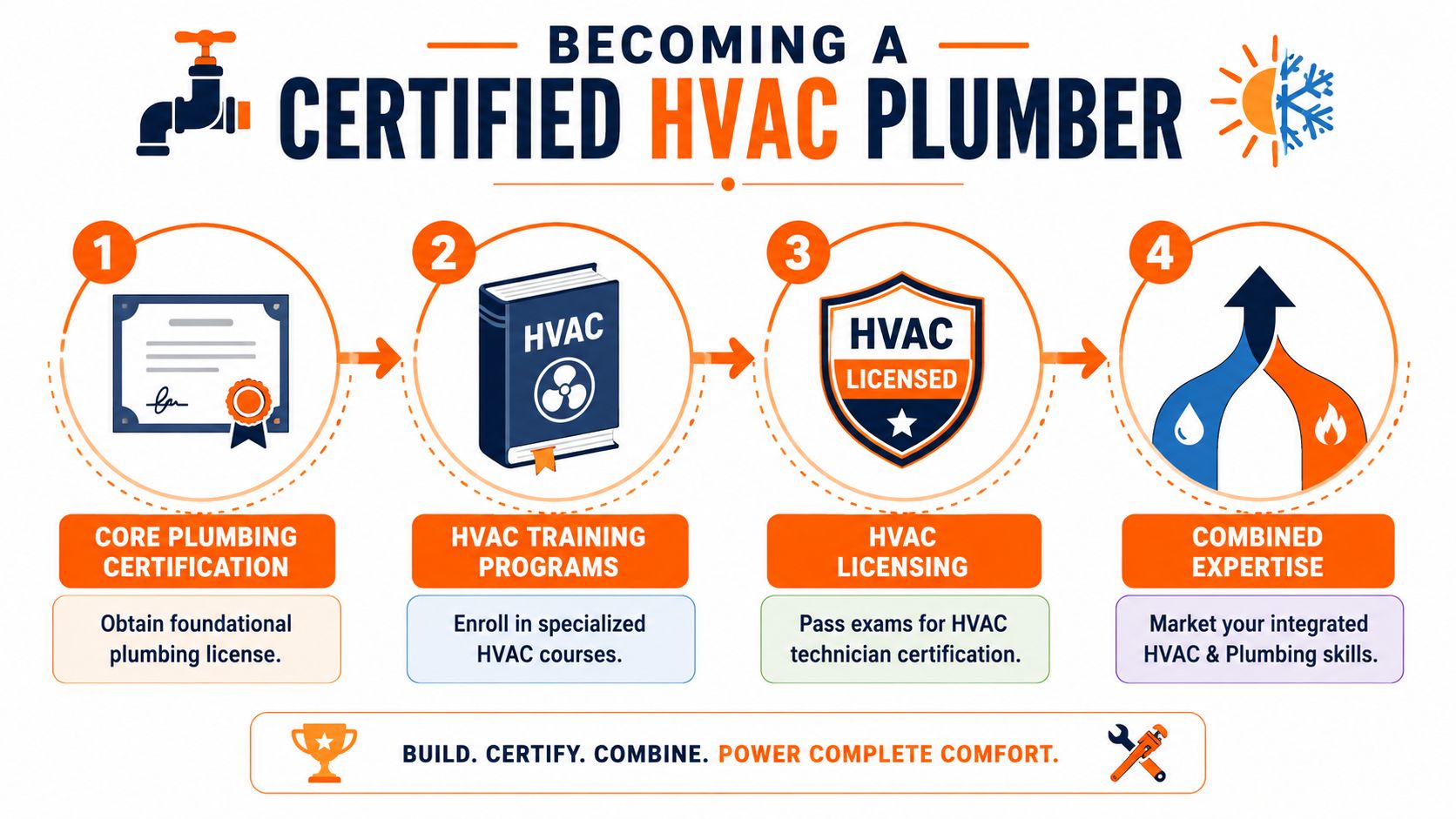
There isn't one magic license called HVAC plumber. If you want to operate legitimately in this space, you build the role by stacking the right qualifications for each trade.
The non-negotiable HVAC credential
If you touch refrigerants in the United States, EPA Section 608 certification is mandatory. It isn't optional, and it isn't a nice extra for your resume. Without it, you can't legally handle equipment capable of releasing refrigerants into the atmosphere. That same source notes the median annual wage for certified HVAC technicians in the U.S. is approximately $59,810, which shows the market value attached to that credential, according to Kaplan's overview of HVAC and plumbing technician certification.
For any tradie crossing from hydronics and piping into refrigeration work, this is the line you can't ignore.
The plumbing side takes time
The plumbing pathway is usually longer than newcomers expect. Master-level plumbing certification in the U.S. typically requires 8,000 hours of supervised on-the-job training through an apprenticeship, along with education requirements such as technical school or vocational training, based on ImmerseLearn's review of plumbing certification standards.
That matters because hybrid work isn't built on shallow exposure. If you're going to diagnose pressure loss, expansion issues, improper sizing, or manifold mistakes confidently, you need real field time.
State licensing can be highly specific
State rules also change the route. In Florida, for example, an HVAC or refrigeration system license 06A requires exactly 4,000 hours of work experience and 48 hours of classroom training, while the restricted 6B license requires 2,000 hours of supervised experience with 100% oversight at all times, as outlined in Next Insurance's guide to Florida HVAC license requirements.
If you're planning your own pathway, start with your state board requirements first. Don't assume your current license lets you cross into the other trade.
A practical place to organize the plumbing side of that journey is this guide on how to get your plumbing license.
What actually works in the field
The tradies who become strong HVAC plumbers usually build in one of two directions:
Plumber first, HVAC second
Best for contractors already doing boilers, radiant, gas, pumps, and mechanical rooms who want to expand into controls and equipment-side work.HVAC first, plumbing second
Best for techs already comfortable with heating equipment, diagnostics, and commissioning who want to own hydronic and piping work end to end.
Don't chase the title first. Chase legal scope, then technical competence, then repeatable job delivery.
Justifying Your Price for Specialized Work
A true HVAC plumber shouldn't price hybrid work like basic service labor. You're not just turning up with tools. You're removing the need for the customer to coordinate two contractors, two diagnoses, and two versions of the truth.

The timing is on your side. The U.S. HVAC industry is projected to grow at a 7.4% CAGR between 2024 and 2030, while the industry also faces a shortage of approximately 110,000 qualified technicians, according to ConsumerAffairs' HVAC industry statistics summary. When demand rises and skilled labor is thin, narrow specialists can charge more, but only if they explain the value clearly.
What the customer is really paying for
Most customers don't care about your trade labels. They care that the system works and that one contractor stands behind the result.
That gives you four strong pricing arguments:
- Single-point accountability: No blame shifting between plumber and HVAC tech.
- Faster diagnosis: You inspect the piping side and the equipment side on the same visit.
- Fewer delays: The customer doesn't wait for one contractor to “come back after the other guy.”
- Lower rework risk: You're less likely to fix the symptom while missing the cause.
Better pricing structure for overlap jobs
Hourly-only pricing can trap you on hybrid work. The diagnosis is worth money even before the repair starts. For that reason, many hybrid specialists do better with a structure that separates assessment, scope, and execution.
A practical format looks like this:
| Stage | What you charge for | Why it protects margin |
|---|---|---|
| Diagnostic visit | System-wide fault finding across both trades | Pays for technical judgment, not just time on site |
| Scope and quote | Repair plan, parts list, sequence of work | Reduces unpaid planning on complex jobs |
| Repair or install | Full delivery of the agreed solution | Lets you price the outcome, not just labour hours |
A solid visual explainer can help when you're training staff or refining your service pitch.
Language that helps close the job
Don't say, “We do plumbing and HVAC.” That sounds broad and cheap.
Say this instead: you handle systems where water, heating equipment, controls, venting, and drainage interact, so the customer gets one diagnosis and one responsible contractor. That's clear. It matches the pain they're already feeling, and it gives your price a reason.
How to Vet a True Hybrid Professional
A lot of contractors say they “do both.” Fewer can prove it in a way that holds up on a real job. If you're hiring staff, choosing a subcontractor, or checking your own standards, the test isn't the business card. It's whether the person can move through both trades without guessing.
Start with the hard checks
Ask direct questions and expect direct answers.
- Licensing first: Ask what active plumbing license they hold and what HVAC license or certification applies to the work they perform.
- Refrigerant legality: Ask whether they hold an active EPA Section 608 credential if the role involves refrigerants.
- Scope clarity: Ask which jobs they won't touch. Good contractors know their limits and state them clearly.
- Permit responsibility: Ask who pulls permits and who owns inspection corrections.
If the answers get vague, the problem usually shows up later on site.
Test real-world system thinking
Then move past paperwork. Ask them to talk through a real hybrid fault.
Useful questions include:
- A radiant loop is losing heat. What's your first sequence of checks?
- A boiler is firing, but the building still isn't warming evenly. What do you inspect on the water side before condemning the equipment?
- A heat pump has recurring condensate trouble. What conditions would you inspect outside the unit itself?
- When do you decide a problem belongs with another specialist instead of forcing a repair?
A real hybrid tech doesn't just list parts. They explain system interaction.
Drawing literacy separates the pros
One of the fastest ways to sort out experience is to ask about plan reading. HVAC and plumbing drawings rely on a standard scale of 1/4 inch equals 1 foot, and misreading those plans can cause pressure drops or system inefficiencies, as shown in this technical drawing overview on HVAC and plumbing plans.
Ask them to explain:
- How they read legends: Valves, fittings, line types, insulation notes.
- How they check routing: Whether a drawing creates service access problems or poor flow paths.
- How they spot risk early: Sizing issues, bad valve placement, awkward equipment clearances.
A short bench test
If you run a shop, give the candidate a simple print and a service scenario. Ask for a verbal diagnosis path. Don't look for polished language. Look for logical order.
A strong HVAC plumber usually starts by isolating the complaint, checking the distribution side, verifying the equipment side, and identifying what evidence would confirm each theory before replacing anything. That's the habit you want.
Marketing Your Dual Skills to Win Local Jobs
Most tradies with hybrid capability undersell it. They post a finished boiler, a manifold wall, or a heat pump outdoor unit and leave it at that. The customer sees a piece of equipment. They don't see why your combined skill set matters.
The fix is simple. Show the overlap. Explain why one contractor handling both sides prevents confusion, repeat visits, and bad diagnoses.

What to talk about in your posts
Good local content for an HVAC plumber usually does one of these jobs:
- Educates the customer: Explain who handles what on radiant heat, boilers, and heat pumps.
- Shows diagnostic authority: Walk through how you found the actual fault on a mixed system.
- Builds trust in scope: Show that you can handle piping, controls, heating equipment, and drainage together.
- Makes the benefit obvious: One contractor, one diagnosis, one accountable fix.
If you want a system for staying consistent with that kind of posting, this guide on digital marketing for HVAC businesses is a practical starting point.
Copy-paste post ideas
Here are ready-to-use angles you can adapt to your own jobs.
“Radiant floor cold spots don't always mean the boiler has failed. Sometimes the issue is flow, air in the loop, balancing, or controls. We handle both the plumbing side and the heating side, which means faster diagnosis and fewer handoffs.”
Job spotlight
“Today's call-out involved a hybrid heating system with pipework, controls, and equipment issues all affecting performance. This is where an HVAC plumber earns their keep. One contractor checking the full system beats two contractors guessing at separate pieces.”
“A lot of heat pump service problems aren't only inside the unit. Drain routing, connected pipework, and installation details can create repeat faults. We look at the whole setup, not just the fault code.”
For builders and renovators
“If your project includes boilers, hydronics, mechanical rooms, or mixed heating systems, use trades that understand both piping and HVAC equipment. It saves time during install and avoids ugly handovers at commissioning.”
“Homeowners get stuck when one contractor says ‘call HVAC' and the next says ‘call a plumber.’ Our work sits in that middle ground, so hybrid systems get diagnosed properly from the start.”
What works and what falls flat
Short before-and-after captions work when the fault is visible and easy to explain. Technical breakdown posts work better for builders, property managers, and serious homeowners. Generic “we do it all” posts usually disappear without impact because they don't connect your skill to a specific pain.
Show the symptom. Name the system. Explain the overlap. State the result in plain language.
If you're strong on the tools but inconsistent online, GrowTradie helps trade businesses stay visible without having to write posts between jobs. It creates and publishes customized content for your trade, services, and local area, so you can keep your profiles active, build trust, and turn attention into real enquiries while you stay focused on the work.