

You finish a long day on site, look at your phone, and realise the enquiries have gone quiet again. Last month was busy. This month has gaps. You tried boosting a post, uploaded a few job photos, maybe even paid someone to build a fancy website, and none of it felt tied to actual booked work.
That’s where most contractors get stuck with online marketing for contractors. Too many moving parts, too much jargon, and not enough phone calls.
The fix isn’t doing more. It’s building a simple system that makes you easy to find, easy to trust, and easy to contact. If you’re a plumber, electrician, carpenter, or HVAC contractor, that system can be lean. It can also run without swallowing your evenings.
Table of Contents
- Why Most Online Marketing for Contractors Fails
- Become the First Call with a Strong Local Presence
- Build a Simple Website That Actually Books Jobs
- Stay Visible with a Set and Forget Content Routine
- Turn Customer Trust into Your Best Marketing Tool
- Measure What Matters and Ignore the Noise
Why Most Online Marketing for Contractors Fails
Most contractor marketing fails for one simple reason. It isn’t built around how tradies work.
You’re on the tools, driving between jobs, quoting at night, chasing suppliers, and trying to keep the calendar full. In that setup, random marketing tasks always slide to the bottom of the list. A few posts go up when work is slow. Then things get busy and the business goes quiet online again.
That stop-start pattern is expensive. Not always in ad spend, but in missed attention. A homeowner with an urgent problem won’t wait for you to become visible next week.
The real problem isn’t effort, it’s scattered effort
A lot of contractors try three things that sound useful but rarely turn into steady work:
- Boosting random posts: It might get attention, but attention alone doesn’t mean calls.
- Overbuilding the website: Plenty of trades pay for pages they’ll never use while basic contact details stay hard to find.
- Posting without a plan: Finished project photos are good, but if they go up once every few weeks, they don’t create steady visibility.
Practical rule: If a marketing task doesn’t help someone find you, trust you, or call you, it probably doesn’t deserve much of your time.
The contractors who get traction usually do less, not more. They make sure their local profile is complete. Their website works properly on a phone. Their reviews keep growing. Their business stays active online even when they’re flat out on site.
What works better than chasing every tactic
Think of online marketing for contractors as a short chain, not a giant machine.
| Step | What needs to happen | What the customer does |
|---|---|---|
| 1 | Finds your business quickly | Searches for a local trade |
| 2 | Trusts what they see | Checks photos, services, and reviews |
| 3 | Contacts you with no friction | Taps to call or fills out a simple form |
That’s the whole game.
If any one of those steps is weak, the job often goes to someone else. Not necessarily the best contractor. Just the one who looked easier to hire.
Become the First Call with a Strong Local Presence
Urgent jobs usually go to the contractor who shows up clearly and looks legitimate right away. Not the contractor with the cleverest branding.
When someone has a burst pipe, a dead circuit, or no heating, they don’t want to browse for half an hour. They want a local business they can call now. That’s why your Google Business Profile matters so much.

Why local visibility wins urgent jobs
Customers search locally when they need help fast. According to contractor marketing data from Amra & Elma, 46% of all searches on Google have local intent, including searches like plumber near me or electrician in [city].
That tells you where the first battle is won. Not in a brochure. Not in a complicated funnel. It’s won when your business appears with the right details at the exact moment someone needs the service.
If you want a deeper breakdown of local setup for trades, this guide on local visibility for contractors is useful.
What your Google Business Profile must include
A weak profile creates hesitation. A complete profile creates calls.
Start with the basics and get them exact:
- Business name and phone number: Use the same details everywhere. If your number changes from place to place, customers get confused.
- Service area: Be clear about the suburbs, towns, or regions you cover.
- Hours: If you offer emergency callouts, say so. If you only answer during business hours, be honest.
- Services: List your real services plainly. General wording loses jobs.
- Photos: Add real job photos, vehicle signage, team shots, and finished work.
A plumber should show blocked drains, hot water systems, leak repairs, and pipework. An electrician should show switchboards, lighting installs, fault finding, and fit-offs. Generic stock images don’t build confidence. Real work does.
A complete local profile does one important job. It removes doubt fast enough for the customer to ring you before they keep scrolling.
A quick local profile checklist
Use this like a site handover list. If one item is missing, fix it.
| Item | What good looks like |
|---|---|
| Contact details | Correct phone number, business name, and website |
| Service list | Specific jobs, not vague labels |
| Service area | Clear suburbs or cities |
| Photos | Real, recent, trade-specific images |
| Reviews | Recent feedback with replies |
| Business description | Plain English, local, service-led |
A lot of contractors leave money on the table here by treating the profile like a one-time setup. It needs upkeep. Add new photos. Update holiday hours. Reply to reviews. Keep the thing alive.
That doesn’t take much time, but it gives people confidence that the business is active and reachable.
Build a Simple Website That Actually Books Jobs
Once someone taps through from your profile, your website has one job. Get the enquiry.
It doesn’t need to impress another designer. It needs to help a stressed homeowner decide that you’re the right contractor to call. The simpler that path is, the better the site performs.
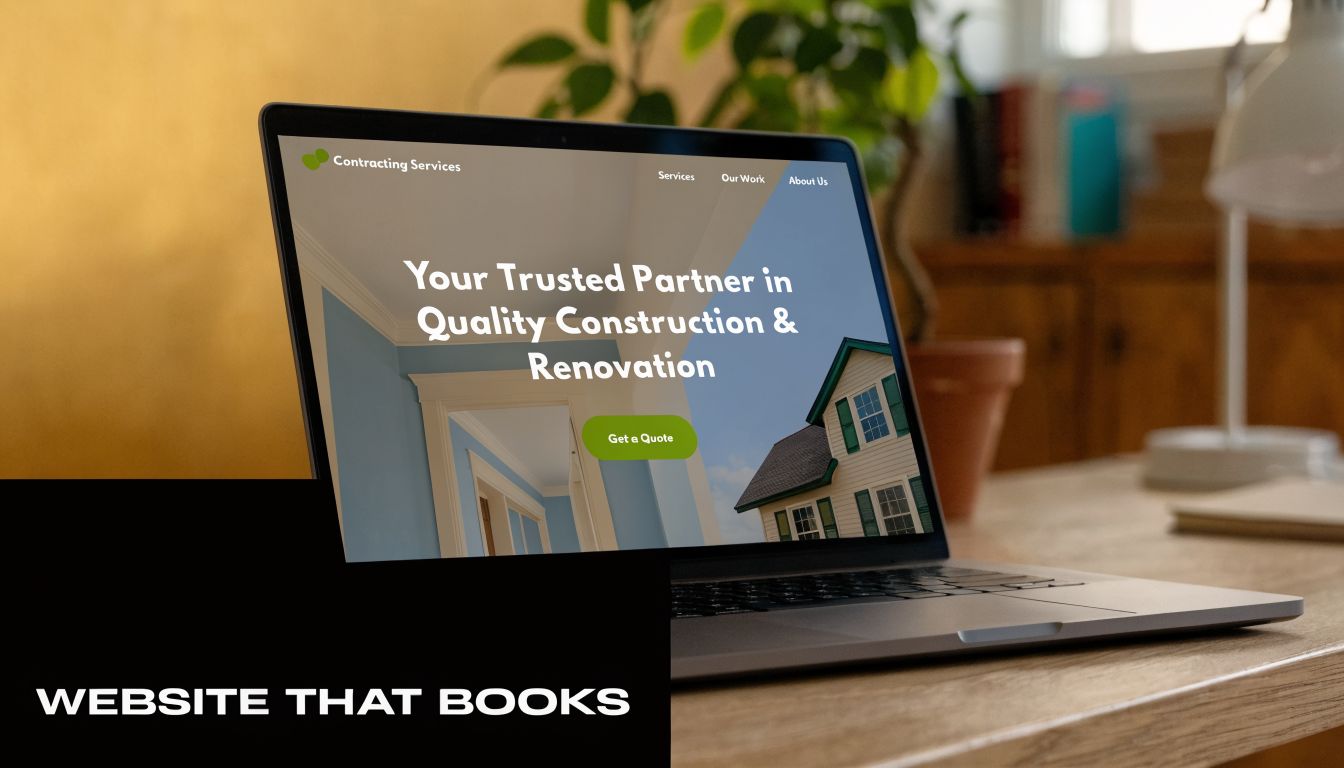
Your website needs five things and not much else
Most trade websites don’t need dozens of pages. They need the right information in the right order.
Here are the essentials:
- A clear headline: Say what you do and where you do it. Straight away.
- A phone number people can tap: Don’t hide it in the footer.
- A short service list: Keep it specific and easy to scan.
- A gallery of real work: Proof beats promises.
- Visible trust signals: Reviews, licences, accreditations, and service area details.
That’s enough to convert a lot of visitors if it’s laid out properly.
One thing matters more than most contractors realise. The site has to work cleanly on a phone. According to contractor website benchmarks from Invite Them Home, 63% of all traffic to contractor websites comes from mobile devices, and mobile-first sites can convert twice as many visitors into leads.
If your site loads awkwardly on mobile, buttons are tiny, or the number isn’t clickable, you’re making it harder for people to hire you.
What to remove from a contractor website
A lot of websites lose jobs because they try to say too much.
Remove or simplify these common problems:
- Long welcome paragraphs: People don’t need your life story before they know your services.
- Too many menu options: If every page fights for attention, none of them win.
- Hard-to-find contact forms: Keep forms short. Name, job, suburb, phone.
- Generic claims: “Quality service” means nothing without proof.
- Slow, oversized visuals: Big banners that load poorly on mobile cost enquiries.
Here’s a simple way to judge your site.
| Keep | Cut back |
|---|---|
| Clear service pages | Corporate-style filler text |
| Click-to-call buttons | Fancy animations |
| Real project photos | Stock trade imagery |
| Short review snippets | Paragraphs of self-praise |
| Simple quote forms | Forms with too many fields |
This short video shows the kind of practical website thinking contractors should follow:
If a customer lands on your website and can’t tell within a few seconds what you do, where you work, and how to contact you, the website is getting in the way.
A good trade website feels obvious. The customer doesn’t have to think. They just call.
Stay Visible with a Set and Forget Content Routine
Many contractors struggle here. Not because they don’t care, but because they’ve got no spare time.
You finish a job, mean to post the photos later, then move on to the next callout. By the time you remember, the week is gone. That’s why random posting never turns into a reliable system.
Why consistency beats random posting
Being visible online matters because people hire names they keep seeing and recognise. A dead profile creates doubt. An active one suggests the business is working, finishing jobs, and still serving the area.
The biggest challenge here isn’t creativity. It’s consistency. According to Contractor Growth Network’s digital marketing overview for contractors, the most common challenge for contractors is maintaining consistent online activity with no time, and the emerging trend is AI-driven auto-posting platforms that tailor content to specific trades and locations, turning consistent visibility into real job enquiries without manual effort.
That shift matters because it changes the job. You no longer need to sit down and act like a full-time marketer. You need a system that keeps your business active while you focus on actual work.
If you want an example of how businesses approach this, this article on content marketing for local businesses is worth a look.
A low effort content system that fits real trade work
You don’t need to film polished mini-documentaries from every site. You need a routine that survives busy weeks.
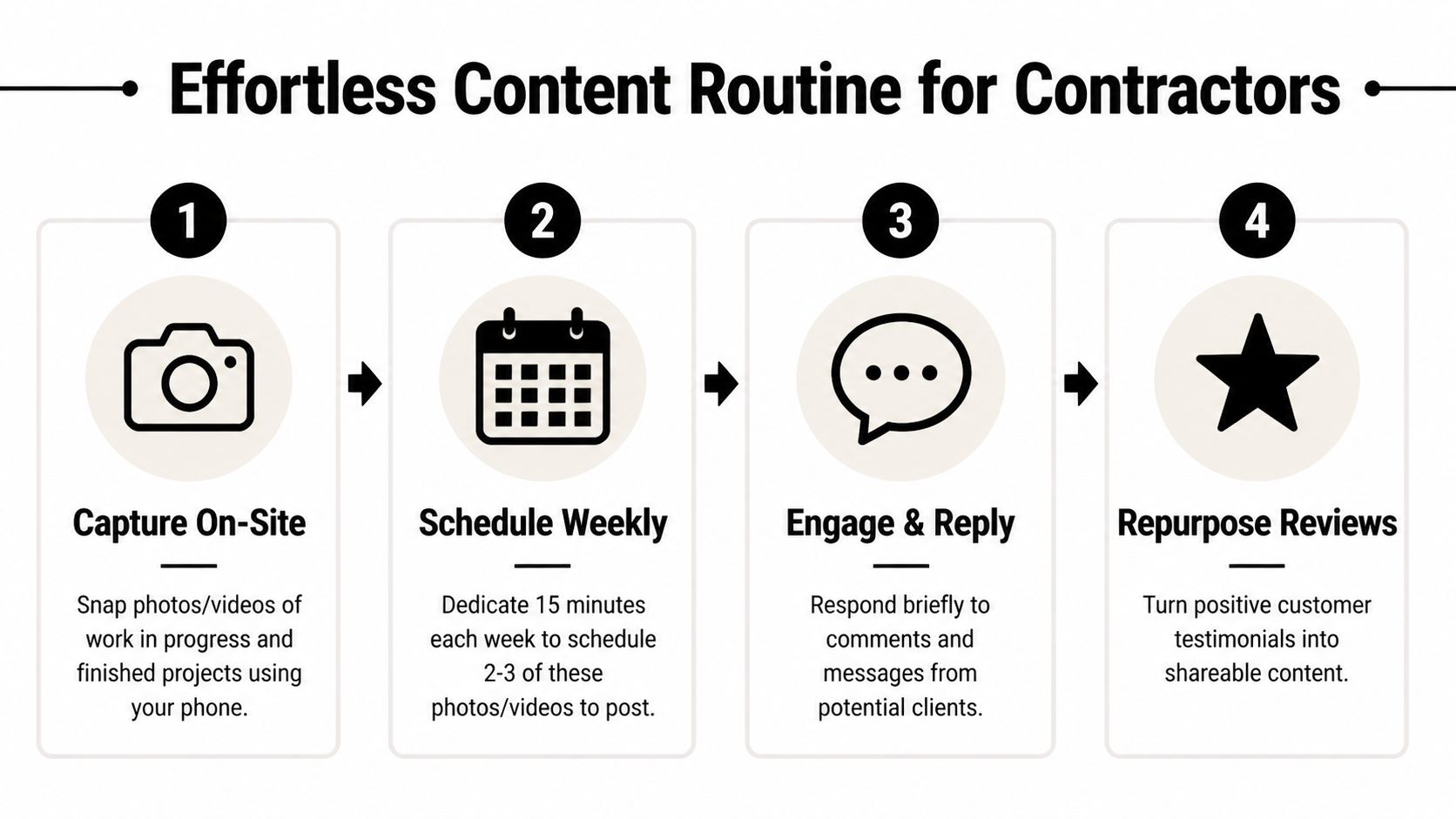
Here’s a practical version that works for most contractors:
Capture while you work
Take a few photos during the day. Before, during, after. Nothing fancy. Good lighting and clear framing is enough.Keep categories simple
Rotate through completed jobs, work in progress, customer feedback, team shots, and common service tips.Batch once a week
Set aside a short block once a week to upload or schedule content.Reply to messages quickly
You don’t need long conversations. A short, prompt reply does the job.
The mistake is thinking every post must be original and handcrafted. It doesn’t. What matters is that your business keeps showing signs of life.
What to post when you’ve got no ideas
A contractor’s content bank is usually sitting in the camera roll already.
- Finished jobs: Show the outcome and name the service.
- Problem and fix: Explain what was wrong and what you did.
- Small upgrades: Not every post needs to be a major project.
- Customer feedback: Turn good reviews into simple graphics or captions.
- Local reminders: Mention the areas you service and the jobs you handle.
Field note: The best content for trades is usually the most ordinary. Clean photos, clear captions, and regular posting beat big ideas that never get published.
The whole point of this routine is reducing friction. If you can automate design, captions, scheduling, and posting, you stop relying on motivation. That’s the difference between online activity that lasts a week and online activity that keeps bringing in enquiries month after month.
Turn Customer Trust into Your Best Marketing Tool
Two contractors can do work at the same standard and still get very different results online.
One finishes the job, gets paid, and moves on. The other finishes the job, thanks the customer, sends a review link, and adds that feedback to the places future customers will see it. Over time, the second contractor looks safer to hire.
That trust compounds because new customers don’t know your workmanship yet. They judge what they can see.
Two contractors, two different outcomes
Contractor A has an old profile, a few scattered comments, and no system for collecting reviews. When a homeowner compares quotes, this contractor feels like a gamble.
Contractor B has recent reviews, replies to them, and shows real customer feedback on the website and social profiles. Same trade. Similar pricing. Better trust.
That difference matters because, according to contractor review data from Ideas Money Art, 88% of customers check reviews for local businesses before making a choice.
If you’re active on social as well, this guide on social media marketing for contractors can help tie reviews into the rest of your online presence.
A review process that doesn’t feel awkward
A lot of tradies avoid asking because they don’t want to sound pushy. Fair enough. The fix is to make it part of the handover, not a weird favour.
Use a short message like this:
“Thanks again for the job today. If you’re happy with the work, would you mind leaving a quick review? It helps other local customers feel confident calling us.”
Then send the link straight away. Don’t make them search for you.
A few practical rules help:
- Ask right after the job: That’s when the good experience is fresh.
- Make it easy: Send the direct review link by text.
- Reply to every review: Thank the customer in plain language.
- Reuse the best ones: Add them to your website, quote follow-ups, and social posts.
You don’t need dozens overnight. You need a steady flow.
Where reviews should appear
Reviews do more work when they’re visible in multiple places.
| Place | Why it matters |
|---|---|
| Google Business Profile | Helps people decide quickly |
| Website homepage | Builds trust before the call |
| Service pages | Supports specific job types |
| Social posts | Turns customer praise into proof |
A contractor with visible, recent feedback makes the decision easier. That’s what good marketing does. It removes doubt before the customer ever speaks to you.
Measure What Matters and Ignore the Noise
Plenty of contractors get distracted by the wrong numbers. Likes, reach, views, impressions. Those things can be interesting, but they don’t pay wages by themselves.
The point of online marketing for contractors is booked work. So track the stuff that sits closest to booked work.
The only numbers most contractors need to watch
For most local trade businesses, two numbers tell you enough:
- Phone calls from new enquiries
- Contact form submissions
That’s it.
If those numbers are moving in the right direction, your setup is working. If they’re flat, something in the chain is weak. Maybe your profile is incomplete. Maybe your website is hard to use. Maybe your business goes quiet online for long stretches.
Don’t let a good-looking report fool you. A campaign with more likes and no extra calls is still underperforming.
A simple monthly tracking habit
You don’t need software overload to do this properly. A basic spreadsheet works fine.
At the end of each month, note:
- How many calls came from new customers
- How many form enquiries came through the website
- Which suburb or service came up most
- How people said they found you
That last point matters. Ask callers a simple question when you can. “How did you find us?” The answers are often clearer than any dashboard.
After a few months, patterns start showing up. You’ll see which services attract interest, which areas respond, and whether your online activity is feeding the pipeline.
Keep the measurement boring and direct. That usually means it gets done.
If you want a simpler way to stay visible without creating posts by hand, GrowTradie is built for trade businesses that need consistent online activity without adding more admin. It creates and auto-posts trade-specific content for your local area, keeps your profiles active between jobs, and helps turn attention into real enquiries instead of vanity metrics.