
If you're a plumbing business owner, you've probably had this thought at some point: I know how to price a repipe, a water heater swap, and an emergency callout. I don't know how to price my company.
That's normal. Most owners build a strong business from the tools up, not from valuation theory down. Then one day a buyer calls, retirement starts to feel real, or you want to bring on a partner, and suddenly the question gets serious. What is this business worth?
A solid plumbing business valuation isn't just a number for a sale listing. It's a reality check on what you've built, what a buyer will pay for, and what parts of the business still depend too much on you. If you understand that early, you can make better decisions long before you ever sign a deal.
Table of Contents
- Why Your Plumbing Business Valuation Matters Now
- First Step Get Your Financials in Order
- Choosing the Right Valuation Method
- Plumbing Business Valuation Methods at a Glance
- SDE is usually the right method for smaller plumbing businesses
- EBITDA matters when the business can run without you
- Asset-based valuation sets a floor, not the full price
- Revenue multiples are a quick check, not the main answer
- What actually moves the number
- A Step-by-Step Valuation Calculation Example
- How to Increase Your Plumbing Business's Value
- Your Pre-Sale and Valuation Preparation Checklist
- Frequently Asked Questions About Valuations
Why Your Plumbing Business Valuation Matters Now
A lot of owners wait too long to ask what their business is worth. They wait until burnout hits, a health issue forces the conversation, or a buyer reaches out unexpectedly. That usually leads to a rushed process and a weak negotiating position.
Knowing your number earlier gives you options. You can decide whether to keep building, whether to hire toward independence, whether to clean up margins, or whether the business is already close to the outcome you want.

There's another reason this matters right now. The market for plumbing companies has moved. BizBuySell's plumbing valuation benchmarks report that the median value of transacted plumbing businesses increased 46% from $572,500 in 2022 to $837,500 in 2025, and that the average earnings multiple was 2.49x. That matters because buyers aren't paying for busy phones or a full calendar by themselves. They're paying for earnings they believe will continue after you leave.
A good valuation gives you two numbers. What the business is worth today, and what's keeping it from being worth more.
Owners often think in terms of revenue because that's the number they watch every week. Buyers usually start somewhere else. They look at profit, stability, systems, and how much of the business disappears if the owner stops answering the phone.
That shift changes how you should run the company. A plumbing business valuation can help with:
- Retirement planning so you know whether the business can fund the exit you want
- Growth decisions like whether another truck, dispatcher, or licensed lead tech will increase enterprise value
- Financing conversations because lenders and buyers both care about documented earnings
- Risk management by exposing overreliance on one owner, one customer, or one revenue stream
Plumbers who understand valuation early usually make better operational decisions. Not because they become finance people, but because they stop guessing what buyers reward.
First Step Get Your Financials in Order
Most valuation mistakes start in the books.
Not because the business is weak, but because the records don't show its real earning power clearly enough. If your P&L mixes personal spending, one-off purchases, inconsistent payroll treatment, and vague expense categories, a buyer won't give you the benefit of the doubt. They'll lower the price or walk.
What normalizing earnings actually means
A defensible plumbing business valuation starts with normalizing earnings. Elite Exit Advisors notes in its plumbing business valuation guidance that buyers focus on profitability, and unsupported add-backs are a common diligence failure that can reduce the final price when the buyer or lender verifies the records.
Think of normalization like tuning an engine before measuring horsepower. The business may be strong, but if the numbers are misfiring, the result will look weaker than it is.
For most owner-operated plumbing companies, that means building a clean Seller's Discretionary Earnings, or SDE, figure. SDE is the total financial benefit available to one working owner. It usually starts with net profit, then adjusts for expenses that a new owner may not continue.
Common add-backs buyers will review
Some add-backs are legitimate. Some are fantasy. The difference is paperwork.
Look through your books and identify items that are discretionary, personal, or non-recurring. Common examples include:
- Owner compensation if the current profit figure already includes your salary or draws
- Personal expenses that were run through the business and won't continue under a buyer
- One-time purchases such as unusual equipment buys that don't reflect normal annual operations
- Personal vehicle or fuel costs if they aren't fully tied to business use
- Family benefits paid by the company when they're really owner perks
- Non-recurring professional fees tied to unusual matters rather than ordinary operations
That doesn't mean you can add back anything you'd like to ignore. If the business needs that expense to keep operating, a buyer will treat it as real.
Practical rule: If you can't prove the add-back with invoices, payroll records, bank statements, or tax support, don't count on getting paid for it.
I've seen owners lose credibility fast by presenting “adjusted earnings” on a spreadsheet that can't be tied back to QuickBooks, tax returns, or bank activity. Buyers notice that immediately. Lenders notice even faster.
Clean books make every later step easier
Before you talk to any buyer, get your financial file tight:
- Reconcile your accounts so bank balances, credit cards, and bookkeeping line up.
- Separate personal and business spending going forward, even if the past was messy.
- Label unusual expenses clearly instead of burying them in generic categories.
- Match payroll records to financial statements so owner pay and staff costs are easy to follow.
- Prepare a written add-back schedule with backup for every adjustment.
If you need outside help to tighten reporting and accountability, working with a plumbing business coach can help you get the operation and numbers lined up before you ever enter a sale process.
What works is boring. Clean books, clear categories, and documented adjustments.
What doesn't work is “trust me, this business makes more than it shows.”
Choosing the Right Valuation Method
A plumber gets one buyer interested, hears that another service company sold for a revenue multiple, and decides that number should apply here too. Then the buyer reviews the file, adjusts the earnings, and the price drops fast.
That happens all the time.
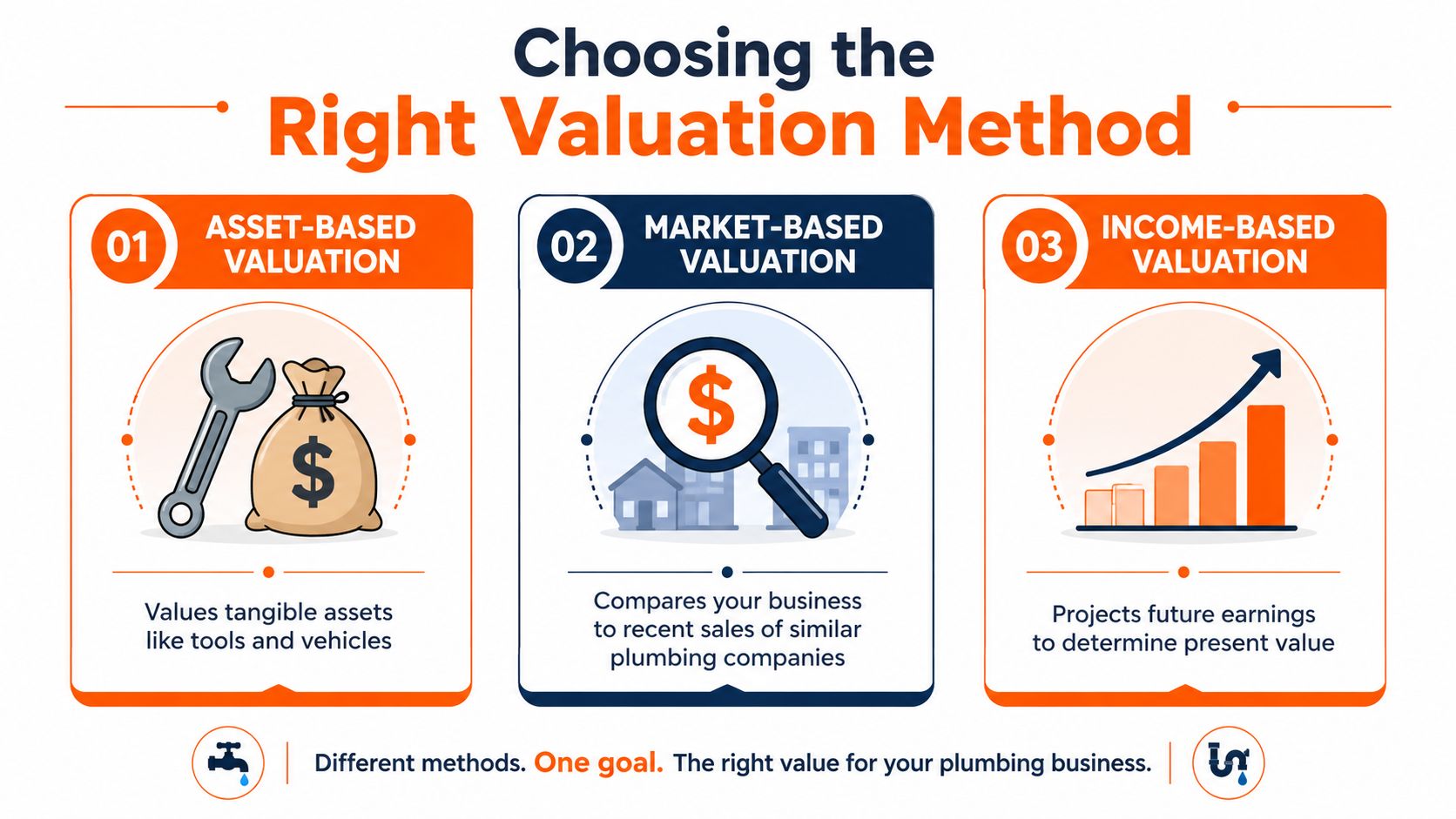
The right valuation method depends on what a buyer is acquiring. In a small owner-led plumbing company, the buyer is often buying a role plus a customer base. In a larger company with management in place, the buyer is buying a cash-flowing operation that can keep running without the owner solving every problem.
That distinction decides whether the market will focus on SDE or EBITDA.
Plumbing Business Valuation Methods at a Glance
| Method | Best For | Calculation Basis | Typical Use Case |
|---|---|---|---|
| SDE | Owner-operated plumbing businesses | Net benefit to one working owner | Small companies where the buyer replaces the owner |
| EBITDA | Larger firms with management depth | Earnings before interest, taxes, depreciation, and amortization | Businesses that can run without the owner in the middle of everything |
| Asset-Based | Companies with valuable tangible assets or weak earnings | Assets minus liabilities | Floor value or liquidation-style reference point |
| Revenue Multiple | Quick reasonableness check | Revenue times a market range | Secondary check, not the main valuation tool |
SDE is usually the right method for smaller plumbing businesses
If you still hold the relationships, quote work, handle dispatch escalations, and step in when a tough job goes sideways, SDE is usually the right starting point.
SDE, or seller's discretionary earnings, measures the total financial benefit available to one owner-operator. It starts with profit, then adds back owner compensation and certain discretionary or one-time expenses that a buyer may not continue. That is why SDE often fits small plumbing companies better than EBITDA. It captures what a working owner can realistically take out of the business.
This is the point many owners miss. They hear that larger companies sell on EBITDA multiples and assume that makes EBITDA the more advanced method. It does not. It is just a different tool for a different type of business.
A small plumbing shop can look weak on EBITDA because EBITDA removes the owner's pay. For a buyer who plans to step into your seat, that owner benefit is not noise. It is part of the economic return they are buying.
EBITDA matters when the business can run without you
EBITDA becomes more relevant once the company has management depth and less owner dependence.
That usually means there is a service manager or operations lead, office leadership that does not rely on you for every decision, and field staff who can produce consistently without your daily intervention. At that point, a buyer is less concerned with replacing your personal labor and more concerned with the company's ongoing earnings as a stand-alone operation.
That shift can raise value, but only if the structure is real. I have seen owners claim they have a management team when the team still calls them for pricing, staffing problems, and customer issues all day long. Buyers test that quickly. If the owner is still the hub, the deal usually gets pulled back toward an SDE framework.
A simple way to judge it: if you disappeared for a month, would jobs still get sold, scheduled, completed, invoiced, and collected without major disruption? If the honest answer is no, the market will usually treat the business like an owner-operated company.
Asset-based valuation sets a floor, not the full price
Asset value matters, especially in plumbing.
Trucks, jetters, excavators, inventory, and equipment all count. Clean vehicles, documented maintenance, and equipment that matches the revenue model can support value and make lender approval easier. But asset value alone rarely produces the best number for a profitable service business. Buyers pay for earnings first, then look at assets to confirm what is included and whether replacements are coming soon.
That trade-off matters. A fleet with high book value looks good on paper, but if half the trucks are near the end of their useful life, a buyer will discount what those assets are really worth to them.
Revenue multiples are a quick check, not the main answer
Revenue gets too much attention because it is easy to quote.
Two plumbing companies can each produce the same top-line sales and be worth very different amounts. One may have strong maintenance revenue, disciplined pricing, and low owner involvement. The other may rely on project work with thin margins and constant owner rescue. Same revenue. Very different risk.
Use a revenue multiple as a rough market check. Do not use it as your headline valuation.
What actually moves the number
Choose the method that matches how your business runs today. Then improve the factors that buyers care about inside that method.
If your company will be valued on SDE, focus on clean add-backs, stable margins, and reducing owner dependence where you can. If it can credibly be valued on EBITDA, build management depth, document processes, and show that earnings hold up without you in the middle of daily operations.
That is how owners get from a hopeful number to a defendable one.
A Step-by-Step Valuation Calculation Example
Theory helps. A worked example helps more.
Here's a simplified example of how an owner-operated plumbing company might be valued using SDE. This isn't a universal formula, and it isn't a substitute for a formal opinion. It's a practical way to show how buyers think through the file.

A simple example using SDE
Take a fictional company, Dave's Reliable Plumbing.
Dave's profit and loss statement shows net profit for the year. On top of that, the books also include some items that a buyer may reasonably adjust when calculating owner benefit. Dave pays himself through the business, the company covers a family health plan, there was a one-time purchase of a jetter that won't recur in the same way, and the books include depreciation.
A basic SDE build might look like this:
| Item | Treatment in valuation |
|---|---|
| Net profit | Starting point |
| Owner salary or draws through payroll | Added back if valuation is based on one owner-operator benefit |
| Family health insurance paid by the business | Added back if it is a personal owner benefit |
| One-time jetter purchase or unusual non-recurring expense | Added back if clearly documented and not part of normal run-rate operations |
| Depreciation | Added back in the earnings calculation |
The logic matters more than the labels. Each add-back has to answer one question: Will the buyer have to keep paying this exact expense to maintain current earnings?
If the answer is yes, it stays in. If the answer is no, it may be added back, but only with proof.
What changes the multiple
Once SDE is established, the next question is the multiple. Owners often expect a fixed answer at this juncture and get frustrated. There isn't one.
A buyer may lean lower in the range if the company depends heavily on Dave's personal relationships, has inconsistent pricing discipline, weak documentation, or mostly one-off emergency work. A buyer may lean higher if the company has a solid service base, dependable office processes, a strong lead technician, and cleaner financial reporting.
Here are the kinds of things that move the number inside the range:
- Owner reliance because heavy dependence on one person raises transition risk
- Service mix because repeat service work is easier to underwrite than unpredictable project swings
- Customer concentration because losing one major account can change the economics quickly
- Operational discipline because dispatch, pricing, call handling, and job tracking affect confidence in future earnings
- Local buyer demand because some markets draw more serious acquirers than others
Buyers don't pay top multiple for potential alone. They pay top multiple when the proof is already in the business.
A simple model like this helps you pressure-test your numbers before a buyer does. If your SDE only works after aggressive adjustments, or the multiple only works if a buyer ignores obvious risks, the valuation isn't realistic.
How to Increase Your Plumbing Business's Value
A plumber gets a decent offer, then loses ground in diligence because the numbers are messy, the owner approves every exception, and too much revenue comes from jobs that are hard to repeat. That happens all the time. Value goes up when a buyer can see dependable earnings and a business that will still perform after the owner steps back.

Improve the number buyers are actually pricing
For many plumbing companies, buyers start with SDE, not EBITDA. That distinction matters.
If the business is owner-operated and the owner takes compensation through salary, distributions, perks, or a mix of all three, SDE usually gives the clearer picture of what a single owner-operator can earn from the business. EBITDA becomes more relevant when the company has a fuller management layer and a buyer is evaluating it as a larger stand-alone operation. Owners who mix those two standards often overstate value without realizing it.
The practical takeaway is simple. Improve the earnings metric that fits your size.
For a smaller plumbing business, that usually means improving true SDE by fixing pricing, reducing callbacks, tightening purchasing, and cleaning up any personal or one-time expenses that muddy the story. For a larger company, it may mean building manager accountability and cleaner overhead allocation so EBITDA holds up under scrutiny.
Raise earnings quality
A buyer does not pay more just because sales increased. They pay more when earnings are consistent, understandable, and likely to continue.
The fastest gains usually come from margin control:
- Tighten pricing rules so technicians and estimators are not discounting inconsistently
- Cut callback costs by tracking repeat visits, warranty work, and install errors by technician or job type
- Clean up receivables so old invoices do not create doubts about cash flow quality
- Separate service lines clearly so a buyer can see which work is steady and which work is volatile
- Remove waste in scheduling and truck stock so gross profit is not leaking through poor coordination
I see owners chase top-line growth while ignoring low-margin work that clogs the schedule. That usually hurts value. A smaller revenue base with stronger margins and better collections often sells better than a bigger company with sloppy economics.
Make the business transferable
Transferability changes both the multiple and the confidence behind it.
If the owner answers every difficult call, prices every nonstandard job, approves every credit decision, and holds all key customer relationships, the buyer is purchasing a job with risk attached. A stronger business has decision rights spread across the team, documented processes, and customer trust tied to the company name.
Work on these areas first:
- Document routine operating processes. Dispatch, quoting, invoicing, collections, after-hours call handling, and job follow-up should not live in your head.
- Develop one or two leaders. A service manager, lead technician, or office lead who can make day-to-day decisions reduces transition risk.
- Move relationships into the brand. Introduce key customers to the team. Use shared email addresses, CRM notes, and service history so the account stays with the company.
- Standardize approvals. Clear rules for pricing exceptions, refunds, and job scope changes keep performance from depending on instinct.
This short video lays out the kind of practical business improvements owners often need to make before exit discussions become serious.
If you want to make revenue more predictable while reducing reliance on owner referrals, review your lead generation for plumbers and build channels the company can keep using after a sale.
Improve customer mix and revenue durability
Buyers pay closer attention to the type of revenue than many owners expect.
A company with repeat residential service, maintenance agreements, and diversified commercial accounts usually looks safer than one built around sporadic project work or one large account that could leave after closing. The goal is not to eliminate every project. The goal is to show that the business has a stable base underneath the bigger jobs.
Useful moves include:
- Reduce concentration so no single customer or referral source can disrupt the year
- Put recurring work in writing with service agreements, maintenance plans, or scheduled account terms
- Track customer history well so future work is tied to records and process, not memory
- Protect online reputation with stronger follow-up and faster resolution of complaints
- Add adjacent services carefully only where the team can deliver them at the same quality and margin as core plumbing work
The pattern is straightforward. Lower risk, cleaner earnings, and less owner dependence produce better offers.
Owners sometimes try to sell the upside story instead: a buyer could fix dispatch, raise prices, hire a manager, and grow the maintenance base. Buyers hear that as work they still need to do. The more of that work you complete before going to market, the more of the value you keep.
Your Pre-Sale and Valuation Preparation Checklist
A smoother sale process usually starts months before the business goes to market. If you wait until buyer questions arrive, you'll spend the whole process reacting instead of controlling it.
The best preparation file is organized, boring, and easy to verify.
Financial documents
Gather the records a buyer, broker, accountant, or lender will ask for first:
- Profit and loss statements with consistent bookkeeping categories
- Business tax returns that match the reported financial story
- Balance sheets so liabilities and working capital issues are visible
- Detailed add-back schedule with backup documents
- Accounts receivable and payable reports to show cash flow quality
Operational documents
These show how the plumbing company runs:
- Vehicle and equipment list with condition notes and ownership details
- Employee roster including roles, tenure, pay structure, and licensing status
- Customer mix summary that shows where work comes from and how concentrated it is
- Service agreements or recurring account records if you have them
- Process documents for dispatch, estimating, invoicing, and collections
Buyers get more comfortable when they can see how the company runs without having to decode it from your memory.
Legal and deal readiness documents
These reduce avoidable friction later:
- Entity formation documents and ownership records
- Lease agreements for office, warehouse, or yard space
- Vendor and subcontractor agreements
- Key customer contracts if they're transferable
- Licenses, permits, and insurance records
If you're seriously considering an exit, it helps to review how a plumbing business for sale is typically presented so you can start assembling the same materials before buyers ever ask.
Preparation doesn't increase value by itself. It does protect value by making the business easier to trust.
Frequently Asked Questions About Valuations
How long does a formal valuation process usually take
It depends on how clean your records are and how quickly you can provide backup. If the books are organized and the add-backs are easy to verify, the process moves much faster. If financials need cleanup, customer concentration needs explaining, or legal paperwork is scattered, expect delays.
Do I need a broker to sell a plumbing business
Not always, but many owners benefit from one. A broker can help with pricing discipline, buyer screening, packaging the business, negotiation, and keeping momentum through diligence. Owners who try to run the sale themselves often underestimate how much work is involved while still running jobs and managing staff.
What mistakes kill deals most often
Three come up again and again.
- Messy financials that don't support claimed earnings
- Aggressive add-backs that collapse under scrutiny
- Owner dependency that makes the buyer doubt a smooth handoff
A fourth issue is poor communication. When a seller goes quiet, takes too long to send documents, or changes the story midstream, buyers start assuming there are deeper problems.
How much does a professional valuation cost
Fees vary by provider, scope, and whether you want a formal appraisal, broker opinion, or sale-readiness review. The important point is fit. A basic estimate may help with planning, but a more detailed valuation is often worth it when timing, tax planning, partner buyouts, or a real sale is on the table.
What if my first valuation feels lower than expected
That's common. Treat it as a snapshot, not an insult.
A realistic plumbing business valuation shows what a buyer can support today based on earnings, risk, and transferability. If the number disappoints you, that usually means the next move is operational improvement, not wishful pricing. Clean up the books, reduce owner reliance, strengthen recurring revenue, and revisit the valuation later.
GrowTradie helps trade businesses stay visible without adding more work to your day. If you want a practical way to keep your company active online, build trust locally, and support the kind of brand presence that makes a business easier to grow and eventually sell, take a look at GrowTradie.