
A crew member arrives at a residential job, sees a warning taped to the gate, and still isn't sure whether the danger is overhead power, an unstable surface, or equipment inside the house. The supervisor assumes the team covered it in the morning briefing. The worker assumes someone else gave clearer instructions. A client walks through the work area because nobody explained where to stand.
That gap isn't just a compliance problem. It damages confidence, slows the job, and can leave a business struggling to prove that people received usable instructions. Safety messaging gives tradies a practical way to close that gap, protect people, and show clients that professionalism continues after the quote is accepted.
Table of Contents
- What Safety Messaging Means for Trade Businesses
- Core Principles That Make Safety Messages Work
- Legal and Insurance Considerations for Tradies
- Channel-Specific Templates for Trade Businesses
- Real-World Examples of Effective Safety Messaging
- Your Safety Messaging Implementation Checklist
What Safety Messaging Means for Trade Businesses
A safety message fails when it arrives too late, uses vague language, or sits where nobody looks. A procedure buried in a manual might be technically correct, but it won't help much if a two-person crew needs to make a quick decision beside an open trench or energized equipment.
For a trade business, safety messaging is the complete system used to communicate the hazard, who may be exposed, and the action required. It includes signs, toolbox talks, site inductions, text reminders, emails, vehicle graphics, website content, and conversations with clients. Safety training develops knowledge and capability over time. Safety messaging guides a specific decision at a specific moment.
Three audiences need different instructions
Your crew needs practical task instructions. A plumber working near an excavation may need to know the access route, protective equipment, and emergency response. An electrician may need a clear isolation and verification process before beginning work. A carpenter may need a direct reminder about exclusion zones and changing site conditions.
Subcontractors need shared-site information. They may know their own trade well but not understand your traffic path, material storage area, temporary services, or emergency arrangements. A short site induction can prevent assumptions that no policy document will catch in the moment.
Clients and homeowners need plain boundaries. Tell them where they can walk, when children and pets must stay away, whether power or water will be interrupted, and who to contact if conditions change. A client who sees a clearly marked work area is more likely to view the business as controlled and dependable.
Practical rule: If someone has to ask what a warning means or what to do next, the message needs rewriting.
A deliberate approach also supports business credibility. Consistent communication across your public presence and active jobs helps demonstrate that safety is part of how you operate, not a document produced only when someone asks. That broader reputation work belongs alongside contractor reputation management, because clients judge professionalism through repeated signals, not one polished promise.
Core Principles That Make Safety Messages Work
Effective safety messaging moves people through several stages. They must notice the message, understand it, believe the risk applies, feel motivated to respond, and then perform the right action. Warning research identifies these as separate processing stages and recommends conspicuous placement, simple text, and a structure that connects the hazard, consequence, and instruction. See the warning effectiveness research for the underlying framework.
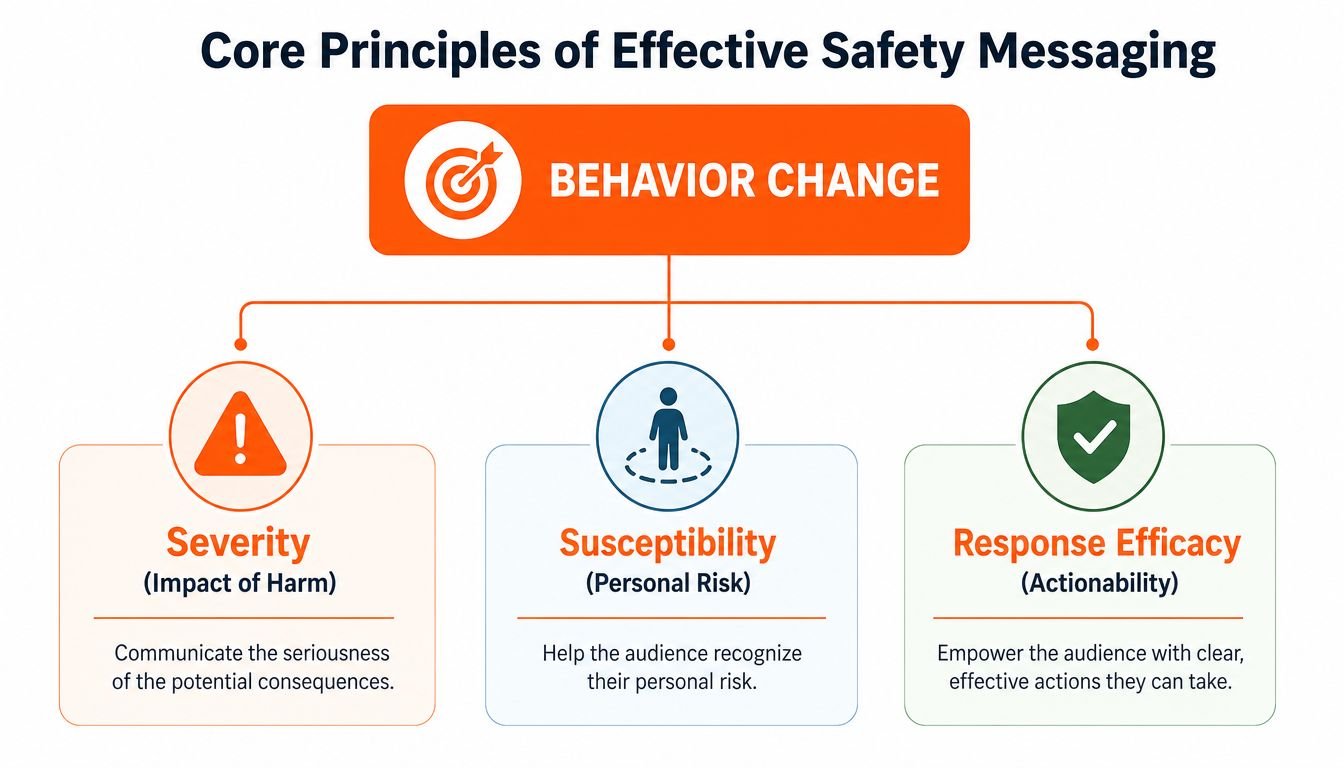
Severity, susceptibility, and efficacy
Severity explains why the issue matters. “A fall can cause serious injury” gives the hazard consequence more weight than “Use care.”
Susceptibility makes the risk personal and relevant. “Anyone entering this area may be exposed to falling materials” identifies who needs to change their behavior. It also helps a client or subcontractor recognise that the warning applies to them, not just to the main crew.
Response efficacy provides the solution. “Wear the required head protection, stay outside the marked zone, and speak to the supervisor before entering” tells people how to reduce exposure. A workplace safety communication analysis found that effectiveness was maximized when severity, susceptibility, and efficacy appeared together, rather than relying on threat alone. The findings are discussed in this PubMed-indexed safety communication analysis.
A message that only frightens people creates attention without direction. On a busy site, that can produce hesitation, shortcuts, or a quick glance followed by inaction.
Put the warning before the task
Placement changes behavior. Put the critical reminder at the gate, on the equipment, or in the briefing before work starts. A warning delivered after instructions are already underway has less chance of shaping the decision that matters.
Keep the message narrow. One sign should deal with one immediate hazard and one main response. Avoid stacking every possible rule into a paragraph nobody can scan. For public-facing posts, practical social media posting should explain a real safety action in language clients understand, rather than turning a post into a list of technical terms.
Message framing matters too. Short, behavior-specific instructions generally give people a better route to action than fear-based copy or a wall of statistics. A 2023 review of road-safety communications links behavior change with clarity, audience context, and pre-testing, while related commentary reported that fatality counts on dynamic roadside signs were associated with more downstream crashes, suggesting that attention-grabbing numbers can distract as well as inform. The road-safety communication evidence synthesis supports a disciplined approach: match the message to the setting and test it before rollout.
Legal and Insurance Considerations for Tradies
A safety policy proves that your business has written expectations. It doesn't prove that a worker, subcontractor, or client received the relevant instruction and understood what to do.
When an incident leads to an insurance claim or regulatory review, your records need to show a working communication process. Keep evidence of site inductions, toolbox talks, task briefings, changes in conditions, equipment instructions, and follow-up actions. The exact retention period depends on your jurisdiction, contract terms, insurer, and regulator, so confirm it with your insurer or legal adviser rather than choosing a period by guesswork.
Build an evidence trail without creating paperwork overload
A useful record answers a few straightforward questions:
- What changed: Identify the task, hazard, site condition, or equipment issue.
- Who received it: Record the crew, subcontractors, visitors, or client representatives involved.
- What instruction was given: Capture the actual action, not only “safety discussed.”
- How understanding was checked: Note questions, demonstrations, acknowledgements, or corrections.
- What happened next: Record controls installed, work paused, or responsibilities assigned.
Use a repeatable digital form on a phone or tablet. A short checklist with names, date, site, topic, action, and acknowledgement is easier to complete than a long narrative. Store supporting photographs when they prove that signage, barriers, or protective equipment were in place, while following your privacy and document-control obligations.
Public consistency strengthens trust
Your social posts, website, vehicle signage, and job-site instructions shouldn't contradict one another. Public claims such as “we work safely” carry little weight unless the client sees clear boundaries, tidy controls, and staff who can explain the plan.
Don't promise an insurance outcome that no message can guarantee. Consistent safety communication may support a broader picture of risk management and professionalism, but insurers assess policies and claims under their own terms. Confirm requirements directly with the relevant insurer, broker, principal contractor, and local authority. Licensing and responsibility can also vary by location, so use an appropriate reference such as this guide to a general contractor license as a starting point, not as a substitute for local advice.
Record the action, not just the attendance. A signature beside “toolbox talk completed” is weaker than a record showing the hazard discussed, the control selected, and the person responsible.
Channel-Specific Templates for Trade Businesses
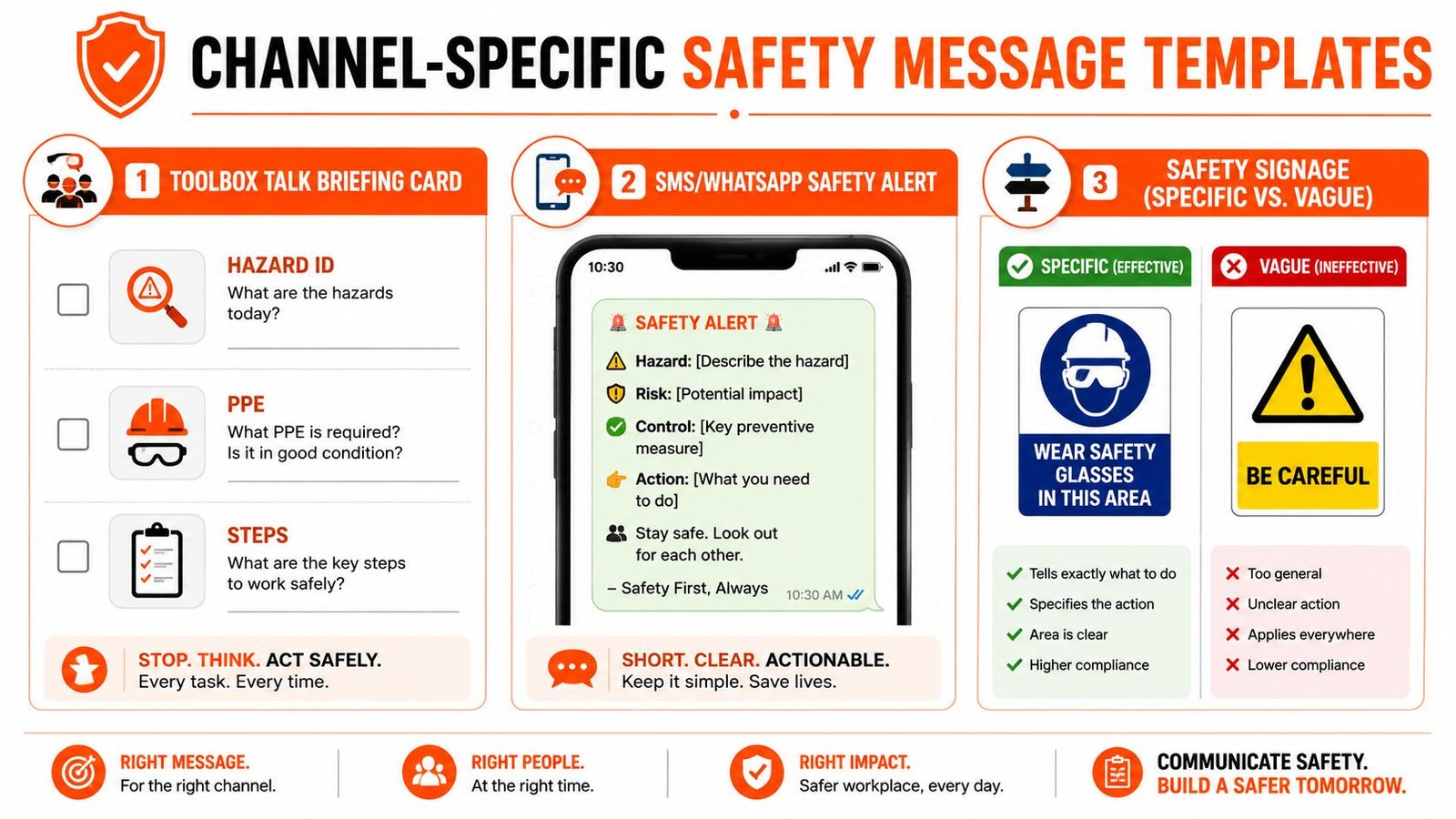
Each channel has a job. A briefing handles immediate coordination, signage controls movement, a message reaches people before they arrive, and public content shows clients how the business behaves. Keep the wording consistent, but adjust the detail to the moment.
Toolbox talk briefing card
Use this before a new task, a changed site condition, or the start of a shift. Keep it short enough to deliver without losing attention.
Hazard: “Today we're working beside [specific hazard]. The main exposure is [injury or damage consequence].”
Who is at risk: “This affects [crew, subcontractors, client, public, or visitors].”
Required controls: “Before starting, use [PPE, isolation, barrier, access route, or equipment control].”
Work sequence: “The safe order is [step one], [step two], then [step three]. Stop if [trigger condition] occurs.”
Emergency response: “If something goes wrong, stop work, move to [location], contact [person or service], and use [first-aid or isolation process].”
Check: “Tell me the main hazard and the first control before you start.”
Site sign template
Use the hazard, consequence, instruction structure:
HAZARD: [Specific hazard]
CONSEQUENCE: [What could happen]
INSTRUCTION: [Exact action, access restriction, or required PPE]
CONTACT: [Supervisor name or radio channel]
“Danger, keep out” may indicate a boundary, but it doesn't explain why the boundary exists or what authorised people must do. A sign should be placed where a person makes the entry decision, not hidden beside the hazard.
SMS or email reminder
Send this before the job type begins, not after the crew is already travelling.
“Tomorrow at [site], we're completing [task]. Watch for [specific hazard]. Bring [required PPE or equipment], use [control], and call [contact] before starting if the site differs from the plan. Meet at [location] at [time].”
Use a reply request when confirmation matters: “Reply received once you've read this.” A reply isn't proof of comprehension, so confirm the key action during the briefing.
Client-facing social post
“Safe work starts before the tools come out. For [service], our team checks [specific site risk], protects [people or property], and explains [access, interruption, or emergency detail] before work begins. If you're planning [service], ask your contractor how they'll keep the work area safe.”
The video below can support a briefing on how to make safety communication clearer and more usable.
Real-World Examples of Effective Safety Messaging
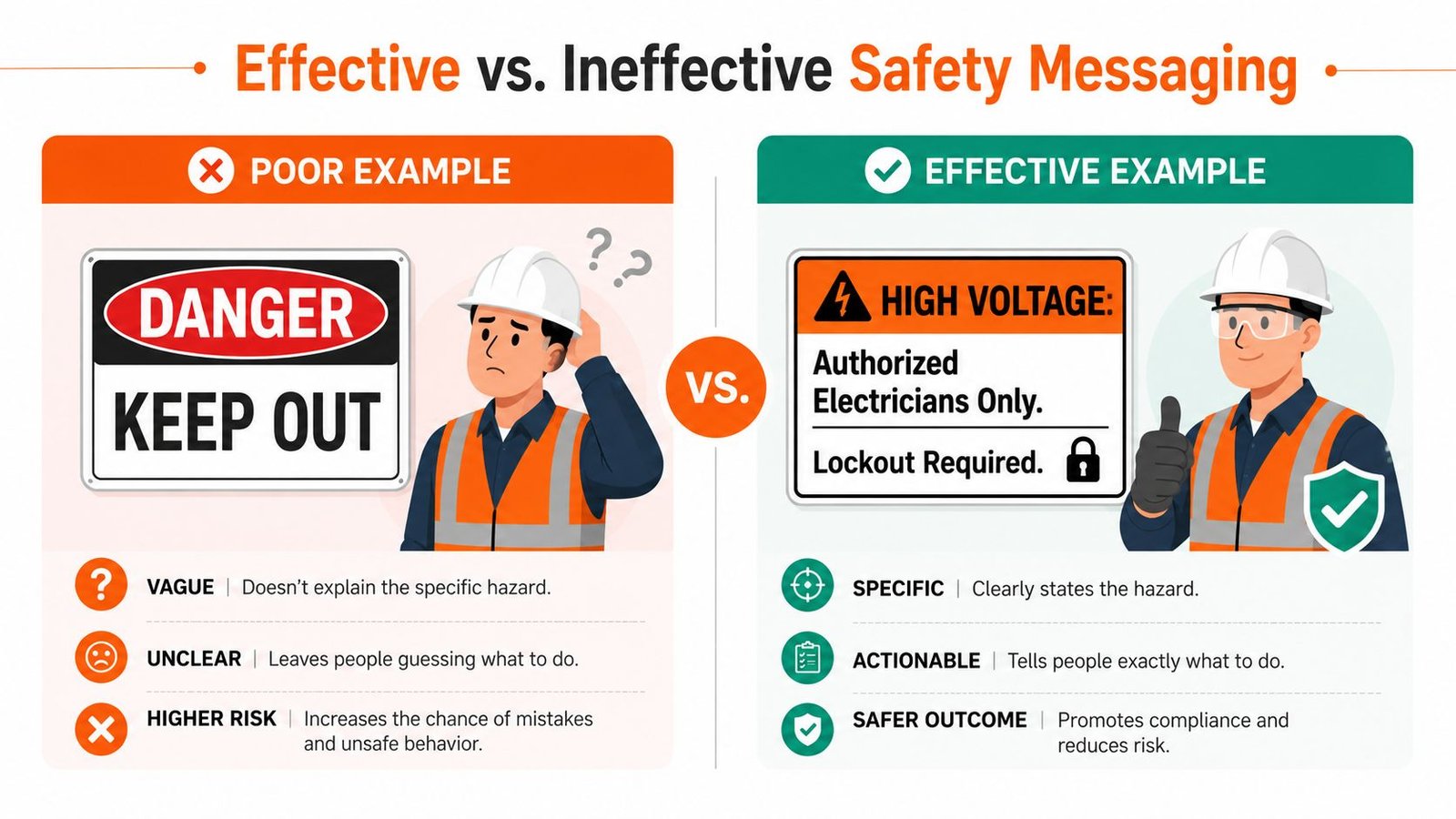
A sign saying “Danger, Keep Out” sounds serious, but it leaves several questions unanswered. Is the danger electrical, structural, chemical, or mechanical? Does the restriction apply to everyone, or can authorised workers enter with controls? What should a person do if they need access?
A stronger version is: “HIGH VOLTAGE: Authorised electricians only. Lockout required. Contact the supervisor before entry.” It names the hazard, identifies the affected group, and gives a clear action.
Public content can either prove standards or create doubt
A plumbing business might post: “Before replacing this hot-water system, we isolate services, protect the work area, confirm access, and explain the shutdown to the homeowner. Safe work keeps the property, crew, and occupants protected.”
That post gives a client something concrete to recognise. A generic stock image with “Safety is our priority” gives no evidence of process and sounds interchangeable with every competitor.
The same difference appears in a toolbox talk. A useful script asks the crew to identify the changed condition, name the control, and confirm who will monitor it. A legalistic script reads out broad obligations without connecting them to today's access route, equipment, weather, or client movement.
Local detail makes instructions believable
Emergency communication research offers a useful lesson for trade businesses. A 2025 study of severe-weather posts by Greek public organisations found that the account with the smallest follower base achieved the highest engagement because it emphasised actionable guidance and local relevance. Related transport research found that graphic-plus-text signs outperformed graphics-only signs on comprehension, compliance intention, and memorability. The study on actionable, location-specific safety communication reinforces a simple test: can the person identify what applies to this place and what they should do now?
For a tradie, “Avoid the area” is weaker than “Use the front path. The rear access is closed while materials are lifted.” The second message respects the reader's need for a decision, not just a warning.
Trust also depends on how you handle changing conditions. If the plan is uncertain, say what is known, explain what may change, and state when you'll update people. Public-health communication research found that explicit uncertainty, reasons for it, and promised follow-up updates increased perceived trustworthiness and understanding. WHO guidance on timely, transparent, locally adapted risk communication supports that approach.
Your Safety Messaging Implementation Checklist
Start small and make the routine visible. A small crew doesn't need a dedicated safety officer to improve its communication. It needs ownership, consistent wording, and records that reflect what happened.
Week one
Audit every active channel. Walk the site and photograph signs, review toolbox talk notes, check texts and emails, and read the safety language on your website, vehicles, and social profiles.
Success indicator: You can identify which messages are vague, missing, outdated, or inconsistent.
Week two
Rewrite the three messages with the greatest practical impact. Use the sequence hazard, consequence, instruction, then ask a crew member or client to explain the action in their own words.
Success indicator: People can state what the hazard is and what they must do without asking you to translate the message.
Week three
Create a repeatable documentation routine for toolbox talks and inductions. Record the topic, people involved, control agreed, questions raised, and follow-up owner. Save it with the job file.
Success indicator: Another person can review the record and understand what was communicated and what changed.
Week four
Publish a regular client-facing safety post based on real work practices. Explain one specific control, use plain language, and avoid claims you can't demonstrate.
Success indicator: Your public content matches what clients see on site, and your team can describe the same standard.
Crew resistance usually drops when messages remove confusion instead of adding rules. Time pressure is handled by using short cards and reusable templates. If the process feels like paperwork, connect each record to a real decision, such as stopping work, changing access, or protecting a household.
Clear safety communication protects people, reduces avoidable uncertainty, supports defensible business records, and gives serious clients another reason to trust your crew.
GrowTradie helps trade businesses maintain a steady, professional social presence with custom posts, clean designs, and automatic scheduling, so your safety standards and workmanship don't disappear between jobs. Visit GrowTradie to keep your local visibility active without adding another marketing task to your week.